
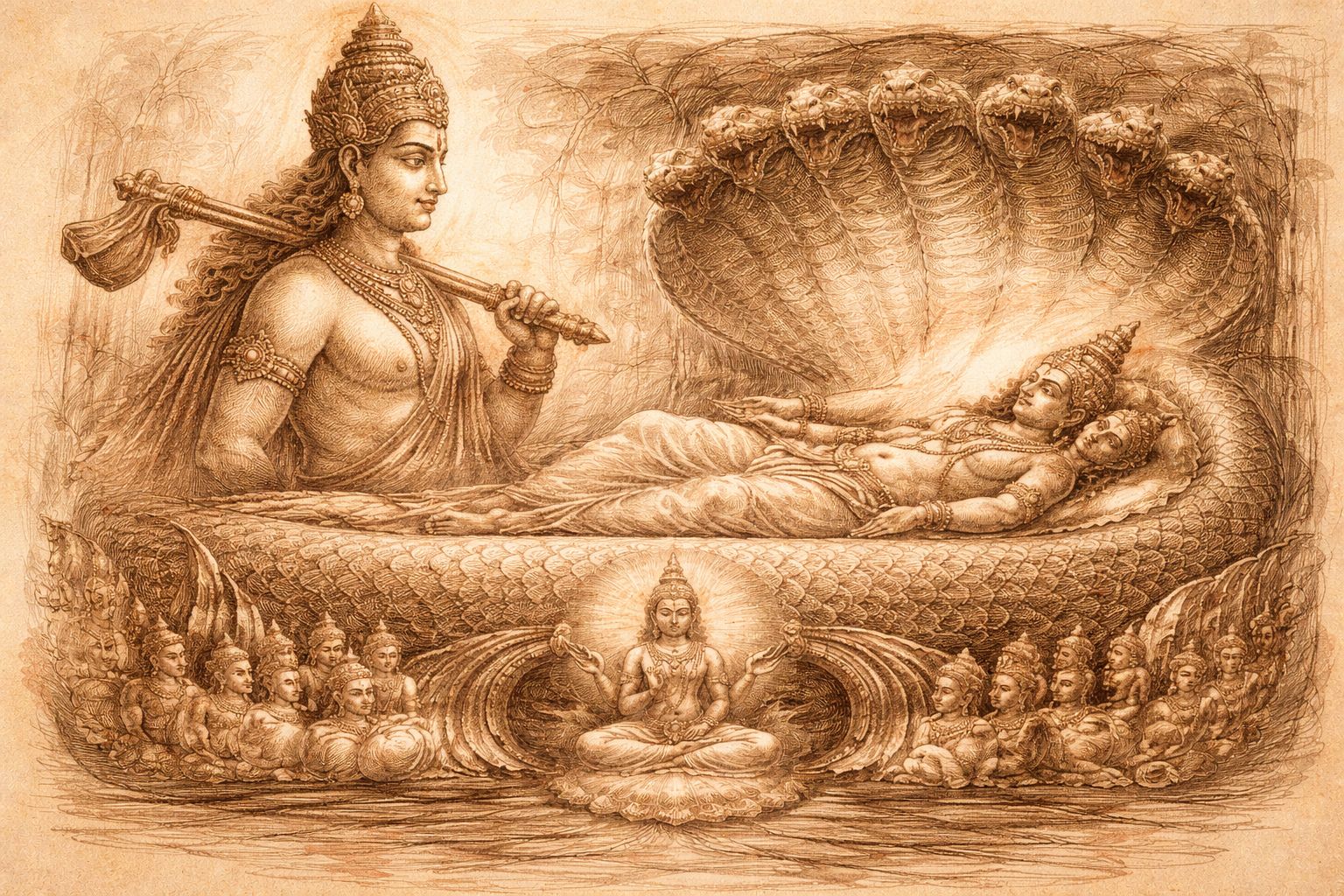

Balarama and the Serpent Beneath the God
In Angkorian stone, figures do not merely appear; they disclose layers. What walks, stands, or fights in one register may recline, coil, or disappear entirely in another. This is not contradiction but cosmology. The temples teach that form is provisional, and that identity, when followed far enough, returns to structure.
It is within this grammar that Balarama must be read alongside the great Anantasayin reliefs of Angkor.
In narrative tradition, Balarama moves through the world as a divine warrior: elder brother of Krishna, bearer of the plough and the mace, master of weight and law. In cosmological truth, however, he is something older and quieter. He is the human emergence of Ananta-Shesha—the endless remainder of creation, the serpent who remains when worlds dissolve.
This same serpent appears, vast and impersonal, beneath Vishnu in the Anantasayin motif. In these reliefs—carved at Angkor Wat, Prasat Phnom Rung, and Preah Khan—Vishnu reclines upon the coils of the serpent during cosmic suspension. Creation has paused. Time has loosened its grip. What remains is support.
The tradition does not present Balarama and Ananta as separate beings. It presents them as two conditions of the same force. What stands beside Krishna in battle is what lies beneath Vishnu in sleep. Action above, endurance below.
Angkorian art makes this relationship legible not through inscription, but through scale and placement. In Anantasayin scenes, the serpent is immense—often exceeding the god himself in length and volume. Vishnu rests; Ananta bears. This inversion is deliberate. Sovereignty reclines only because something more ancient continues to hold.
Balarama’s mythology preserves this truth with startling clarity. At the end of his life, seated in meditation by the sea, his inner nature emerges. From his mouth issues the colossal serpent Ananta, returning to the cosmic waters. The human body collapses, emptied of function. The foundation withdraws from the visible world.
This moment explains the reliefs. The serpent beneath Vishnu is not a servant but a remainder—the structural necessity that persists when form is set aside. In Angkor, where naga balustrades line causeways and serpents form the very thresholds of approach, this logic is extended architecturally. One does not enter a sanctuary without crossing what bears the world.
The doctrine of the two hairs clarifies the iconography further. Vishnu’s white hair becomes Balarama; the dark becomes Krishna. Colour here is not moral, but elemental. The pale body belongs to weight, restraint, and knowledge. In reliefs, Balarama’s fair complexion, his plough, his measured stance all echo the same function the serpent performs beneath Vishnu: stabilisation.
Even when Balarama appears in narrative panels—lifting Govardhana, fighting Bana, standing on Garuda’s wings—he does not displace the serpent below. He rehearses it in human scale. The Anantasayin reliefs then reveal the truth behind the rehearsal: the actor removes the mask, and the stage itself is disclosed.
Thus, Angkor does not depict Balarama and Anantasayin as separate themes. It presents them as vertical readings of a single cosmology. Above: motion, kinship, struggle. Below: suspension, remainder, support. The pilgrim learns to see both at once.
In this way, the temples teach a discipline of perception. What dazzles is not what holds. What holds does not announce itself. Balarama walks through the epic so that the serpent may continue to lie unseen beneath the god. And Angkor, faithful to this wisdom, carves both truths into stone—one in action, one in silence.
—
Receive the next work
Subscribe free to receive new work from the Lucas Varro Library by email.
More from the Library
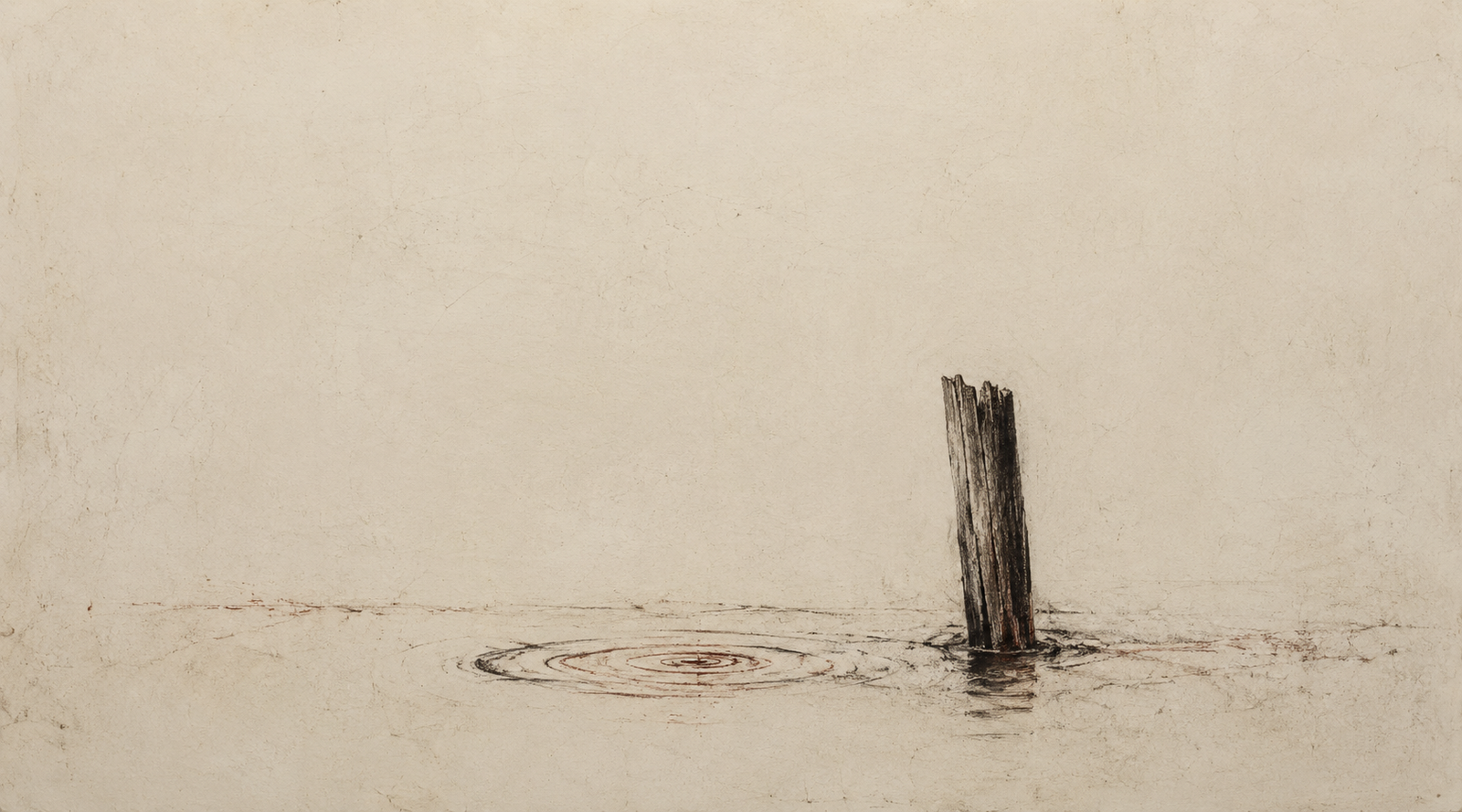

Houses of Wood, Light, and Smoke
Some of Angkor’s most intimate ruins do not rise above the ground at all. They are postholes, low mounds, hearths and ponds: durable traces of a domestic city built largely from things that decay. To restore that city is to see Angkor not only as stone, but as wood, smoke, water, repair, and people living within calling distance.
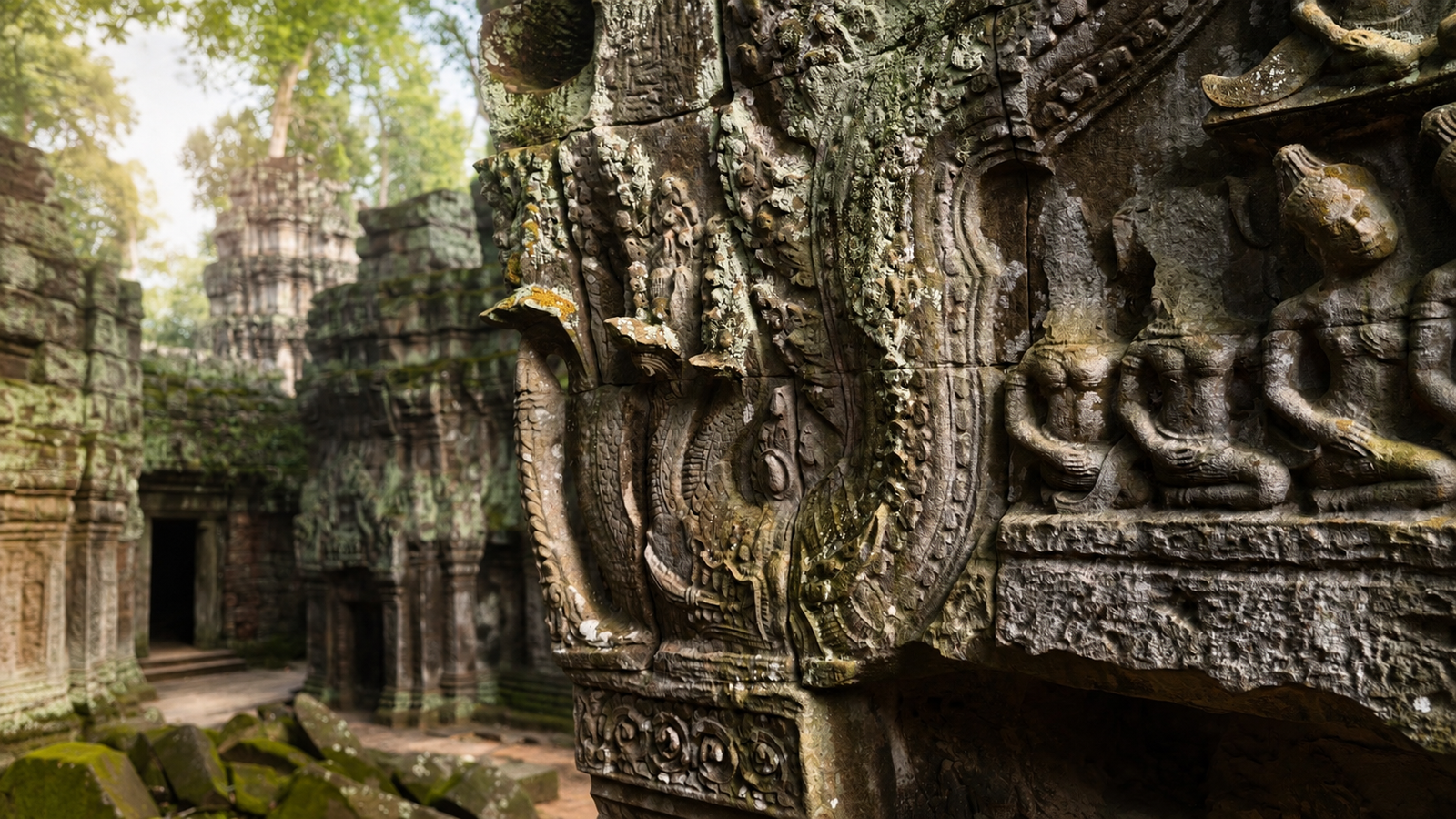

What Stone Brings Forth
I had mistaken a gift for something being expelled.
Beneath the nāga's mouth, a stone garland descended bead by bead. Nearby, a makara opened its jaws and another form emerged. Looking closer, the whole temple began to change: serpent became ornament, ornament became architecture, architecture became foliage.
The forest did not introduce this language.
It answered it.
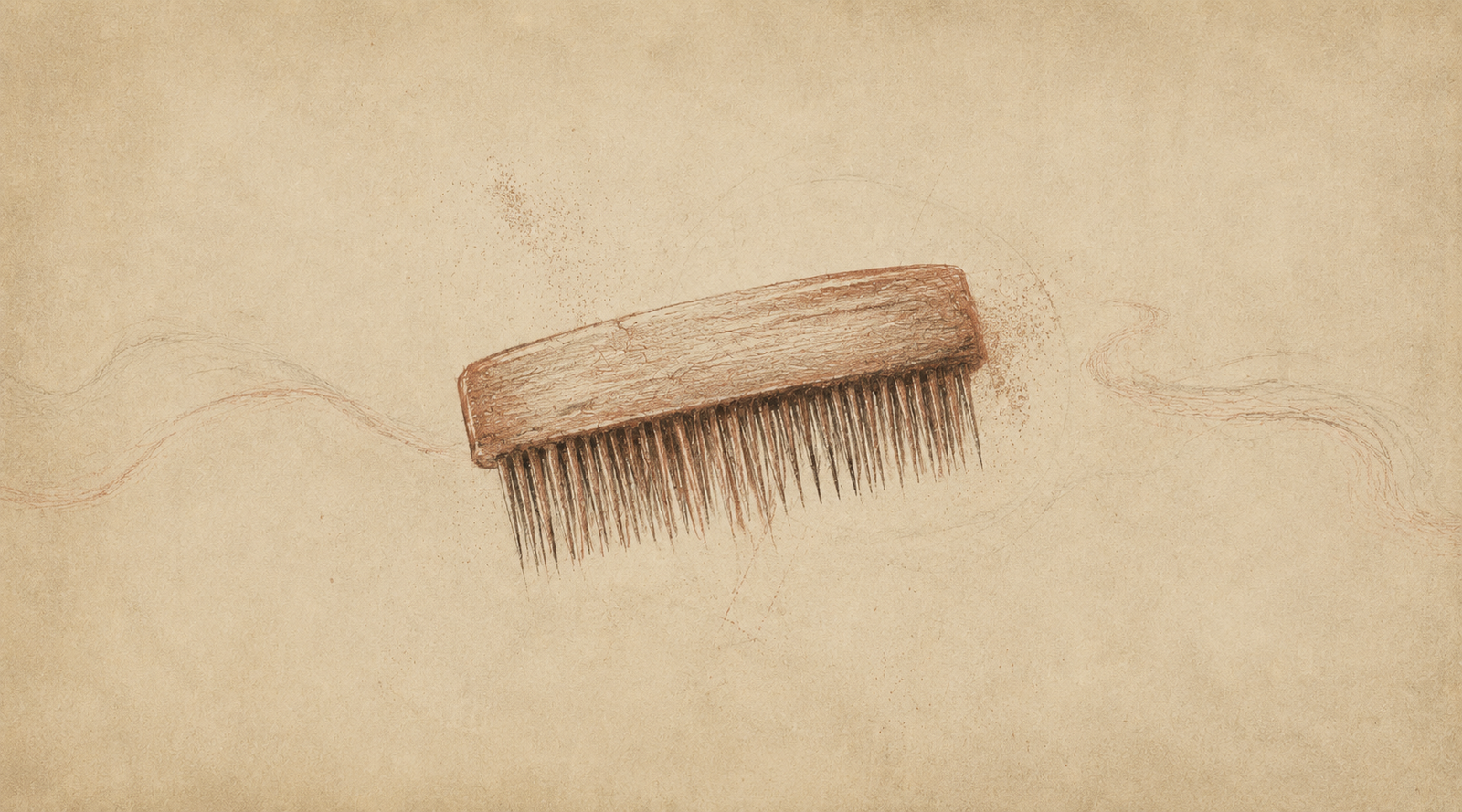

The Eighth Daughter
Seven daughters have already been taken by Yamata-no-Orochi when Susanoo reaches the River Hi. Only Kushinada-hime remains. The Eighth Daughter retells the Kojiki episode through a family’s waiting, a girl transformed into a comb, and the patient preparation for the serpent’s return.