

Those Who Keep the Way Open — On the Quiet Guardians of Angkor’s Thresholds
“Where care lingers, the threshold remains open.”
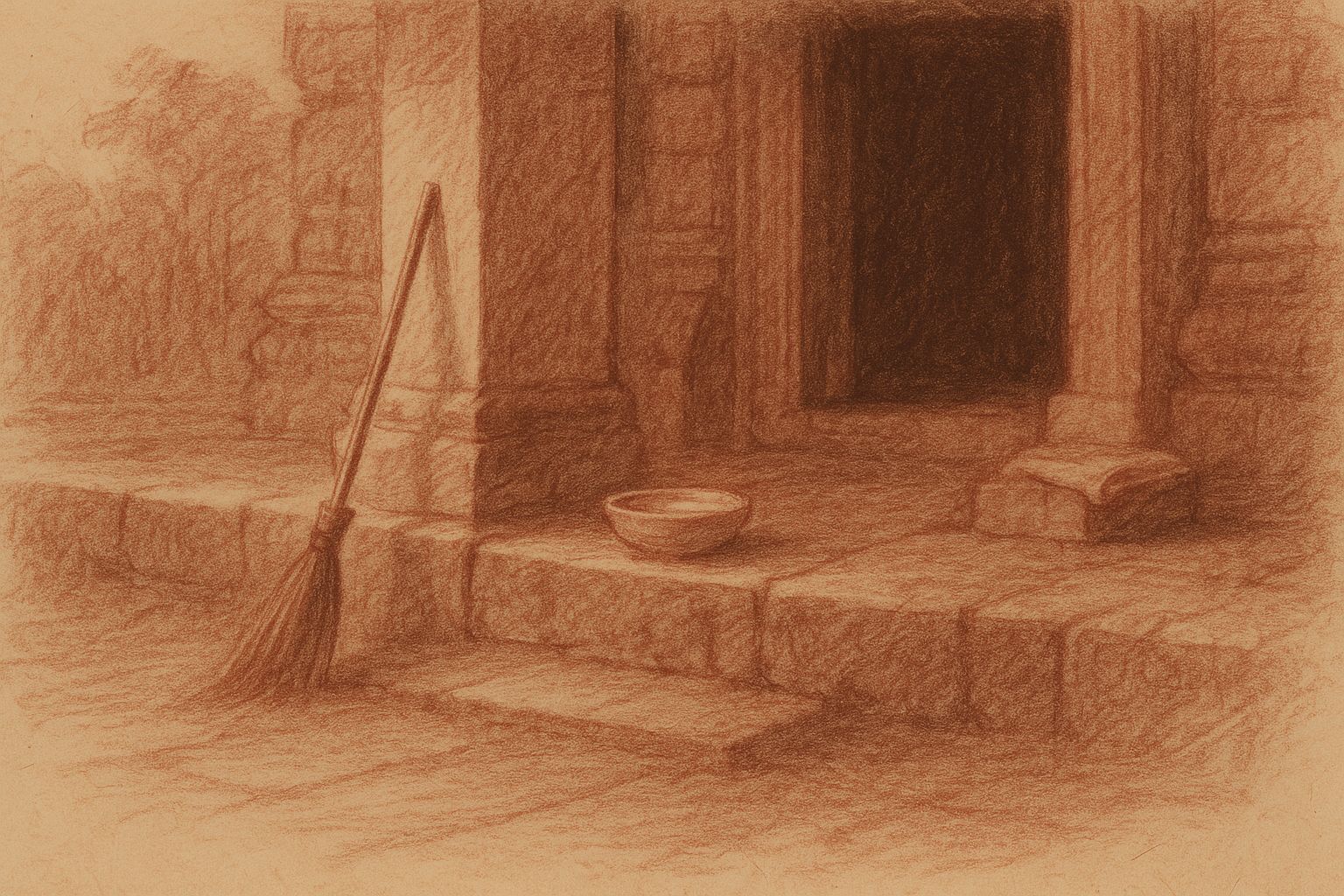
There is a kind of devotion at Angkor that rarely appears in photographs — devotion not marked by ritual display, but by the simplest gestures: a swept stone, a folded cloth, the faint trace of incense pressed into a crack in the threshold. These are small things, almost invisible to the hurried visitor. Yet they form the first architecture a pilgrim truly encounters. Before cosmology, before doctrine, before grandeur, there is care.
Angkor’s thresholds have always asked for it. The builders of the twelfth century understood that a temple begins not with its towers but with its crossings — the bridges, balustrades, and gates that prepare the body and the mind for what lies within. Inscriptions from the reigns of Suryavarman II and Jayavarman VII list entire households responsible for tending these liminal spaces: sweepers, lamp-lighters, guardians of shrines, keepers of water. Their roles were not marginal. They were part of how the temple held its meaning. A threshold aligned to cosmic measure required human presence to keep it alive.
That truth remains unchanged, even as the world around Angkor has transformed.
Today, the forms of guardianship are more diverse, the ethical terrain more intricate, but the underlying principle is the same: the sacred does not survive without those who make its approach visible.
APSARA conservators walk ancient routes with scientific precision, stabilising corbelled arches, clearing encroaching roots, preserving sightlines that once guided processions. Local villagers tend small shrines and familiar stones, sweeping in the cool of early morning before visitors arrive. Monks bless gateways, refill water bowls, and offer spiritual counsel to restoration work. International partners bring technical knowledge and train local artisans whose hands carry centuries of craft lineage. Even youth volunteers — students from nearby towns, conservation groups, temple enthusiasts — join in clearing paths long surrendered to the forest.
This wide ecology of presence does not dilute the sanctity of the threshold; it deepens it. It reveals the temple not as a static monument, but as a shared inheritance.
And yet, guardianship in the present day is not simple.
The very practices that keep a threshold spiritually alive — incense, offerings, shrines tended with familial affection — can harm fragile sandstone. Conservation laws designed to protect the monuments can unintentionally separate communities from traditions they have kept for generations. Entire villages relocated from temple perimeters carry memories of tending thresholds they can no longer approach freely. Meanwhile, tourism exerts relentless pressure: millions of footsteps abrade steps never meant for such numbers.
These tensions do not indicate competing versions of care. They reflect the complexity of loving a place that must remain both living and enduring. Angkor asks its guardians — and all who advocate for it — to hold these obligations in tension: protect the material, honour the immaterial; safeguard the ancient, respect the present.
In recent years, this delicate balance has begun to grow more generous. Rights-based conservation frameworks encourage collaboration rather than control. Restoration projects open with blessings from monks. Community consultations accompany decisions that once would have been imposed administratively. Certain shrines remain not because they are old, but because they matter. The threshold becomes not a boundary to be protected from people, but a space to be shaped with them.
A threshold, after all, is a place defined by movement. It gains meaning through the bodies that cross it and the hands that prepare it. Care keeps that movement legible. Care keeps the invitation open. Care ensures that a pilgrim arriving today enters not merely a site, but a relationship tended across centuries.
To recognise the guardians of Angkor’s thresholds is to see that sacredness is never self-sustaining. It is a collaboration across generations — from the temple households of Preah Khan to the elder who still sweeps Ta Prohm’s entrance path; from the stoneworker inheriting his father’s craft to the conservator aligning a displaced naga with tender precision; from the monk who blesses a restored lintel to the child who places a single flower beside a guardian lion.
Each act, however modest, keeps the temple recognisable as a place of orientation, welcome, and presence.
And perhaps this is the deepest insight Angkor offers. The temples endure not because they were built to last, but because someone has always been tending the way in. Every pilgrimage begins in the shadow of those labours. Every threshold we cross has been prepared by hands largely unknown.
To honour the guardians, then, is to acknowledge this quiet lineage: the human thread that binds stone to meaning, past to present, sanctuary to community. Through their work, the threshold remains what it has always been — a place where one world softens into another, held open by care.
—
Receive the next work
Subscribe free to receive new work from the Lucas Varro Library by email.
More from the Library


See Also
A concise and impartial dictionary of absence, promises, quarrels, ordinary objects, and the troublesome instability of words.

The City of Service
The temple we inherit is a building from which almost all necessity has been removed. Nothing must be brought for it to continue being what we call a temple. The sanctuary asks nothing of us. Stone is good at this kind of independence.
A living temple was otherwise.
Water had to come in. So did grain, cloth, oil, aromatic substances, fuel. The things required for worship arrived because someone carried them across a threshold.


Houses of Wood, Light, and Smoke
Some of Angkor’s most intimate ruins do not rise above the ground at all. They are postholes, low mounds, hearths and ponds: durable traces of a domestic city built largely from things that decay. To restore that city is to see Angkor not only as stone, but as wood, smoke, water, repair, and people living within calling distance.