

Indrābhiṣeka — The Rite That Restores the World
Kingship at Angkor was never a private matter. It did not belong to the body of the king alone, nor even to the dynasty. It belonged to the order of the world itself. When a ruler was crowned, something larger than authority was at stake: balance, continuity, and the moral alignment of heaven and earth.
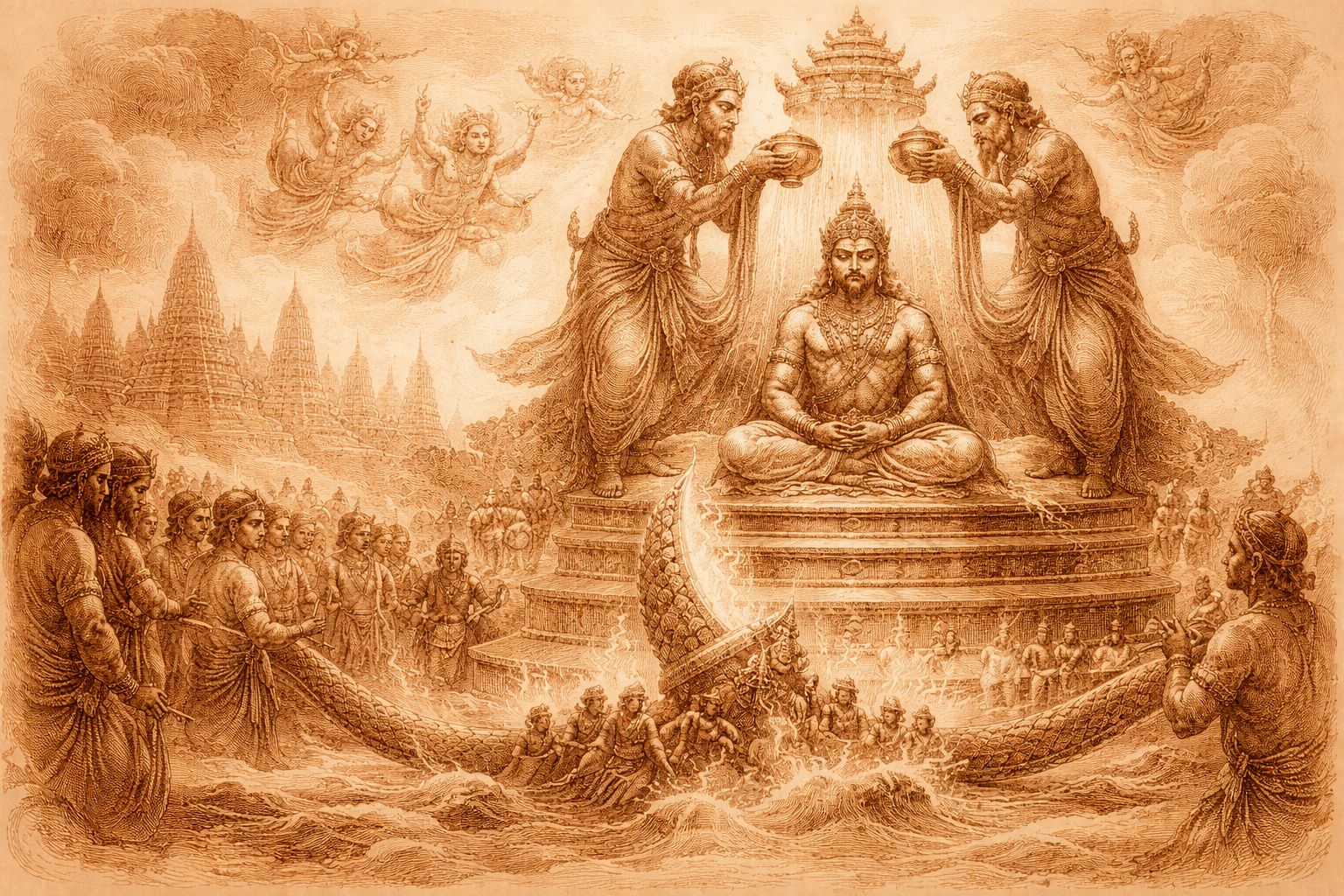
The Indrābhiṣeka, the “Anointing of Indra,” emerges from this understanding. Rooted in the ritual imagination of the Aitareya Brahmana, it was not conceived as a simple coronation but as a cosmic restoration—a reenactment of the moment when the god Indra himself was reinstalled as king of the gods after a period of loss, disorder, and humiliation.
In Vedic myth, Indra does not rule eternally by right. His sovereignty must be regained. Stripped of his power, he recovers it only after the Churning of the Sea of Milk, when gods and demons together wrench immortality from chaos. The Indrābhiṣeka mirrors this logic exactly. It assumes that power is fragile, that victory decays, and that kingship must periodically be re-won, not merely inherited.
To undergo this rite was to claim the status of cakravartin—a universal monarch whose authority radiated in all directions like the turning of a wheel. The king did not become a god in substance, but he was aligned with one in function: an “Indra on Earth,” responsible for maintaining prosperity, fertility, and cosmic measure. The rite announced the renewal of the Kṛta Yuga, a restored golden age, even if only provisionally.
The ceremony unfolded as a carefully staged withdrawal and return. Before appearing in splendour, the king was required to disappear—to retreat into the forest, entering a period of ascetic restraint and inward recalibration. Power, the ritual insisted, could not be renewed without first being relinquished. Only after this interval of symbolic absence did the monarch return to be anointed.
The abhiṣeka itself was an act of controlled abundance. Sacred liquids—water, milk, honey—were poured over the king as he sat upon a nine-tiered throne, a ritual Mount Meru. The act was not decorative. It enacted the descent of cosmic waters, the blessing that once restored Indra’s dominion. The king was not crowned above the world, but washed back into it, re-entering the cosmic flow he was sworn to regulate.
Public celebration followed. The Indrābhiṣeka was not hidden within palace walls. It unfolded as spectacle: wrestlers, acrobats, musicians, dancers. Order, once restored, overflowed into joy. The body politic was invited to witness the renewal of its own coherence.
At Angkor, the rite became a defining grammar of power. Inscriptions at the Bayon record that Jayavarman VII retired to the forest to celebrate a “holy Indrābhiṣeka,” likely around 1203, following the defeat of the Cham and the reassertion of Khmer authority. The retreat was not a footnote; it was the hinge. Victory alone was insufficient. It required ritual conversion into legitimacy.
At Angkor Wat, the rite appears not as text but as stone. The vast bas-relief of the Churning of the Sea of Milk is widely understood as an allegory of Suryavarman II’s own Indrābhiṣeka. Gods and demons pull in equal number. Measurement, symmetry, and effort are held in perfect tension. The relief does not celebrate conquest; it encodes the exact moment when chaos is forced into order.
This understanding of kingship proved durable. The Khmer Indrābhiṣeka passed westward into Siam, where Thai courts continued to stage elaborate reenactments centuries later. In 1557, a Thai ceremony involved hundreds of participants physically churning a replica Mount Meru for days on end. The universe, it seemed, still required resetting.
What the Indrābhiṣeka reveals—quietly but insistently—is a political theology without permanence. Power must be renewed. Order must be re-established. The king does not stand above the cosmos; he kneels within it, submitting himself to the same cycles of loss and restoration that govern gods and men alike.
At Angkor, stone preserves this lesson with remarkable clarity: sovereignty endures only when it agrees to be washed clean.
—
Receive the next work
Subscribe free to receive new work from the Lucas Varro Library by email.
More from the Library


See Also
A concise and impartial dictionary of absence, promises, quarrels, ordinary objects, and the troublesome instability of words.

The City of Service
The temple we inherit is a building from which almost all necessity has been removed. Nothing must be brought for it to continue being what we call a temple. The sanctuary asks nothing of us. Stone is good at this kind of independence.
A living temple was otherwise.
Water had to come in. So did grain, cloth, oil, aromatic substances, fuel. The things required for worship arrived because someone carried them across a threshold.

Houses of Wood, Light, and Smoke
Some of Angkor’s most intimate ruins do not rise above the ground at all. They are postholes, low mounds, hearths and ponds: durable traces of a domestic city built largely from things that decay. To restore that city is to see Angkor not only as stone, but as wood, smoke, water, repair, and people living within calling distance.