
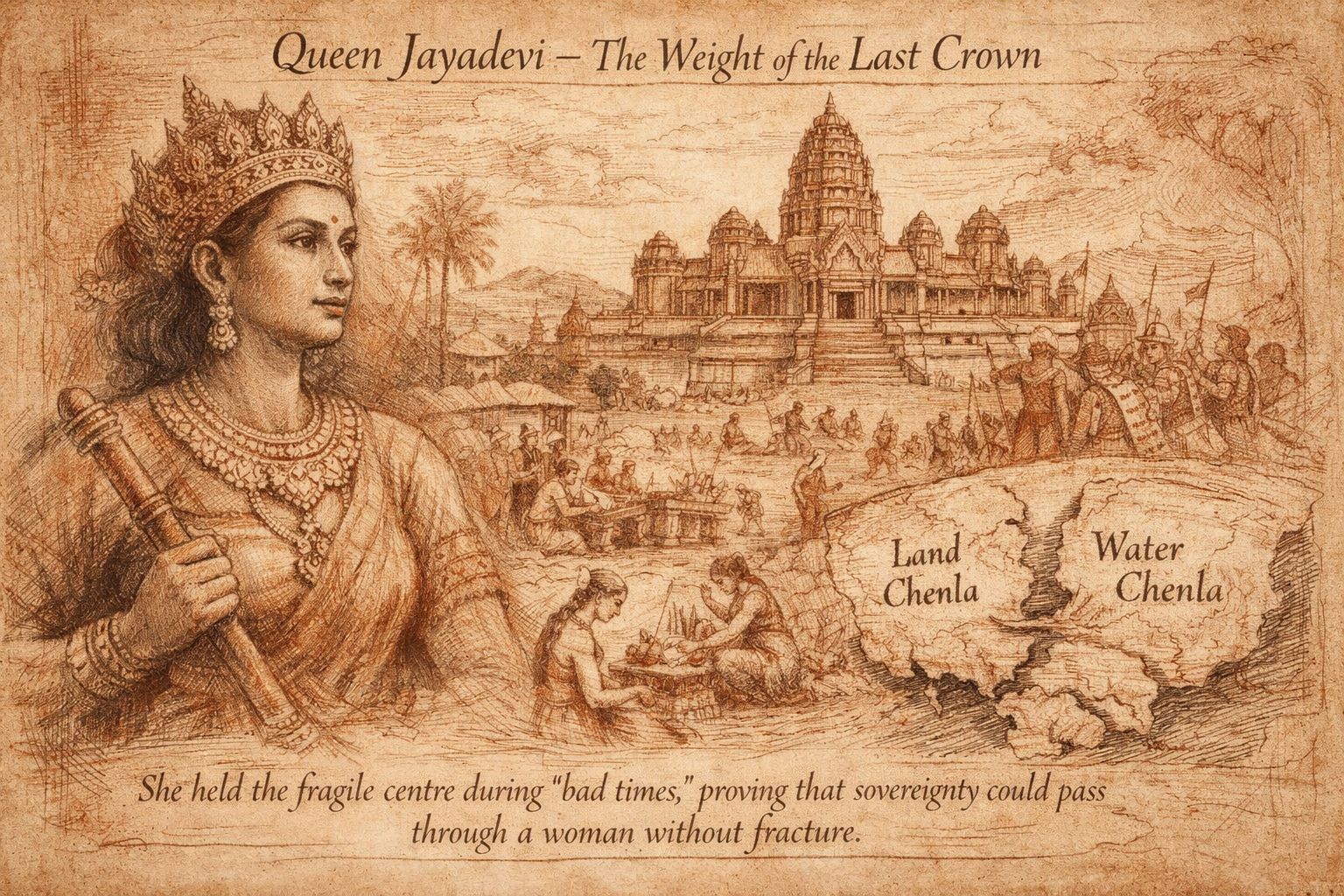

Queen Jayadevi — The Weight of the Last Crown
Some reigns are remembered for what they build. Others for what they are asked to hold.
Queen Jayadevi inherits her place in history not as a founder, but as a bearer. When she ascends the throne around 681 CE, the armour of the state forged by her father, Jayavarman I, is already under strain. Central authority exists, but it must now be maintained without the force of masculine lineage or the momentum of conquest. What remains is endurance.
Jayadevi rules from Aninditapura, in the region that would later become Angkor, from a palace known as Kamyarama. The names are calm, even lyrical, yet the world they sit within is not. Inscriptions would later describe her reign as unfolding during “bad times”—a phrase that carries more weight than it first appears. It does not suggest incompetence or collapse, but pressure: the slow unravelling of unity under competing claims, rival houses, and regional powers that had been temporarily subdued but never extinguished.
Her authority, nevertheless, is unmistakable. Jayadevi adopts the title vrah kamratan an—Holy Lord—the same sacral designation used by male kings and deities. This is not ornament. It is a statement that sovereignty in the Khmer world resides in blood and order, not gender. In claiming the title, she does not ask permission; she continues the line. The crown does not change shape to fit her. She steps fully into it.
That choice alone marks her reign as extraordinary. In a political culture that fused kingship with cosmic hierarchy, Jayadevi asserts that the axis of the world can pass through a woman without deviation. She is not a regent. She is not a placeholder. She is ruler.
The material traces of her time tell a quieter story beneath the political turbulence. Rice fields are measured and recorded. Weaving continues. Jewellery is crafted with care. Offerings are made to the crown. Life persists in rhythm and skill, even as the centre weakens. The state may be under threat, but society remains alive, ordered, and productive. Jayadevi’s realm does not fall into immediate ruin; it thins, stretches, and begins to separate.
When her authority finally ends—by death or displacement—the unity established by her father dissolves. Chinese chroniclers will later describe the land as divided into “Land Chenla” and “Water Chenla”: uplands and lowlands, interior and delta, power once again dispersed across geography. The split is not sudden catastrophe, but release. What had been bound loosens. What had been held together is allowed to separate.
Jayadevi thus becomes the final keystone of an early Khmer arch. Her reign does not fail; it completes a phase. She holds the structure long enough for its principles to be remembered. Centralisation, sacral kingship, administrative order—these do not vanish with her. They wait.
More than a century later, Jayavarman II will return to these ideas and give them monumental form. Angkor will rise not from nothing, but from memory: the memory that Cambodia once had a centre, and that it was held, for a time, by a queen who refused to let it collapse quietly.
In the long view of history, Jayadevi stands not at the beginning of Angkor, but at its threshold. She is the silence between two epochs—the final stillness before stone remembers how to stand.
—
Receive the next work
Subscribe free to receive new work from the Lucas Varro Library by email.
More from the Library


See Also
A concise and impartial dictionary of absence, promises, quarrels, ordinary objects, and the troublesome instability of words.

The City of Service
The temple we inherit is a building from which almost all necessity has been removed. Nothing must be brought for it to continue being what we call a temple. The sanctuary asks nothing of us. Stone is good at this kind of independence.
A living temple was otherwise.
Water had to come in. So did grain, cloth, oil, aromatic substances, fuel. The things required for worship arrived because someone carried them across a threshold.

Houses of Wood, Light, and Smoke
Some of Angkor’s most intimate ruins do not rise above the ground at all. They are postholes, low mounds, hearths and ponds: durable traces of a domestic city built largely from things that decay. To restore that city is to see Angkor not only as stone, but as wood, smoke, water, repair, and people living within calling distance.