
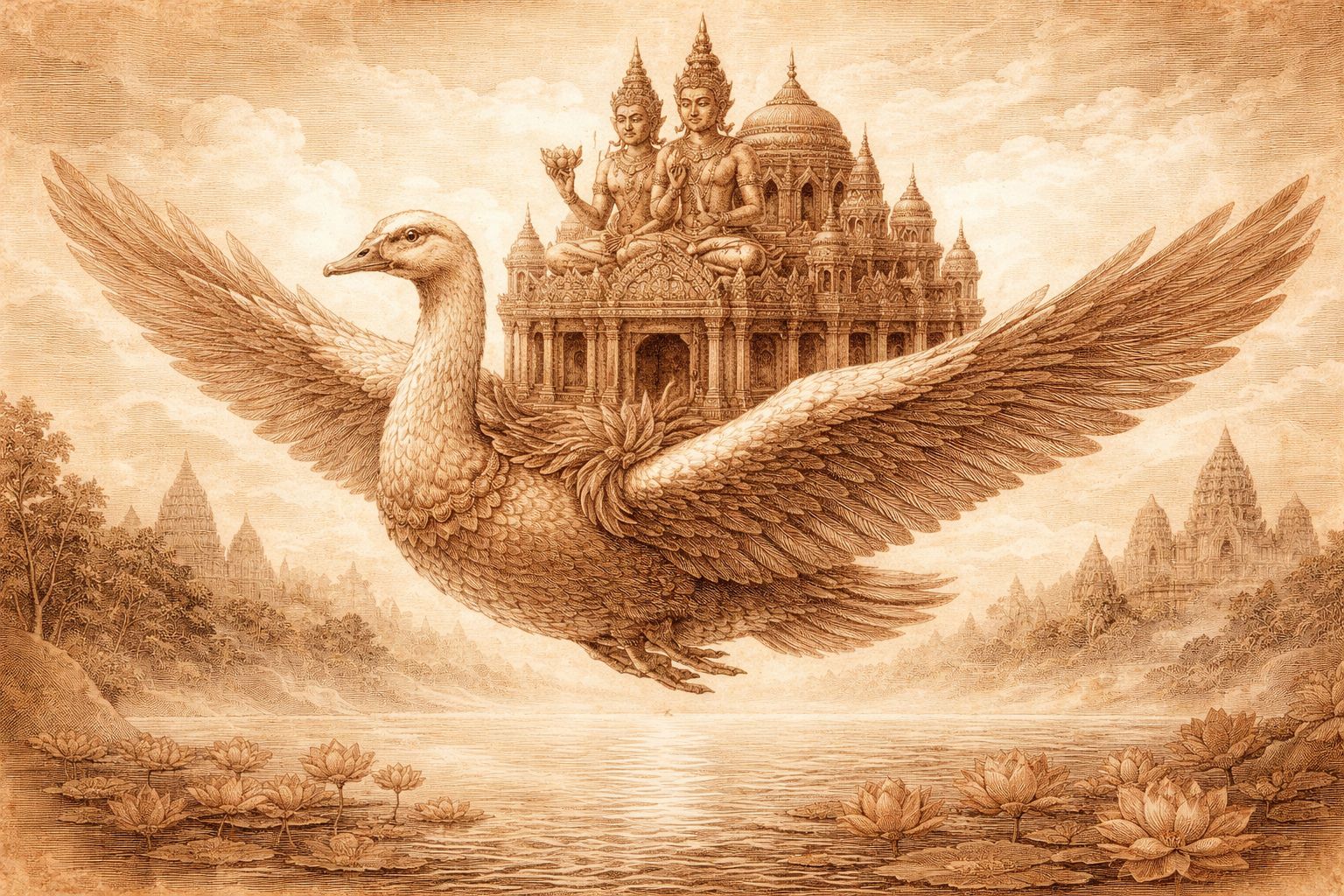

The Hamsa — The Bird That Knows Two Worlds
In the iconography of Angkor, some beings do not announce themselves with force or flame. They arrive instead through poise, balance, and quiet mastery of elements that rarely meet. The hamsa—the sacred goose—belongs to this order. It is neither predator nor guardian in the usual sense, but a bearer: a living threshold between water and sky, matter and breath, stillness and ascent.
In Khmer tradition, the hamsa serves as the vahana, or sacred vehicle, of both Brahma and Varuna. This dual association is not incidental. Brahma, the architect of form and measure, and Varuna, the sovereign of cosmic waters and ethical restraint, share a need for a mount that moves freely between domains. The hamsa does not dominate the elements it traverses. It understands them.
Unlike birds bound exclusively to air, the hamsa swims with ease. Unlike creatures of water, it rises without effort. This twofold nature grants it a metaphysical clarity that Khmer artists understood instinctively: the divine must be present in the world without being held by it. The hamsa touches water without sinking, inhabits sky without severance. It is not escape, but equilibrium.
This equilibrium is architectural as much as mythic. When hamsas are carved with wings outspread beneath sanctuaries—as at Sambor Prei Kuk—they are not decorative flourishes. They announce the structure above as a vimana, a celestial palace sustained by laws other than gravity alone. The bird does not lift the temple by strength; it reveals that the building already belongs to the heavens. Stone becomes flight by consent.
The same logic governs the Pushpaka, the luminous aerial chariot of the Ramayana, often shown borne by hamsas. This is not speed for its own sake. The chariot moves because it is aligned—because it obeys a higher order of direction. In Khmer visual thought, movement without harmony is chaos; true motion is measured, ethical, and serene.
Within Buddhist transmission, the hamsa takes on another inflection. It becomes an image of doctrine itself in flight—teaching that moves without coercion, that crosses waters of ignorance without disturbance. The dharma does not drown the world; it skims its surface, leaving only widening rings.
This spiritual refinement is echoed in breath. In yogic sound mysticism, the rhythm of inhalation and exhalation is heard as ham and sa. Together they murmur hamsa—the soul in motion. Reversed, the breath confesses sa’ham: I am That. The bird is not merely carried by the gods; it carries the recognition that separation itself is provisional.
Thus the highest rank of ascetic is named paramahamsa—one who has learned to dwell where water and sky meet without confusion. Not withdrawn from the world, but no longer submerged by it.
In Angkor, the hamsa is rarely dramatic. It does not roar or strike. It supports, bears, and releases. Its wisdom is not conquest but orientation. To follow the hamsa is to learn how to be here without heaviness, how to move without leaving, how to touch the sacred without breaking its surface.
—
Receive the next work
Subscribe free to receive new work from the Lucas Varro Library by email.
More from the Library

See Also
A concise and impartial dictionary of absence, promises, quarrels, ordinary objects, and the troublesome instability of words.

The City of Service
The temple we inherit is a building from which almost all necessity has been removed. Nothing must be brought for it to continue being what we call a temple. The sanctuary asks nothing of us. Stone is good at this kind of independence.
A living temple was otherwise.
Water had to come in. So did grain, cloth, oil, aromatic substances, fuel. The things required for worship arrived because someone carried them across a threshold.

Houses of Wood, Light, and Smoke
Some of Angkor’s most intimate ruins do not rise above the ground at all. They are postholes, low mounds, hearths and ponds: durable traces of a domestic city built largely from things that decay. To restore that city is to see Angkor not only as stone, but as wood, smoke, water, repair, and people living within calling distance.