

The Body That Became the World
Purusha, sacrifice, and the cost of becoming many
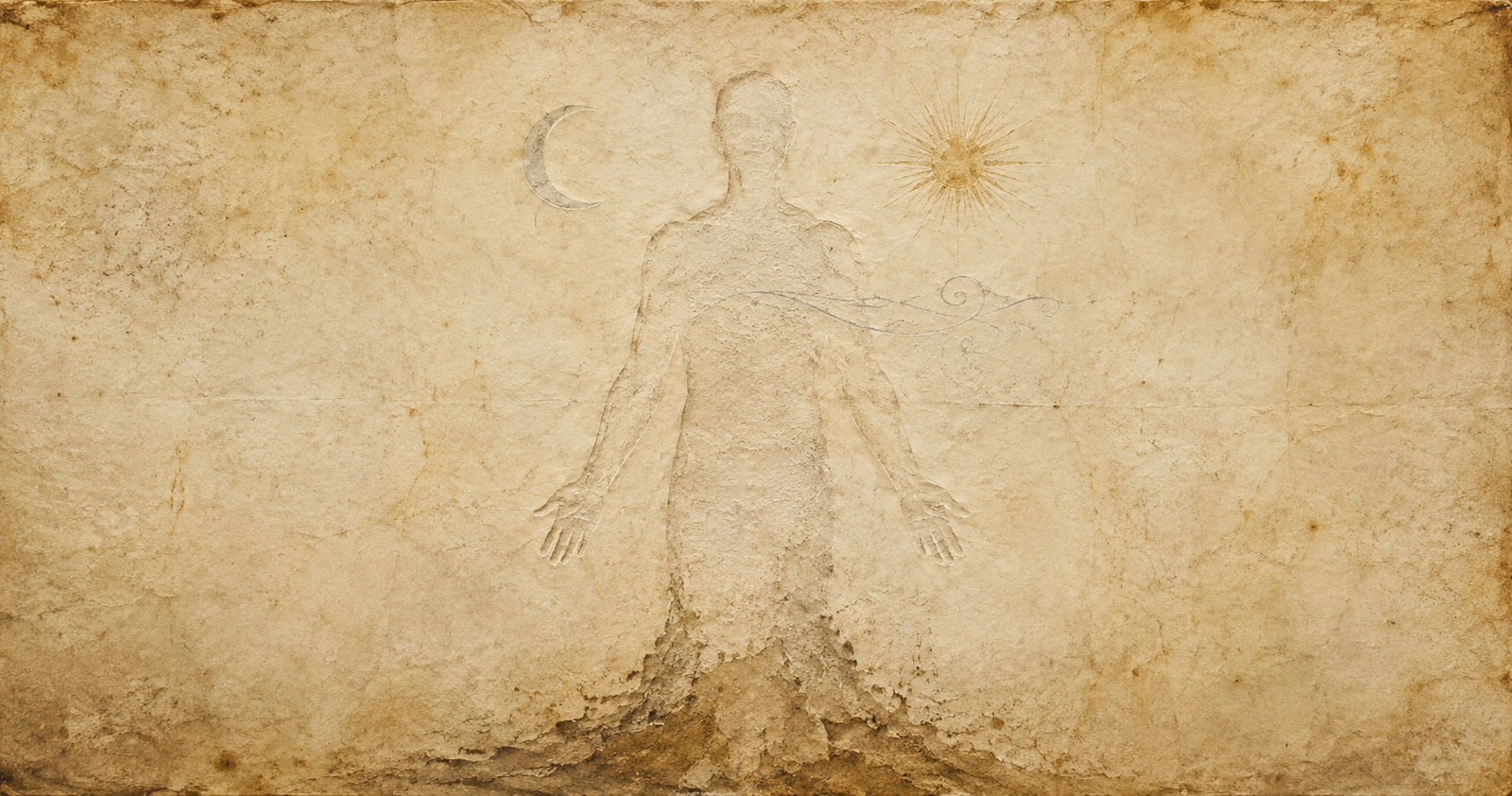
Before the world has learned to appear as separate things, the hymn gives it a body.
It has a thousand heads, a thousand eyes, and a thousand feet. It covers the earth, yet extends beyond it. Everything that has existed and everything that will exist belongs to it. All living beings are contained within it, but even the whole created world amounts to only one quarter of its being. The other three quarters remain beyond manifestation, undiminished and deathless.
Then the gods prepare a sacrifice.
They do not bring Purusha into a world already made. They place him at the beginning of making. Spring becomes the richness of the offering, summer its fuel, autumn its gift. The seasons gather around the altar before there is yet a world through which the seasons can pass.
Purusha is bound upon the sacred ground.
From the offering come animals, hymns, ritual formulas, celestial bodies, human society, earth, sky, and the directions of space.
The world begins when wholeness is divided.
But the body does not disappear.
It becomes everything.
The Being Greater Than the World
The Purusha hymn—Rigveda 10.90—begins with an image too large to be pictured. “A thousand” does not ask us to count. It tells us that counting has already failed.
The heads are every head. The eyes are every act of seeing. The feet are every place where life stands upon the earth. Purusha is not a giant among other beings. He is being itself imagined as a person: not personality in the modern sense, but total presence given form.
Yet the hymn immediately prevents us from enclosing him within the universe. All creatures are only one quarter of Purusha. Three quarters remain beyond the visible world.
Creation proceeds from him, but creation does not exhaust him.
Without this distinction, the myth could be reduced to a crude tale of manufacture: a great body is dismantled, and its parts are used as materials. But Purusha is not merely raw substance. He exceeds the cosmos before the sacrifice, and he continues to exceed it afterwards.
The world belongs wholly to him, but he does not belong wholly to the world.
The hymn then gives us a sequence that refuses ordinary chronology. From Purusha comes Viraj, the expansive or radiant form. From Viraj, Purusha is born again. Source gives birth to manifestation; manifestation gives birth to source.
A modern account might try to repair the circle. The hymn does not.
It is not describing a chain of events in which one finished thing causes another. It is showing a relation in which origin and manifestation continually disclose one another. Purusha gives rise to the form through which Purusha becomes present.
The maker, the material, and the made will not remain separate. Nothing is brought from elsewhere. There is no second substance waiting beside the first being. There is only the one who contains what has been and what is to come—and the act through which that unity acquires innumerable forms.
The world does not arrive from outside Purusha. It happens within him.
The First Sacrifice
The gods prepare the offering with Purusha as its centre.
Here the hymn becomes deliberately impossible.
Spring is poured upon the sacrifice. Summer becomes its fuel. Autumn becomes its gift. Yet the ordered year belongs to the world the sacrifice is bringing into being. The gods use the seasons to perform the act from which the seasons receive their place.
The same circle governs the ritual itself. The gods conduct a sacrifice from which sacred speech, ritual formulas, and sacrificial order will emerge. They perform the first offering before the full grammar of offering exists.
The act produces the conditions that make the act possible.
This is not confused chronology. It is mythic concentration. The first sacrifice does not occur at one moment within an already established world. It establishes the pattern through which the world will be understood.
Sacrifice, in this vision, is not merely destruction. It is transformation through consecrated division. Something is given. Something changes form. A larger order becomes possible because what was whole is no longer held in its first condition.
This does not make the act gentle. Purusha is bound. He is made the offering. The hymn asks how he was divided and what portions were made from him.
But it does not linger over the wound.
Its severity lies in statement, not spectacle. The poem is concerned less with the body’s breaking than with what enters the world through it.
Form requires distinction. Distinction requires separation. For one thing to become moon and another sun, for earth to be earth and sky to be sky, the undivided must surrender its undividedness.
The beginning of a world is therefore also the end of a condition. Purusha does not cease to exist, but he can no longer exist only as one.
What the Body Becomes
The sacrifice releases an astonishing abundance.
From it come creatures of the air, animals of the forest, and animals kept near human dwellings. Horses emerge, along with cattle, goats, and sheep. From the same offering come sacred verses, chants, formulas, and poetic metres.
Animal life, religious speech, and cosmic order arise from one body.
The hymn does not imagine language as a late human invention imposed upon a mute universe. Sacred utterance is drawn from the same offering as the creatures that breathe and the worlds through which they move. Word and animal, liturgy and landscape, are related before they become distinct.
Then the cosmic anatomy opens.
The moon comes from Purusha’s mind, the sun from his eye, and wind from his breath. The middle realm comes from his navel, heaven from his head, earth from his feet, and the directions from his ears.
The hymn does not say that Purusha manufactures these things. His eye does not construct the sun as a craftsman might fashion a lamp.
His eye becomes sun.
His mind becomes moon.
His breath becomes wind.
Creation is not an act performed upon matter. It is a change in the condition of the sacred body.
The correspondences are not arbitrary. Sight becomes the great source of light. Breath becomes the movement no living creature can hold. The head becomes the height above; the feet, the supporting earth; the ears, the directions from which sound arrives.
The body is not merely cut into pieces. Its powers are extended into cosmic form.
The world is the body translated into distance.
This is the hymn’s great act of imaginative compression. It takes things that appear separate—the moon above us, thought within us, breath moving through us—and gives them one ancestry.
The sun is not the eye, nor the wind the breath. Yet each carries the memory of the power from which it came.
Everything becomes itself through division. Nothing becomes wholly unrelated.
The world can be many because it was once one.
The Social Body
At the centre of the hymn, the voice pauses.
When Purusha was divided, it asks, what became his mouth? What were his arms called? What became his thighs and feet?
The body waits to become an order.
The answer is not only cosmological.
The Brahmin is associated with the mouth. The Rajanya, the noble or ruling order, with the arms. The Vaishya is associated with the thighs. The Shudra comes from the feet.
This is the most difficult movement in the hymn because the image that has given all things a single sacred origin now gives human beings unequal positions within that origin.
It would be easy to soften the verse.
We might say that every part of the body is necessary. A mouth cannot stand by itself. Arms cannot carry a body without legs. No part survives apart from the life that joins it to the others.
There is truth in that reading. The hymn does not cast the Shudra outside creation. All four orders are placed within Purusha.
But common origin is not the same as equal position.
The mouth speaks sacred words. The arms carry force and rule. The thighs bear productive strength. The feet support the whole, but they also occupy the lowest place.
The image unites, and the image ranks.
No part stands outside the body. Not every part is given the same place within it.
To make Purusha into a simple emblem of spiritual unity is therefore to ignore the political force of sacred anatomy. Once a human arrangement has been placed inside the body of creation, it no longer appears merely conventional. It begins to resemble the order that placed the sun in the sky and the earth beneath our feet.
Hierarchy has been given cosmic likeness.
Rigveda 10.90 is generally treated as a relatively late hymn within the collection, and its fourfold social scheme is commonly read within a period when social distinctions were becoming more sharply articulated. The verse does not contain the whole later history of caste. It names four varnas; it does not describe the full complexity of the innumerable communities, occupations, regional systems, and hereditary structures that developed over centuries.
The distinction matters because criticism becomes careless when it compresses all later social history into one ancient verse.
But the verse remains consequential. It gives sacred form to a principle whose afterlife is immense: human difference can be presented as cosmic placement.
The body teaches belonging.
The body can also teach obedience.
That tension cannot be removed without diminishing the hymn.
Its image of unity is real. Every order depends upon one body. No part is self-created. No life exists apart from inherited language, nourishment, labour, care, soil, weather, and the unseen work of others.
Yet dependence does not tell us what justice requires.
A foot supports the body because it is a foot. A human being is not born with a single social function visibly inscribed into the flesh. The movement from organic difference to fixed human rank is not inevitable, even when sacred poetry makes the two resemble one another.
Every social order depends upon an image through which its arrangements come to appear natural. Some call hierarchy divine. Others call it merit, efficiency, tradition, or necessity.
The Purusha hymn is more revealing than many later systems because it makes the act visible.
It shows society being placed upon a body.
It does not pretend that social order has no mythology.
Its difficulty therefore becomes a gift, provided we receive it without piety or contempt. It forces every vision of unity to answer a further question:
How are the parts permitted to belong?
It is not enough to say that all beings come from one source. We must ask what happens when that claim enters speech, labour, authority, duty, and power.
A unity that abolishes all difference becomes shapeless and false. A unity that makes difference permanent may become another name for rank.
The hymn does not solve that problem.
It makes the problem impossible to ignore.
The Being Who Does Not Speak
After the social body, the hymn returns to the cosmos.
Purusha widens until he can no longer be pointed to as one object among others. He is everywhere, yet nowhere available in his original form.
The sacrifice has made his unity invisible.
Before creation, Purusha could be imagined as one immeasurable presence. Afterwards, he can be encountered only through difference: in eye and sunlight, breath and wind, foot and earth, mind and moon.
Nothing alone is Purusha. Nothing is wholly without him.
This places a limit upon every claim of absolute possession. The mouth cannot become the entire body merely because it speaks. The arms cannot become the whole because they hold force. The feet cannot be dismissed as though the body would remain standing without them.
Every named order depends upon a body none of them owns.
Then the hymn returns to the altar. The gods bind Purusha as the victim. Through sacrifice, they sacrifice the sacrifice.
Action, offering, and sacred order fold into one another. The sacrifice gives birth to the pattern by which sacrifice will be repeated.
Yet one fact remains almost hidden beneath the grandeur of the transformation.
Purusha never speaks.
The being from whom sacred speech arises is given no words within the hymn. The mouth of society comes from him. Hymns and formulas come from him.
The gods perform the ritual. The hymn asks the questions, assigns the portions, and gives the resulting order its sacred form.
Purusha is the source of speech. He is not its speaker.
We should not fill that silence with a modern personality the text does not provide. The hymn gives us no account of consent, reluctance, fear, or willing self-offering. To invent these would turn sacred strangeness into familiar psychology.
But neither should the silence be treated as empty.
The one from whom everything receives a voice remains voiceless within the act that makes the world.
Everything speaks through him afterwards.
The silence places a question beside every order founded upon another’s offering: who names the gift, who receives it, and who declares its cost necessary?
Sacrifice can name generosity. It can also be the word power gives to someone else’s loss.
The distinction cannot be found by admiring the altar from a distance. It must be sought in the relation between the one who is bound and the ones who speak.
The hymn does not answer that question. It returns instead to the created order, where Purusha is no longer present as one visible being. He remains only in what the sacrifice has allowed him to become.
What Remains
There is no discarded body beneath creation, no grave from which earth and heaven have been carried away.
Purusha remains as thought and moon, sight and sun, breath and wind, head and heaven, feet and earth. He remains in animal life, sacred speech, human work, and the divisions through which society understands itself.
The sacrifice has ended.
Its consequences have not.
Every separate thing carries the memory of a wholeness it cannot recover by becoming less itself. The moon does not honour Purusha by refusing to be moon. Earth does not return to unity by dissolving into sky.
Difference is not the error creation must undo.
The task is harder: to recognise relation without destroying form; to know that the part is real but not absolute; to remember that common origin does not excuse unequal suffering.
The hymn gives the world one body, then lets that body disappear into everything we call the world.
It can sanctify hierarchy, yet it also denies that any hierarchy is self-sufficient. It gives each part a place, yet leaves most of Purusha beyond every place. It makes division necessary, yet refuses to let division become final.
The world is not the monument raised over Purusha.
It is Purusha, appearing as everything else.
—
Source Note
This essay follows the sixteen-verse form of Rigveda 10.90, commonly known as the Purusha Sukta. Stephanie W. Jamison and Joel P. Brereton’s The Rigveda: The Earliest Religious Poetry of India serves as the governing modern English translation, with other translations consulted where differences of wording affect interpretation.
The essay reads the hymn’s movement from the immeasurable cosmic being, through primordial sacrifice, to the emergence of animals, sacred speech, social orders, and the regions of the cosmos.
The discussion of the hymn’s late Rigvedic character, its use of Rajanya rather than the later Kshatriya, and the emergence of fourfold social stratification draws particularly upon Michael Witzel, “The Realm of the Kuru: Origins and Development of the First State in India,” Electronic Journal of Vedic Studies 28, no. 1 (2023): 1–165, especially pp. 124–26 and 143. The distinction between the hymn’s four varnas and the later historical complexity of caste and jati is maintained throughout.
—
For paid subscribers, I have added a Workroom note on the making of this essay: the beautiful first reading that proved incomplete, the difficult verse that changed its conscience, and the sentences revision had to quiet.
—
Receive the next work
Subscribe free to receive new work from the Mytharium Library by email.
More from the Library

See Also
A concise and impartial dictionary of absence, promises, quarrels, ordinary objects, and the troublesome instability of words.

The City of Service
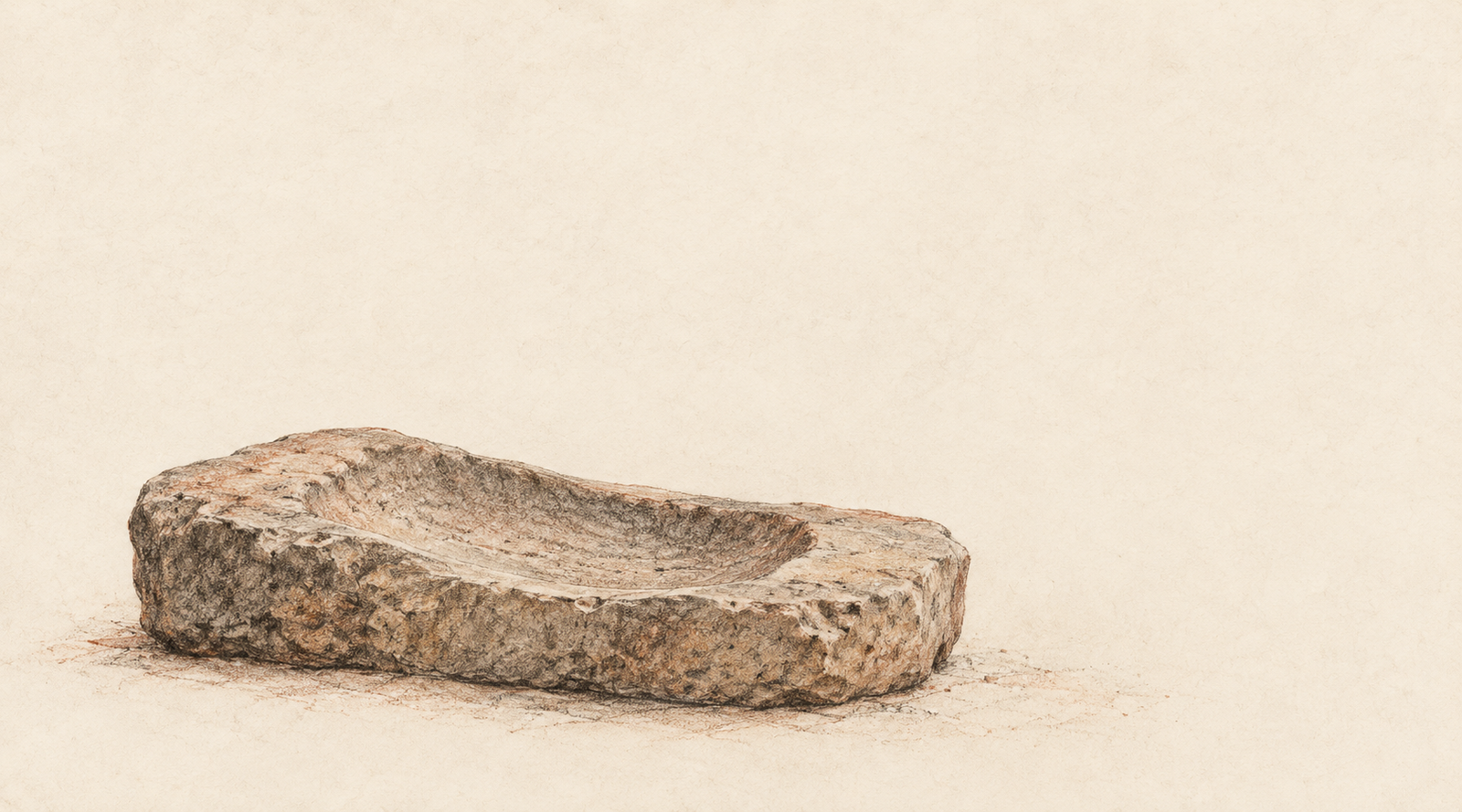
The temple we inherit is a building from which almost all necessity has been removed. Nothing must be brought for it to continue being what we call a temple. The sanctuary asks nothing of us. Stone is good at this kind of independence.
A living temple was otherwise.
Water had to come in. So did grain, cloth, oil, aromatic substances, fuel. The things required for worship arrived because someone carried them across a threshold.

Houses of Wood, Light, and Smoke
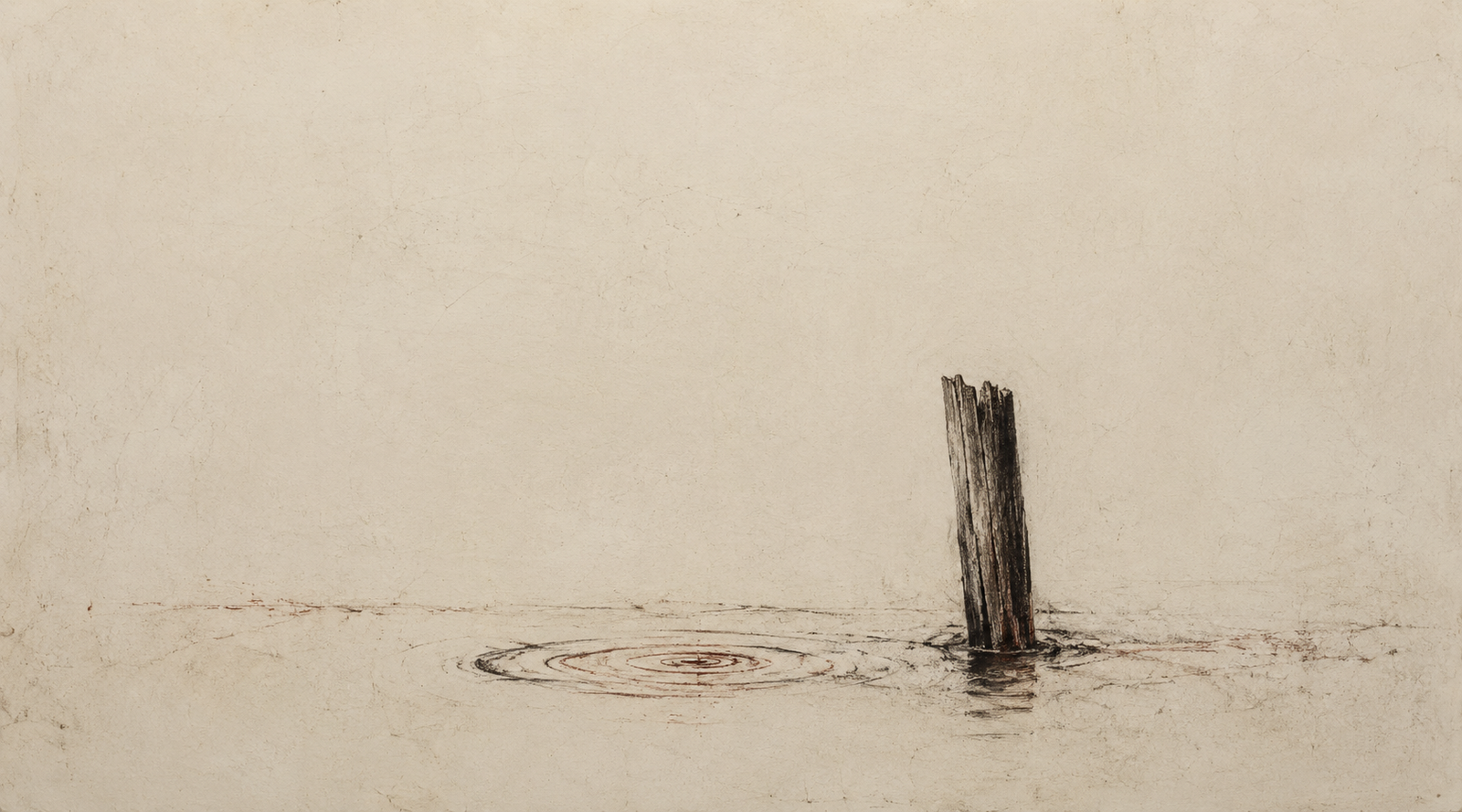
Some of Angkor’s most intimate ruins do not rise above the ground at all. They are postholes, low mounds, hearths and ponds: durable traces of a domestic city built largely from things that decay. To restore that city is to see Angkor not only as stone, but as wood, smoke, water, repair, and people living within calling distance.