
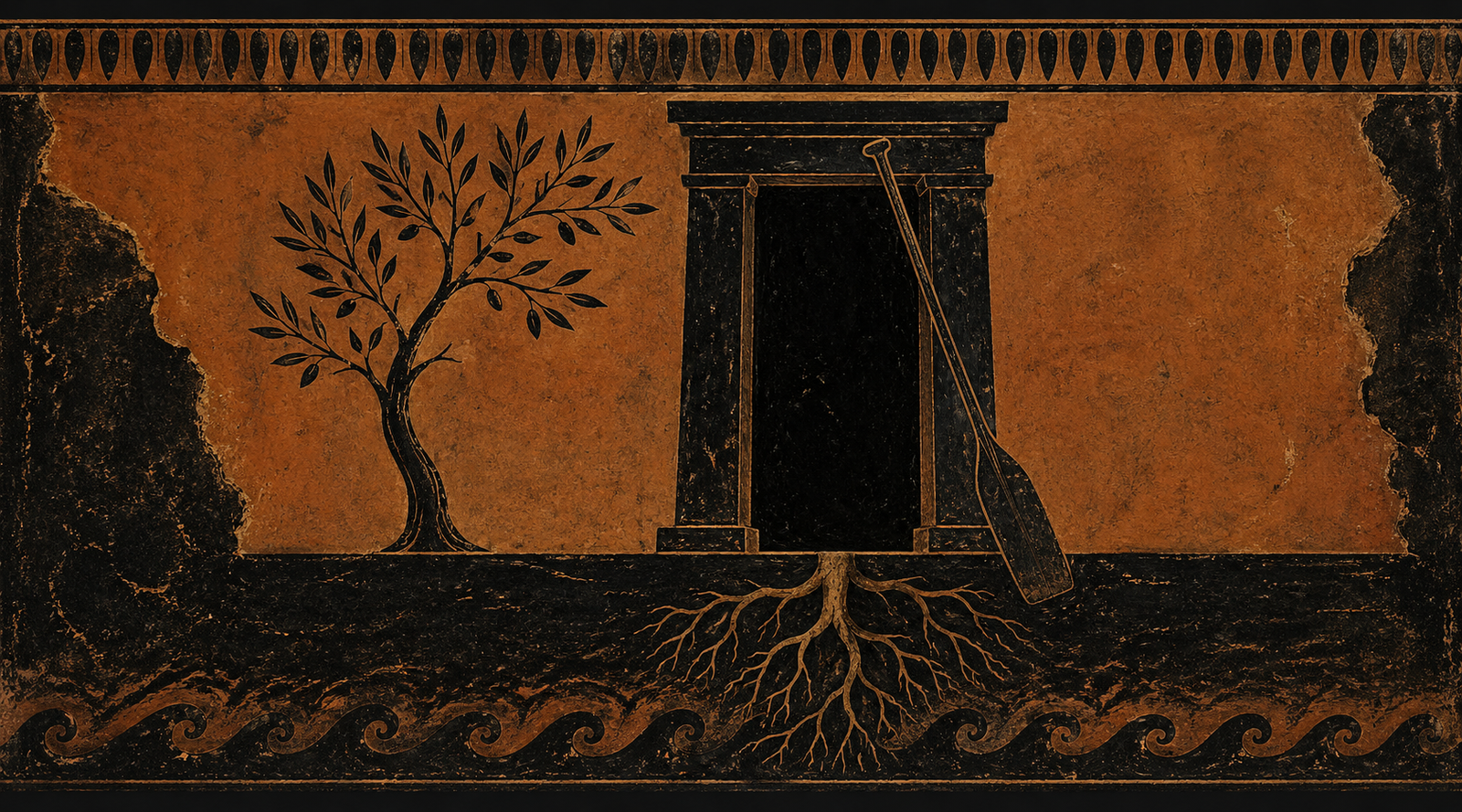

No Man Comes Home VIII — What the Oarsmen Did Not Hear
Odysseus hears what his men must not hear, then chooses the passage where some must die so that others may continue.
Circe told him enough to make obedience impossible.
That was the first cruelty.
A warning is not the same as rescue. It enters the listener and leaves him altered, but still required to act. The danger has not diminished. Only ignorance has been taken away. Sometimes this is mercy. Sometimes it is another form of burden.
The men ate before departure.
They had buried Elpenor. They had slept again under a roof that was not home. They had heard the goddess speak of the road ahead, though not all of them heard all that Odysseus heard. There are instructions meant for crews and instructions meant for captains. The distinction begins quietly. Later it becomes death.
The ship waited.
So did the sea.
The men went down to it with the movements of those who have survived too much to be innocent and not enough to be wise. They took their benches. They touched rope, wood, leather, mast, sail. Familiar things. Necessary things. A man can steady himself before terror by arranging what his hands already know.
Odysseus watched them.
Perhaps he loved them.
This should not be denied merely because love in him often arrived mixed with command. Men are rarely pure in the form by which they care. He had eaten with these men, escaped with them, misled them, saved them, endangered them, counted them after losses, and slept within reach of their breathing. He knew some by voice in darkness. He knew which hands were strongest, which courage needed watching, which fear became useful under order, which man would joke too near disaster because silence frightened him more than death.
They were his.
That was the danger.
Possession is not always greed. Sometimes it is responsibility corrupted by the very fact that others must answer to one voice when the storm rises. A captain cannot love like a brother only. He must love through number, through order, through choosing when no choice remains clean.
Circe had told him of the Sirens.
Their song did not merely please. It knew. That was its horror. It gathered the lives of men into sound and returned them as irresistible meaning. It promised not wine, not flesh, not rest, but knowledge sweetened until the soul forgot the body’s danger. No man who heard them freely could sail on. The shore around them was proof enough: bones whitening, bodies undone by listening, desire fed until it had consumed the listener.
Yet she had told Odysseus how to hear and live.
Wax for the men.
Ropes for the captain.
The ship must pass, he had been told, with the oarsmen sealed against the song and the one who governed them bound upright to the mast, hearing what would have destroyed them had he allowed them to share it.
That was the arrangement.
Knowledge above.
Labour below.
Silence between.
He did not tell them everything.
He told them there would be danger. He told them their ears must be stopped. He told them they must bind him and refuse him even if he begged, raged, promised, cursed, ordered, or pleaded with the old authority in his voice. He gave them the command by which they were to disobey him.
That is one of command’s strangest forms: the order that anticipates its own betrayal.
The men listened.
Perhaps some laughed uneasily. Men dislike instructions that require them to distrust the very voice by which they have survived. Perhaps some looked at the mast and understood that a leader tied upright is not a comforting sight. Perhaps some wondered what kind of sound required wax in every ear and rope around the captain’s body.
But they did not ask enough.
Men under command learn not to ask enough.
Odysseus softened the wax in his hands.
The sun warmed it. His fingers worked it until it yielded. A small, ordinary substance. Bee-labour. Hive-memory. Sweetness hardened into seal. Nothing in it resembled doom. Yet with it he closed the ears of men who would row him past knowledge they were not permitted to receive.
One by one, they bent their heads.
He pressed silence into them.
The gesture was intimate.
That made it worse.
He touched each man near the face. Men he had commanded in storm. Men who had watched companions die. Men who had followed him into caves and away from burning coasts. He sealed them gently, because the act required care. A rough hand might fail. A careless seal might leave a slit for ruin to enter.
Mercy demanded precision.
When he had finished, the ship had become a place of divided worlds. The men could see his mouth move, but not hear him. They could see one another labour, but not share warning except by eye and hand. The sea continued its old speech under the hull. The oars entered and lifted. Entered and lifted. The rhythm began.
Then they bound him.
Not as enemies bind a man.
As men obeying the order of the man they bound.
Rope crossed chest, arms, waist. Knot after knot tightened. The mast took his body. His hands, which had gripped sword, cup, rope, thigh, oar, bedpost, throat, prayer, and branch, could not rise to answer desire. He stood upright because he had been fastened to the thing that carried the sail. A man made instrument by his own foresight.
He nodded.
They rowed.
The island came.
At first there was nothing terrible.
That was part of the terror. No cliffs rising black against heaven. No teeth in the water. No god standing visible on the shore. Only a brightness ahead, a softness of air, the sea narrowing its sound as if the world itself had leaned closer to listen.
Then the song reached him.
Not through the ears only.
Through memory.
Through wound.
Through every chamber in him that had kept a name, a face, a road not taken, a dead man’s breath, a wife’s silence, a son’s unknown height, a mother passing three times through his arms. The song did not enter like music. It arrived as recognition perfected beyond the limits of human love.
They knew him.
That was the bait.
They sang not to a general hunger, but to the exact wound by which he could be opened. They knew Troy, and the horse, and the men hidden in wood, and the city’s last night. They knew the cave and the false name. They knew the island where immortality had failed to keep him. They knew the dead, and the mother, and the ache no honour answered. They knew the house before he entered it. They knew what he longed to know of himself.
Come, Odysseus.
The name came without accusation.
That was unbearable.
Come, they sang, and know what has been done, what will be done, what men hide from themselves to continue. No more fragments. No more omens. No more gods speaking slant through birds, smoke, dreams, old men, dead mouths. Come and hear the whole shape.
The whole shape.
There are temptations of pleasure.
This was not one.
This was the temptation to be completed by knowledge before life had finished exacting its cost.
He strained against the ropes.
The men rowed.
He ordered them to loose him.
No one heard.
He shouted, perhaps. The mouth made authority. The body made command. But the wax held. The men saw his face and bent harder to the oars because that was what he had told them to do when he had still been master of himself. They obeyed the earlier man against the present one.
This saved him.
It also humiliated him.
A leader depends, at the end, on others preserving the wisdom he can no longer inhabit.
The song deepened.
It did not beg.
Begging would have made it weaker. It promised what kings, warriors, wanderers, husbands, sons, and liars all desire secretly: that nothing need remain partial. That every wound could become intelligible. That every death could be placed. That every concealment could finally be opened without destroying the one who opened it.
The dead had given him knowledge without comfort.
The Sirens offered knowledge as comfort.
This made them more dangerous than the dead.
He saw, beyond the narrowing water, the shore where listeners had come to completion and never left. Bones. Rot. Flowers, perhaps. Beauty does not mind growing near ruin. The song had not lied about knowledge. It had lied about what a living man may do with it.
To know all before the end is to cease moving.
The oarsmen did not hear.
They saw water, wind, captain struggling, one another’s shoulders, the narrowing passage. Their world was labour and visible command. They were spared the song’s intimacy. They were also excluded from the knowledge by which their captain was changed.
This is one of command’s oldest wounds.
Those who labour under an order may never know what the order spared them.
Or what it cost.
Odysseus heard until hearing became almost another body inside him.
Then the song passed behind.
Not away.
Behind.
There are sounds that do not cease when distance takes them. They continue under later speech, inside sleep, beneath judgement. The Sirens were no longer audible to the men, and perhaps no longer to the air, but Odysseus carried them. He had heard the promise of total knowledge and lived. This did not make him wise.
It made him marked.
The men saw his body alter.
They did not know why.
They cut him loose when the shore had fallen behind. Wax came from their ears. Sound returned to the ship in fragments: water, wind, breath, groan of wood, one man’s nervous laugh, another’s question swallowed before it formed. The world resumed its ordinary incompleteness.
No one asked what he had heard.
Or if they asked, he did not answer fully.
How could he? The song’s danger lay partly in its refusal to become report. To describe it would be to betray it and fail it at once. It had known too much. Speech can repeat melody, perhaps, but not the sensation of being known by what intends to consume you.
So he turned them onward.
The ship continued.
Ahead waited the place where knowledge could not save all who obeyed him.
Circe had told him of the two rocks.
One held Scylla.
The other Charybdis.
Between them, passage narrowed into cruelty. One danger took some. The other could take all. There are choices that enter the world already corrupted, and whoever chooses among them will be blamed by the part of the soul that still believes goodness should have offered another road.
Circe had told him which loss to accept.
Not because it was good.
Because it was less total.
Six men rather than all.
The arithmetic was clear.
Clarity did not make it clean.
Odysseus did not tell them.
He armed himself, foolishly perhaps, because the hand still hopes to answer horror with the old grammar of bronze. He looked towards the rocks. He watched water behave wrongly near Charybdis, watched the sea inhale and expose what should remain hidden, watched the returning rush as if the world’s throat had opened beneath them. To lose the ship there would be to vanish together into a mouth no courage could instruct.
So he held the ship nearer Scylla.
He chose.
That must be said plainly.
Not fate alone. Not the goddess alone. Not the sea alone. Odysseus held the knowledge and chose the side where some would die so that others might pass.
He did not tell the men because panic would scatter rhythm. Oars must continue. Hands must remain where passage needs them. A man cannot row through terror if terror has already entered the muscles before the monster does.
Perhaps this was true.
Perhaps it was also the explanation command gives itself because the alternative is unbearable.
The oarsmen rowed.
Their ears were open now.
That was almost worse.
They could hear surf, command, water, the dangerous breathing of the passage, perhaps the strange sound of the whirlpool drawing sea into itself. They could hear everything except the one knowledge that would have made their fear exact.
Scylla struck from above.
Not as battle.
As taking.
The six were lifted out of the ship’s world before the ship could understand itself as battlefield. Hands left oars. Voices rose. Names broke open. Men who had rowed through songless ignorance now became the price of the chosen side.
No detail should be loved here.
There are scenes the imagination must not decorate.
The captain saw.
That is enough.
He saw men taken while their hands still remembered the work of rowing. He saw mouths calling to him because command had trained them to believe his attention might still alter the world. He saw the impossible distance between hearing a man cry and being able to return him to the bench.
He could not save them.
He did not turn back.
The ship passed.
This was survival.
It did not resemble victory.
Afterwards the benches were wrong.
An empty place at an oar is not empty in the ordinary manner. It disturbs rhythm. It changes the breath of those beside it. It makes every remaining stroke answer for the missing one. The ship moved on with six absences labouring in reverse.
The men who survived did not yet know the full shape of what had happened.
Perhaps they understood enough.
Enough can be very cruel.
They had obeyed. They had rowed. They had trusted the passage of command through the captain’s body into their own. Some had been spared by ignorance. Some had died inside it.
Odysseus carried the rest.
The song still lived in him.
This is the wound no one saw.
Not that the song had tempted him before the loss. Not merely that he had heard what they could not hear. But that after six men were taken, after the ship moved on, after command had done what command does when the world offers only corrupted choices, the song remained.
Beauty had survived in him beside their deaths.
That was almost intolerable.
No honest account of him should make cruelty easy. He did not wish his men dead. He did not hear the Sirens with lightness. He did not row away pleased by calculation. Yet the fact remained: he had heard what would have destroyed them, withheld what might have prepared them, chosen what would cost them, and continued.
Continuing is not innocence.
The ship went on.
The sea closed behind them as it always closes, hiding its own wounds better than men can. The rocks receded. The oars resumed under fewer hands. Above them gulls wheeled, indifferent scribes of passage. The sun shone as if light had no responsibility towards those who died in it.
Odysseus stood among the living.
Six names had entered the underworld.
The others looked to him still.
That is command’s punishment.
It does not end when men die under it. It must speak again to those who remain.
He could not tell them everything. Perhaps that was mercy. Perhaps it was cowardice. Perhaps the difference had become too narrow inside him to name. He gave what words he could. Order. Direction. The next shore. The need to continue. Men who have survived horror often ask for meaning, but first they require water, food, repair, the next act by which the body refuses collapse.
Meaning can wait.
Hunger cannot.
So they sailed.
Behind them lay the song the oarsmen had not heard and the six cries all had heard too late.
Ahead waited the island of the Sun, where hunger would test what warning had not yet destroyed.
But for a while there was only passage.
Wood into water.
Shoulders bending.
Breath finding rhythm around absence.
A captain with song inside him.
Men rowing under the authority of what he would never fully tell them.
—
No Man Comes Home is a twelve-canto literary retelling of The Odyssey within The House of Cadmus: a poem of return, concealment, recognition, and the cost of surviving long enough to come home.
—
Receive the next work
Subscribe free to receive new work from the House of Cadmus Library by email.
More from the Library


See Also
A concise and impartial dictionary of absence, promises, quarrels, ordinary objects, and the troublesome instability of words.

The City of Service
The temple we inherit is a building from which almost all necessity has been removed. Nothing must be brought for it to continue being what we call a temple. The sanctuary asks nothing of us. Stone is good at this kind of independence.
A living temple was otherwise.
Water had to come in. So did grain, cloth, oil, aromatic substances, fuel. The things required for worship arrived because someone carried them across a threshold.

Houses of Wood, Light, and Smoke
Some of Angkor’s most intimate ruins do not rise above the ground at all. They are postholes, low mounds, hearths and ponds: durable traces of a domestic city built largely from things that decay. To restore that city is to see Angkor not only as stone, but as wood, smoke, water, repair, and people living within calling distance.