Complimentary worldwide shipping on orders over $400 · No import tariffs for most countries

0

Your Cart is Empty

The Buddha enters Angkor quietly. Not as a proclamation, not as a doctrine announced, but as a posture learned by stone. He is recognised less by name than by stillness: a seated figure, spine upright, gaze lowered, hands resting where effort ends. In a landscape shaped by kingship, lineage, and cosmic ambition, his presence does not compete. It withdraws. And in that withdrawal, something enduring takes root.

Across the galleries and sanctuaries of Angkor, the Buddha does not argue with the gods. He does not displace them. He waits. The architecture receives him as it receives rain: without ceremony, without resistance. Walls that once carried epics of conquest and divine descent learn another grammar—one of inward turning, of attention held rather than projected. Stone that once moved outward toward the horizon begins to settle back toward the breath.

The Buddha’s story is known, yet here it is not recited. The palace, the departure, the years of austerity, the awakening beneath the tree—these remain present as an undertone rather than a sequence. What matters in Angkor is not the journey but the residue it leaves behind: a way of sitting with the world that neither rejects nor possesses it. This is not renunciation as drama, but as calibration.

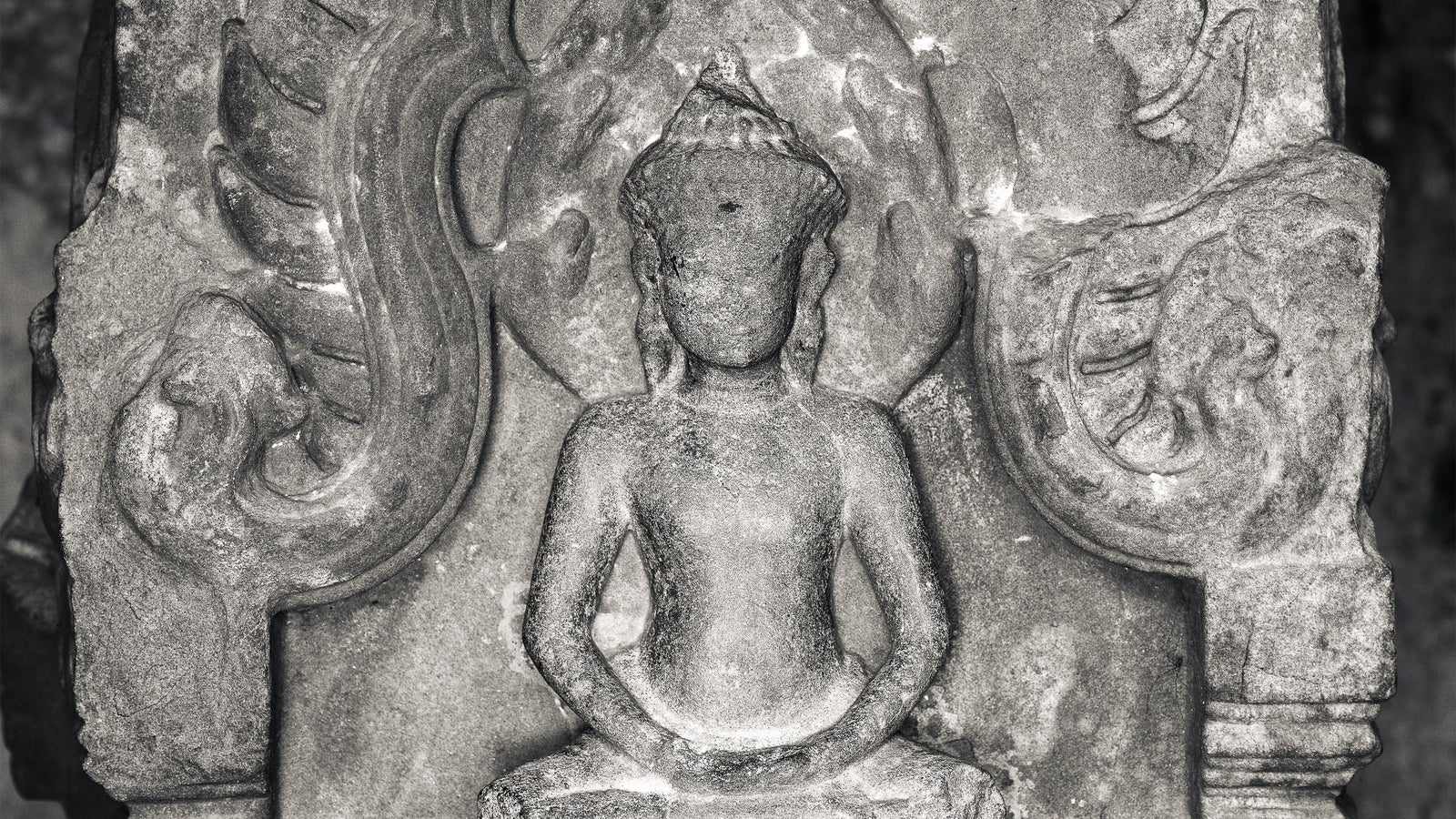
In Khmer hands, the Buddha often appears seated upon the coils of the naga Mucalinda. The image is precise and restrained. The serpent does not strike; it supports. The storm does not end; it is endured. The coils lift the body just enough to keep it from sinking, while the hood opens above—not as domination, but as shelter. This is the Buddha as one who remains undisturbed without becoming distant. Protection here is not force. It is alignment.

What the Buddha introduces into Angkor is not belief, but a discipline of seeing. The world is not denied its weight. Suffering—dukkha—is not softened or explained away. It is acknowledged as texture: ageing stone, weathered face, the long fatigue of history. Yet alongside this recognition appears a different orientation, one that refuses both indulgence and denial. The Middle Way does not dramatise itself. It holds.

Within later Mahayana understanding, the Buddha is not confined to his historical form. He is understood through the threefold articulation of presence: dharmakaya, the unmanifested body of truth; sambhogakaya, the luminous body of shared vision; nirmanakaya, the body that walks, teaches, ages, and dies. Angkor does not illustrate these distinctions. It absorbs them. The temples themselves become bodies—architectural enactments of teaching that is not spoken but inhabited.

There is a moral gravity to this presence. The Buddha does not govern, yet he reshapes kingship. He does not command, yet authority bends toward him. Under his influence, power is measured not by expansion but by restraint; not by inscription, but by conduct. The stone faces that look outward across the empire begin, subtly, to look inward as well. Compassion here is not sentiment. It is the refusal to turn away.

The Buddha’s final gesture, reclining at the edge of life, is echoed in Angkor’s long endurance. Nothing here claims permanence. Everything is subject to weather, growth, collapse. The teaching does not resist this. It names it. All conditioned things pass. Attention, therefore, must be trained—not to escape the world, but to meet it without grasping. This is not consolation. It is clarity.

To encounter the Buddha in Angkor is to encounter a practice rather than a figure. A way of standing, sitting, breathing, noticing. Stone learns it. Water learns it. And the pilgrim, moving slowly through galleries worn smooth by centuries of touch, may begin—almost without noticing—to learn it too.