

Cakravartin — The King Who Turns the World
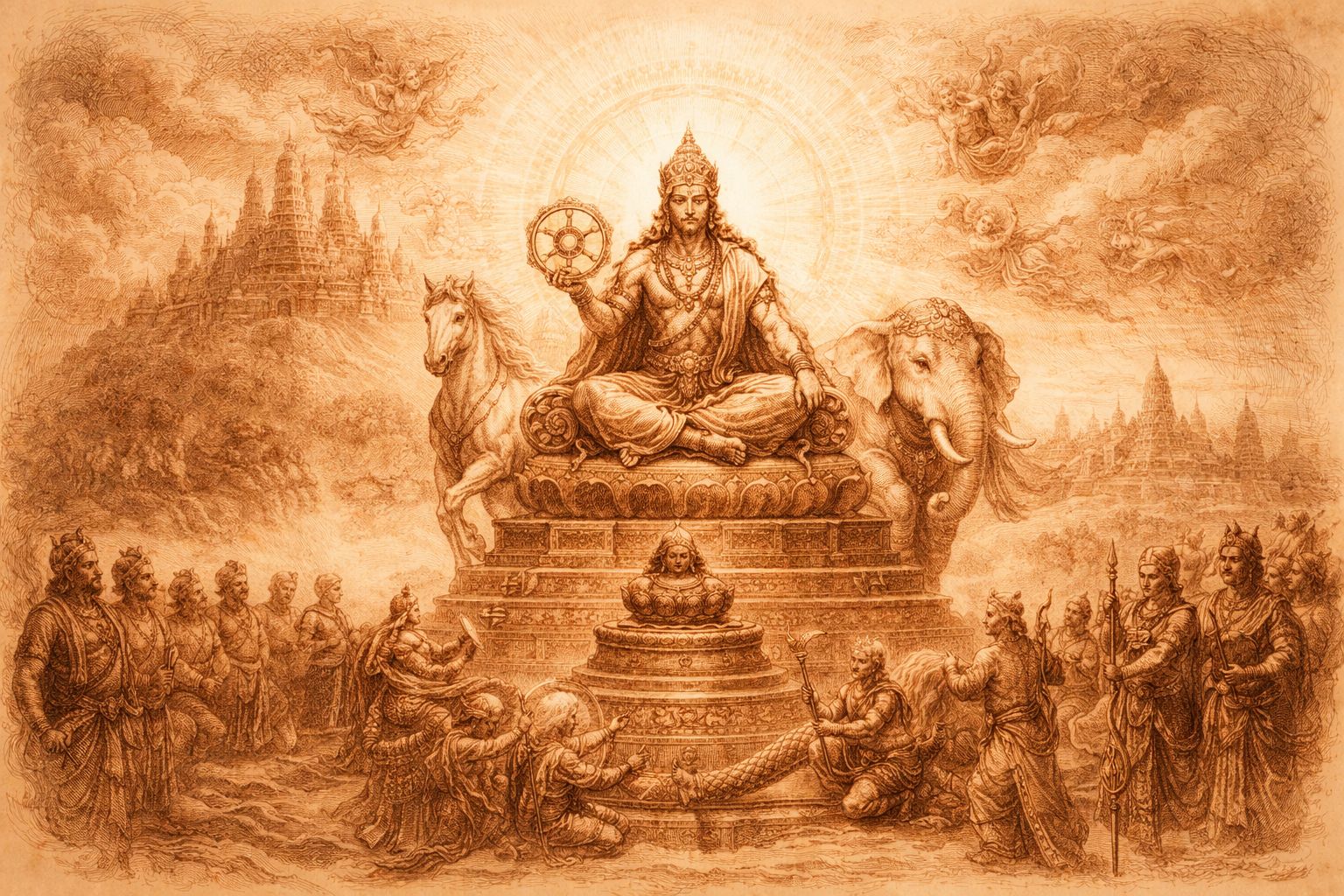
In the cosmologies that shaped South and Southeast Asia, true kingship was never imagined as domination alone. It was imagined as rotation—the quiet, ceaseless turning of a world held in balance. The ruler worthy of this task was named cakravartin, “he who sets the wheel in motion,” a monarch whose authority did not radiate outward by force but organised space itself around a moral centre.
The image is precise. The king is not the rim of the wheel, flung outward into excess, but the hub, still and weighted, around which everything else moves. As the heavens revolve around the pole star, so society revolves around a ruler whose presence aligns the world into coherence. Justice, prosperity, fertility, and peace are not policies; they are symptoms of correct alignment.
In both Hindu and Buddhist traditions, the cakravartin is not merely a political figure but a cosmic condition made human. His reign signals a moment when the world has become governable again—after war, fragmentation, or moral drift. He does not conquer in order to rule; he rules because conquest has already been absorbed into order.
This ideal announces itself through signs. When a cakravartin is ready to appear, the world responds by producing the seven jewels—not ornaments, but instruments of universal governance. The sacred wheel rolls before him, declaring that no land lies beyond his moral horizon. The white elephant and solar horse carry him effortlessly across the realm, for the world itself has become traversable. The wish-fulfilling jewel abolishes scarcity. The queen embodies harmony within the household of power. The minister guarantees generosity without exhaustion. The general ensures that violence, when unavoidable, remains disciplined and finite.
Together, these jewels describe a state in which nothing resists circulation—wealth, authority, compassion, protection all move without obstruction. The cakravartin does not hoard; he turns.
In Buddhist thought, this figure acquires a profound parallel. The cakravartin becomes the secular counterpart of the Buddha, who sets in motion not a wheel of empire but the Wheel of the Law. Both are counted among the rare mahapurusa, beings marked from birth by signs that indicate a destiny larger than the self. One governs the outer world; the other governs the inner. Both bring order without coercion.
This symmetry matters deeply at Angkor.
When Khmer kings reached for legitimacy, they did not invent new symbols. They aligned themselves with this ancient grammar of sovereignty. In 802 CE, Jayavarman II was proclaimed cakravartin on Phnom Kulen, severing ritual dependence on foreign powers and declaring a world recentred around a single king. The proclamation was not administrative; it was cosmological. Cambodia itself was being reoriented.
Later rulers refined this alignment. Suryavarman II bound the cakravartin ideal to Vishnu, bearer of the discus, the divine wheel that preserves the universe through measured force. Angkor Wat is not simply a temple; it is an architectural cosmogram of universal rule—causeways, galleries, and towers laid out as a world made legible and stable under a single axis.
Ritual completed what architecture declared. Through the Indrabhiseka, the king was anointed as Indra’s terrestrial analogue. Through the asvamedha, the wandering horse tested whether the world would resist his movement—or accept it. These were not gestures of arrogance but examinations of balance. A world that could be traversed without obstruction was a world at peace.
The great myth that frames this beginning—the Churning of the Sea of Milk—makes the same claim in symbolic form. Order does not arise gently. It must be extracted from chaos through sustained, disciplined effort. The cakravartin is the one who holds the rope without losing measure, who draws prosperity from turbulence without letting the churn become destruction.
What emerges from these traditions is not the fantasy of limitless power, but a warning. The cakravartin is rare precisely because the wheel must keep turning. When generosity falters, when violence exceeds necessity, when the centre grows rigid or vain, the wheel wobbles. Another age begins. Another restoration will be required.
At Angkor, stone remembers this truth with unusual clarity. Kings are not immortal. Empires turn. What endures is the demand that power remain centripetal rather than explosive—that it draw the world inward toward coherence instead of flinging it apart.
To rule the world, the cakravartin teaches, is first to hold it together.
—
Receive the next work
Subscribe free to receive new work from the Lucas Varro Library by email.
More from the Library

See Also
A concise and impartial dictionary of absence, promises, quarrels, ordinary objects, and the troublesome instability of words.

The City of Service
The temple we inherit is a building from which almost all necessity has been removed. Nothing must be brought for it to continue being what we call a temple. The sanctuary asks nothing of us. Stone is good at this kind of independence.
A living temple was otherwise.
Water had to come in. So did grain, cloth, oil, aromatic substances, fuel. The things required for worship arrived because someone carried them across a threshold.

Houses of Wood, Light, and Smoke
Some of Angkor’s most intimate ruins do not rise above the ground at all. They are postholes, low mounds, hearths and ponds: durable traces of a domestic city built largely from things that decay. To restore that city is to see Angkor not only as stone, but as wood, smoke, water, repair, and people living within calling distance.