
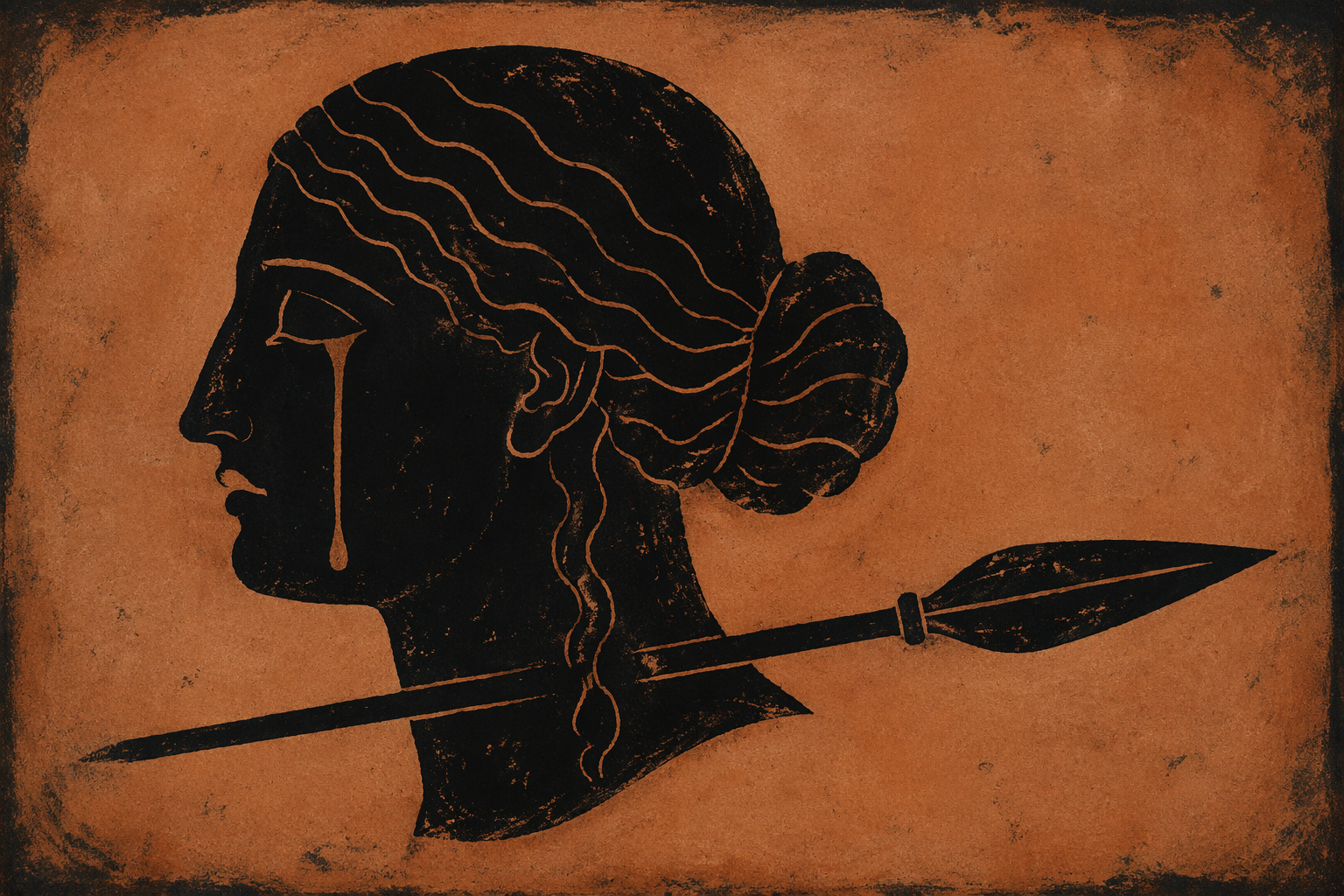

Narcissus and Echo
There are forms of ruin that begin long before the body knows it has entered them.
Echo learned hers in the mountains, where sound is never alone. A call leaves the mouth, strikes stone, and returns altered by distance, cliff, hollow, and height. The ridges above her kept more voices than they should have been able to hold. A laugh could live there for a moment after the mouth that gave it had closed. A name could come back thinner, delayed, made strange by the rock that received it. The nymph knew these returns intimately. She belonged to slopes, glens, and broken ground. Her feet were sure on shale. Her body moved easily among fir, scrub oak, and pale stone that kept the sun’s heat long after noon had passed. She had the quickness of mountain things: not hidden, not displayed, only difficult to catch at rest.
She spoke often. That was first merely true of her. Then it became useful.
When Zeus crossed those upper regions in pursuit of what pleased him, he did not always move alone, and he did not always wish to be found. Hera, who missed little and forgave less, came more than once seeking what had already shifted beyond her reach. At such times Echo met her with abundance. She met her with speech itself — stories, turns, diversions, little roads of sound laid one after another so the goddess’s attention followed language while bodies elsewhere escaped it. She did not oppose Hera by force. She delayed her by continuity. She kept words arriving. She made one sentence lean into the next. By the time the chain broke, the thing sought had withdrawn beyond recovery.
It was not deceit of a high order, but it was enough.
When Hera understood what had been done, she did not tear Echo apart, nor strike her mute. Either would have been crude. The punishment was narrower and therefore harder. She left the nymph speech, but she took from it beginning.
From that hour Echo could not shape first utterance. No word could rise from her of its own force. She could not call, warn, answer before being addressed, plead from herself, or lay language into the air as one lays a hand upon water. She had only the ends of others. When a voice came near her, the final word or phrase might still be taken up and sent back. But nothing commenced in her now. Speech no longer opened outward from the body. It arrived from elsewhere and returned.
This was not silence. Silence can still belong to the one who keeps it. This was occupation.
At first she tried to test the edges of it. She stood in narrow places where a goat-path cut along a ridge and opened her mouth against the sky. Nothing came. She knelt beside a stream and watched her own lips shape effort without sound. Then a woodcutter passed below and called to his mule in irritation. The last word of the curse struck her like a thrown object and left her again before she knew she had taken it. She flinched at the sound of her own voice, which now no longer answered to intention.
So the mountains acquired her differently. Once she had moved through them as a creature among them. Now she dwelt there like a property of their acoustics. The hollows loved her better than the open. Ravines held her. Cliffs gave her back to herself in fragments. If a hunter cried out, she returned the end of him. If shepherd boys shouted across distance, she broke their noises against each other and gave them back thinner, stranger, harder to place. Those who did not know her thought the hills were answering. In a sense they were.
It was during those years that Narcissus came to his height.
He was born of water and force: Leiriope, taken in the river’s coils; Cephisus, who did not ask. From the beginning people spoke of his beauty as though speaking might reduce it, make it ordinary by repetition. It did not. It passed instead into that dangerous region where description gives up and report begins. Men returning from roads altered course to see him. Girls delayed at springs where they had heard he might appear. His face moved before him by reputation, and his body only confirmed what had already been said.
Teiresias, asked what length of years might be granted such a child, gave an answer that lived after him: he would endure, provided he never knew himself.
Prophecies are often made to seem clearer afterward than they were at the moment of speaking. This one had clarity enough from the start and still no one knew how to obey it.
Life proceeded badly for others.
Narcissus did not court. He did not pause in kindness where kindness might have cost him little. He did not receive the feeling that gathered around him as one receives weather or debt. Desire met him and found no hold. This in itself would not have made him singular. Not all are bound to return affection. But there was in him a harder condition than indifference. He would not merely refuse; he refused in a way that stripped approach of dignity. Those who reached toward him found themselves not only denied but exposed, as though the act of longing had been made foolish by coming too near a surface that offered nothing back. Men who had thought themselves disciplined became clumsy under his notice. Women who had kept their bearing before gods and fathers felt the body betray them in his presence. He did not deceive them. He did worse. He let the distance remain naked.
Stories collected around this as burrs gather on a cloak. One youth — some named him Ameinias — bore rejection past endurance and laid his blood on Narcissus’s threshold. Whether the dead are heard as prayers by the gods, or whether the structure of an act is already a form of summons, the effect was the same: a request entered the world that something be answered.
Yet Narcissus continued as before. He hunted. He crossed woodland and upland with spear and dogs. He preferred places where air moved cleanly and sound travelled far. He had the ease of one who has never yet been required to answer for the form of his being. He did not think of himself as cruel. That would have required a kind of reflection not yet granted him.
Echo saw him first among pines where the path narrowed between rock and shadow. She knew him before sight completed itself. Others had filled the mountains with report of him for years. Then his body came where report had been, and the body was worse. He moved with the economy of one accustomed to being watched and therefore careless of it. Nothing in him petitioned. Nothing bent. The dogs ran ahead, then circled back. Sun crossed one side of his throat and left the other cool. His bow hung unstrained in his hand. There are faces that seem composed for response — faces that ask to be read, that promise alteration if read truly. His did not. His seemed already finished.
Echo followed.
There was no choice in that, though choice would not have spared her. Desire in her condition was harsher than in others because it could not go outward to test itself. It had no first word. It could not venture, withdraw, recover. It could only gather as pressure. She moved from tree to tree, keeping trunks between them, keeping just enough distance that the dogs would not turn their attention to her. Need worked upon her not as fever alone but as arrangement. Every possibility in her was narrowed to the hope that he might speak first, and that the curse, for one instant, might permit a joining.
His companions drifted away among the trees. Horn calls moved through the wood in pieces, then ceased. A stag had crossed stony ground and broken the track. Narcissus stood still to listen. The afternoon held its breath around him. Then he called out into the silence:
“Who is here?”
Echo, struck by the last word, answered from the trees.
“Here.”
He turned sharply at the sound. The dogs lifted their heads.
“Come,” he said, not warmly, only to locate what had answered.
“Come.”
The word passed through her like sudden light through water. She stepped from cover with both arms already opened by hope. It was not calculation. It was the body hurling itself toward the only aperture the world had left it.
He recoiled before she reached him.
Not in fear. In refusal.
He saw at once what she meant. Perhaps he saw too the poverty of her speech, the dependence that made her answer late and repeat what was not hers. Perhaps he saw only a woman approaching with need in her face. Whatever passed through him then did not soften as it crossed. He pushed her from him with the force reserved for things one will not permit near the skin.
“I would die,” he said, “before you possessed me.”
The curse gave her only the end.
“Possessed me.”
It is difficult to say where humiliation takes the body first. Sometimes the face burns. Sometimes the belly hollows. Sometimes the limbs lose instruction and act with an animal economy older than shame. Echo did not stand to plead; she could not. She did not attempt again to embrace him; the world had already made that answer. She turned and fled between the trees with the speed of a struck creature seeking any dark enough place to hide its wound.
He watched her go only long enough to see that she had gone. Then he called for the dogs and moved on.
But the mountains keep what is given to them.
Echo withdrew into clefts, caves, abandoned places where water had once run and left only coolness. She did not seek death as an act. She diminished under a condition the body could not carry forever. Food lost taste. Sleep lost kindness. The limbs thinned. Colour left the skin. What she had suffered was not merely rejection but completion of the curse. She had been made unable to begin and then driven against one who would not receive what came to him. The structure had closed. Nothing in her now had room to open.
Those who later told the tale said that she pined for love and vanished. This is true so far as it goes. But pining suggests languor, softness, a wasting inwardly entertained. Her reduction was harsher. She became incompatible with embodiment. Flesh requires some traffic with the world: touch answered, hunger answered, the body met by more than stone and air. Her condition offered only return without meeting. Little by little she fell from matter. Bone showed. Then even bone ceased to define her. What remained was adherence to place. A cry struck rock, and she was in it. A shepherd called from one ridge to another, and she lived briefly in the seam of his own voice. She no longer moved through the mountains. She occurred there.
Whether Nemesis heard the dead youth at the threshold, or whether Artemis saw the pattern and judged it fit for correction, the result came in the season of heat, when even shade seems a temporary agreement and hunters go farther than they intend because water lies hidden under stone.
Narcissus had pursued game since morning. The trail was poor. The dogs were tired and ranged less widely. Dust clung to his legs. Sweat marked the nape of his neck and dried there. The wood opened at last onto a place held apart, a basin of stillness where no hoof had muddied the edge and no branch had dropped rot into the water. A spring rose there under rock and fed a clear pool ringed with grass and low flowers not yet opened to full colour. The surface was so undisturbed it seemed not water first but brightness laid flat.
He knelt.
Thirst brought him down. That must be remembered. He did not arrive seeking marvel. He bent to drink.
Then the face in the pool met him.
He thought first that another had come there before him, some boy or nymph of impossible fairness hidden within the spring’s depth. He leaned closer. The image leaned. He smiled despite himself. It smiled. He reached toward the cheek. The hand broke the surface. The face shattered into light, fragments, rings moving outward. When the water cleared, it returned.
But revelation is not the same as release. Narcissus had spent his life under the law of asymmetry without knowing it. Now the law stood before him perfected. Here was beauty that answered every look and yielded nothing. Here was nearness without possession, invitation without crossing, fidelity without substance. The structure of his own refusals had become visible and, becoming visible, had bound him.
He remained by the spring.
At first he may have believed patience would solve it. Things hidden sometimes emerge if one waits long enough and disturbs them little. He lay on the bank and watched. The face watched him. Light altered. Wind crossed branches overhead and ceased. Once a leaf dropped and sent the features flowing apart. He waited for them to compose again. When they did, relief passed through him so sharply that it taught him what had already happened.
He spoke. The image spoke. Not in sound, of course — the mouth shaped response in silence — yet that silent consent was worse than silence, because it mimed return. He stretched his arms toward it and drew them back. He lowered his lips and met only cold division. He accused. He pleaded. He laughed once in disbelief and saw laughter wound the face he desired. He wept and watched tears enter the water from above while tears, impossible and exact, stood also below.
Echo heard him.
Grief carries farther than joy. When Narcissus cried out in frustration, the endings of his cries began to move among the ridges. The nymph who had become those ridges received them.
She came as near as she could.
No body now emerged from brush or glen. No foot broke twig or grass. Yet in every call he gave, the last word was returned from rock and distance. At first he may not have marked it. A man speaking to an image is already divided enough. But as his distress sharpened, the answer sharpened too.
“Why do you flee?”
“Flee.”
“I cannot leave you.”
“Leave you.”
“Stay.”
“Stay.”
“Look at me.”
“Look at me.”
“Answer.”
“Answer.”
Each repetition was both cruelty and mourning. Echo could not comfort him. Her condition had not altered because his had worsened. She could only inhabit the ends of his speech as she had always done. Yet now what she returned was no longer an offer of approach but a witness to enclosure. He was trapped before an image that could not become flesh; she was trapped within language that could not become appeal. Their distances were different and identical.
Days passed. The body can survive astonishingly long when desire becomes its occupation and pain its discipline. He felt hunger and refused it. He felt thirst and refused it too, though water lay before him. Or rather he could not take it without destroying the face. The pool mattered first. Shade moved and left him. Night cooled the stones, and still he remained. Dawn remade the face from darkness. He reached toward it with the same hope that had already failed a hundred times. Each failure instructed him further in what he could not stop doing.
At last knowledge entered him.
Not wisdom. Wisdom alters conduct.
But he understood. The beloved was himself. The mouth he had begged to answer was the mouth from which the begging came. The eyes that had seemed to meet him were his own eyes held on him by water’s craft. He knew himself.
The discovery gave him no mastery. It only removed the last error between suffering and its form. Now he saw clearly that he loved an image and could not cease; that the beauty he had denied as relation had returned to him as prison; that he had come not upon another but upon the exact impossibility fitted to his life. To some, self-knowledge is liberation. To him, under this law, it was closure.
He weakened quickly then.
The body, once denied the hope of confusion, surrendered more readily. His limbs lost steadiness. His face, still beautiful, grew sharp with want. He no longer rose even when night made the spring black and blank. He waited for dawn as the condemned wait for a door to open. When light returned the image, he gave himself back to it with the gratitude of one restored to pain he recognises.
Echo remained.
When he said, “Alas,” the mountain gave him “Alas.”
When he said, “Farewell,” from lips already drying, the answer came to him from stone and distance:
“Farewell.”
It is said that when others came at last to seek him, they found no body. Only a flower had taken the place beside the spring: white at the petals, yellow at the heart, bent slightly downward as though still attending the surface below. This is not the kind of change that should be mistaken for consolation. Metamorphosis in the old world does not repair what preceded it. It fixes it.
So the basin kept its witness. Where a youth had failed to survive recognition, a flower now leaned under the same law of inclination. Where a nymph had been stripped of first utterance and then of flesh, a voice remained in ravines, quarries, glens, and all stony places where sound can lose ownership and return.
Neither was restored. The world was not corrected. It only became more legible.
Even now the structure holds. Call into a mountain hollow and what comes back is not answer but your own ending, delayed and made strange by distance. Bend over still water long enough and the face there seems almost capable of crossing. Almost. That is sufficient for grief.
This was their fate: not that one loved himself and one loved him, but that both were taken into forms where relation could approach completion and never arrive. One could answer without beginning. One could behold without touching. Between them the world set voice, image, stone, and water, and from those materials made a law that outlasted their bodies.
The flower remains by springs and damp places. The voice remains where cliffs keep the shape of sound.
Call, and she will give you back your end.
Lean, and he is still there.
—
—
Receive the next work
Subscribe free to receive new work from the House of Cadmus Library by email.
More from the Library

Houses of Wood, Light, and Smoke
Some of Angkor’s most intimate ruins do not rise above the ground at all. They are postholes, low mounds, hearths and ponds: durable traces of a domestic city built largely from things that decay. To restore that city is to see Angkor not only as stone, but as wood, smoke, water, repair, and people living within calling distance.
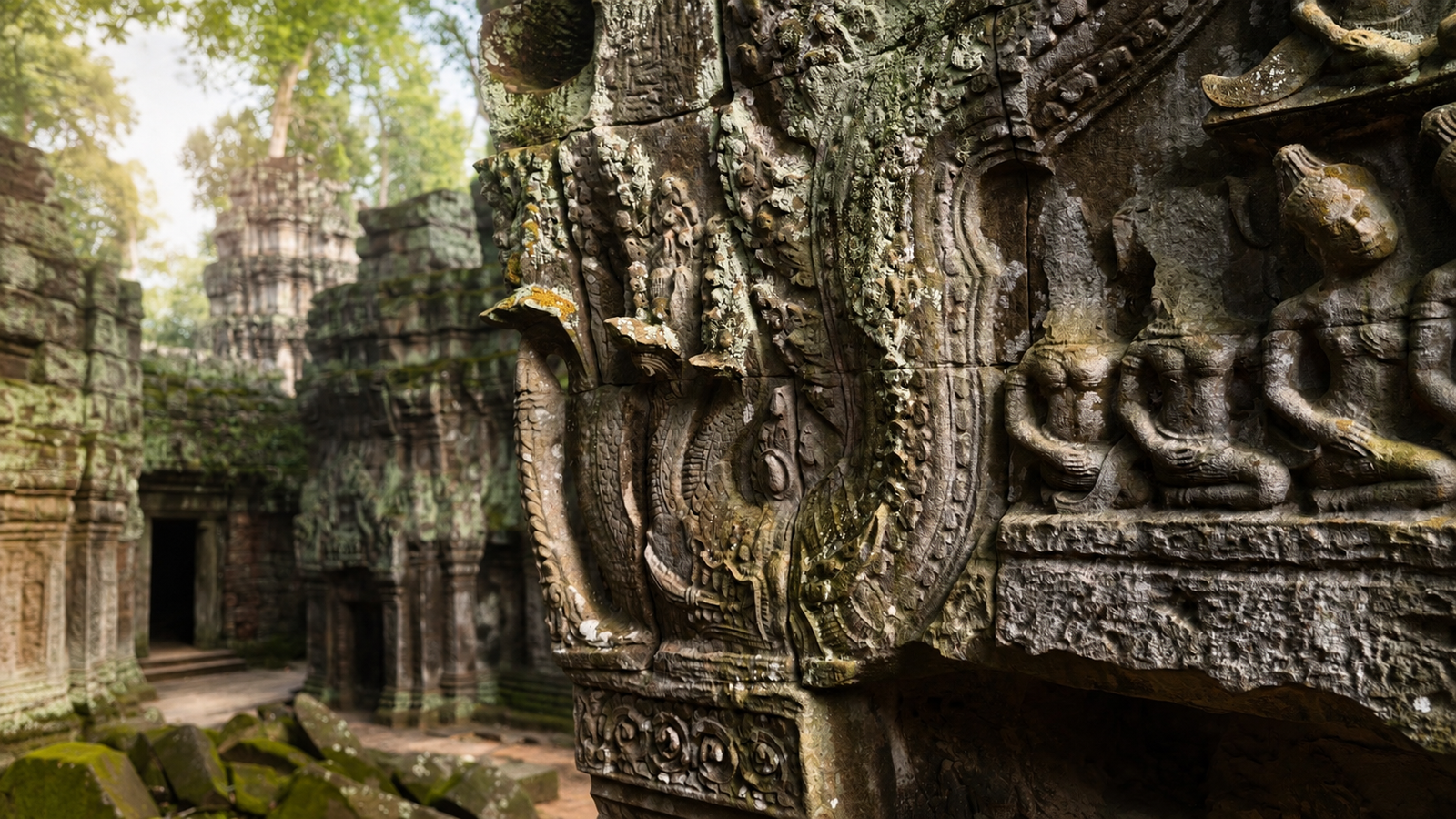

What Stone Brings Forth
I had mistaken a gift for something being expelled.
Beneath the nāga's mouth, a stone garland descended bead by bead. Nearby, a makara opened its jaws and another form emerged. Looking closer, the whole temple began to change: serpent became ornament, ornament became architecture, architecture became foliage.
The forest did not introduce this language.
It answered it.

The Eighth Daughter
Seven daughters have already been taken by Yamata-no-Orochi when Susanoo reaches the River Hi. Only Kushinada-hime remains. The Eighth Daughter retells the Kojiki episode through a family’s waiting, a girl transformed into a comb, and the patient preparation for the serpent’s return.