
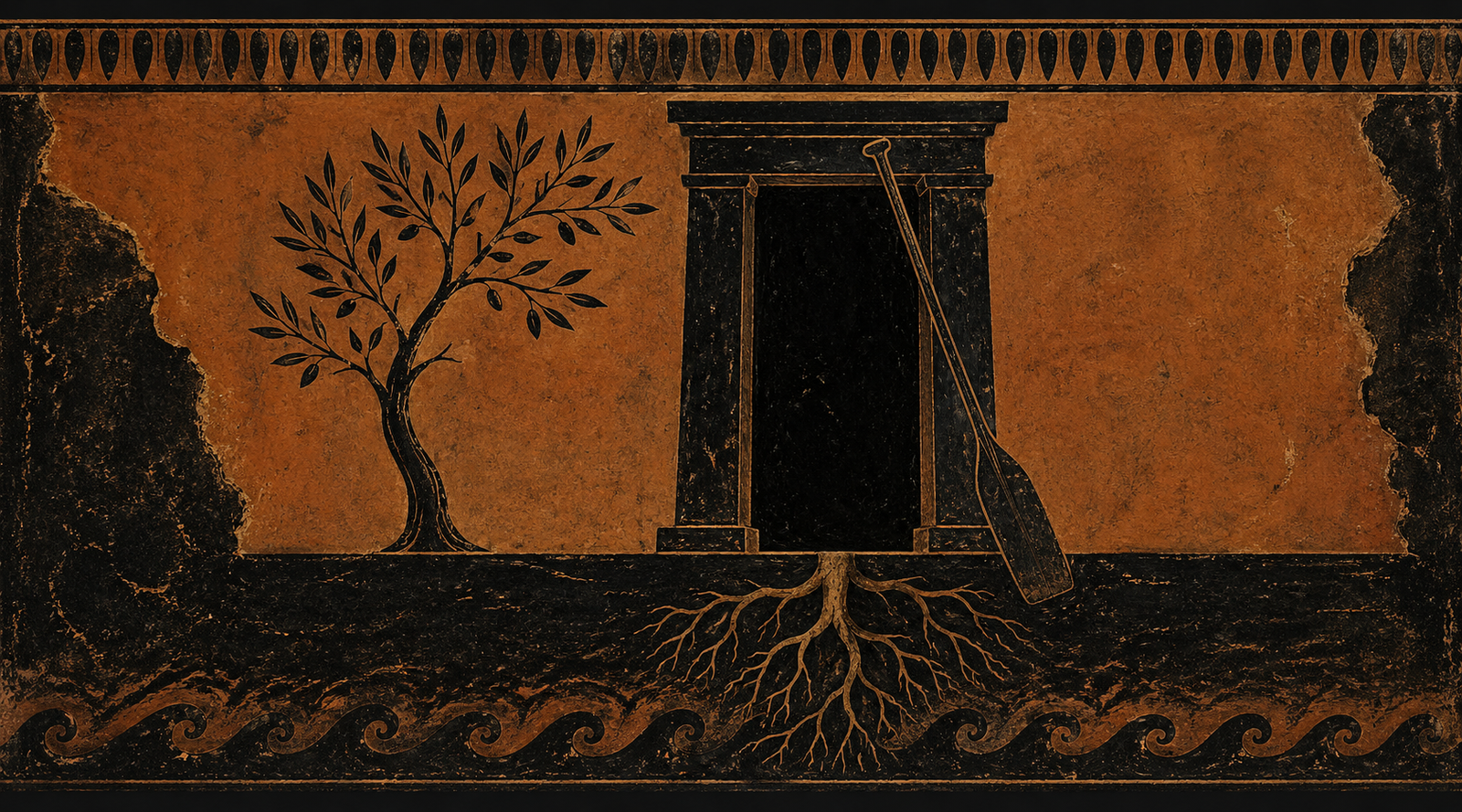

No Man Comes Home VII — The Dead Know the Way Home
Odysseus descends seeking the road home and returns carrying the dead.
The dead did not come because he called.
That should be understood.
No living man summons the dead as one summons servants, sailors, witnesses, men owing favour, women under household law. The dead are not commanded. They are approached through cost. Blood opens the border, but it does not make the living sovereign there.
Odysseus went to them because the road home had become too dark for the living.
That was the shame of it.
A man may cross seas, deceive monsters, refuse goddesses, command men, survive storms, and still reach a point where the next instruction must come from those who can no longer act. The living know how to desire. The dead know what desire becomes when it has spent the body.
Circe had sent him there.
That, too, mattered.
The enchantress who had once turned men into the shapes of appetite became, after delay and bed and difficult release, the one who gave him the road beneath all roads. She did not merely tell him to sail. She told him how far downward the desire for home must go. To reach Ithaca, he must first go where no homecoming is possible.
So the ships went to the edge.
Not an island in the ordinary sense. Not harbour, not market, not palace, not field. A margin of the world where light weakens before it has finished its work. The air thinned. The sea changed its voice. Even the men felt it, though they did not all have words for what their bodies knew. There are places where courage becomes quiet because noise would offend the threshold.
They landed.
Odysseus dug the pit.
A king digging for the dead is no less a king. He is only less protected from the truth of his need. The earth opened under his hands. He poured milk and honey, sweet wine, water, barley meal, the gifts owed to those who no longer eat as the living eat. Then came the animals, the knife, the blood.
The blood darkened the hollow.
That was the door.
The dead gathered.
Not as men gather in assembly. Not with footsteps, not with clear rank, not with the old shape of public life. They came as thirst, as memory without weight, as names loosened from breath. Young brides. Old men. Warriors. Girls who had not finished growing into their lives. Men who had once shouted orders and now made no sound until the blood gave them nearness.
The companions were afraid.
Odysseus was afraid too.
The difference was that he had to stand where fear could see him.
He drew his sword.
Steel is a poor defence against the dead. Yet the hand wants something it understands. He held them back from the blood because even among the powerless there are orders to keep. Tiresias must drink first. Prophecy must precede grief. Knowledge before longing. That was the instruction.
Then Elpenor came.
Not the prophet.
Not a king.
Not a hero.
A young man badly lost.
He had fallen from Circe’s roof in the confusion after sleep and wine and had gone unburied. His death had been almost too small for epic attention. No battlefield, no monster, no god’s visible anger, no famous wound. Only a body mishandled by forgetfulness, a companion absent from the count until absence itself found a voice.
This was the first accusation.
Odysseus had come seeking the future, and the dead gave him first what he had failed to honour in the recent past.
Elpenor asked for burial.
Not glory.
Burial.
The modest right by which a human life is not left as refuse after the spirit has gone where it must go.
Odysseus listened.
Here command had no splendour. A captain may lose men in storm or battle and still clothe the loss in necessity. But this was not necessity. This was neglect. A man had died near the house where they had rested, and the living had sailed without him.
The dead remember what the living call accident.
Odysseus promised.
It was a small promise.
Therefore binding.
The shades pressed close. He held them back. Tiresias came.
The prophet’s blindness had not ended with death. Or rather, death had made sight no longer dependent on eyes. He drank and spoke. No warmth. No consolation. No welcome for the man who had travelled so far to hear what the living could not tell him.
Poseidon’s anger.
The cattle of the Sun.
The ruin of companions if hunger overthrew restraint.
The late return.
Another man’s ship.
A house full of men consuming his goods.
Violence.
The wife.
Then the oar.
Always after home, another road.
Tiresias did not speak like one offering sequence alone. He spoke as one laying weight upon weight until return no longer resembled arrival, but burden continued under another name. Odysseus had asked for the way home. He received the knowledge that home would not end what had made the journey necessary.
That is the cruelty of true prophecy.
It grants direction and removes simplicity.
Odysseus heard.
He did not yet know how each word would become flesh. Men rarely do. They receive the future as sound, then spend their lives being interpreted by it.
Tiresias withdrew.
The dead remained.
Then came his mother.
No prophecy had prepared him for that.
Anticleia stood among the shades, and the world narrowed more severely than it had in storm or cave. A mother is the first country of the body. Before house, before kingdom, before wife, before son, before name carried into war, there is the woman whose body made one’s body possible. To meet her among the dead is to learn that the road home has already failed in one place forever.
Odysseus had not known she was dead.
That ignorance became grief instantly.
He tried to speak as men speak when shock has not yet arranged itself into lament. What brought you here? What death took you? What of my father? What of my son? What of my wife? Does she remain? Does another man hold what is mine? Does my name still stand in the house?
Even here, even before his mother, the questions turned homeward.
This should not be condemned too quickly.
A man trained by danger asks first what danger has taught him to ask. House. Son. Wife. Father. Power. Continuity. He had come so far that even grief had to pass through the doorway of return.
Anticleia answered.
Penelope remained.
Telemachus held the estate, though under sorrow and pressure.
Laertes lived apart, worn by age and grief, lying sometimes in the ashes of his sorrow, carrying his son’s absence as if it had entered the bones.
And she herself had died not by spear, not illness alone, not the clean violence songs can hold at a distance.
She had died of longing.
Not in the pretty way poets sometimes give the word. Longing had thinned the world around her. The absence of the son had entered the daily body until life no longer had enough argument to keep her. She had died because Odysseus had not returned.
That was the knowledge.
No monster had done this.
No enemy.
No storm.
Absence had hands.
Odysseus reached for her.
Three times.
Three times she passed from his arms like shadow, like smoke, like water too dark to hold.
The gesture was older than speech: the son trying to gather the mother back into the body’s law. It failed because death has no body to return to embrace. The living hand, so useful with sword, oar, cup, rope, spear, bedpost, cannot grasp what has crossed fully into memory.
He asked why.
She told him.
This is what the dead are. Not flesh, not bone, not tendons holding shape under skin, but spirit flown like a dream after the body has burned. Go home, she told him. Tell your wife what you have seen. Remember.
Remember.
The word had followed him from the island of Calypso.
There, an immortal had asked to be kept inside a mortal burden. Here, the mother required what only the living can carry back upward: the knowledge of the dead, the report, the honour of transmission. Memory was not ornament. It was duty.
Odysseus could not hold her.
He could only carry her.
That was harder.
The women came then.
Old heroines. Mothers of lines. Beloved of gods. Damaged by gods. Women through whom houses, monsters, dynasties, disasters, and strange births had entered the world. The living often remember such women by the sons they bore, the men who desired them, the curses that followed them, the wars their bodies were made to begin.
Among the dead, they stood before all that.
Not free of history.
No dead are free of what the living keep saying.
But nearer themselves than stories usually permit. The uses made of their bodies had not ceased speaking through the world above, yet here, before the blood, they stood with the grave priority of those who had once been lives before they became origins.
Odysseus saw them.
He told the Phaeacians enough.
Not all.
No man tells all he sees among the dead. Some things resist the public hall. Some things become smaller when arranged for listeners. Some things must pass through silence if they are to remain true.
The Phaeacians urged him on.
They were safe enough to want more.
That is not a moral failure. It is the condition of listeners. A tale told well creates appetite even when its matter is sorrow. They wanted the heroes. The great names. The dead men whose fame had already prepared places for them in the hearing mind.
Odysseus continued.
Agamemnon came.
The murdered king of men, once commander before Troy, now a shade shaped around betrayal. He spoke of homecoming as slaughter, of a wife’s treachery, of welcome made lethal inside the house. His story entered Odysseus like warning sharpened by another man’s blood.
Do not be too open.
Do not trust the threshold because it bears your name.
Do not think a wife is proved by waiting, nor a house by longing.
Agamemnon’s grief was not wisdom entire.
The dead, too, speak from their wounds.
But Odysseus listened because a man returning home must hear even the poisoned version of return. Clytemnestra was not Penelope. Ithaca was not Mycenae. Yet analogy is dangerous because it does not need to be exact to trouble the body.
The house became, for a moment, a place of possible knives.
Then Achilles came.
Here was the great one.
The beautiful ruin of Greek glory. The man whose rage had shaped Troy’s final years, whose choice had made short life blaze over long obscurity, whose name would not die because he had allowed the body to do so early. Among the living, Achilles had been almost more than man. Among the dead, he knew the correction.
Odysseus praised him.
How could he not? Honour among the dead. Fame above all others. Rule among shades. The consolation poets give when bodies are gone.
Achilles rejected it.
He would rather labour as the poorest servant to a poor living man than rule all the breathless dead.
There are sentences that destroy whole systems of praise.
This was one.
The underworld did not make glory false. It made glory insufficient. Fame survived. Achilles did not deny that. But fame could not warm the body, could not put bread in the mouth, could not restore the sun as sun, could not make the hand lift a cup. The living had invented honour to answer death. The dead knew how little of death honour answered.
Odysseus heard, and perhaps some part of him understood why Calypso’s gift had been terrible in another direction.
Mortality gives life its weight.
Death removes the weight and leaves fame floating uselessly above what cannot feel it.
Then Achilles asked of his son.
That was the turn.
The great warrior, who had just dismissed fame among the dead, wanted news of the living boy who carried his line. Neoptolemus. Had he been brave? Had he stood among men? Had he honoured the father’s name?
Odysseus answered with praise.
He gave the dead father what news could give.
Achilles moved away rejoicing.
Not because fame had saved him.
Because the son still lived inside action.
Even in the underworld, fatherhood reached towards the living.
Odysseus watched him go.
Perhaps he thought of Telemachus.
Perhaps he avoided doing so.
The dead do not require that every thought be spoken.
Ajax stood apart.
Still angry.
Still wounded in honour beyond death.
Odysseus spoke to him. He regretted. He offered words around the old contest for Achilles’ armour, around pride and judgement and the ruin that followed. Ajax did not answer. He turned away and went back among the other shades.
Silence can be the final form of refusal.
Not every wound is healed by the speaker’s readiness to be forgiven.
This, too, Odysseus had to learn, or should have learned.
The underworld gave him no single lesson. It gave him a field of unfinished reckonings. The unburied companion. The dead mother. The deceived king. The glory-stripped warrior. The father seeking news of a son. The offended comrade who would not be reconciled. Each shade carried a different correction to the living man’s assumptions.
Return would not restore all things.
Speech would not mend all things.
Memory would not hold all things.
Fame would not warm the dead.
Cunning would not open every closed mouth.
Then came the punishments.
He saw figures bent under laws that had become eternal: desire reaching and failing, labour repeated without arrival, hunger made endless, pride fixed into torment. Such sights are dangerous to describe too richly. The living enjoy imagining punishment when they believe themselves outside it. Better to say only this: the underworld was not merely a place where the dead remained. It was a place where certain acts continued after the actors had lost the mercy of time.
That was enough.
Then fear rose in him.
Not ordinary fear. A fear larger than courage because courage requires a world in which action is possible. The dead pressed near. The great names had been seen. The knowledge had been received. The mother had passed from his arms three times. The old wounds had refused closure. He had enough. Perhaps more than enough.
He went back.
This return from the dead was not triumph.
No one returns from the underworld victorious. At most, one returns carrying what must now be suffered among the living.
The ship waited.
The men waited.
The upper air waited, though air does not know what it gives until the lungs are nearly deprived of it. Odysseus came back to the shore where the world still had weight. Wood under hand. Rope. Hull. Voices. Salt. The exhausted comfort of things that could be touched.
He had gone below to find the road home.
He came back knowing that home contained the dead.
His mother would not be there.
Elpenor must be burned.
Agamemnon had made the threshold dangerous.
Achilles had made fame smaller.
Ajax had made forgiveness uncertain.
Tiresias had made return unfinished.
The dead had not answered one question. They had multiplied the cost of asking.
The men saw him return and perhaps believed knowledge had been gained.
They were right.
They could not know what kind.
This is the loneliness of the one who has crossed downward and come back. He shares the route; he cannot share the weight. Even when he speaks, the knowledge remains partly under his tongue, darkened by the place from which it came.
He led them back to Circe’s island.
Elpenor was buried.
The small promise had to be kept before any great journey could honour itself. They burned the body, raised the mound, planted the oar on the grave.
An oar again.
Not the inland oar of final appeasement, not the future burden through dust and misrecognition, but an oar placed for a dead sailor, marking the man by the labour that had carried him. Even in burial, the instrument knew where it belonged.
The dead ask for little and everything.
A mound.
A marker.
A name not left behind in confusion.
After that, Circe fed them once more and told what waited ahead: the Sirens, Scylla, Charybdis, the cattle of the Sun. Knowledge continued. Warning continued. The road home narrowed into choices no good man would choose unless all other choices had already been taken.
Odysseus listened.
Again.
This was becoming one of his burdens: to receive knowledge others could not bear in full, then decide how much of it to carry alone.
The dead had taught him the way home.
Not because they loved him.
Because the dead know the shape of all roads once the living have stopped pretending arrival is simple.
When the ship left Circe’s island again, Elpenor’s grave remained behind it, with the oar standing over the mound. The sea took the vessel. The men returned to their benches. The rhythm began. Wood entered water. Bodies obeyed. The living moved away from the newly honoured dead.
Odysseus looked ahead.
The next dangers were waiting in song and rock and hunger.
Behind him, the dead kept what they had always kept: the portion of every journey that cannot be brought home except as silence.
His mother was there now.
That changed Ithaca.
It was no longer only the place where wife, son, father, dog, bed, servants, and enemies waited.
It was the place where one absence would answer another.
He would return to the house and find it full.
He would also return to find it emptier than longing had allowed him to imagine.
That is what the dead know before the living.
The way home.
And what home has already lost.
—
No Man Comes Home is a twelve-canto literary retelling of The Odyssey within The House of Cadmus: a poem of return, concealment, recognition, and the cost of surviving long enough to come home.
—
Receive the next work
Subscribe free to receive new work from the House of Cadmus Library by email.
More from the Library


See Also
A concise and impartial dictionary of absence, promises, quarrels, ordinary objects, and the troublesome instability of words.

The City of Service
The temple we inherit is a building from which almost all necessity has been removed. Nothing must be brought for it to continue being what we call a temple. The sanctuary asks nothing of us. Stone is good at this kind of independence.
A living temple was otherwise.
Water had to come in. So did grain, cloth, oil, aromatic substances, fuel. The things required for worship arrived because someone carried them across a threshold.

Houses of Wood, Light, and Smoke
Some of Angkor’s most intimate ruins do not rise above the ground at all. They are postholes, low mounds, hearths and ponds: durable traces of a domestic city built largely from things that decay. To restore that city is to see Angkor not only as stone, but as wood, smoke, water, repair, and people living within calling distance.