
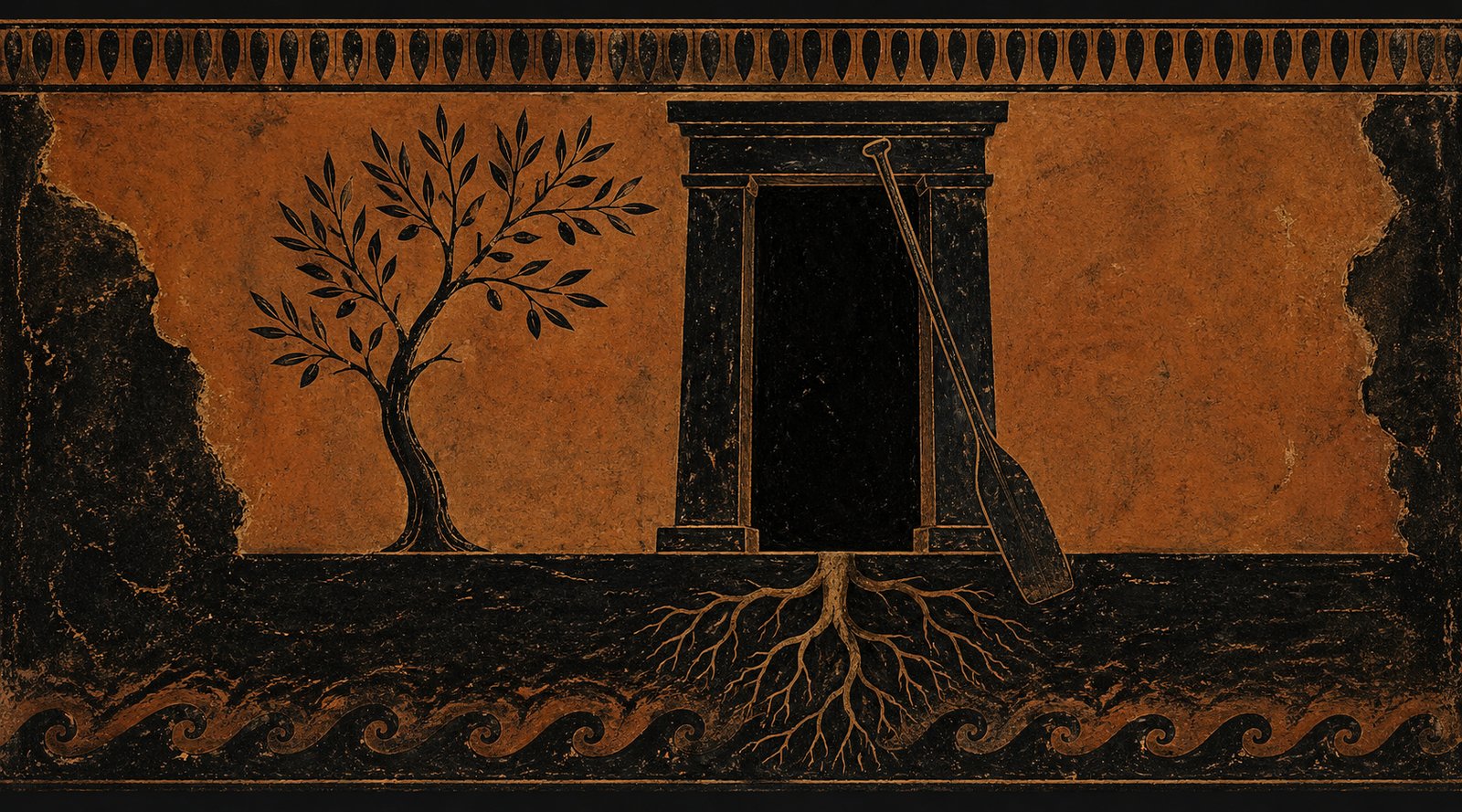

No Man Comes Home I — The House Without the Man
Before Odysseus returns, the house has already become a battlefield.
Troy ended.
Odysseus did not.
That was the wound.
The city had burned behind him, and the ships had taken the victors westward with their bronze, their captives, their songs, their dead unburied in memory. Other men carried spoils. Odysseus carried continuation. He had survived the end of one world and therefore could not simply enter another. The sea received him as it receives all men who think victory has granted them passage: without admiration.
In Ithaca, his house remained.
That was the second wound.
A house can outlive the man who gives it shape. It can keep his chair, his bed, his thresholds, his old authority hanging in the air like smoke after a lamp has gone out. It can preserve him so faithfully that his absence becomes a form of rule. Men crossed Odysseus’s floor every day and felt him there only as obstruction: the missing king, the rumoured corpse, the inconvenient name by which a woman refused to be taken.
They ate under his beams.
They drank from his cups.
They courted his wife with their mouths full.
No army had come against Ithaca. No walls had been breached, no towers fired, no gates dragged open by horses and gods. Yet the house was occupied. Not by enemies from another shore, but by young men born close enough to know better. They did not arrive as conquerors. They arrived as guests.
This made the violation worse.
Hospitality is the first law because it is the most easily corrupted.
A stranger at the door may be a god, a beggar, a murderer, a king, a son returned too late, a father returned unrecognised. The house does not know. Therefore the house must honour before it judges. A seat. Water. Bread. Wine. The name can wait. The story can wait. The human need comes first.
But appetite knows how to wear the mask of welcome.
The suitors had learned this. They did not seize the house in one bright act of violence. They consumed it by repetition. A meal became a habit. A habit became a claim. A claim became a right spoken loudly enough to shame resistance. They entered as guests and remained as weather. Their laughter altered the rooms. Their sandals taught the floors a new obedience.
Each day the cattle diminished.
Each night the jars grew lighter.
The servants moved differently now, not because any single command had changed the house, but because power had changed its temperature. A young man’s cup held out too long became an order. A jest about the absent king became permission. A glance towards the women’s quarters became weather coming under the door.
Nothing had been declared.
That was how the house was taken.
It is possible to ruin a thing without naming the act. This, too, the suitors understood. They did not call themselves invaders. They did not call their hunger theft. They did not call their waiting violence. They sat where guests should sit and stretched the sacred law until it served the men who broke it.
They wanted Penelope to choose.
They did not understand that choosing, too soon, would be another form of surrender.
Penelope listened.
Listening was one of the forms her rule had taken.
There are women whose grief is imagined by men as stillness because men do not see the labour inside restraint. Penelope’s waiting was not emptiness. It was governance under siege. Each day she preserved the house by not yielding it. Each night she measured what could be undone before morning. She learned the politics of delay, the cruelty of hope, the uses of silence, the danger of appearing too faithful before men who had grown tired of her fidelity.
She did not wait like a lamp.
She waited like a locked door.
The men thought they were wearing her down because they mistook refusal for a finite material. They had known gates, girls, animals, servants, debts, fathers eager for alliance, mothers eager for security. They had known the give of things. They had not known a woman whose grief had become architecture.
So they laughed.
Penelope heard them from the upper rooms. She knew their voices by weight and appetite. She knew which men drank before speaking, which men spoke before thinking, which men pretended courtesy because they had not yet been refused in public. She knew which fathers would deny responsibility if blood came. She knew which servants bent too quickly. She knew how much oil remained, how much grain, how many animals had been driven in, how many had gone out as meat for men who called themselves suitors because the older word would have condemned them.
She did not need prophecy to know ruin.
She had been living inside its measurements.
At night, she worked.
The cloth lay across the loom like a country that had not yet decided its borders. By lamplight she passed the shuttle through the threads and made delay visible. A shroud for Laertes, she said. The old man must not go unhonoured. No decent house would force a widow to choose while a father-in-law waited for burial cloth.
The suitors accepted this because honour, when useful, is welcome even to men without reverence.
So she wove.
By day, before the eyes of the house, she gave shape to obedience. By night, when the lamps had burned low and the footsteps had thinned, she undid what she had made. Thread returned through her fingers. Pattern loosened. Time reversed by inches.
This was not deceit as men used deceit.
This was the defence of a threshold.
Every night she took back one day of her life.
Telemachus grew within the sound of that loom.
He knew his father first as lack: a chair no one should sit in, a name men used to mock him, a story old servants lowered their voices to tell. He had inherited not a kingdom but an interruption. He was old enough to feel shame and too young to know whether shame was a command or a poison. Men older than he was ate his cattle, drank his wine, spoke across him, and watched to see when the boy would become either dangerous or broken.
He had his father’s house.
He did not yet have his father’s force.
No one teaches a son how to rule absence. There are instructions for sacrifice, sailing, harvest, supplication, the binding of animals, the greeting of strangers, the pouring of wine. There are stories of kings and monsters, of gods in disguise, of men who win cities by patience and fire. But there is no rite for standing in the place of a man who is both dead and not dead, both sovereign and rumour, both father and wound.
Telemachus stood where his father’s voice should have stood, and the room did not turn.
That was the daily education.
The suitors understood his weakness before he understood it himself. They had the crude genius of appetite: they knew what could be pressed. A young man may be made ashamed of his youth before he can use it. He may be forced to see his own hands as insufficient. He may be made to feel that every delay in manhood is a public failure, even when the delay was made by others.
They called him boy without always using the word.
That was worse.
He learned the violence of being tolerated in his own inheritance. He learned how men can sit at another man’s table and make the rightful heir seem like an interruption. He learned that mockery does not need to strike the body to leave it disciplined. He learned the strange helplessness of knowing the law and lacking the power to make the room obey it.
Sometimes he looked at the door.
Not because he expected it to open.
Because expectation is one of the last forms of childhood to die.
The servants saw this and lowered their eyes. Some pitied him. Some grew tired of pity. Some attached themselves to the new weather because weather, even corrupt weather, is still what one must live beneath. A household does not break all at once. It divides silently. Loyalty becomes posture before it becomes action. Fear becomes prudence. Prudence becomes habit. Habit becomes explanation.
Outside, the island continued.
Goats moved over the hard slopes. Boats cut the water. Men bargained, mended, buried, fathered, harvested, lied, prayed, and slept. Ithaca did not stop because one house was wrong. No land grants that mercy. The olive trees stood in their old patience. The sea kept breaking and withdrawing as if return were easy, as if every wave knew how to arrive and leave without consequence.
The people spoke of Odysseus.
Less often now.
At first, after Troy, his name had travelled like a lit coal. Men wanted news. Had he taken the city? Had he counselled the kings? Had he angered gods? Had he filled his ships? Was he close? Was he delayed? Was he dead? Each rumour arrived wearing salt. Each rumour left the house larger and emptier than before.
Then the years gathered.
Rumour rots when it is fed too long.
A man missing for one year is awaited.
A man missing for five is invoked.
A man missing for ten becomes argument.
A man missing for twenty becomes a place where others put their hunger.
By then, Odysseus had become most useful to those who wanted him gone.
If he was dead, Penelope must choose.
If he lived, where was he?
The question itself became a knife laid carefully on the table.
Penelope did not answer it. Telemachus could not. The servants dared not. The suitors sharpened it daily without appearing to touch it.
This is where the poem begins: not with the hero, but with the damage made by his absence.
That is its first severity.
The old songs knew that a man does not belong only to himself. If he leaves, he leaves a shape behind him. Wife, son, servants, land, bed, name, dog, oar, scar, roof-beam, rumour — all must carry the vacancy. War does not end where the war ends. It travels home ahead of the warrior and takes up residence.
In Ithaca, war had become domestic.
It sat at table.
It asked for more wine.
Far away, beyond the reach of the house and yet inside every room of it, Odysseus longed for home.
This was true, and not enough.
Longing does not cleanse a man of what saved him.
The house did not know what the sea had done to him. It did not know what clung to his hands, what habits had entered his mouth, what silences had become useful, what losses had taught him to continue. It did not know whether the man it wanted could still walk through a door without measuring it first.
Perhaps no house ever knows what it has summoned by wanting the lost one back.
Perhaps return is always a form of danger.
But Ithaca wanted.
Penelope wanted, though she had disciplined want until it no longer exposed itself. Telemachus wanted, though want had humiliated him so often that he had begun to distrust it. The old servants wanted in the manner of old servants, through memory, habit, and the preservation of small things. The dog wanted in the last language left to dogs. The bed wanted nothing. It stood rooted in its secret, waiting for truth to find it useful.
The suitors wanted too.
That was the disorder.
They wanted the woman, the house, the meat, the wine, the name, the ease of becoming lords without earning lordship. They wanted the end of waiting without the burden of reverence. They wanted the door opened from inside by the very woman whose refusal kept them from being thieves.
They did not understand the house they had entered.
A house is not possessed by appetite. It remembers.
It remembers hands on lintels, oil poured before journeys, women crossing floors with infants, old men seated in winter light, the first cry after birth, the washed body before burial, the footfall of the master, the weight of marriage, the words spoken once and never repeated because secrecy itself became a beam in the walls. It remembers injury also. Every insult leaves some grain of itself behind. Every unlawful meal makes the table less innocent. Every laugh at the absent man teaches the roof what must fall.
The suitors believed they were waiting for Penelope.
The house was waiting for someone else.
Above them, the goddess had seen enough.
Athena does not enter a story to make it gentle. Wisdom is not gentleness. It is clarity joined to action. She had watched the man delayed, the son diminished, the wife besieged, the sacred law twisted into cover for consumption. She had seen the gods debate what mortals call fate when they want to forget how much harm is made by choice.
She came first not to Odysseus, but to the son.
That, too, was law.
The absent man could not yet be restored. The diminished one could be set in motion.
So a stranger stood at the door.
The house should have known what this meant. Every violated law returns first as a test.
Telemachus saw the stranger before the suitors did, because shame had made him watchful. Those who are dishonoured in their own rooms learn the entrances. He crossed the floor quickly, angry that any guest should stand waiting while men with full cups forgot the first duty of a house.
In that movement, something of the father appeared.
Not enough.
Enough.
He took the stranger’s hand. He led the guest in. He gave the seat, the welcome, the food owed before questions. Around them the suitors continued their noise, bright and blind, not knowing that judgement had entered under the shape of courtesy.
The goddess watched him.
She did not give him manhood. Gods do not give what must be suffered into form. She gave him direction. She placed a command where shame had been. Speak. Call the men to assembly. Name the wrong. Seek news of the father. Go out from the house that has made your weakness visible. Learn the size of the name you carry.
Telemachus listened.
Instruction entered him like weather changing.
Not comfort. Not rescue. Not certainty. Something harder. A line drawn inside the body. He had thought, until then, that courage would feel like power arriving. Instead it felt like the removal of an excuse.
When the stranger left, the room remained the room.
The suitors still ate.
Penelope still listened above.
The servants still moved under divided loyalties.
Nothing had changed in the visible house, and yet the first stone had shifted under it.
That is how return begins before the returning man appears.
Not with sails.
Not with footsteps.
With the son standing a little differently among the men who have mistaken delay for victory.
That night the house breathed around its injuries.
The suitors slept heavily, as men sleep when they have never imagined consequence entering quietly. The servants banked the fires. The jars stood in their places, less full than they had been. The loom waited. Somewhere in the dark, Penelope prepared to undo the day’s obedience.
Telemachus did not sleep quickly.
A command is also a form of waking.
He lay in the house of his father and felt the shape of the journey before knowing its roads. Pylos, Sparta, the old men of the war, the stories kept in other houses, the terrible possibility of news. He would go looking for the absent man and find, perhaps, only the scale of what had been missing.
Below him, the floor held the footmarks of the suitors.
Above him, the roof held.
Beyond the island, the sea moved in its black labour.
Somewhere on that sea, or beyond it, or under the punishment of a god, or in the arms of a goddess who could not become home, Odysseus was still not arriving.
The house waited.
It had waited so long that waiting had become one of its rooms.
No man comes home.
Not truly.
The sea returns a body.
The house asks for a man.
Between them stands the door.
—
No Man Comes Home is a twelve-canto literary retelling of The Odyssey within The House of Cadmus: a poem of return, concealment, recognition, and the cost of surviving long enough to come home.
—
Receive the next work
Subscribe free to receive new work from the House of Cadmus Library by email.
More from the Library


See Also
A concise and impartial dictionary of absence, promises, quarrels, ordinary objects, and the troublesome instability of words.

The City of Service
The temple we inherit is a building from which almost all necessity has been removed. Nothing must be brought for it to continue being what we call a temple. The sanctuary asks nothing of us. Stone is good at this kind of independence.
A living temple was otherwise.
Water had to come in. So did grain, cloth, oil, aromatic substances, fuel. The things required for worship arrived because someone carried them across a threshold.

Houses of Wood, Light, and Smoke
Some of Angkor’s most intimate ruins do not rise above the ground at all. They are postholes, low mounds, hearths and ponds: durable traces of a domestic city built largely from things that decay. To restore that city is to see Angkor not only as stone, but as wood, smoke, water, repair, and people living within calling distance.