
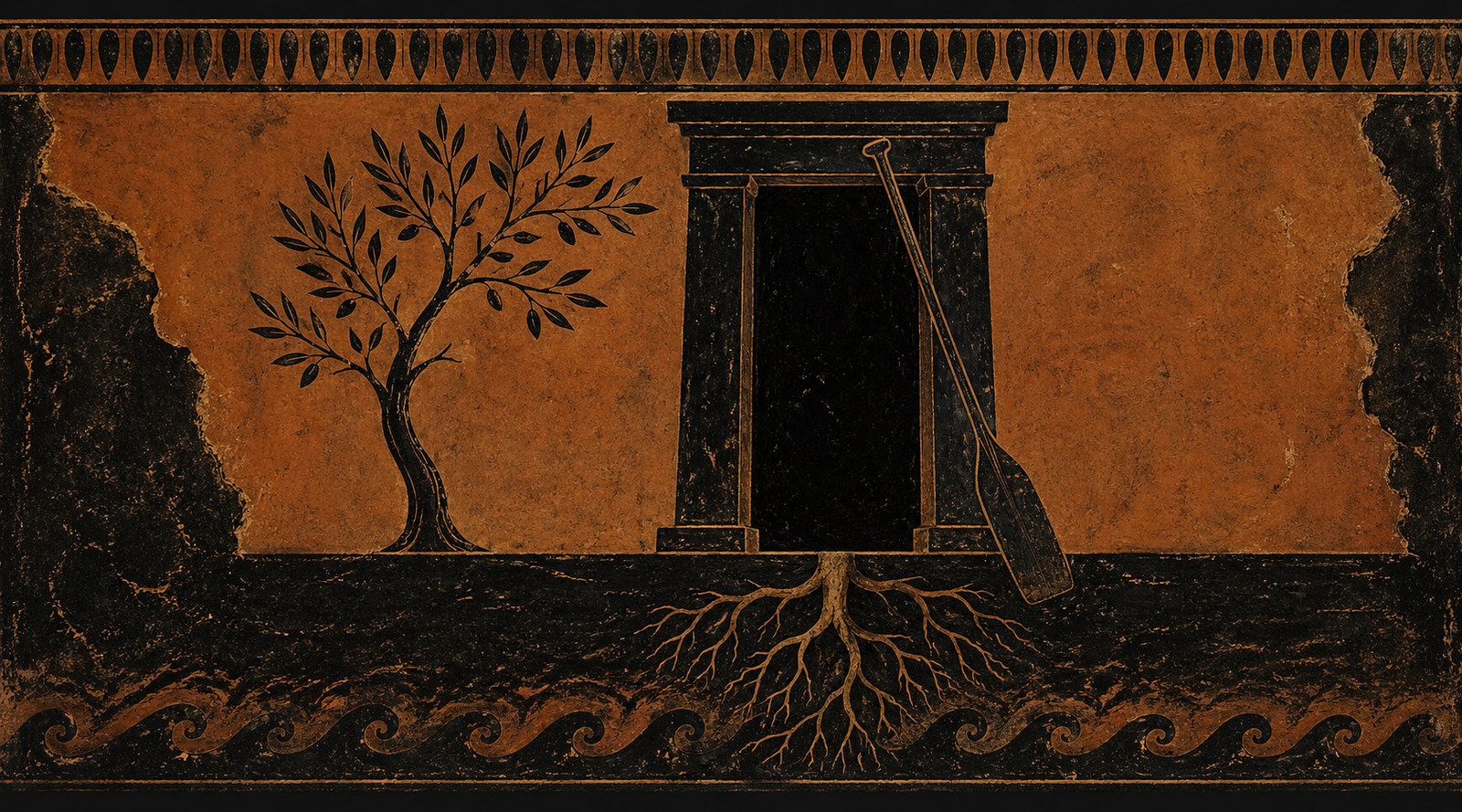

No Man Comes Home II — The Son Sent Out
Telemachus leaves Ithaca seeking news of his father and discovers the public size of a private absence.
Morning entered the house without asking permission.
It touched the cups, the benches, the threshold, the ash in the hearth, the unfinished cloth, the places where men had slept too heavily and risen without shame. Light is not mercy. It reveals without correcting. It showed the house to itself and did not cleanse it.
Telemachus rose before the suitors.
That was new.
Not because he had never woken early, but because something in him had begun before the day did. The stranger’s words had not comforted him. Comfort settles the body. This had unsettled it. He had slept as men sleep before departure: shallowly, already listening for the hour that will require them.
The house seemed unchanged.
That was how change began.
The servants moved in their accustomed caution. Women carried water. Men opened doors. The smell of last night’s wine had not yet left the hall. Somewhere an animal called from the yard, ignorant of inheritance. The world remained full of small obedience.
Telemachus washed.
He dressed.
He took the spear.
A boy can carry a spear for years before the spear believes him.
This morning, it did not yet believe him. But it did not refuse him either. It stood in his hand with the cold patience of things made for use. Bronze does not flatter. Wood does not pity. If a man lacks force, the weapon tells him by its silence.
He went out.
Behind him, the house held its breath badly.
The assembly had not been called for many years. Men had grown older under silence. Fathers had become grandfathers. Boys who had heard of Odysseus as fire had become men who spoke of him as inconvenience. Ships had come and gone. Harvests had failed and recovered. Children had learned the names of the suitors before they had learned the king’s voice.
A people can become accustomed to the absence of law if disorder arrives slowly enough.
They gathered because the summons was strange.
Old men came first, because memory makes them obedient to forms younger men mistake for emptiness. Then the curious came. Then the cautious. Then those who wanted to see whether the son would shame himself in public. Last came the suitors, not hurried, not troubled, wearing leisure like a second cloak. They knew how to enter a serious place without granting it seriousness.
Telemachus stood before them.
The open air made him smaller.
In the hall, his humiliation had walls. Here it had sky. The men of Ithaca sat beneath the morning, and every face became another measure of what he lacked. He felt the spear in his hand. He felt his father’s name around him, larger than his body, heavier than armour, impossible to wear and impossible to put down.
Then he spoke.
The first words did not make him a man.
That is not how speech works.
Speech reveals the distance between what must be said and the one who says it. He felt that distance as soon as his voice entered the assembly. It went out from him and could not be recalled. It belonged now to the men who heard it, to their judgement, their laughter, their silence, their pity, their contempt. A spoken wrong becomes dangerous because it asks the world to admit that it has seen.
He named the injury.
Not fully. No first accusation is ever full. Shame edits before courage can finish. But he named enough. The house. The feasting. The cattle. The wine. The men who came as suitors and remained as ruin. The mother pressed to choose before truth had returned or death had been proved. The father gone, perhaps dead, perhaps wandering, perhaps under the anger of gods, while others consumed the life he had left behind.
The words struck some men as words.
That was their failure.
A few lowered their eyes.
That was not enough.
The suitors listened with the bright contempt of men who have learned that public blame is survivable when private appetite has many allies. They knew the island. They knew fathers. They knew who had sons in the hall and who owed favour and who would rather injustice remain domestic than require a public answer.
One of them rose.
Not the worst, perhaps. The worst men are not always first to speak. But he had the gift of making greed sound like impatience. He answered not by denying the hunger, but by naming Penelope’s delay as the wound. A woman’s cunning, he said. A shroud woven by day and undone by night. Years lost to thread. Men held in suspension by the widow who would not become a widow, the wife who would not release the house, the queen who kept all Ithaca waiting because she could not bear to choose.
The assembly shifted.
There are accusations that succeed because they offer weakness a place to rest.
If Penelope was the problem, then the island need not judge its sons. If a woman’s delay had caused disorder, then men’s appetite could be called endurance. If the loom had deceived them, then the theft of cattle became almost a grievance.
Telemachus heard the trap close.
So this was public speech: not truth against falsehood, but force against force, story against story, shame moved from one body to another until someone too weak to resist was made responsible for the ruin.
His mother’s intelligence had protected the house. Now it was being offered to the crowd as proof of her guilt.
He learned then that law spoken aloud does not become law. It must be held by men willing to be inconvenienced by it.
The men of Ithaca did not rise.
The sky remained blue.
The old order did not come back because a son had named its absence.
Then two eagles appeared.
They came from the height where signs are still signs before men begin to bargain with them. They crossed the assembly in violent nearness, wheeled, struck at one another, tore the air with wings and anger, then rose again, leaving the men below to decide whether heaven had spoken or only birds had quarrelled above them.
The prophet understood.
That did not mean he would be believed.
Age gave him the right to say what younger men feared hearing. He warned them. The absent king would return. The suitors were not merely eating a man’s goods; they were storing judgement in their own bodies. The house they violated had not forgotten its master. The gods had not confused delay with pardon.
The suitors laughed.
Not because they were certain.
Because laughter can be used to keep certainty from entering the room.
They mocked the old man, mocked signs, mocked age, mocked the ease with which prophets make weather useful. Men who intend to continue do not welcome omens. They prefer explanations. Explanations can be argued with. Signs can only be obeyed or refused.
They refused.
Telemachus stood among them and felt something colder than disappointment.
He had thought the assembly might reveal the strength of his cause. Instead it revealed the loneliness of right without power.
The suitors would not leave.
The people would not compel them.
The island would watch.
That was knowledge.
It hurt differently from shame. Shame bends inward. Knowledge stands upright and does not offer comfort. He saw now that his house would not be rescued by the mere fact of being wronged. Wrong can become ordinary if enough men profit from not naming it.
So he asked for a ship.
That request changed the air more than the accusation had.
A housebound son may be mocked. A travelling son becomes uncertain. Movement has danger in it. Those who rule a damaged room prefer the injured to remain where injury can be measured. If Telemachus stayed, he was a boy speaking too loudly. If he sailed, he became a question no one controlled.
The suitors heard it.
So did Athena.
The goddess had already placed departure inside him; now she gave it shape outside him. Gods often work by making the necessary thing appear possible. A ship. Companions. Provisions. Night movement. A departure half-hidden from the men who had made his house a public wound.
But first he returned home.
This was its own cruelty.
To leave the house, he had to enter it again. The suitors were there, as he knew they would be, beautiful in their waste. They laughed with meat in their hands. They spoke of songs and marriage, of whose turn it might soon be to claim what had not been granted. The hall had the obscenity of continuity.
Telemachus crossed it differently now.
Not bravely. Bravery is too clean a word for the body learning necessity. He crossed it as one who has discovered that fear need not be obeyed first.
Some of the suitors saw the change and hated it.
It was small.
Small changes in the humiliated are often the first things power notices.
He spoke to them with more force than he possessed the day before. That is how force begins: by borrowing from the shape it must grow into. He told them to leave. He told them the feasting must end. He told them he would seek news of his father. If Odysseus lived, let them reckon with that. If Odysseus was dead, then he would bury his name properly, give his mother to marriage, and stand where a son must stand.
It was a reasonable speech.
Reason does not defeat men who have chosen appetite.
They answered him as men answer the first resistance of those they have long dismissed: with mockery sharpened by unease. Where had he learned this boldness? Which god had instructed him? Was he now king? Did he imagine the sceptre had come to his hand because he had found a voice?
A man can be mocked most cruelly at the edge of becoming.
Telemachus did not win the room.
That was not the purpose.
The purpose was to become impossible to forget.
Above, Penelope heard.
Mothers know the footfall of change before men name it. She came down into the hall, not as a queen entering judgement, but as a woman whose private wound had been made public too many times. She heard song where grief should have been honoured. She heard the singer drawing Troy into the house, and Troy was where her husband had vanished into fame and rumour and god-bitten sea.
She told the singer to stop.
Telemachus answered her.
That answer cost him before he understood it.
He told her to go back to her rooms, to the loom, to the women’s work, and leave speech to men. It was the old formula. It had passed through many mouths before his. Yet in his mouth it became both injury and inheritance. He was not merely silencing his mother. He was stepping, awkwardly and terribly, into the shape of authority available to him.
Penelope looked at him.
The hall did not see what she saw.
His hand was still too young on the spear, but it did not fall from it. His voice had cut her, and the cut had frightened him, though he tried to hide that fear inside command. For one breath she saw the child who had once followed her through the rooms, and the man the house was forcing into being because no other man had stood there. The old words had used his mouth; the need beneath them was newer and more terrible.
She did not obey because the words were just.
She obeyed because she heard in them the beginning of the son’s departure from childhood. That, too, was grief. A mother can lose a son not only to death, but to the forms by which men are taught to stand.
She went back upstairs carrying more than insult.
Telemachus remained below carrying more than command.
No one in the hall understood what had passed between them.
That was why it mattered.
The suitors went on eating.
Their failure was always this: they could see appetite, insult, wealth, woman, boy, house. They could not see thresholds. They crossed them daily and never felt the floor change beneath them.
Night came.
The voyage had to be hidden.
Departure, like return, sometimes begins under concealment. Telemachus could not stride openly to the shore with glory in his face and garlands on the mast. He had no such story. His journey began like a theft from the house that belonged to him. He needed darkness, help, and silence. He needed the goddess in the shape of a friend. He needed men willing to row before the suitors understood that the boy had become movement.
He went to the storeroom.
There, among jars and stored grain, oil and wine, the household’s future lay in vessels made by hands that had not imagined this night. His old nurse came to him, faithful in the old way, which is to say terrified of change and unable to refuse love. He told her what must be done. Wine prepared. Barley gathered. No word to his mother for eleven days, unless he did not return.
The instruction wounded her.
It wounded him too.
A son leaving secretly injures the woman he is trying to protect. There is no clean obedience in a broken house. Every necessary act touches someone innocent.
The old nurse lamented. She had held him when he was small. She had watched him become tall inside the absence of the man who should have taught him height. Now he spoke of ships, and news, and fathers, and men across the sea. To her, the voyage was not heroic. It was another mouth of loss opening in the house.
Telemachus commanded her to silence.
The word came hard.
He was learning already that command often begins by injuring those most loyal to us.
She obeyed.
Love, too, can be conscripted.
Athena moved through the island.
She borrowed faces. She stirred young men. She arranged what mortals would later call good fortune. One by one, companions gathered near the ship, each thinking perhaps that he had chosen freely, each carrying into the dark some mixture of loyalty, curiosity, courage, and ignorance. This is how gods and humans make action together: not as puppets and hands, but as weather and sail.
The ship waited.
For the first time, Telemachus saw it not as a thing that brought others home, but as the instrument that would take him away.
That changed the shape of the sea.
Until then, the sea had been the distance that held his father from him. Now it became the road by which he must approach the wound. He stood before it and understood that water does not care whether a voyage is made by a king or a son trying to discover whether he is still a son.
The men loaded the provisions.
The sail hung ready.
The oars lay along the benches like questions.
Telemachus stepped aboard.
No house moved with him, and yet the whole house was in his body: his mother’s withheld grief, the suitors’ laughter, the servants’ divided eyes, the old nurse’s fear, the untouched authority of a man he had never known except as pressure. He carried the hall in his chest. He carried the loom. He carried the chair. He carried the name.
The ship pushed out.
Behind him, Ithaca darkened.
A strange thing happens when a young man leaves the place that has shamed him: the shame does not remain behind. It travels. But in motion it loses some of its sovereignty. It no longer sits above him in the hall. It must keep pace. It must answer wind.
Athena sent the breeze.
The sail filled.
The island began to withdraw.
Telemachus watched until the shore became less than shape, until the house could no longer be distinguished from the dark land that held it. Somewhere within that darkness his mother did not yet know he was gone. Somewhere men slept in the place they were ruining. Somewhere a dog dreamed perhaps of footsteps no one else remembered. Somewhere the bed stood in its secret, waiting for a man whose son had now entered the sea.
He did not feel free.
Freedom would have been a simpler story.
He felt enlarged and more alone.
By morning they reached Pylos, where the old war still lived in men’s mouths.
Nestor’s shore was full of sacrifice. Bulls fell. Smoke rose. Men feasted with order. The sea beside them shone as if it had never swallowed anyone’s father. Telemachus came among them unknown and known at once, a stranger by body, recognisable by name. This was his first lesson outside Ithaca: his father belonged to other men also.
That discovery hurt.
In his own house, Odysseus had become vacancy. In Pylos, he was memory with honour around it. Nestor spoke his name as one speaks of a man who had occupied the world forcefully enough to remain in speech. The old king remembered counsel, stratagem, quarrels, endurance, the long labour before Troy, the cleverness that made other kings uneasy and grateful. Odysseus expanded as Nestor spoke.
The son listened.
Every praise increased the absence.
He had come seeking news and found magnitude.
This is one cruelty of fathers: they may be larger in the mouths of others than in the lives of their sons.
Nestor could not give him what he needed. No old man can return another man’s father. He could offer story, honour, precedent, hospitality, horses, direction. These are not nothing. To a son formed by disorder, they were the first pieces of an ordered world. He saw a household where sons moved around a living father without the air breaking. He saw sacrifice completed, guests honoured, speech given its place, age obeyed not perfectly perhaps, but visibly. He saw what authority looked like when it did not need to shout through violation.
This, too, was painful.
Order is hard to witness when one has been raised inside disorder.
From Pylos he went onward to Sparta, where wealth had learned to shine over grief.
There, in the house of Menelaus, everything was beautiful and not innocent. Bronze, gold, polished stone, woven cloth, bowls bright with reflected fire. The rooms held splendour as a body can hold fever: impressively, dangerously, not as proof of health. Helen moved there like someone history had not finished accusing. Menelaus received the son with kingly grace, but the war sat beside every cup.
Telemachus entered another version of aftermath.
In Ithaca, war had become absence.
In Sparta, war had become memory decorated.
Here they spoke of Troy not as rumour, but as a wound dressed for guests. They remembered men. They named cunning. They wept, then restrained weeping with food, then resumed. Helen gave what dulled sorrow, and the room accepted relief because even grief becomes tired of itself.
Then they spoke of Odysseus.
Again the father grew.
Menelaus told of the wooden horse, the hidden men, the silence inside danger, the voice that could mimic wives, the discipline that kept soldiers from betraying themselves at the edge of victory. Helen remembered him in beggar’s rags before Troy, already master of disguise, entering the enemy city beneath another shape and leaving with knowledge concealed inside him.
Telemachus listened.
He was beginning to learn the father’s true inheritance.
Not land.
Not cattle.
Not even kingship.
Method.
The man he sought had survived by becoming difficult to know. Other men admired this. They called it cunning, endurance, brilliance, strategy. They owed victories to it. They shaped stories around it. But Telemachus, who had lived twenty years inside the cost of not knowing him, heard something else beneath the praise.
A father concealed from enemies may become concealed from his son.
No one said this.
The room was too courteous.
Then Menelaus told what he had heard: Odysseus alive, held on an island by a goddess, longing for return, unable to cross the sea that separated desire from arrival.
Alive.
The word did not enter Telemachus cleanly.
Hope is not gentle when it has been starved. It can hurt more sharply than grief because it requires the future to reopen. The son had not known how much of himself had been arranged around not knowing. Now knowledge came and did not complete him. It unsettled every room inside him.
Alive.
Not home.
Alive.
Not father.
Alive.
Still withheld.
He had crossed the sea to discover that absence had a body.
That was almost worse.
That night, in the shining house of another king, Telemachus lay awake and understood that news is not restoration. The world beyond Ithaca had honoured his father, enlarged him, confirmed him, preserved him in story, and still none of it placed a hand on the son’s shoulder. He had wanted certainty. He had received scale.
Scale is a cold gift.
He thought of Penelope, who did not yet know he had gone. He thought of the suitors, perhaps waking into anger. He thought of the assembly, the laughter, the eagles, the spear in his hand. He thought of Odysseus held somewhere beyond ordinary reach, a man alive inside delay, perhaps looking at the same sea from the other side of longing.
For the first time, Telemachus did not imagine his father as merciful.
He imagined him as difficult.
That was progress.
Meanwhile, in Ithaca, the suitors learned that the boy had sailed.
Their laughter changed its shape.
Mockery can tolerate weakness. It does not tolerate movement. The son who had seemed useful as a measure of his father’s absence had become dangerous as a man in search of proof. If he returned with news, the house might stiffen around him. If he returned with allies, the island might remember shame. If he returned with the father’s name sharpened by public honour, the suitors’ long feast might begin to look like what it was.
So they planned his death.
This, too, was a form of recognition.
They had called him boy while he could be endured. Now they made him an enemy because he had left their definition of him behind. A trap at sea. A ship hidden in the strait. Men watching the road by which a son might return with more than youth in his hands.
They still did not understand the story they were in.
They believed they were preventing news.
They were becoming part of it.
Penelope learned.
Grief came to her not as one blow, but as several finding the same wound. The son gone. The suitors plotting. The old nurse silent under oath. The house pierced in another place. The future, which had been narrow and terrible, widened into terror. A mother can endure much while the child remains visible. Remove the child into distance, and imagination becomes a god without mercy.
She wept.
There is no shame in saying this.
Her strength had never been the absence of tears. It had been the refusal to let tears govern the house. But now the house had taken another risk into itself. The son had gone towards the father’s shadow, and the men below wanted to make absence hereditary.
Night found her in sorrow.
Athena came again.
Not to explain. Gods explain less than mortals wish. Explanation is a human hunger, often mistaken for consolation. The goddess gave sleep, image, reassurance shaped as dream. A sister-form, a voice near enough to love to be received, told Penelope that the son was guarded. Not safe, exactly. Safety is too large a promise for gods to give truthfully. Guarded.
Penelope slept because the body, too, has laws.
Far away, Telemachus had begun the return that would not bring him back unchanged.
He had gone out as the son of an absence.
He would return as the son of a living difficulty.
That was the voyage.
Not Pylos.
Not Sparta.
Not the roads between old kings.
The real journey was from wound to knowledge, and knowledge, when it came, did not heal the wound. It gave it edges.
Before he left Ithaca, he had thought his father’s return would answer the house.
Now he knew better.
The father’s return would ask questions the house had spent twenty years avoiding.
What is a son when the father comes back?
What is a wife when waiting ends?
What is a king when his house has learned to survive without him?
What is a name after others have carried it longer than the man himself?
Telemachus did not yet have these questions in words.
He had them in his body.
That was where true questions begin.
At dawn, the horses were made ready. Menelaus gave gifts, as kings must. Cups, horses, shining things that proved honour had passed between houses. Telemachus received them because refusal has its own arrogance and because gifts are the visible grammar of welcome. Yet what he carried most heavily could not be tied to a chariot.
He carried the news.
Alive.
Held.
Longing.
Delayed.
He carried, too, the stories: the horse, the beggar’s rags, the silence under danger, the man whose greatness lay partly in not being known until knowledge became useful.
The son had gone seeking his father.
He had found the outline of a man no childhood could survive unchanged.
Now the road turned him homeward.
Not home.
Homeward.
There is a difference.
Home is the place one imagines before knowledge.
Homeward is the road taken after knowledge has made return dangerous.
Telemachus had left Ithaca because absence had become unbearable. He would return because knowledge had become necessary. Between the two, the sea waited with its old indifference, and somewhere beyond it Odysseus, still withheld from all who needed him, looked towards the same impossible shore.
The son had been sent out.
The son was coming back.
What left as shame would return as witness.
—
No Man Comes Home is a twelve-canto literary retelling of The Odyssey within The House of Cadmus: a poem of return, concealment, recognition, and the cost of surviving long enough to come home.
—
Receive the next work
Subscribe free to receive new work from the House of Cadmus Library by email.
More from the Library


See Also
A concise and impartial dictionary of absence, promises, quarrels, ordinary objects, and the troublesome instability of words.

The City of Service
The temple we inherit is a building from which almost all necessity has been removed. Nothing must be brought for it to continue being what we call a temple. The sanctuary asks nothing of us. Stone is good at this kind of independence.
A living temple was otherwise.
Water had to come in. So did grain, cloth, oil, aromatic substances, fuel. The things required for worship arrived because someone carried them across a threshold.

Houses of Wood, Light, and Smoke
Some of Angkor’s most intimate ruins do not rise above the ground at all. They are postholes, low mounds, hearths and ponds: durable traces of a domestic city built largely from things that decay. To restore that city is to see Angkor not only as stone, but as wood, smoke, water, repair, and people living within calling distance.