
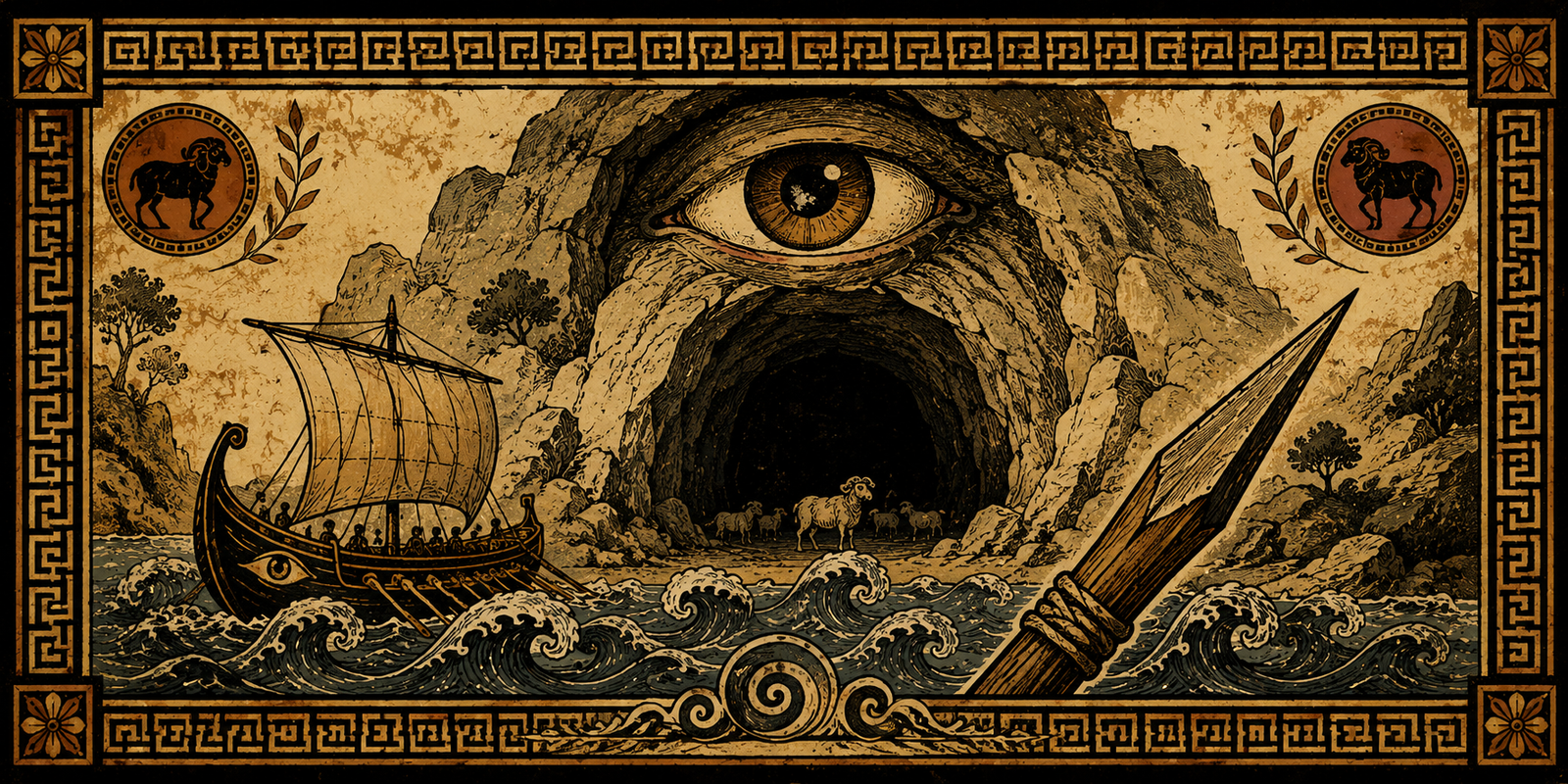

Odysseus in the Cave of the Cyclops
A sailor, a cave with one terrible eye, and a name clever enough to save his life.
Some shores look gentle from the sea.
That does not mean they are gentle.
Odysseus and his men had learned this already, though not well enough. They had left Troy behind them, with its blackened towers and long grief, and every man among them wanted the same thing: a clear wind, a safe harbour, and the sight of home rising at last beyond the waves.
Instead, the sea kept giving them islands.
Some islands gave food. Some gave fear. Some gave both.
One morning, after many days of rowing, hunger, and salt dried white on their arms, the ships came near a strange shore. It had green slopes, quiet beaches, and caves cut into the hills. Goats moved along the rocks. Smoke rose somewhere inland.
The men stared.
Smoke meant fire.
Fire meant someone lived there.
And someone who lived there might have bread, cheese, milk, meat, water, and perhaps enough kindness to share it with tired men who had been too long at sea.
Odysseus stood in the prow of his ship, looking toward the shore.
He was not the strongest of the Greeks. He was not the youngest, nor the loudest, nor the easiest man to understand. But he had a mind that did not stop moving. It moved when other men panicked. It moved when other men boasted. It moved in darkness, which is one of the most useful places for a mind to keep working.
“We will go and see who lives there,” he said.
Some of the men looked pleased.
Some looked less pleased.
A clever captain saying “we will go and see” had caused trouble before.
Still, they trusted him. They had followed him through war. They had followed him across the sea. They would follow him now into a quiet green island where nothing, at first, seemed especially wrong.
That was the first mistake.
They left most of the men with the ships and took only a chosen company. Odysseus led them up from the beach, carrying a skin of dark, strong wine. It was fine wine, the kind that did not merely warm the throat, but seemed to speak to the bones in a deep red voice.
“This may be useful,” he said.
No one argued with a man carrying wine.
They climbed inland. The air smelled of thyme, salt, goats, and sun-warmed stone. Soon they found the cave.
It was enormous.
That should have warned them.
A small man may live in a large house, of course. Kings do it all the time. But this cave was not large in the way a rich man’s house is large. It was large in the way a mountain’s mouth is large.
Inside were pens for lambs and young goats. There were bowls of milk, racks of cheese, and baskets heavy with food. Everything was rough, but orderly. Whoever lived here was not poor. Whoever lived here owned animals, knew their ways, and had no need to ask anyone’s permission.
The men looked at the food.
“Let us take what we need,” one man said. “We can carry the cheeses to the ship, drive off some of the lambs and kids, and be gone before the owner returns.”
This was sensible advice.
Odysseus did not take it.
“We will wait,” he said. “A host should give gifts to strangers. We will see what kind of man lives here.”
Now, this was not foolish in an ordinary house. In the Greek world, a stranger at your door mattered. You did not simply ask whether he was convenient. You fed him, gave him a place by the fire, and only afterwards asked his name. Anyone might be travelling under the eye of Zeus, and it was dangerous to insult the god who watched over guests.
But not every creature honours the guest-god.
Not every cave is a house.
Not every host is human enough to know what hospitality means.
The men waited.
The shadows lengthened.
The sheep and goats began bleating outside.
Then the owner came home.
He was a Cyclops.
You must not imagine a large man with one eye and poor manners. That is not enough.
Polyphemus was huge in the way cliffs are huge. He filled the cave mouth when he entered. His arms were thick as young tree trunks. His single eye sat beneath his brow, dark and watchful, like something that had never once had to look kindly upon the world.
Across his shoulders he carried firewood. Behind him came the flock, pressing and bleating into the cave.
The men shrank back into the shadows.
Polyphemus did not see them at first. He drove the animals into their pens, sat down, milked the ewes and goats, and put aside half the milk for drinking and half for cheese. His hands were enormous, but not clumsy. He knew his work.
That made him worse.
A monster who is only wild may be escaped.
A monster with habits is another matter.
When the chores were done, Polyphemus lifted a great round stone and rolled it across the cave mouth.
The sound of it closing was the sound of hope being shut outside.
No man there could have moved that stone. Not six men. Not twelve. Perhaps not all of them together.
The cave had become a trap.
Then Polyphemus saw them.
He turned his single eye upon the strangers in his house.
“Who are you?” he said.
His voice was not loud because he was shouting. It was loud because he was large.
Odysseus stepped forward. A lesser man might have hidden. A foolish man might have threatened. Odysseus did neither.
“We are Greeks,” he said. “We have come from Troy, driven across the sea by winds and trouble. We are your suppliants. We ask for the gifts due to strangers. Honour Zeus, who watches over guests.”
This was a brave speech.
It was also a dangerous one, because it assumed Polyphemus cared.
The Cyclops looked at him.
Then he laughed.
It was not a laugh that invited anyone to join him.
“You are a fool, stranger,” said Polyphemus, “or you have come from very far away. We Cyclopes do not trouble ourselves about Zeus. I am stronger than your guest-god. I will do as I please.”
There are moments when a room changes.
This was one of them.
The men had been frightened before. Now they understood.
They were not merely trapped with a giant. They were trapped with someone outside the laws that made human life possible. No welcome. No table. No prayer. No shame.
Polyphemus asked where their ship was.
Odysseus’ mind moved.
It moved quickly.
“Our ship was broken by Poseidon,” he said. “It was dashed on the rocks. We alone escaped.”
This was a lie.
It was also an excellent lie.
A man who tells a giant where his ship is may soon have no ship.
Polyphemus said nothing for a moment.
Then the first dark thing happened.
It must be told, because otherwise you will not know how terrible the cave was. But it need not be looked at for long.
The Cyclops seized two of the men.
By morning, they were gone.
Afterwards, the cave was very quiet.
The others sat in the dark with their backs against the stone, listening to the monster breathe. They did not speak their friends’ names. Not yet. Names would have made the fear too large to bear.
Odysseus watched the stone at the cave mouth. He thought of his sword. He thought of driving it into the Cyclops while he slept.
Then he thought further.
This is what saved them.
If they killed Polyphemus, the stone would still be there. The monster would be dead, and they would be sealed in the cave with him until thirst, hunger, and darkness did the rest.
Bravery is not enough when the door is too heavy.
So Odysseus waited.
Waiting is not nothing. Sometimes waiting is the hardest part of courage.
In the morning, Polyphemus rolled back the stone, drove out the male animals, and left the ewes and lambs penned inside. He closed the cave again behind him, as easily as a child closing a box.
The men heard his footsteps fade.
Then Odysseus rose.
“Listen,” he said.
They listened because there was nothing else to do, and because his voice still sounded like a road out.
In the cave lay a great green olive-wood club, cut by Polyphemus for his own use. To ordinary men it looked less like a club than the mast of a ship.
Odysseus chose a length of it. He and his men cut it, shaped it, and sharpened one end. Then they hardened the point in the fire and hid it beneath the dung and straw.
This was not glorious work.
It was necessary work.
That evening Polyphemus returned. Again he rolled the stone across the entrance. Again he milked the animals. Again he turned toward the men.
The cave grew smaller around them.
Odysseus stepped forward with the wine.
“Cyclops,” he said, “drink this after your meal. It is wine. Good wine. Men drink it and remember that life has sweetness in it.”
Polyphemus took the bowl.
He drank.
His eye changed.
Wine had not visited that cave often. Perhaps it had never been there at all. Polyphemus swallowed, breathed out, and held out the bowl again.
“More,” he said.
Odysseus gave him more.
Then more.
The Cyclops smiled a terrible smile.
“You have pleased me, stranger,” he said. “Tell me your name, and I will give you a guest-gift.”
This was not comforting.
Odysseus bowed his head slightly.
“My name,” he said, “is Nobody. My mother calls me Nobody. My father calls me Nobody. All my friends call me Nobody.”
The men stared at him.
Even in terror, one or two of them almost understood.
Polyphemus nodded heavily.
“Then I will eat Nobody last,” he said. “That shall be my guest-gift.”
There are better gifts.
Soon the wine worked through him. His great head drooped. He sank backwards, and sleep took him.
The cave filled with the sound of his breathing.
Odysseus did not move at once.
He waited until the sleep was deep.
Then he touched the hidden stake.
The chosen men came to him. Their faces were pale in the firelight. They were afraid, and rightly so. Courage is not the absence of fear. Courage is when fear has to come with you because there is no time to leave it behind.
Together they lifted the sharpened wood.
Together they carried it toward the sleeping Cyclops.
What happened next was swift, terrible, and necessary.
The fire-hardened point found its mark.
Polyphemus woke with a cry that seemed to shake the cave. The men leapt back. The flock bleated wildly in their pens. The cave rang with pain and rage.
Outside, other Cyclopes heard him.
They came near the cave mouth and called through the stone.
“What is wrong, Polyphemus? Is someone killing you by trickery or by force?”
Polyphemus shouted back, “Nobody is killing me by trickery! Nobody is hurting me!”
There was silence outside.
Then one of the Cyclopes answered, rather crossly, “If nobody is hurting you, then you must be ill. Pray to your father Poseidon.”
And they went away.
Odysseus did not laugh.
Not then.
A trick is not finished while the monster is still between you and the door.
Polyphemus stumbled through the cave, reaching with his enormous hands. He could not see, but he could feel. He dragged the stone away from the entrance and sat there with his arms stretched out, waiting to catch any man who tried to run past him.
Cold air entered the cave.
Freedom was visible.
No one could reach it.
The men looked at Odysseus.
Once again the first plan had only made the second problem clearer.
Once again Odysseus’ mind moved.
He looked at the sheep.
They were large, thick-fleeced animals, strong and slow, the finest of Polyphemus’ flock. In the morning, the Cyclops would let them out to pasture. He would feel their backs as they passed beneath his hands, making sure no man rode on top.
So Odysseus did not put his men on top.
He tied them underneath.
Three sheep for each man: one on either side and one in the middle, with a man bound beneath the middle sheep’s belly, hidden by wool and shadow. Quietly, carefully, he fastened them there with withies from the cave floor.
Last of all, he chose the great ram.
It was the strongest of the flock, heavy with wool, proud and slow. Odysseus clung beneath it with his arms locked into the fleece.
Morning came.
Polyphemus sat by the door, blind and furious.
One by one, the sheep passed out.
His huge hands moved over their backs.
He felt wool.
He felt horns.
He felt nothing else.
Underneath, the men hardly breathed.
Imagine it.
The animal smell. The press of wool against the face. The scrape of hooves on stone. The great blind hand passing so close above you that one careless breath might bring it down.
The cave mouth came nearer.
Then light.
Then air.
Then the open world.
Odysseus, beneath the great ram, was the last to pass.
Polyphemus laid both hands on the animal’s back and spoke to it.
“Dear ram,” he said, “why are you last today? You were always first before. Are you grieving for your master’s eye?”
Odysseus held still beneath the fleece.
The ram stepped forward.
The hand lifted.
The cave released him.
When they were far enough away, Odysseus dropped from beneath the ram and cut his men free. They ran to the ship, driving the best of the flock before them. No one wasted time. No one argued about cheese. No one wished to learn anything more about the hospitality of Cyclopes.
They pushed the ship into the water.
The oars struck the sea.
The island began to fall behind them.
Only then did the men breathe as men breathe when they have been dead in their minds and find, to their surprise, that their bodies are still alive.
They had escaped.
That should have been enough.
It was not enough for Odysseus.
When the ship had pulled some distance from shore, he stood and shouted back across the water.
“Cyclops! If anyone asks who blinded you, say it was Odysseus, sacker of cities, son of Laertes, whose home is Ithaca!”
His men cried out in alarm.
“Be quiet!” they begged him. “He may still reach us! Do not anger him again!”
This was also sensible advice.
Odysseus did not take it.
There are times when a man has survived so narrowly that silence feels impossible. There are times when cleverness, having saved his life, rises up in him and demands to be recognised. Odysseus had beaten the giant in the dark, and some burning part of him wanted the darkness to know his name.
Polyphemus heard.
He tore a great rock from the hillside and hurled it toward the voice. It crashed into the sea near the ship, and the wave it raised drove them back toward shore. The men bent to the oars with all their strength. Foam flew. The ship groaned. For a moment, it seemed the sea itself had chosen sides.
They pulled away again.
Odysseus shouted once more.
His men could not stop him.
Polyphemus lifted his arms to the sky and called upon his father.
Poseidon heard.
That is the trouble with gods. They are not always listening when you need them. They are very often listening when you do not.
“Father Poseidon,” cried Polyphemus, “if I am truly your son, grant that Odysseus of Ithaca may not come home. Or if he must come home, let him come late, broken, alone, on another man’s ship, and find trouble waiting in his house.”
The words went out over the water.
The men did not speak.
Odysseus stood with the wind in his face.
Behind them, the cave grew smaller. The shore drew back. The Cyclops became a dark shape against the rocks.
They had escaped the monster.
They had won the impossible thing.
They had proved that a mind in darkness may be stronger than a giant at the door.
But the sea ahead looked wider than before.
And somewhere beneath its moving light, Poseidon had begun to remember the name of Odysseus.
—
Meet Poseidon in The Greek World — the god of the sea, storms, horses, earthquakes, and remembered insults.
After Odysseus has escaped the cave, visit The Greek World: Cyclopes to discover what Cyclopes are, why they are not all the same, and why this victory opens a larger trouble.
—
Receive the next work
Subscribe free to receive new work from the The Alexander Series Library by email.
More from the Library

See Also
A concise and impartial dictionary of absence, promises, quarrels, ordinary objects, and the troublesome instability of words.

The City of Service
The temple we inherit is a building from which almost all necessity has been removed. Nothing must be brought for it to continue being what we call a temple. The sanctuary asks nothing of us. Stone is good at this kind of independence.
A living temple was otherwise.
Water had to come in. So did grain, cloth, oil, aromatic substances, fuel. The things required for worship arrived because someone carried them across a threshold.

Houses of Wood, Light, and Smoke
Some of Angkor’s most intimate ruins do not rise above the ground at all. They are postholes, low mounds, hearths and ponds: durable traces of a domestic city built largely from things that decay. To restore that city is to see Angkor not only as stone, but as wood, smoke, water, repair, and people living within calling distance.