

The Long Return I — The Boy and the Goddess
The Odyssey begins in an occupied house, where Telemachus receives a stranger and learns that waiting has become a form of danger.
The house had learned to make room for absence.
At first, perhaps, there had been a place left for him. A chair not taken. A cup not touched. A servant pausing at the sound of a step beyond the door. A wife turning her face, not because she believed, exactly, but because grief is slower than knowledge and will look up at almost anything.
But years are patient.
They take what sorrow leaves unguarded. They teach hands to move around what cannot be repaired. They settle dust where hope once stood. In time, even longing becomes a household object: familiar, heavy, often moved, never put away.
So it was in Ithaca.
Odysseus had been gone so long that his absence no longer felt like a wound newly opened. It had become part of the house’s structure. Men ate beneath it. Servants crossed under it. His son grew up inside it, learning the shape of a father from stories, rumours, silences, and the behaviour of men who had begun to treat the missing as dead because it suited them.
They filled the hall now.
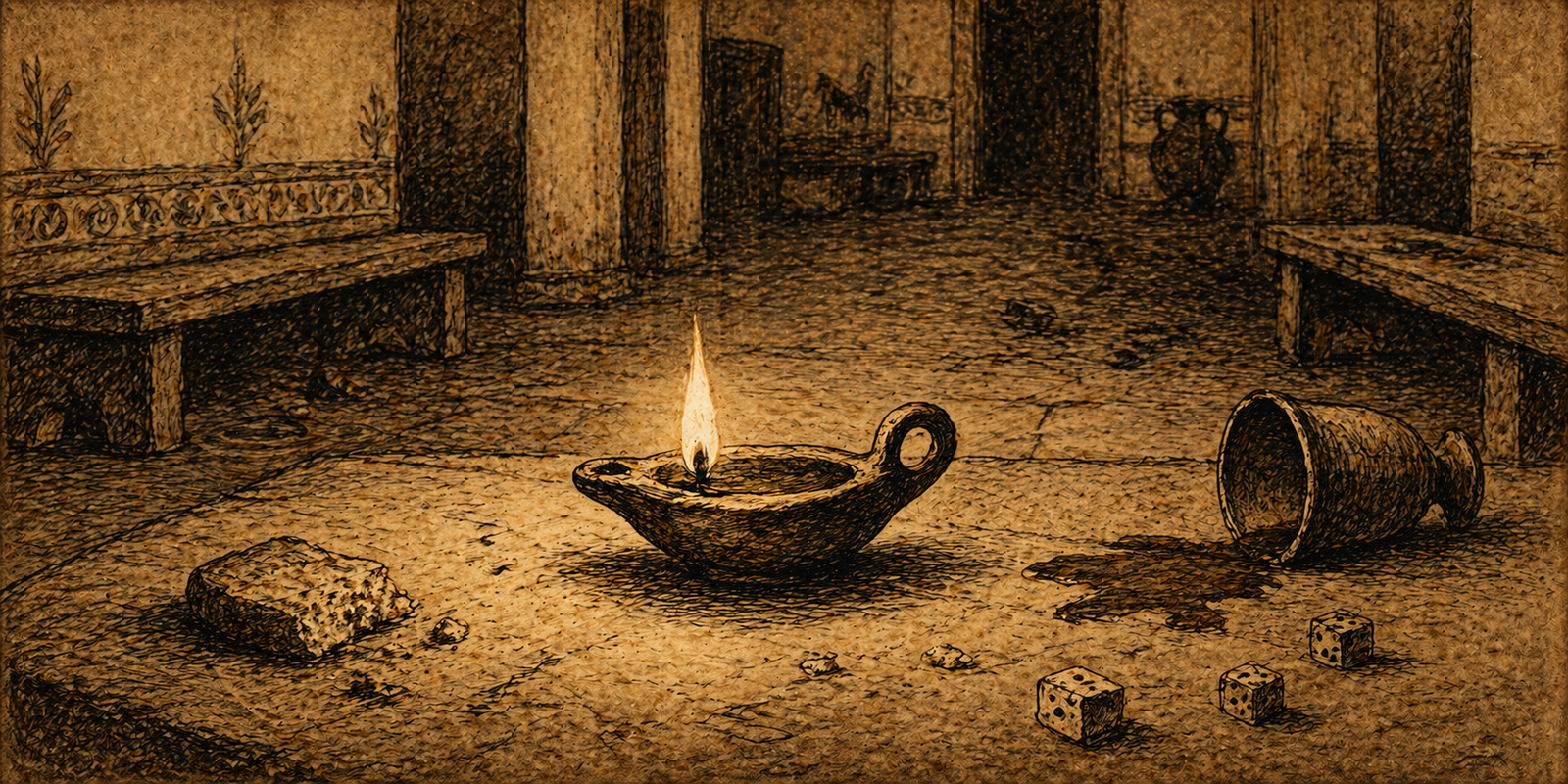
The suitors came early and stayed late. They lounged on the benches, called for wine, took meat from the tables, and laughed with the careless force of men spending another man’s wealth. Their sandals scraped against the floor. Their hands shone with grease. Their voices rose whenever the singer paused. They had the confidence of those who had discovered that no one present could make them ashamed.
The lamps burned before evening had fully gathered.
That was one of the wrongnesses Telemachus noticed. In a well-ordered house, light answered need. Here it answered appetite. The hall was too bright, too noisy, too full of men who should have been guests but had become something closer to a siege.
Telemachus sat among them because there was nowhere else for the son of the house to sit. He was no child now, though many still spoke to him as if he were. His shoulders had begun to broaden; his face had lost the softness of boyhood; there were moments when the servants, glancing up, saw his father in the line of his brow and looked away too quickly.
That only made the shame worse.
He could see what was happening. That was the torment of it. He was old enough to understand the ruin, but not yet strong enough to stop it. Every cup poured for the suitors was taken from what should have been his inheritance. Every animal slaughtered for their feasting thinned the substance of the house. Every laugh at his expense entered him and lodged there.
His mother remained above.
Penelope lived in the upper rooms with her women, weaving by day, grieving when grief would not be governed, and holding the house together by the strange power of not yielding. Her absence from the hall had its own authority. Yet it also deepened the insult. The men below waited for her as wolves might wait around a closed door.
Telemachus watched them and hated them.
More painfully, he hated himself for watching.
Outside, beyond the court and the doors and the sloping land of Ithaca, the sea kept its own counsel. It had carried his father away before Telemachus could remember the weight of his hand. It had brought rumours back instead: Odysseus dead at Troy, Odysseus wandering, Odysseus drowned, Odysseus kept by gods, Odysseus forgotten, Odysseus coming home tomorrow, Odysseus never coming home at all.
A man can fight an enemy. It is harder to fight uncertainty. It enters the house softly and sits down.
Far above that house, where mortal smoke rose thinly into the sight of the gods, Odysseus was remembered.
Not by all, and not kindly by all. The gods are not one mind, whatever men may wish when they pray. Some pitied him. One had long obstructed him. One watched more closely than the rest.
Poseidon, whose anger lay like weather over the man’s return, was elsewhere among distant worshippers. In his absence the divine talk turned, as it sometimes does, towards justice: towards men who blame the gods for sorrows earned by their own folly; towards blood paid for blood; towards the old arrangements of fate and consequence.
Then Athena spoke of Odysseus.
She did not speak like a woman grieving prettily over a lost hero. There was tenderness in her, but it had a blade inside it. She remembered his mind, his endurance, the offerings once burned to the gods, the man himself held far away on an island by a goddess who wanted him for her own. She remembered also Ithaca: the house wasting, the son unformed, the wife besieged by waiting.
Favour, when it comes from Athena, does not always feel like comfort.
It often arrives as pressure.
So she went down to Ithaca.
Not in splendour. Not with shield flashing and the high terror of Olympus about her. She came as a stranger might come: in the likeness of Mentes, lord of the Taphians, a man of the sea, with a spear in hand and travel on his clothing. She crossed the outer ground and stood at the threshold of Odysseus’ house.
Inside, the suitors were playing at ease.
They threw dice on hides laid out before them. Servants moved among them with bread and meat. A herald brought the singer his lyre, for even in corrupted houses men like to be accompanied in their pleasures by song. No one hurried to the door.
Telemachus saw the stranger first.
He rose at once, not because he felt brave, but because shame moved him faster than thought. It was bitter enough that the stranger should have to see the hall as it was. It would be unbearable if he were left standing there like a beggar before a house that had forgotten the laws of welcome.
Telemachus went to him, took his right hand, received the spear, and spoke quietly.
“Welcome, stranger. Come in. Eat with us first. Afterwards, tell us what you need.”
He led him away from the suitors’ noise, set the spear in a polished rack beside the old weapons of his father, and brought him to a seat apart. He gave him a chair and a footstool. A servant came with water in a golden jug and poured it over their hands into a silver basin. Another set bread before them. Meat was brought. Cups were filled.
All this was done as it should be.
That was the first small restoration.
Around them the suitors continued in their disorder, but for a little space near the stranger the old law of the house still breathed. Before a name is asked, the guest is fed. Before business is spoken, the traveller is received. Identity comes after bread.
Athena watched the young man who did this.
He was troubled. That much was plain. He kept glancing towards the suitors, and each glance carried injury. But he knew the shape of courtesy. He had not been trained by neglect into neglect. The house had not wholly lost itself while he lived in it.
The meal began.
The suitors ate noisily. Their hunger had no ceremony in it. They called for more wine. They smiled at one another across another man’s tables. Then the singer lifted his lyre, and the hall settled into a pleasure that made the wrongness sharper. Song can enter any room, even a spoiled one, and for a while men will listen as if listening proves them civilised.
Telemachus leaned towards the stranger.
His voice was low, private, edged with the anger of one who has had to lower it too often.
“Stranger,” he said, “do not be offended by what you see. These men care for nothing except the feast and the song. It is easy for them. They are consuming the house of a man whose bones, for all we know, lie somewhere in rain or sand. If my father were only dead and known to be dead, there would be grief, and grief has rites. But he has vanished. No messenger comes with certainty. No grave holds him. His name is everywhere, and he is nowhere.”
Athena, still in the form of Mentes, looked at him with the eyes of a traveller who has seen many houses and knows when one is failing.
“Your house,” she said, “is full of insolence.”
Telemachus almost smiled. It was a hard thing to hear from a guest and a relief to hear from anyone.
“It is,” he said.
“And you,” said the stranger, “are Odysseus’ son?”
The question entered him more sharply than accusation.
“That is what my mother says,” Telemachus answered. “A man cannot know it for himself.”
There was bitterness in the words, but also something lonelier than bitterness. To be the son of a famous man who has not raised you is to inherit both a glory and a vacancy. Others remember greatness. You remember waiting. Others tell you whose blood you carry. You look down at your own hands and wonder what such blood is supposed to do.
Athena heard all this.
“You are like him,” she said.
Telemachus looked away.
Many had told him so when they wanted something from him, or when pity had made them clumsy. The words had become almost useless.
The stranger continued. “I knew your father. I came here before, when he was preparing to sail for Troy. He welcomed me as a friend. We exchanged gifts. If he were standing in this doorway now, those men would not sit so easily.”
Telemachus’s face changed despite himself.
There it was again: the imagined arrival. The sudden door. The impossible figure in the hall. His father entering not as rumour, not as story, but as body, voice, authority, hand. Telemachus had dreamed it so often that the dream had become another form of pain.
“If he came,” he said, “they would learn fear. But the gods have not granted that. They have made him vanish more completely than other men. If he had died at Troy, among his companions, the whole army would have raised a mound for him, and I would have inherited honour from grief. Instead he has been taken without witness. And I am left here with men who devour my house.”
The suitors laughed at something across the hall. One of them struck the table with his palm. Wine jumped in a cup.
Athena did not look towards them.
“Listen to me,” she said.
There was command beneath the stranger’s voice now, though Telemachus did not yet know why it compelled him.
“You are no longer a child. Whether your father lives or has died, this cannot continue as it has. Tomorrow call the men of Ithaca to assembly. Speak before them. Tell these suitors to leave your house. If your mother wishes to marry, let her father arrange it properly and provide the gifts. But these men must not eat you hollow while they wait.”
Telemachus was still.
The words did not give him strength exactly. They named the shape strength would have to take.
“And then?” he asked.
“Then seek news of your father. Take a ship with twenty men. Go first to Pylos and ask Nestor, who returned from Troy and remembers much. Then go to Sparta, to Menelaus, who came home last of all the bronze-clad Greeks. If you hear your father is alive and returning, endure this ruin a little longer. If you hear he is dead, come home, raise his mound, give him the honour due, and see your mother married. Then you will know what must be done.”
What must be done.
The phrase stood between them.
It had weight. It meant that uncertainty could not remain an excuse forever. It meant a son could not wait endlessly for a father to return and make the house whole. It meant grief needed form, and absence needed to be answered, whether by mourning or by action.
Telemachus felt fear.
Not the fear he knew already, the daily fear of being mocked in his own hall. This was larger and cleaner. It had wind in it. It smelled of ships.
“I have no ship,” he said, though the answer sounded weak even to him.
“You will find one.”
“I have no men.”
“You will ask for them.”
“They will laugh.”
“Let them.”
The suitors called for the singer to begin another song. A servant hurried past with a mixing bowl, eyes lowered.
Athena leaned closer.
“If you are indeed the son of Odysseus, you must not sit forever among men who shame your house. Your father was not such a man.”
Something in Telemachus bristled. Something in him answered.
It was not yet courage. It was not yet command. But it was the beginning of a refusal to be only wounded.
The stranger rose.
Telemachus, startled, moved with him. “Stay,” he said. “Bathe, rest, and in the morning I will give you a gift, something worthy of a guest-friend.”
Athena smiled then, though not softly.
“Keep the gift until I return. Choose it well. I will take it gladly another time.”
She went towards the door.
Telemachus followed, but at the threshold the stranger was no longer moving like a mortal guest. The air seemed to alter around him. A bird’s quick shadow flashed upward, sudden and impossible, and then the visitor was gone.
Telemachus stood with his hand still half lifted.
He understood then that a god had come to him.
Not because the room had filled with radiance. Not because thunder had spoken. But because the stranger’s words remained inside him with a force no ordinary conversation leaves behind. They had not comforted him. They had changed the weight of the air.
He turned back to the hall.
The suitors were still there. The cups were still passing. The singer still held his lyre. Nothing had changed.
Everything had changed.
Then the singer began a new song.
It was of the return from Troy — the bitter road home the Greeks had taken after the city fell, the losses they suffered after victory, the storms that scattered them, the gods who would not let war end simply because men had left the battlefield.
The hall listened.
Upstairs, Penelope heard.
The song found her where she sat among her women. Perhaps she had been working. Perhaps the thread had already fallen into her lap. There are griefs that sleep lightly, and songs know how to wake them.
She came down the stair with two attendants beside her, drawing her veil across her face. She did not enter the hall like a woman with no authority. Even sorrow did not strip that from her. The men looked up because they could not help looking. She stood by the doorpost, apart from them all, and spoke to the singer.
“Phemius,” she said, “you know many songs. Sing one of those. Sing of gods or men, if they must hear you. But do not sing this sorrow. Do not sing of the Greeks’ return from Troy. That song breaks my heart each time, because I remember a man whose fame is wide in Greece, and whose body has not come home.”
There was no loud weeping in her speech. That would have been easier to bear. Her grief had been worn too long for display. It had become exact.
Before the singer could answer, Telemachus spoke.
“Mother,” he said.
The hall quietened at the word, but not respectfully. Men enjoy the moment when private pain becomes public.
Telemachus felt their attention and did not step back from it.
“Let the singer sing what his heart urges. It is not the singer who is to blame, but Zeus, who gives men their portions. The return from Troy is grief to many, not to us alone. Go back to your rooms. See to your loom and your women. Speech will be the concern of men — all men, and mine especially. For power in this house belongs to me.”
The words shocked the hall.
They shocked Penelope too.
She looked at him then, truly looked, as if the boy she had been protecting from the house had suddenly spoken from within it as its heir. There was pain in what he said. There was the harshness of custom, the edge of youth, the first awkward use of authority. But there was also something she recognised and did not answer.
She went back upstairs with her women.
When she reached her room, she wept for Odysseus until Athena laid sleep gently upon her eyes.
Below, the suitors began to murmur.
Some laughed, but not as freely as before. The sound had a testing quality now. Telemachus had stood before them and spoken as master. The words did not make him master yet. Words alone cannot clear a hall. But they can mark the place where submission begins to end.
Antinous was the first to speak sharply.
“Telemachus,” he said, “may the gods not make you king in Ithaca, though it is your father’s right by birth.”
The insult was plain enough: they had heard him. They had also heard the future in him and wished to cut it out while it was still tender.
Telemachus answered more steadily than he felt.
“Antinous, you may be angered by what I say. But if Zeus grants it, I would not refuse kingship. Is that such a terrible thing? Yet there are many princes in Ithaca, young and old. Let one of them be king if Odysseus is dead. But I will be lord of my own house and of the servants my father won for me.”
That, too, was a beginning.
Eurymachus smiled then, smoother than Antinous, dangerous because he knew how to sound reasonable.
“Telemachus,” he said, “these matters rest with the gods. Keep your goods and rule your house. No man should take that from you while Ithaca stands. But tell us about the stranger. Who was he? From what land? Did he bring news of your father?”
Telemachus heard the trap inside the courtesy.
“He was Mentes,” he said, “lord of the Taphians, an old friend of my father.”
He said it calmly.
But in his heart he knew the truth. A god had come and gone. A command had been left behind.
The suitors returned to their feasting, but the pleasure had lost some of its ease. The singer sang on. The servants moved with lamps. Night gathered outside the doors, and the sea beyond Ithaca darkened into invisibility.
At last the men went to their own houses to sleep, full of another man’s bread.
Telemachus climbed to his room.
An old nurse, Eurycleia, carried torches before him. She had held him when he was an infant, long ago, before absence had finished teaching the house its silence. She set the light in its place, folded away his tunic, and closed the door when he dismissed her.
He lay awake.
Below, the hall was quiet at last. But quiet was no longer the same as peace.
He thought of the stranger’s face. He thought of the spear at the threshold. He thought of Pylos and Sparta, names that had always belonged to stories and now seemed to stand somewhere beyond the dark, waiting for him. He thought of his father, not as a rescue coming through the door, but as a question he might have to cross the sea to ask.
In the court, the last lamp burned low.
For years, it had lit a house where men waited for another man either to return or be forgotten.
Now it lit the beginning of a road.
A. M. Sharp
—
Receive the next work
Subscribe free to receive new work from the The Hospitable Dark Library by email.
More from the Library


See Also
A concise and impartial dictionary of absence, promises, quarrels, ordinary objects, and the troublesome instability of words.

The City of Service
The temple we inherit is a building from which almost all necessity has been removed. Nothing must be brought for it to continue being what we call a temple. The sanctuary asks nothing of us. Stone is good at this kind of independence.
A living temple was otherwise.
Water had to come in. So did grain, cloth, oil, aromatic substances, fuel. The things required for worship arrived because someone carried them across a threshold.

Houses of Wood, Light, and Smoke
Some of Angkor’s most intimate ruins do not rise above the ground at all. They are postholes, low mounds, hearths and ponds: durable traces of a domestic city built largely from things that decay. To restore that city is to see Angkor not only as stone, but as wood, smoke, water, repair, and people living within calling distance.