

The Long Return III — An Old King Remembers
A young man reaches Pylos and learns that the return from Troy was not the end of danger.
He had seen men eat badly.
That was one of the things his father’s absence had taught him. In Ithaca, the eating had become a kind of conquest. Men took bread as if it had no history, lifted cups as if no hand had filled them, sat in another man’s hall as if a house were only a roof and walls and a place where hunger might be satisfied. There had been sacrifices, of course. Men who want to look respectable seldom forget the public shape of religion. But Telemachus had learned the difference between an offering and an appetite wearing clean clothes.
At Pylos, the difference was visible before anyone spoke.
The shore was bright with bodies and smoke. The people had gathered by the sea in ordered companies, and the black bulls stood garlanded for Poseidon, who hears every oar and every drowning prayer. The fires were already working. Fat hissed. Meat darkened. Wine was poured upon the ground with hands that knew what they were doing. Boys ran where boys were needed. Men stood where men were expected. Old men watched without needing to command loudly, because command had already entered the habits of the place.
Telemachus looked at it all and felt, with a sudden sharpness, how badly his own house had been allowed to come apart.
Beside him, the one who looked like Mentor watched with a calm that was almost unkind.
“You must go forward,” she said.
He did not answer at once. The ship lay behind them, hauled up out of the water, its men waiting to see what their prince would do. That was another new thing: men waiting for him. In Ithaca they had either mocked him or pitied him, and pity was often the harder thing to bear. Now the sailors stood back with their cloaks gathered against the wind, trusting him to speak because he had brought them here.
It is one thing to leave home in anger.
It is another thing to arrive somewhere as the person who must ask.
“I do not know how to begin,” he said quietly.
Mentor turned and looked at him. The face was old and familiar enough. The gaze was not.
“No one knows how to begin until the first word has left him.”
This was not comforting. Gods, when they comfort at all, often do it by removing the easier escape.
Telemachus breathed once, then stepped down from the ship.
The people of Pylos saw the strangers at once. A sea arrival is never invisible for long. The men nearest the fire turned, and then others turned after them, curiosity passing through the gathered crowd like wind through grass. But no one shouted. No one demanded their names. No one put a hand to a weapon.
That, too, was a form of civilisation.
A young man came toward them first, tall, smooth-faced, with the confidence of someone born into a house where honour had not yet become theoretical. He looked at Telemachus, then at Mentor, then at the ship, and whatever questions he had were put aside until the proper things had been done.
“Come,” he said. “The feast is for the god, but guests are not turned away from it.”
He brought them into the gathering and gave them places near the old king.
Nestor sat among his sons like a tree that had weathered too many storms to be impressed by wind. His hair was white, and his hands had the deliberate patience of age, but there was nothing diminished in him. Age had not made him vague. It had made him spacious. One felt, looking at him, that many dead men still had room in his memory.
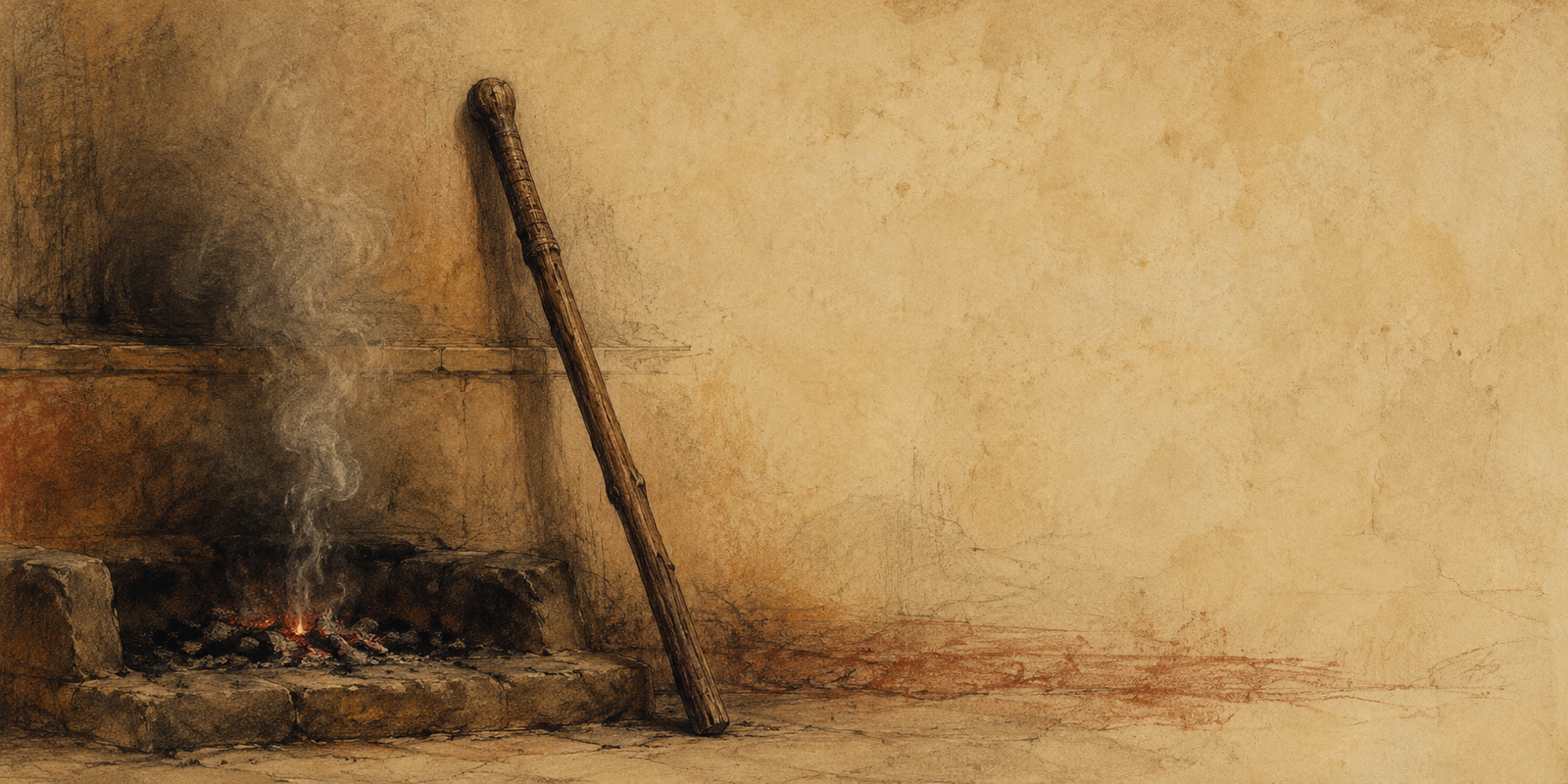
Beside his chair leaned a staff, dark from long use, polished where the hand had held it year after year. It looked less like an ornament than like a witness.
Food was set before the strangers. Wine was poured. Portions were given. Prayers were made. No one asked Telemachus who he was until the hunger of the guests had been honoured.
A house reveals itself before the first question. It does so with bread, with water, with the place it gives a stranger near the fire. Kingdoms are not different in this respect. They are only larger houses, and their manners are harder to hide.
Only when they had eaten did Nestor turn his face fully toward them.
“Now,” he said, “we may ask what the sea has carried to us. Strangers, who are you? Merchants? Wanderers? Men driven out by weather? Or have you come with some purpose that has not yet found its words?”
Telemachus felt the old fear rise in him — the fear of sounding like a boy in front of men who had known his father as a man. He could still feel the assembly in Ithaca around him, the public air turning hostile, the suitors smiling as if his grief were a childish interruption to their meal.
Mentor’s voice came beside him, low enough that only he could hear.
“Speak.”
So he did.
“I am Telemachus, son of Odysseus, if that name has not been emptied by time. I have come from Ithaca seeking news of my father, who fought with you before Troy and did not return with you. Men say many things. Some say he is dead. Some say nothing at all. In my house the silence has grown stronger than any rumour.”
He stopped. He had meant to say more. He had meant to speak with dignity, perhaps even with force. But the words had taken him to the house too quickly, and there the shame waited: the suitors, the wasted stores, his mother upstairs, his own helplessness standing like an uninvited guest in every room.
Nestor did not hurry to answer.
That was the first kindness.
He looked at the young man before him for a long while, and what passed over his face was not surprise, nor pity exactly, but the grave recognition of one sorrow finding its place among many others.
“Odysseus,” he said at last.
The name did not sound in his mouth as it sounded in Ithaca. There, it was an absence, an accusation, a convenient emptiness into which other men poured their wishes. Here it sounded like a man remembered by another man.
“Odysseus,” Nestor repeated. “There was no one like him for counsel. No one. Many were stronger. Some were quicker to anger. A few thought themselves wiser, which is a dangerous condition and common among kings. But when a matter had knots in it, your father was the man whose fingers found the hidden cord.”
Telemachus sat very still.
It is a strange thing to hear praise of a father one cannot remember. It warms nothing cleanly. It gives shape and deepens the wound at the same time.
“You knew him well?” he asked.
Nestor smiled, though not happily.
“I knew him at Troy. That is not the same as knowing a man at home. War shows much and hides more. I saw him in councils, in raids, beside the ships, in quarrels, in danger, in the long misery of waiting. He could speak until men saw a path where moments before there had only been mud and blood and pride. He could also keep silence better than most men could speak. That saved us more than once.”
The fire snapped softly between them.
“But if you have come to me for certainty,” Nestor said, “I do not have it. I would give it if I could. Old men are fond of giving what they no longer need. Advice. Memory. Warnings. But certainty is not among my possessions.”
Telemachus lowered his eyes.
A younger man might have softened then. Nestor did not. There are griefs that are not helped by softening.
“You must understand what happened after Troy,” the old king said. “Men speak as if the city fell and the story ended. That is because men like the shape of victory. It is clean. It gives them something to carve on stone. But the return from Troy was not a procession.”
He took the cup beside him and held it without drinking.
“It was a second war, though no one carved that one on stone. It was fought against sea and weather, against anger kept too long in the mouth, against old offences that had crossed the water with the ships, and against gods who had not finished making their opinions known.”
He looked toward the shore, where the smoke of sacrifice drifted and thinned over the bright water.
“We had spent ten years learning how to survive together badly. That is what war does. It teaches men to endure one another’s faults because there is always an enemy outside the wall. When the wall falls, the faults remain. They simply come home.”
Telemachus thought of the men in his hall and wondered, not for the first time, whether the war had ever truly ended for Ithaca. Perhaps absence itself was a kind of siege. Perhaps every year without Odysseus had been another army at the gate.
Nestor began to speak of the leaving.
He spoke of Troy after its destruction, of smoke, ships, quarrels, and tired men who had thought themselves hungry for home until home became a direction and direction required obedience. He spoke of Athena’s anger and the sacrifices that should have been made. He spoke of Agamemnon and Menelaus dividing in counsel, brother from brother, because even after ten years of war men could still discover new ways to refuse agreement.
Some sailed at once. Some delayed. Some returned quickly and badly. Some did not return at all.
The names came one after another, and Telemachus tried to hold them. Ajax. Agamemnon. Menelaus. Diomedes. Others whose stories had already become shortened by death. These were the men who had filled his childhood not as people but as weather: great names spoken by servants, by old soldiers, by passing traders, by singers when they wanted the room to grow larger than it was.
Now Nestor placed them back into time.
He gave them quarrels, bad decisions, ships, griefs, wives, deaths.
Glory, Telemachus began to understand, was what survived after pain had been made easier to repeat.
His father was somewhere among these names and not among them. Present in every telling. Absent from every answer.
“And my father?” he asked.
Nestor’s eyes returned to him.
“Your father did not come home with me. That is the hard truth, and you have crossed water to hear it. We were together at Troy, but not after. I came away with those who chose my route, and the gods allowed me passage. I reached Pylos. I made offerings. I embraced my household. I buried what needed burying inside myself and took up the work of being king again.”
He looked toward the fire, and in the light his face seemed older than it had a moment before.
“Not every man was granted that.”
Telemachus wanted to ask what a man must do to be granted it. But the question was foolish, and some part of him knew it. The world was not arranged so that the deserving always came home, or the careful, or the brave, or even the loved. If it were, his father would have walked through the doors of Ithaca years ago and found him still small enough to lift.
“What should I do?” he asked instead.
That was a better question. Not easier, but better.
Nestor leaned back. His hand moved once toward the staff, not quite touching it.
“You should go to Sparta. Menelaus came late, but he came. He has travelled far, and grief has a way of gathering news from places joy never visits. If any man among the living has heard of Odysseus, it may be he.”
Sparta. Another name. Another road. Another house where Telemachus would have to arrive as a son carrying his father’s absence before him.
“But before you go,” Nestor said, “hear this.”
The old king’s voice changed. It did not become louder. It became more exact.
“There was another house where a king did not return when he should have. You know the name of Agamemnon.”
Everyone knew the name. Even in Ithaca, even among men too young to remember the war itself, Agamemnon’s name had weight. High king. Leader of the Greeks. Brother of Menelaus. The man who had called the ships to Troy.
“I know it,” Telemachus said.
“He came home from the war,” Nestor said. “After all that danger, after all that wrath, after the long years before Troy, he came within sight of his own roof. And there death found him, not in battle, not beneath a tower, not before a foreign spear, but inside the country that should have received him.”
Telemachus felt the words enter him slowly.
Nestor did not describe the killing. He did not need to. Some things become smaller when too much is said of them. He spoke instead of the disorder around it: of Aegisthus, who had sat in another man’s place; of Clytemnestra, whose welcome had become a snare; of the long absence of the son; of the house waiting, darkening, changing hands in everything but name.
Telemachus listened, and the hall of Ithaca rose inside him so clearly that for a moment he smelled its smoke.
Men in another man’s place.
A woman forced to endure them.
A son not yet strong enough.
He looked up.
Nestor saw that he had understood.
“Orestes was far away when the wrong was done,” the old king said. “But he did not remain far away. He returned. He made his father’s house answer.”
There it was.
Not command. Not advice, exactly. Something worse for a young man who still hoped the world might excuse him: a story laid quietly on the table, sharp side turned toward him.
Telemachus felt shame move in him, but it was not the same shame he had felt in Ithaca. That shame had bent him downward. This one stood him upright, though painfully.
“I am not Orestes,” he said.
“No,” said Nestor. “You are not. Nor is your house his house. Nor is every wrong answered by the same act. Beware men who carry one story into another as if the gods made only one pattern. But a son should know what has been asked of sons before him.”
The old king drank then.
Mentor watched Telemachus with an unreadable face.
It seemed to Telemachus that everyone around the fire was suddenly older than he was. Not in years only, but in their nearness to consequences. These men had seen cities emptied. They had seen kings return and not return. They had seen sons grow into vengeance because houses had failed to remain houses. Until now, Telemachus had thought his trouble large because it filled every room he knew. In Pylos, he began to see that his trouble belonged to a world in which many houses had been broken by the same war, though not all in the same way.
That did not lessen it.
It made it heavier.
Nestor’s youngest son, Pisistratus, sat nearby and listened as young men listen when they have been raised among old stories but have not yet discovered which of them will become personal. He looked at Telemachus with interest, and perhaps with pity, but not the pity that diminishes. He had grown up in a house full of sons. He could not know what it meant to be the only one standing between a mother and the men downstairs.
But he would travel with him. That was already taking shape in Nestor’s mind.
The feast continued. More wine was poured. Men honoured the god. The sea received the smoke and did not answer, which is often the way with gods and seas alike.
When the light began to change, Nestor turned again to his guests.
“You will not return to your ship tonight,” he said. “No guest of mine sleeps beside the benches like a hired oarsman when there is a roof to receive him. You will come to my house. In the morning we will make proper offerings to Athena, whose hand, I think, has been closer to this journey than it first appeared.”
At that, Mentor stood.
“I will go back to the ship,” she said. “The men should be watched, and the young should sleep under honour when honour has been offered.”
Nestor looked at her then with sharper attention.
There are moments when disguise remains in place but no longer fully protects itself. A gesture, a voice, an ease in leaving — some small seam opens, and everyone near it feels that the world is larger than it had seemed a moment before.
Mentor stepped away from the fire.
For a breath she was only an old companion of the house of Ithaca, moving toward the shore in the dusk.
Then she was not.
A bird rose where the old man had been, strong-winged and bright against the lowering sky. It passed above the heads of the gathered people and out toward the sea, and the men of Pylos fell silent in a single motion, as if one hand had touched them all.
Telemachus stood frozen.
Nestor bowed his white head.
“The goddess,” he said softly.
The words moved through the people. Athena. Daughter of Zeus. She who favours counsel and the hard work of clear seeing.
Telemachus did not feel honoured at first.
He felt exposed.
It is no small thing to discover that a god has been walking beside your fear.
Nestor turned to him, and now there was no mistaking the regard in his face.
“You are fortunate,” he said, “but do not make the common mistake. Divine favour is not ease. It is a form of being asked more directly.”
Telemachus had no answer to that.
The old king ordered sacrifice for the morning, and his sons moved quickly to obey. That, too, Telemachus noticed: sons who heard and acted, a father whose words still had weight, a household in which command did not need to shout itself hoarse. It was not a perfect house. No house is. But it stood.
At Nestor’s hall, water was brought. Food was given again, because old kings and good houses do not believe once is sufficient when guests have come by sea. A bed was prepared for Telemachus beneath a roof that did not belong to him and yet did not make him feel unwelcome. Pisistratus slept near him, and before sleep came the two young men spoke quietly, as young men do when the old have filled the room with history and then left them alone with the future.
“Have you been to Sparta?” Telemachus asked.
“No,” Pisistratus said. “But the horses know roads better than men do, and my father knows which men to trust with them.”
Telemachus almost smiled.
“You speak as if that solves everything.”
“No. Only the part involving horses.”
It was the first easy thing Telemachus had heard since leaving Ithaca, and because it was easy, it nearly undid him.
He turned his face toward the dark.
Pisistratus, to his credit, said nothing more.
That night Telemachus slept under another man’s roof and dreamed not of his father’s face, which he did not know well enough for dreams to keep faithfully, but of a door standing open in Ithaca. Beyond it, men were eating. Behind him, someone old was speaking, but when he turned to listen, the voice became the sea.
In the morning, Pylos was already awake.
Nestor’s house moved before the sun had fully gathered its strength. Water was drawn. The sacrificial animal was brought. Gold was laid on its horns, bright and solemn in the early light. The old king stood with his sons around him, and Telemachus stood among them as guest, not yet kin, not merely stranger.
They sacrificed to Athena.
The smoke rose cleanly. Prayers were spoken. The goddess, if she heard, gave no visible sign. But after the day before, no one in Pylos needed one. Some presences, once revealed, remain even when they have withdrawn.
When the rites were finished, Nestor called for the chariot.
It came polished, ready, alive with the small restlessness of horses. Pisistratus took his place with the reins. Supplies were set aboard. Bread, wine, what was needed for the road. Not extravagance. Provision. The practical mercy by which one house sends a traveller toward another.
Nestor came to Telemachus before he mounted.
Up close, the old king smelled faintly of smoke, wine, wool, and age. Not decay. Age. There is a difference. One is loss. The other is time made visible.
“I have given you what I can,” he said. “It is less than you wanted.”
“It is more than I had,” Telemachus replied.
Nestor looked at him, and his eyes softened then.
“Good. That is a sentence worth keeping.”
For a moment the old king’s hand rested on the top of his staff.
“Go to Menelaus. Listen carefully. Do not be ashamed to ask plainly. A son seeking his father has already paid for the right to ask.”
Telemachus bowed his head.
He wanted, suddenly and painfully, to ask Nestor one more thing. Not about Odysseus. Not about Troy. About how a man becomes the kind of man other men remember truly. But the question was too large, and perhaps it had no answer except the road itself.
So he climbed into the chariot beside Pisistratus.
The horses moved.
The house of Nestor fell behind them: the fires, the shore, the ordered people, the old king standing with his sons around him, his staff dark beside his body, his memory still burning like a hearth that had known too much winter and had not gone out.
Telemachus looked back until the road turned.
He had come to Pylos hoping for news of his father.
He left with no certainty, no proof, no rescued name to carry home like treasure.
But Troy, he understood now, had not ended when its walls fell. It had scattered itself into ships, roads, bedrooms, councils, widows, sons, and old men’s stories. Return was not the opposite of danger. Sometimes it was danger finding the house before the man did.
Most of all, he had learned that a son’s life may begin long before the father returns.
The horses ran eastward over the brightening road.
Ahead of them waited Sparta, Menelaus, Helen, and another house full of beautiful things that had survived the war without being healed by it.
Behind him, beyond sea and silence, Ithaca remained.
It was not safe. It was not still. But it was waiting.
—
Receive the next work
Subscribe free to receive new work from the The Hospitable Dark Library by email.
More from the Library


See Also
A concise and impartial dictionary of absence, promises, quarrels, ordinary objects, and the troublesome instability of words.

The City of Service
The temple we inherit is a building from which almost all necessity has been removed. Nothing must be brought for it to continue being what we call a temple. The sanctuary asks nothing of us. Stone is good at this kind of independence.
A living temple was otherwise.
Water had to come in. So did grain, cloth, oil, aromatic substances, fuel. The things required for worship arrived because someone carried them across a threshold.

Houses of Wood, Light, and Smoke
Some of Angkor’s most intimate ruins do not rise above the ground at all. They are postholes, low mounds, hearths and ponds: durable traces of a domestic city built largely from things that decay. To restore that city is to see Angkor not only as stone, but as wood, smoke, water, repair, and people living within calling distance.