
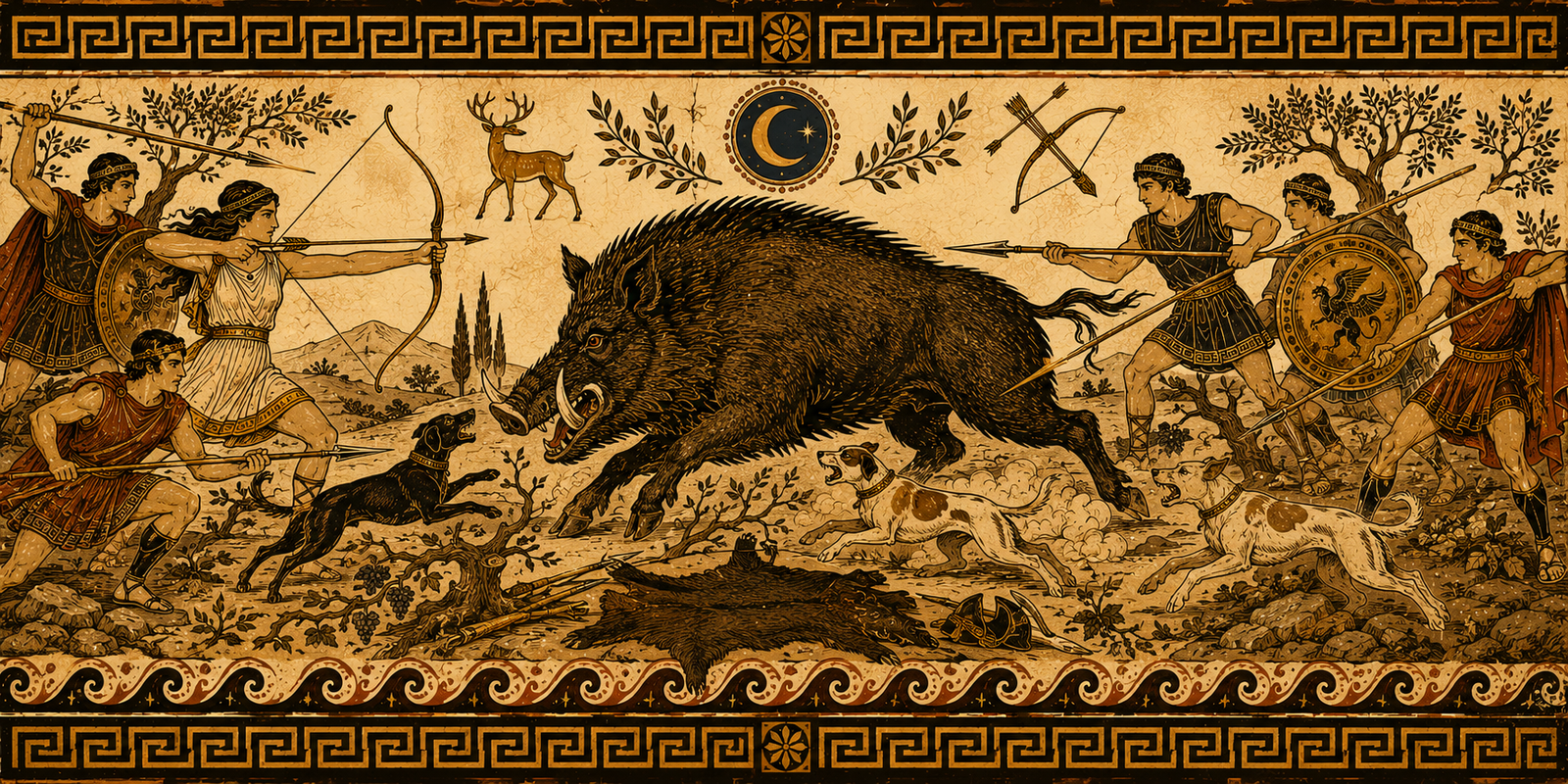

The Calydonian Boar Hunt: Artemis, Atalanta, and the Monster in the Fields
After Atalanta’s race, meet the monstrous boar, Artemis’s anger, and the hunt where heroes learned that pride can survive the monster.
Now that you have seen Atalanta run, you should see her in another part of the old Greek world: not on a race path this time, but in a hunt where kings, heroes, dogs, spears, and one terrible boar all met in the fields of Calydon.
This matters because Atalanta was not only swift.
She was not only the girl in the race.
She was a hunter too.
And in the story of the Calydonian Boar, she stood among famous men who had to learn, rather uncomfortably, that courage is not always found where they expected it.
The Short Answer
The Calydonian Boar Hunt was one of the great hunts of Greek myth.
It began when King Oeneus of Calydon honoured the gods after a rich harvest, but failed to honour Artemis properly. In Greek myth, forgetting a goddess is not a small mistake.
Artemis answered by sending a monstrous boar into the land.
This was not an ordinary animal wandering where farmers wished it would not wander. It was a punishment with tusks. It tore through the fields, ruined vines and orchards, frightened people from their work, and made the land itself feel unsafe.
So Oeneus’s son, Meleager, called for heroes to come and hunt the boar.
Many came.
Among them was Atalanta.
She was not there to watch.
She was there to hunt.
Why Artemis Was Angry
Artemis is the goddess of the hunt, wild animals, young creatures, swift arrows, and the wild places that do not belong to anyone.
She can protect. She can guide. She can stand near the young, the swift, and the untaken.
But Artemis is not a goddess one forgets safely.
When King Oeneus celebrated his harvest, he gave honour to the gods. That was wise. A harvest does not arrive only because a king says so. It comes through rain, soil, seed, labour, sun, season, and the mysterious patience of the earth. In the old Greek world, it also came under the eyes of gods who expected to be remembered.
But Oeneus failed to honour Artemis.
Some tellings say he forgot her. Some suggest he neglected her. Either way, Artemis was left out.
This was unwise.
A mortal may forget a cup, a cloak, or where he has put his sandals. Forgetting Artemis is a different matter.
She did not need to come to the palace and shout. A goddess with a bow can answer an insult from very far away.
She sent the boar.
The Boar in the Fields
The boar came into Calydon like rage given a body.
It had bristles along its back, hard and dark. Its tusks curved white from its mouth. Its shoulders were heavy. Its eyes were small, hot, and full of the simple dreadful certainty that everything before it should be broken.
It tore through the fields as if the earth had offended it.
Vines were ripped up. Young trees were broken. Crops were flattened. The neat work of human hands became mud, splinters, and fear. Dogs barked from a distance and then thought better of it. Men who had boasted loudly indoors discovered excellent reasons to remain indoors a little longer.
The people of Calydon could not live like this.
Fields must be tended. Roads must be used. Children must be able to walk without every bush becoming a possible terror. A kingdom cannot continue if one terrible animal has made the outside world belong only to fear.
So Meleager called for help.
The Heroes Gather
Heroes came from many places.
This is what heroes often do when there is danger, honour, and the chance that someone else might become famous first.
They came with spears, bows, hunting dogs, polished weapons, strong legs, louder voices than were strictly necessary, and the air of men who believed the story would remember them kindly.
Some names were already famous. Some would become famous later. Some probably became more famous in their own telling of the story than in anyone else’s.
Meleager was there, of course. He was the son of Oeneus, prince of Calydon, and the man who had called the hunt. He was brave, strong, and young enough to believe that courage might be enough to solve what had been broken.
Others came too: hunters, princes, warriors, men with heroic fathers, men hoping to become heroic fathers, men who had done great things, men who intended to begin very soon.
And Atalanta came.
This displeased some of them.
That is one of the quickest ways Greek myth has of telling you something important about those men.
They did not think a woman belonged among the hunters. They did not think she should stand beside them with bow and spear. They did not think she should share the danger, the glory, or the story.
That was unfortunate for them, because the boar did not care what they thought.
The boar cared about tusks, rage, speed, and whatever stood in its path.
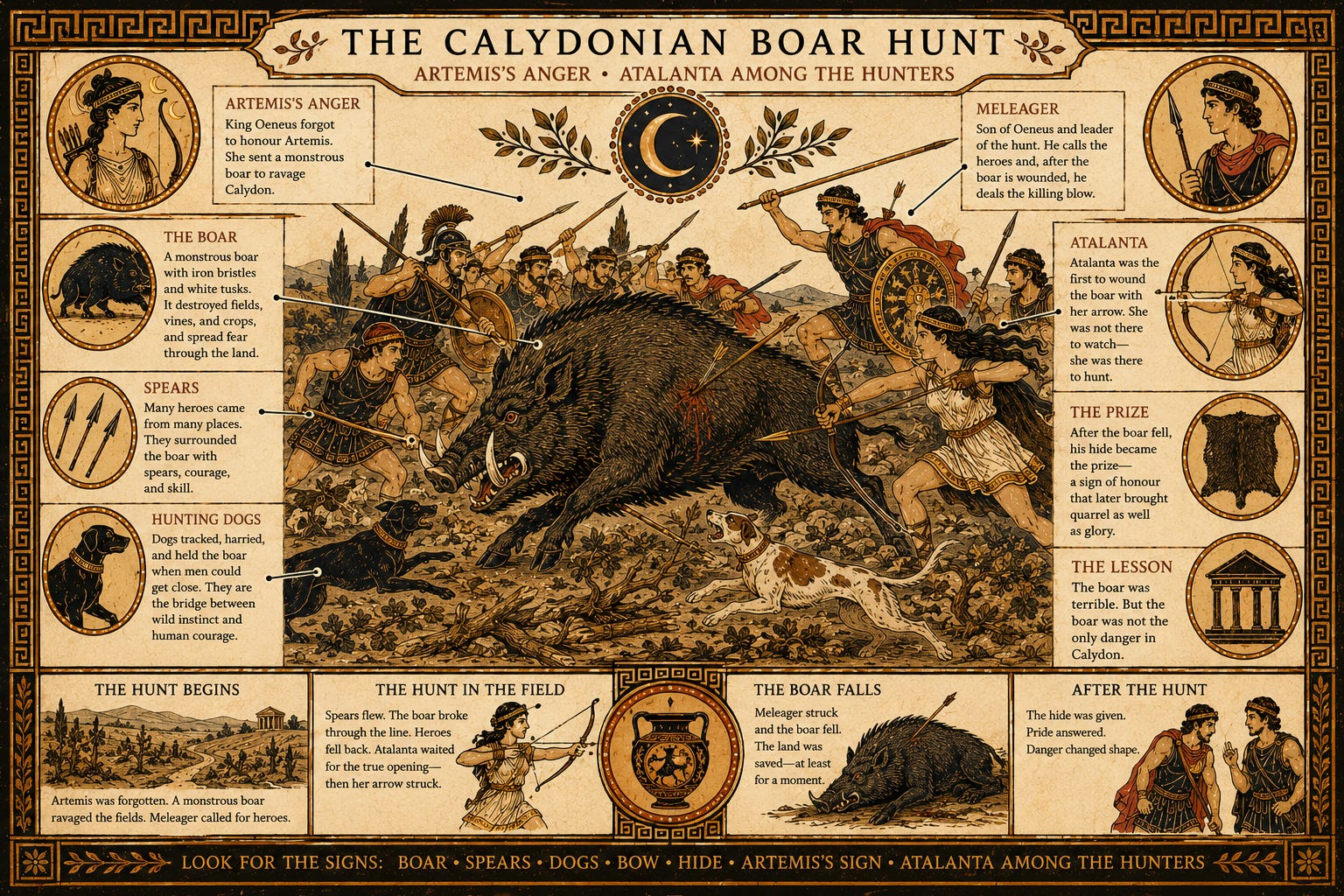
Atalanta Among the Hunters
Atalanta had already learned the wild.
She knew tracks. She knew silence. She knew the place between waiting and movement. She knew that fear could be useful if you did not let it drive the chariot.
A hunt is not only strength.
A hunt is patience, reading, listening, judgement, and the ability to move at exactly the moment when waiting has ended.
Atalanta knew these things.
When the hunters entered the land where the boar had been seen, the fields no longer felt like ordinary fields. Every broken vine was a sign. Every churned patch of earth was a message. Branches hung torn. Mud held the deep marks of hooves. The dogs moved uneasily, noses low, then heads up, then low again.
The heroes tightened their grips on their weapons.
Even the loud ones became quieter.
There are many kinds of silence. The silence before a feast is not the silence before a storm. The silence before a race is not the silence before a monster. The silence before the Calydonian Boar was the kind that makes every person present discover how much breath they have been wasting.
Then the boar came.
It burst from cover with a force that made the dogs scatter and men shout before they had decided to shout. Spears flew. Some struck badly. Some glanced away. Some went nowhere useful at all, which is an old problem with panic.
The boar moved faster than its size should have allowed.
It threw men aside. It broke the line of hunters. It turned the careful gathering of heroes into a disorderly lesson in how little a plan means once a monster has arrived.
Atalanta did not rush in.
That is worth noticing.
Bravery is not always the first person forward. Sometimes bravery is the person who waits long enough to see the true opening.
She drew her bow.
The string tightened.
For a moment, everything narrowed: the boar, the breath, the line between danger and aim.
Atalanta loosed.
Her arrow struck.
In many tellings, Atalanta was the first to wound the boar.
Remember that.
Not the loudest hunter.
Not the proudest.
Not the man most certain that he belonged there.
Atalanta.
The wound did not kill the boar. A creature like that does not fall because one arrow has told the truth about it. But the arrow mattered. It slowed the beast. It turned the hunt. It showed the others where the monster could be struck.
Meleager saw.
That matters too.
He saw what she had done.
Then he attacked. Spears struck. Dogs surged in and back. Men shouted. Dust rose. The boar turned, charged, bled, fought, and at last, after fear, confusion, skill, and force had all had their say, Meleager killed it.
The monstrous boar fell.
For a moment, the danger seemed finished.
Of course it was not.
The Prize and the Quarrel
The hide of the boar was the prize.
This was not only a useful thing to make into something warm. It was honour. It was proof. It was the sign that the hunt had happened and that the story would remember a name beside it.
Meleager gave the prize to Atalanta.
He did this because she had wounded the boar first, because her arrow had mattered, and because he was brave enough in that moment to see what many of the others did not wish to see.
Atalanta had earned honour.
Some of the men objected.
This is the part of the story where the boar is dead and the danger should be over.
But in Greek myth, danger often changes shape.
The men who had disliked Atalanta’s presence now disliked her honour even more. It was one thing, apparently, for her to stand in danger beside them. It was another for the proof of that danger to be placed in her hands.
They quarrelled.
The quarrel grew ugly.
The story becomes darker from here. Meleager’s anger, his family, the prize, the old resentments of a house, and the terrible speed with which honour can become bloodshed all belong to the larger myth. You do not need every sorrow here in order to understand the hunt.
What you need to know is this:
The boar was terrible.
But the boar was not the only danger in Calydon.
What the Hunt Shows
The Calydonian Boar Hunt shows several things at once.
It shows that Artemis must not be forgotten. The wild has gods behind it, and those gods remember insult.
It shows that a monster can make a whole kingdom afraid.
It shows that heroes may gather bravely and still quarrel foolishly.
It shows that Atalanta was not merely swift. She was skilled, watchful, and brave where danger was real.
It shows that some people are willing to accept help from someone they do not respect, but unwilling to see that person honoured.
That is not wisdom.
It is pride wearing armour.
The hunt also shows one of the old Greek truths: killing the monster does not always end the trouble. Sometimes the monster only reveals what was already waiting inside the people who came to fight it.
That is why the story matters.
Not because the boar was large, though it was.
Not because the heroes were famous, though many were.
Not because Artemis was angry, though she was.
It matters because when the danger came, Atalanta stood among the hunters. When her arrow struck, the story could not pretend she had not been there. And when honour came toward her, the pride of others showed its teeth.
Signs and Symbols
If you see a picture of the Calydonian Boar Hunt, look for the boar first.
It will usually be large, dark, bristling, and central. It may have curved tusks and a lowered head. It should not look like an ordinary farm animal. It is Artemis’s anger moving through the fields.
Look for spears and bows.
The spears belong to the gathered heroes. The bow may lead you toward Atalanta, especially if she stands slightly apart, watching for the moment when aim matters more than noise.
Look for hunting dogs.
They show that this is a hunt, not a battle. Dogs belong to the wild edge between human skill and animal instinct.
Look for the hide.
After the boar falls, the hide becomes the prize. In the story, that prize carries honour, and honour can be more dangerous than it looks.
Look for Artemis’s signs.
A bow.
A deer.
A crescent moon.
A wild tree.
Even when Artemis is not standing in the picture, the hunt begins because of her.
And look for Atalanta.
Do not let the famous men crowd her out.
She came to hunt.
She struck.
She mattered.
One Thing to Remember
The Calydonian Boar Hunt began with a goddess forgotten, and it ended by showing what heroes are like after the monster falls.
Sometimes the monster is killed, and the danger is still not finished.
—
Receive the next work
Subscribe free to receive new work from the The Alexander Series Library by email.
More from the Library

See Also
A concise and impartial dictionary of absence, promises, quarrels, ordinary objects, and the troublesome instability of words.

The City of Service
The temple we inherit is a building from which almost all necessity has been removed. Nothing must be brought for it to continue being what we call a temple. The sanctuary asks nothing of us. Stone is good at this kind of independence.
A living temple was otherwise.
Water had to come in. So did grain, cloth, oil, aromatic substances, fuel. The things required for worship arrived because someone carried them across a threshold.

Houses of Wood, Light, and Smoke
Some of Angkor’s most intimate ruins do not rise above the ground at all. They are postholes, low mounds, hearths and ponds: durable traces of a domestic city built largely from things that decay. To restore that city is to see Angkor not only as stone, but as wood, smoke, water, repair, and people living within calling distance.