
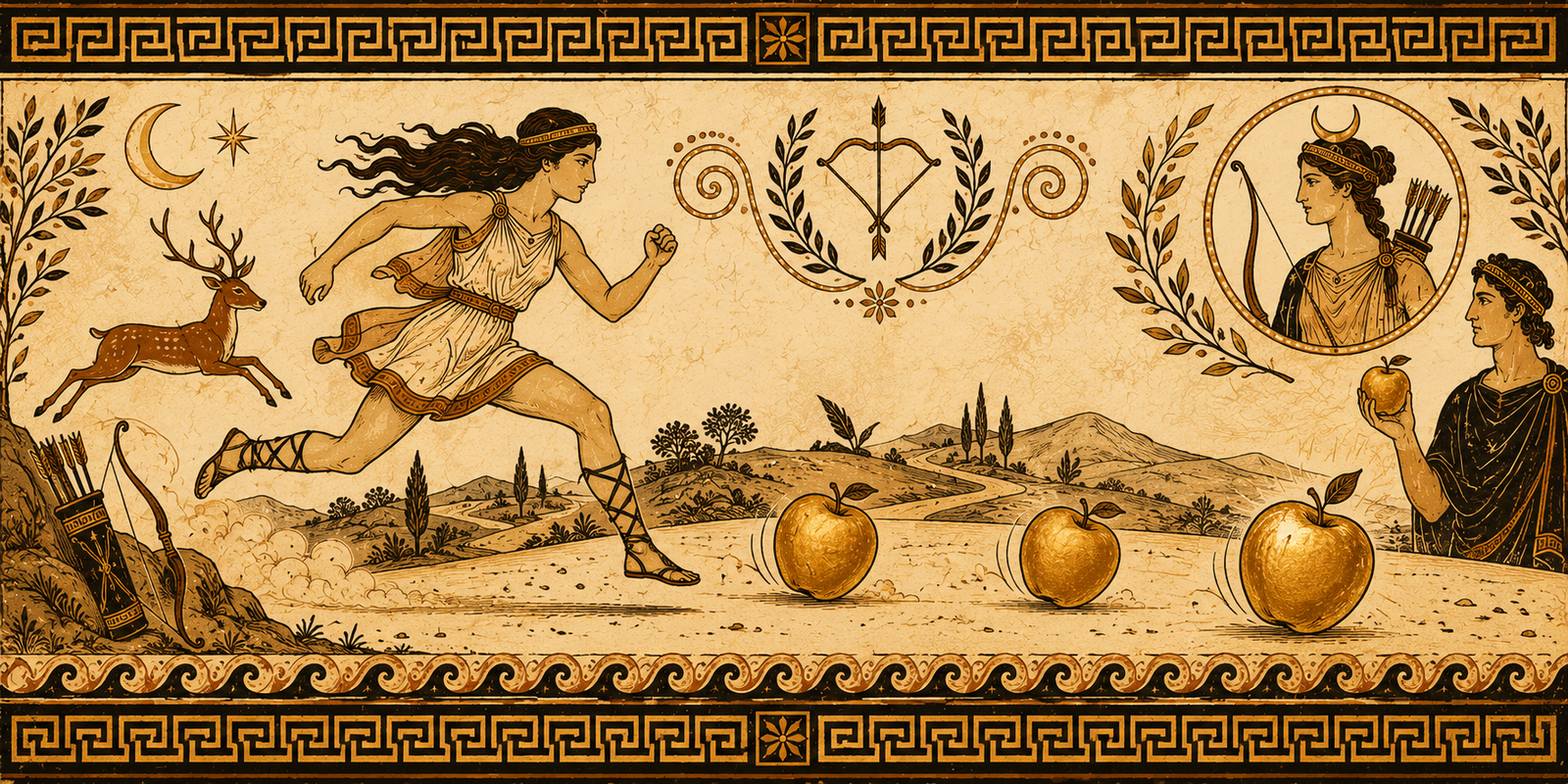

Atalanta Runs for Her Freedom: The Girl No One Could Catch
A Greek myth retold with speed, danger, golden apples, and the fierce cost of trying to remain uncaught.
Atalanta knew the forest by speed.
She knew which stones shifted after rain, which roots would catch a careless foot, where the deer crossed at morning, and how the air changed just before a hare broke from cover. Other children learned the rooms of a house. Atalanta learned the spaces between trees.
No one had taught her to run as if the whole world had opened a road beneath her. She had learned because running was how the world first answered her.
When she was very small, people who should have kept her safe left her where the wild could find her. That is the gentlest way to say it.
The wild did find her.
It did not do what they expected.
A she-bear came first, great-shouldered and dark, with breath like warm earth and paws that could have broken a man’s courage without trying. But she did not harm the child. She fed her. She kept her alive. And if this sounds strange, you must remember that Greek stories are full of people behaving worse than beasts, and beasts behaving better than people expected.
Later, hunters found Atalanta and raised her among bows, dogs, tracks, weather, and the hard good sense of the woods. She grew straight and swift. She learned the pull of a bowstring. She learned when to move and when to be still. She learned that a snapped twig could mean supper, danger, or nothing at all, and that only fools decided too quickly which it was.
Whether Artemis herself watched over the child no one had wanted, the story does not say. Greek stories are often careful about what they refuse to say.
But anyone who saw Atalanta run would have thought of Artemis.
She ran like something the forest had meant to keep.
She could pass between trees without losing breath. She could cross a stream by touching only three stones. She could follow a deer until the deer itself began to seem surprised. When she ran downhill, loose pebbles leapt after her as if trying to keep up. When she ran uphill, men who watched from below stopped speaking, which is not a small achievement where men are concerned.
Soon people began to talk.
This is what happens when someone is very good at something. First one person sees it. Then three people speak of it. Then a stranger repeats the story and adds a little shine to it. Then someone far away, who has never seen the thing at all, begins to behave as if it belongs partly to him because he has heard of it.
Atalanta’s name travelled.
Hunters spoke of her. Shepherds spoke of her. Young men spoke of her while pretending not to be impressed. Old men spoke of her with the suspicious tone of people who think the world has been arranged incorrectly because it no longer surprises them in the old ways.
“She is swift,” they said.
“She is proud,” said others, who usually meant that she had not bowed quickly enough.
“She is beautiful,” said some, and that was when the trouble sharpened.
Men came to see her.
At first they came as if they had only happened to be passing by, which was unlikely, since several had crossed mountains to happen in exactly that direction. They watched her shoot. They watched her run. They watched her stand beneath the trees with her bow across her shoulder and her hair caught back from her face.
Then they began to ask for her hand.
This was a strange thing to do after watching Atalanta run. A sensible person might have thought, “Here is someone who belongs to herself more clearly than most people do.” But a surprising number of men, having seen a girl no one could catch, decided that the next sensible thing was to try to catch her.
Atalanta refused them.
She refused princes, hunters, sons of kings, men with polished shields, men with excellent horses, men with too much confidence, and one man who had composed a very long speech about destiny and seemed disappointed when she did not stay for the end of it.
Still they came.
At last Atalanta gave them a rule.
“If any man wishes to marry me,” she said, “he must race me. If he outruns me, he may have what he came for.”
The men brightened at this. Men often brighten just before they understand the second half of a sentence.
“If he loses,” said Atalanta, “he will not ask again.”
That was the polite version.
The truer version was darker.
Those who lost would pay with their lives. The old stories say this plainly. We do not need to stand beside that darkness for long, but we must not pretend it was not there. Atalanta had made the race dangerous because the thing being gambled was dangerous. Her life was not a ribbon to be handed over after sport. If men wanted to turn her freedom into a contest, then the contest would have teeth.
Some men heard the rule and went home.
These were the wiser ones.
Many stayed.
The first runner came with a laugh, as if laughter might make his legs longer. He had trained, he said. He had raced horses, he said. He had never been beaten, he said.
Atalanta listened politely, because there is no reason not to let a man use up his breath before a race.
They stood at the line.
A strip of dust stretched ahead of them, pale under the sun. The watchers gathered. The leaves held still. Somewhere above, a hawk turned once in the sky.
The signal came.
The man leapt forward.
For a few heartbeats he looked splendid. His arms drove hard. His feet struck dust. His face shone with the grand surprise of discovering that stories about Atalanta had perhaps been exaggerated.
Then Atalanta passed him.
She did not strain. She did not look angry. She did not even look particularly interested. She passed him as a deer passes a gate: briefly near, already gone.
The watching men grew quiet.
That was the first race.
There were others.
One man lasted longer and began, foolishly, to hope. Atalanta let him hope until the final stretch, then lengthened her stride and left him with his mouth open and his glory behind him.
Another tried to start before the signal. Atalanta caught him anyway.
Another prayed loudly to several gods at once, which may have confused the gods and certainly did not help him.
Another wore a fine cloak until someone explained that fine cloaks are excellent for banquets and very poor for running away from Atalanta.
Each race ended the same way.
Atalanta crossed the line first.
After a while, the path itself seemed to know her.
Then Hippomenes came.
He did not arrive boasting. That is something in his favour. He came to watch, and at first he thought the other men were mad.
Why would anyone risk so much for a race he could not win?
Then Atalanta stepped to the line.
Hippomenes saw the set of her shoulders. He saw the calm in her face. He saw that she was not performing for the crowd. She was simply waiting for the world to make room for her speed.
The signal came.
She ran.
And Hippomenes understood at once why the others had lost.
A moment later, he understood why they had tried.
That was his danger.
He was not a fool. If he had been only a fool, this would be a simpler story. He saw Atalanta clearly enough to be astonished. He saw her speed. He saw her courage. He saw that ordinary confidence would break itself against her like a clay cup against stone.
But he did not see clearly enough to leave her free.
Instead, Hippomenes went to Aphrodite.
Now, you must not imagine Aphrodite as merely the goddess of sighs, roses, and people leaning out of windows. That is a very small idea of Aphrodite, and a dangerous one. Aphrodite could set cities trembling. She could turn sense aside. She could make the wise behave strangely and the proud behave foolishly. She knew how beauty worked upon the human heart, which is another way of saying that she knew where people were weakest.
Hippomenes asked for help.
Aphrodite gave him three golden apples.
They were not ordinary apples. Ordinary apples are fine things and should be respected, especially when one is hungry, but these were not that sort.
These apples shone as if the sun had been persuaded to become fruit. Their skins held a deep gold, warm and impossible. They seemed heavier than apples should be, as if each one carried a secret inside it. To look at them was to feel that something beautiful had appeared where it did not belong.
“Use them carefully,” Aphrodite said.
Gods are fond of saying things like this after giving mortals objects that will almost certainly cause trouble.
On the day of the race, many people came.
By now Atalanta’s races were famous. Some came because they admired her. Some came because they wanted Hippomenes to win. Some came because people have always been willing to watch danger when they think it belongs to someone else.
Atalanta stood at the line.
Hippomenes stood beside her.
He held the apples hidden in his tunic. He could feel their weight against him.
Atalanta looked at him once.
Perhaps she knew he was different from the others. Perhaps she saw fear in him, and that made her respect him more than the men who had arrived wrapped in their own certainty. Perhaps she saw nothing except another man who had chosen the race.
The signal was given.
They ran.
At first Hippomenes ran well.
That matters. The apples alone would not have saved a man who could barely move his feet. He was young, strong, and swift. Dust rose behind him. The crowd shouted. His breath came hard but steady. For a little while, the race was almost a race.
Almost.
Then Atalanta began to pass him.
There was no drama in it. That was the terrible thing. She did not suddenly become mighty. She simply became herself.
Her stride opened. Her feet touched the earth lightly and left it at once. The air seemed to know her and move aside. Hippomenes heard her before he saw her: the quick rhythm, the soft strike of foot on dust, the sound of someone arriving from behind who would soon be ahead.
He drew out the first apple.
For one breath he held it.
Then he threw it.
The apple struck the path and rolled once, bright as a small fallen sun.
Atalanta saw it.
Of course she saw it. She had been trained by the forest. She saw movement at the edge of sight. She saw colour where colour had no business being. She saw danger, beauty, and strangeness almost before they appeared.
For the smallest moment, she turned.
Only a little.
Only enough.
Her foot shifted. Her stride shortened. Her hand went down, and the apple came up into her palm, warm and gold and impossible.
Hippomenes gained several paces.
The crowd cried out.
Atalanta’s head lifted.
Now she knew.
She ran again.
This time she ran harder.
The distance between them vanished. Hippomenes heard her coming and felt fear open inside his ribs. Not shame. Not surprise. Fear. The fear of a man who has asked for divine help and discovered that even divine help may not be enough.
Atalanta drew beside him.
He threw the second apple.
It flew farther than the first, flashing as it went, and landed near the edge of the path where the dust thinned into grass.
Atalanta should have ignored it.
She knew this now. She knew it as clearly as she knew the slope of the ground beneath her. She knew Hippomenes was not faster. She knew the apples were the race.
But knowing a thing is not always the same as being free of it.
The second apple shone in the grass.
Not like food.
Not like treasure exactly.
Like a question the world had no right to ask in the middle of her running.
Atalanta turned again.
This time the turn cost more.
Hippomenes ran on. His lungs burned. His legs ached. The finish line waited ahead, no longer impossibly far.
Behind him, Atalanta sprang back onto the path.
She had lost ground.
She had not lost the race.
Not yet.
The crowd was no longer cheering properly. It had become too tense for that. People made sounds and then stopped. Dust hung in the air. Somewhere, far above the race, the gods may have watched. Greek gods often did, especially when they had made the trouble themselves.
Atalanta came on.
No one who saw her forgot it.
She ran as if the first two apples had angered the truth of her body. She ran as if the path had called her back by name. She ran as if every tree she had ever passed, every deer she had ever followed, every morning of cold breath and wet stones and wild silence had gathered into her legs.
Hippomenes looked back.
This was a mistake, but an understandable one.
She was there.
Nearer.
Nearer.
Her face was fierce now. Not cruel. Not afraid. Fierce in the way a living thing is fierce when something has tried to close around it and failed.
Hippomenes took out the third apple.
It was the brightest of the three.
Or perhaps it only seemed brightest because it was the last.
For one heartbeat, he did not throw it. He held it and ran, and in that heartbeat perhaps some better part of him understood what he was doing.
Then fear answered before wisdom could.
He threw.
The third apple flew high.
Sunlight struck it.
The whole path seemed to flash.
Atalanta saw it rise, turn, fall.
By the third apple, even the dust seemed to know.
It landed beyond her, not far from the line, where one more stride might have carried her past it forever.
That was the cruel wisdom of Aphrodite’s gift. The apple did not fall where Atalanta could easily despise it. It fell where she could think, only for a moment, that she might take it and still win.
Atalanta reached.
Her fingers closed around gold.
Hippomenes crossed the line.
For a moment, no one moved.
Then the shouting began.
Men shouted because Hippomenes had won. Others shouted because they had seen something impossible. Some shouted because people often shout when silence would ask too much of them.
Hippomenes bent forward, gasping, one hand on his knee. Dust clung to his legs. His heart hammered. He had won the race.
Atalanta stood behind him.
The third apple lay in her hand.
It was beautiful. That was part of the sorrow. If the apple had been ugly, if it had been crude, if it had looked like a trap, the story would be easier to bear. But it was beautiful, and Atalanta had seen beauty even while running for her freedom.
The shouting came from far away.
The apple was very near.
Hippomenes turned to look at her. What he saw in her face, the story does not tell us plainly. Perhaps that is mercy. Perhaps it is another of the old story’s silences.
Atalanta had lost.
Not because she was slow.
Not because she was weak.
Not because the men had been right about her.
It had taken a goddess, three golden apples, and a young man’s cunning to make Atalanta lose by a breath.
That is not the same thing.
Some stories go on from here, and not gently. Greek myths often do. They follow promises, punishments, marriages, mistakes, and gods who remember being forgotten. But this tale has been running toward one bright thing on the path, and there we will leave it.
Atalanta stood with the apple in her hand.
Behind her, the road lay open, bright with the speed she had spent.
—
Receive the next work
Subscribe free to receive new work from the The Alexander Series Library by email.
More from the Library


See Also
A concise and impartial dictionary of absence, promises, quarrels, ordinary objects, and the troublesome instability of words.

The City of Service
The temple we inherit is a building from which almost all necessity has been removed. Nothing must be brought for it to continue being what we call a temple. The sanctuary asks nothing of us. Stone is good at this kind of independence.
A living temple was otherwise.
Water had to come in. So did grain, cloth, oil, aromatic substances, fuel. The things required for worship arrived because someone carried them across a threshold.

Houses of Wood, Light, and Smoke
Some of Angkor’s most intimate ruins do not rise above the ground at all. They are postholes, low mounds, hearths and ponds: durable traces of a domestic city built largely from things that decay. To restore that city is to see Angkor not only as stone, but as wood, smoke, water, repair, and people living within calling distance.