
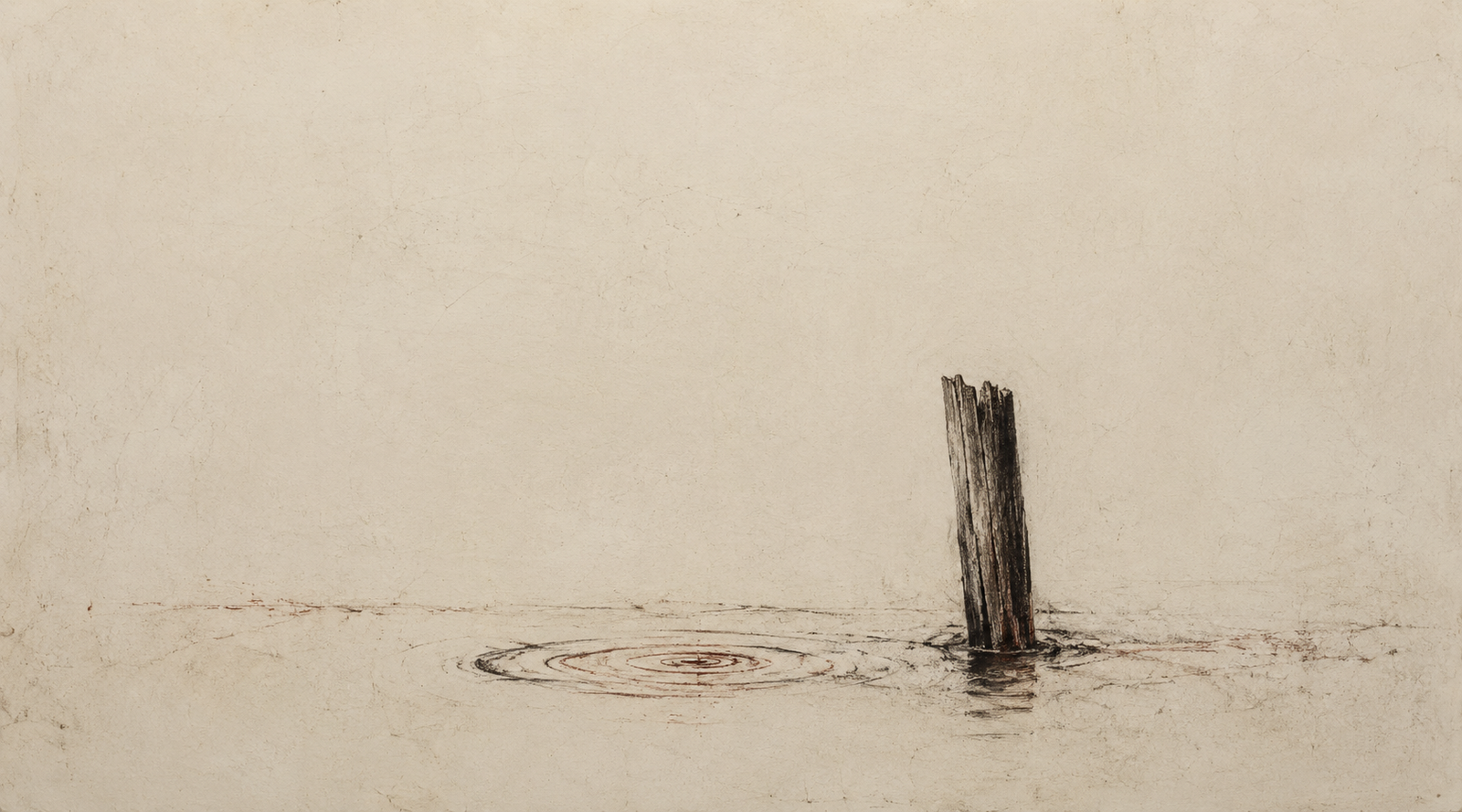

Houses of Wood, Light, and Smoke
On Angkor’s vanished wooden houses, household ponds, and the human world that stone could not preserve.
The Vanished House
Some of Angkor’s most intimate ruins do not rise above the ground at all.
They are hollows in the earth, changes in the soil, lines of postholes where timber once stood, low mounds whose slight elevation means almost nothing until someone tells you to look again.
There is no doorway to enter, no wall to touch, no lintel from which to read a name or a god. The building itself has gone. This requires a different kind of seeing.
We are accustomed to ruins that remain recognisably architectural. Even in collapse, a stone temple gives us something to work with. Walls survive without roofs. Doorways open into vanished rooms. Columns stand without the beams they once carried. The imagination has only to complete what is broken.
A wooden house asks more of us.
At places across Angkor, archaeologists have found traces of structures that once stood on raised ground: patterns of holes where wooden posts had been driven into the earth, compacted surfaces, hearths, fragments of cooking vessels, grinding stones, the debris of ordinary use. At Prasat Trapeang Ropou, at Angkor Wat, at Ta Prohm, the timber has disappeared but its arrangement has not vanished completely. The earth remembers where weight once rested upon it.
Occasionally the material itself survives. In the Royal Palace enclosure at Angkor Thom, charred lower portions of great wooden posts have been recovered from the soil. They are exceptional precisely because wood so rarely leaves us this much. Elsewhere, there is usually only the place where the post had been.
A void becomes evidence.
A row of postholes implies uprights. Uprights imply a structure lifted from the ground. The raised earth beneath them tells us that a surface had been prepared for habitation. A hearth nearby tells us that fire was tended here. Broken earthenware belongs to food, water and storage. A grinding stone implies repetition: something placed upon it, crushed or rubbed, lifted away, and placed there again.
The smallest durable objects begin to gather around the vanished structure, and slowly the house returns.
Not a particular house. That is beyond us. We do not know the exact arrangement of its interior, if rooms are even the right way to imagine it. We cannot say with confidence where a child slept, how possessions were kept, how privacy was created, or precisely how one household arranged itself beneath a roof. The organic partitions, mats, baskets, ropes, cloth and timber that might have answered such questions have gone with the walls themselves.
It is remarkably easy to rebuild too much. Once a roof has been restored in the mind, a ladder follows; then rooms, furniture, a family arranged within them. Before long the archaeologist’s postholes have become a scene, and possibility has hardened into fact.
What survives permits something less precise and, in another sense, more important: a material world.
Wood was everywhere and almost nowhere survives. So too the lighter substances that accompanied it—thatch, fibre, matting, basketry, rope, cloth. These were not incidental materials around the margins of an otherwise permanent civilisation. They were among the substances of ordinary life.
The imbalance in what remains is immense. A clay vessel may survive after the basket or shelf that held it has disappeared. A stone mortar remains after the wooden pestle is gone. Seeds may be preserved by charring while the containers that stored them vanish. A ceramic roof tile can endure in the soil for centuries; a roof of grass or palm leaves leaves almost nothing recognisable behind.
The durable objects accumulate in excavation reports and museums. The softer world recedes.
Time has stripped the domestic city of many of the things that made it domestic: the woven wall, the thatch, the mat beneath a body, cloth hung to dry, a wooden tool smoothed by repeated handling, the cord tying one thing to another.
Stone gives Angkor its surviving weight. Ordinary life must once have given it another quality altogether: lighter, warmer, more provisional. Not weak or insubstantial, simply made according to another material logic.
Permanence can deceive us about significance. A stone tower that survives for eight centuries has not thereby become more real than the house beside it that disappeared.
The mound beneath our feet may be all that remains above ground of a place inhabited through years or generations. Here is raised earth. Here the dark mark where a post once entered the soil. Here a broken vessel, the trace of a hearth.
If we allow only what those fragments permit, the posts begin to rise again.
Beyond them, smoke becomes possible.
Raised Dwellings and Compounds
Raised timber construction appears repeatedly in the archaeological and visual evidence for domestic Angkor. Houses stood on posts associated with elevated surfaces or habitation mounds, lifting lived space away from ground that could be damp, muddy and seasonally wet.
Elevation was not ornament. It was an accommodation.
The same plain that hardened beneath the dry-season sun changed character when the rains came. Soil softened. Hollows filled. Paths became mud. Water tables rose. The distinction between dry ground and wet shifted with the season. The house answered by lifting itself—not into monumentality, but high enough for another kind of space to exist beneath it.
This changes how we should imagine domestic architecture at Angkor. A modern eye tends to place the life of a house inside its walls. We think first of rooms: where people slept, cooked, stored possessions, gathered or withdrew. The building becomes a container for domestic life.
The surviving evidence suggests something more open.
Above was a sheltered platform, removed from the wettest ground and protected beneath a roof. Below and around it lay another zone: shade, working space, storage, animals, tools, movement. Domestic artefacts occur around vanished buildings. Hearths, cooking vessels, grinding stones and working surfaces show that practical life spread onto the ground. Reliefs reinforce the impression, showing raised structures around which activity continues.
The space beneath a raised floor offered shade, some protection from rain and immediate access to working ground. Heavy objects could remain below. Animals and equipment could stay close without occupying the sheltered platform above. It was neither fully indoors nor fully outside, and that ambiguity may have been one of its virtues.
For this reason, compound may be more useful than house, provided we do not make the compound too precise. There is no reason to suppose that every dwelling shared one arrangement of structures, fences, gardens and work areas, and no reason to treat a modern Cambodian village as an unchanged survival from the twelfth century. What the evidence gives us is a broader spatial logic: much domestic life belonged to the territory beneath and around the house as well as to the platform above.
A relief may show a loom, livestock, baskets or tools around a raised structure. Such details tell us what was possible and, in some cases, customary; they do not give us a single representative household to reconstruct. The real domestic city was more variable than any reconstruction can comfortably show.
It was also unequal.
One household possessed what another did not. A substantial residence differed from a poor one. An official’s dwelling did not announce the same status as that of an agricultural worker. Zhou Daguan, who lived at Angkor in 1296–97, described a society in which roofing materials and the scale of dwellings could mark rank: ordinary people used thatch, while tiled roofing belonged to privilege. His account comes after the central twelfth-century world of this book and belongs to a society already undergoing change. It is most useful here where his observations meet archaeological or visual evidence rather than where they stand alone.
Decay has made such distinctions harder to see. A fine timber residence and a poorer structure of lighter materials may both eventually end as disturbed earth. The disappearance of wood does not merely erase buildings; it can erase differences between them.
Yet the recurring architectural gesture remains powerful. Lived space was raised, the ground beneath remained active, and domestic life occupied both.
At Angkor Wat, the relationship between monumental construction and ordinary occupation becomes particularly vivid. Archaeologists have found flat sandstone pieces lying within residential areas, interpreted as reused construction material that may have provided firmer surfaces around timber dwellings.
Fragments of the monument lay beneath the feet of ordinary life.
Whoever placed them may simply have wanted somewhere less muddy to step. That practicality is precisely what matters. The worlds of stone and wood were not sealed apart. Temple construction altered nearby ground. Discarded material could become useful. Workers, attendants and households inhabited the same wider landscape in which the monument rose.
Around it stood timber: posts carrying floors, beams carrying roofs, lighter walls or woven surfaces whose precise form we can only partly recover, thatch across much ordinary habitation.
Domestic architecture was more exposed to its surroundings than the stone monuments were. Its surfaces were thinner. Shade lay close to sunlight. The boundary between inside and outside was softer.
To restore these houses, then, we need not begin by drawing walls. It is more useful to restore gradients: above and below, shade and glare, dry ground and wet, shelter and openness, private and shared.
The household was not a box placed in the landscape. It was a way of arranging life within it.
And near that raised ground, often close enough to belong to the same daily rhythm, there was water.
The Pond Beside the House
The pond changes the house. Without it, we might still imagine the dwelling as something placed upon the land: a timber structure raised against dampness, surrounded by working ground, belonging to a household or group of dependants.
With the pond beside it, the house becomes part of a larger arrangement.
Across the Angkorian landscape, raised habitation and small excavated ponds occur together again and again. From the air, through LiDAR, and on the ground, these pairings emerge as one of the signatures of settlement: a low mound, a rectangular depression, another mound beyond it, another pond.
What survives is geometry. What has vanished is use.
A pond is easier to preserve than a house because emptiness can endure. Wood rots, thatch disappears, fibre returns to soil, but a hollow in the earth can remain long after the hands that dug it are gone.
The ponds varied. Some may have served individual households, others several households or larger compounds. Their functions probably overlapped and changed with place, season and need. But the association is too persistent to dismiss as incidental.
To live here was to live near water.
Not yet the monumental water of moats and great reservoirs, nor the larger engineered landscapes through which Angkor managed abundance, risk and power. This was smaller water, close enough to belong to domestic life.
Zhou Daguan, writing a century later than much of the world considered here, also noticed households with pools, sometimes shared among several families, and described bathing and washing as ordinary practices. In this instance, his testimony rests beside something more durable.
The ponds are still in the ground.
Their persistence allows us to approach cautiously what their presence meant. Water held near habitation shortened the distance between domestic life and one of its basic necessities. Bodies needed washing. Containers needed filling. Animals needed water. Plants around habitation required moisture. Working ground had to be negotiated through seasons of saturation and dryness.
The pond shortened distance.
That alone gives it importance.
There is another relationship embedded in its form. To dig a pond is to create two things: a hollow and a quantity of earth. Across Angkor, where habitation often occupied deliberately raised ground, the connection is suggestive. Soil removed from one place could contribute to elevation in another. Water and dryness were not simple opposites. The act of making one could help create the other.
The evidence does not give us a universal sequence—pond dug, mound raised, house built—but the material logic matters. A landscape of mounds and ponds was made through subtraction and accumulation: earth taken away here, earth raised there, water gathered in one place, human life lifted in another.
The plain was not merely occupied. It was worked into habitability.
The scale of that work matters. The great reservoirs make Angkor’s manipulation of water spectacular. Their dimensions encourage explanation. The household pond does the opposite. It contracts our attention, bringing us back from the capital to the distance between shelter and water, from the monumental to the bodily.
A rectangular pond beside a timber house also invites beauty: a roof repeated in the surface, morning light, smoke doubled in stillness. Yet a pond used every day was not a reflecting pool arranged for contemplation. Its edges were worked. Feet disturbed them. Animals approached them. Rain changed them. Dry months lowered them. Mud belonged to them, along with insects, plants, debris and the ordinary untidiness of water held near human habitation.
Its intimacy was practical before it was beautiful.
It could also be shared. Paths crossed. Water was approached from more than one direction. The sounds of one compound carried into another.
House, pond, raised ground, path, another house, another pond, perhaps a local shrine or temple, fields beyond. The pattern changed from place to place, but the principle accumulated. Households existed within networks of shared ground and repeated use.
This makes the pond one of the quietest correctives to the monumental image of Angkor. The moat tells us about enclosure. The household pond tells us about return.
Again and again people came back to it—for water, for washing, for practical needs too ordinary to leave much record. Civilisation consists largely of things done too often to be commemorated. No inscription records the thousandth walk between a dwelling and its water, yet such journeys belong to the ordinary infrastructure on which a city depends.
A hole where timber once stood. A hollow where water gathered. Between them, the space in which people lived.
The house required dry ground. Daily life required water. Angkorian domestic architecture negotiated both.
Once that relationship becomes visible, the vanished house gains another dimension. It is no longer merely timber raised over earth. It belongs to earth that has been lifted and water that has been gathered.
And now it can begin to fill with work.
Smoke, Cooking, Storage, Repair
A house becomes inhabited through repetition: rice husked, water carried, a fire made, a vessel washed, something ground against stone, something hung out of the rain, something repaired before it failed.
Around Angkor’s vanished houses, archaeology finds traces of precisely this kind of recurrence. Hearths, broken cooking vessels, portable clay stoves, grinding stones, utilitarian ceramics, cotton seeds and spindle whorls—objects too ordinary to commemorate, yet durable enough to survive after almost everything around them has gone.
They bring us closer than architecture does. A posthole tells us where a building stood. A cooking pot tells us that somebody had to eat.
At the level of the temple, Angkor can seem to have been built from acts of extraordinary intention: foundations laid, towers raised, inscriptions carved, gods installed. At the level of the household, civilisation was maintained by recurrence. Fire had to be made again. Food prepared again. Grain made edible. Cloth spun or woven. What was used had to be stored. What broke had to be repaired or replaced.
Nothing about this is uniquely Angkorian, and that is partly the point. The invisible city becomes human when its necessities cease to be exotic.
A hearth cut into the ground is not mysterious. Neither is a clay pot blackened by fire. Their power lies in familiarity. We know what it means for a vessel to be used until it breaks. We know what a household becomes when fire, water, food and storage must continually be organised around one another. We need not invent the family to recognise the work.
The evidence for cooking is among the most tangible parts of the vanished domestic world. Hearth arrangements are known. Portable pottery braziers survive in fragments. Earthenware vessels occur in residential deposits. Grinding implements speak of food preparation and other repeated tasks. Reliefs add images of cooking and provisioning, though a carved kitchen scene cannot tell us the plan of an ordinary house, and a banquet cannot stand for an ordinary meal.
Still, fire belongs securely here. And where there was fire, there was smoke.
Smoke cannot survive excavation, but it follows from the work that can. Fuel burned, food cooked, fires were tended. In low morning light, smoke from domestic fires would have become visible above timber and thatch: a settlement revealing itself not through towers but through what the air briefly held.
Here imagination can restore movement without pretending to restore biography. Fire burns, smoke lifts, a pestle falls, a vessel is moved. The work continues.
Grinding stones return us to hands. Stone survives here not as temple but as tool, its authority coming from use. The same is true of pestle and mortar. The wooden component may disappear while the heavier object remains.
Again the archaeological record divides the original action in two: the durable half survives; the organic half vanishes.
We inherit the mortar without the pestle, the spindle whorl without the thread, the ceramic jar without whatever it held, the metal blade without its wooden handle.
Tropical preservation has not simply removed buildings. It has preferentially removed things that bent, frayed, wore smooth, absorbed sweat, carried weight and yielded beneath the hand.
Rope. Basketry. Cloth. Thatch. Wood. Matting.
Much of the tactile civilisation has disappeared.
What remains is disproportionately hard—stone, ceramic, metal—and the archaeological city therefore appears more rigid than the lived one was.
The domestic compound required far more than those surviving objects suggest. Grain, water, tools, cloth, food and small possessions had to be carried, held, covered, suspended, stored. Some containers were ceramic and survive. Many others were made from substances that do not.
A household containing only the things archaeology preserves would have been scarcely habitable.
Cotton offers another glimpse. Carbonised seeds and objects associated with spinning survive in some residential contexts while the cloth itself is gone. If cotton was processed, fibres had to be prepared, thread made, cloth worked somewhere within the orbit of domestic life. We do not need to know precisely who sat where to understand the larger fact: the wooden city made cloth, and the cloth disappeared.
Work survives unevenly.
That matters because Angkor’s monumental surfaces can create the impression that the civilisation’s characteristic labour was building in stone. Domestic archaeology reverses the scale. Most human effort never touched sandstone. Most hands were occupied by substances that did not last: food, water, wood, fibre, soil, plants, animals, fire.
And the house itself belonged to that labour.
Organic architecture reacts to its environment. Rain finds weakness. Heat dries and opens. Moisture lingers. Insects enter. Thatch loosens. Timber deteriorates. We do not need an exact schedule for replacement to recognise the larger material truth: maintenance was not an occasional interruption to domestic life. It was part of domestic life.
This alters the image of construction. A stone temple encourages us to imagine a moment of completion: scaffolding descends, the deity is installed, the building stands. A wooden house has no equivalent final state. Sooner or later something asks for attention.
Stone concentrates enormous labour into construction and then carries some of that work forward in its mass. Wood distributes labour through time.
Human attention becomes part of the architecture.
Temporary is therefore the wrong word if it suggests disposable. These houses were renewable. Roofs could be patched or replaced, lighter surfaces remade, weakened elements renewed, mats worn through and exchanged for others. What persisted was not always the material itself, but the place, the arrangement and the knowledge required to make it again.
A wooden civilisation could remain stable while its materials changed. That is a different form of endurance from the stone monument, and one almost invisible to us now.
The temple survives without the masons who raised it. A wooden house cannot continue indefinitely without people who tend it. Its survival depends upon repeated noticing: something loosening, leaking, rotting, wearing through.
A broken cooking pot and an empty posthole therefore belong to the same world of recurring attention. What cracked was replaced. What loosened was mended. The fire that went out was made again the following morning.
By then smoke would be rising above more than one roof, and domestic life would already be audible beyond the limits of a single compound.
Family Nearness and Human Scale
Other people were near.
The city revealed by mounds, ponds, roads and temple enclosures was not a landscape of isolated dwellings standing alone in empty space. Houses gathered into compounds and neighbourhoods. Water was sometimes shared. Paths crossed. Work spread beyond walls. Temple communities placed large numbers of people within the same wider residential landscape.
This does not tell us exactly who slept beneath each roof. The evidence for household composition is thinner than the evidence for posts or ponds. Inscriptions record names, occupations, dependants and service populations, but they were not written to describe domestic affection or everyday arrangements. Reliefs show women, men, children, workers and servants, but carved scenes are not household censuses.
The Angkorian household was more complicated than a modern nuclear family translated backwards into time. Kinship extended more widely. Wealthier households could include servants, dependants and bound labourers. Temple populations were entangled with obligations reaching far beyond one dwelling.
Nearness did not therefore imply equality. The material intimacy of the compound existed within a society in which rank, dependence and obligation mattered profoundly.
Zhou’s account is stark on this point. He describes subordinate or enslaved people sitting and sleeping beneath raised houses and entering upper living areas under conditions of marked deference. We cannot turn one late account into a universal domestic plan, but neither should the warmth of timber, ponds and cooking smoke soften away what such evidence reveals.
The household could contain coercion as well as kinship.
The same shaded space beneath a raised floor might mean relief from the sun to one person, work to another, and subordination to someone who had little choice about being there. People could live, work and eat within the same domestic orbit without sharing equally in its security. The human scale of the house did not diminish hierarchy; it made hierarchy intimate.
That recognition belongs here even though its larger structure belongs to the chapter that follows. Service did not begin at the temple door. Obligation reached into households, kinship, land and the organisation of everyday life. The domestic world from which people walked towards the monuments was already threaded with unequal claims upon labour.
Yet hierarchy is not the only form of nearness the evidence allows us to recover.
A compound was surrounded by signs that other lives were close: another hearth, another pestle striking grain, movement along a neighbouring path, another household approaching shared water, animals shifting beneath a nearby floor. Structures made from timber, thatch and lighter walling would have offered far less acoustic separation than stone. Work announced itself—grinding, pounding, cutting, animals, water disturbed at its edge, speech, objects lifted and put down, the sounds of repair.
The city did not wait in silence between ceremonies. It sounded like people living.
Children are among the inhabitants who occasionally cross the barrier of abstraction. They appear in reliefs and in administrative records. Their presence should not surprise us, yet somehow it does. Monuments age the civilisation that made them; stone gives the past gravity. Children restore its youth.
Angkor was not populated only by kings, priests, warriors, workers and dancers. It contained people who had not yet become any of those things.
Older people lived there too. Written records occasionally give elders formal importance as witnesses to land, boundaries and community memory. That institutional role hints at something more ordinary. A city continually rebuilding itself depended upon remembered practice.
Knowledge belonged to bodies as much as inscriptions. People knew how things were repaired, where boundaries lay, how water behaved, how work was done. A technique may survive without the hands that taught it; a place-name can outlast the voice that explained it.
Domestic life carried civilisation forward in ways the monuments could never record.
This is perhaps what human scale finally means: not simply smaller architecture, but another measure of continuity. Temples leave reigns, dedications, foundations and dates more readily than households do. Domestic life proceeds through meals, seasons, illnesses, births, repairs and returns.
Most of that memory is gone.
We possess almost none of the private voices of ordinary Angkor. No body of household letters or diaries tells us how weather, illness, quarrels, absences, dependence or affection were experienced from within these compounds. The great archive is instead full of power: kings, foundations, donations, gods, land, obligations, names arranged in service to institutions.
Domestic life survives largely without speech. We know it through where people stood, what they discarded, what they cooked with, the ground they raised, the water they dug, the work their households owed.
The closer we come to ordinary experience, the quieter the record becomes.
Historical imagination does not require us to supply the lost voices ourselves. Sometimes it is enough to restore the conditions in which those voices once existed: timber, raised floors, ponds, working ground, smoke, neighbouring houses.
Then stop.
The people will not become individuals, but the space between them becomes visible. A child does not need a name for us to know that children were here. A person grinding something against stone does not need to become a character. An elder does not need invented memories. A servant does not need fictional thoughts placed in their mouth.
Their humanity does not depend upon our completing them. The refusal to complete them is a form of respect.
We can know that they lived near one another; that their lives crossed; that some relationships were chosen and others imposed; that people shared water, work, shelter, risk and weather while occupying very different positions within the same world.
Almost all of this has disappeared.
The surviving stone makes loss look architectural. We stand before Angkor and think of fallen towers, missing roofs, collapsed galleries, vanished statues. But much of what is truly missing never had a stone form.
The nearness of people. The sound of work from another house. A path worn because many feet used it. Smoke from several roofs entering the same morning air. An elder who remembered. A child who did not yet. A neighbour at the pond. Someone repairing what rain had loosened. Someone carrying food. Someone carrying water.
A civilisation lived at these distances.
Then its domestic materials disappeared and the distances opened. Houses went. Ponds remained as hollows. Postholes filled. Working surfaces sank beneath soil. Paths blurred. Compounds loosened into landscape. Stone appeared to stand farther apart because the human fabric between the monuments had vanished.
That is the Angkor we inherited: magnificent, and strangely spacious.
It was not always spacious.
Once there were roofs between the towers, shade beside the roads, fires beyond the temple walls, people within calling distance.
To restore that nearness is not to invent the lost city. It is to correct the scale at which we see it.
The monuments stood inside this quieter world of houses, ponds, food, repair, dependence and human proximity. Every day, people left that domestic world and walked towards the stone.
There, the claims upon their labour became larger, more organised, and more visible.
Service.
—
Receive the next work
Subscribe free to receive new work from the Lucas Varro Library by email.
More from the Library


See Also
A concise and impartial dictionary of absence, promises, quarrels, ordinary objects, and the troublesome instability of words.

The City of Service
The temple we inherit is a building from which almost all necessity has been removed. Nothing must be brought for it to continue being what we call a temple. The sanctuary asks nothing of us. Stone is good at this kind of independence.
A living temple was otherwise.
Water had to come in. So did grain, cloth, oil, aromatic substances, fuel. The things required for worship arrived because someone carried them across a threshold.

Harmonia and the Fatal Union
The gods came to Thebes for Harmonia’s wedding.
The Muses sang in the house Cadmus had built, and Cadmus fastened around her neck a necklace wrought by Hephaestus. They feasted with the gods.
The day had been beautiful.
Nothing that came later took that day from them.
In the years that followed, the house filled with children, grandchildren, ordinary voices—and losses for which no beginning could finally provide an answer.