

Harmonia and the Fatal Union
A tale of marriage, inheritance, grief, and what remains when almost everything else has been taken.
The gods came to Thebes for Harmonia’s wedding.
For eight years Cadmus had served Ares for killing the serpent at the spring. Now Ares’s daughter stood beside him. Her mother, Aphrodite, had come too. The Muses sang in the house Cadmus had built, and people working in the courtyard stopped to listen. The song carried into the streets of the new city.
Cadmus gave Harmonia a robe and a necklace wrought by Hephaestus. She held her hair aside while he fastened the necklace. The clasp was small, and his fingers took time to close it. When he had finished, she turned towards him. He was still looking at his work.
They feasted with the gods. There was singing and enough food to carry through the rooms all day. By evening the cups needed washing, the fires tending, the places where the guests had sat clearing. Harmonia remembered the voices of the Muses after she could no longer hear them. The day had been beautiful. Nothing that came later took that day from them.
In the years that followed, they had four daughters and a son. The children knew where to find each parent by the sounds they made about the house. They learned which doors caught against the floor and how far they could run before someone called them back. Harmonia fastened small garments, loosened them again as the children grew, and kept the worn ones for a while before letting them go.
Cadmus grew older beside her. The city grew too. Men came to him with disputes that had begun among people neither of them knew. Their daughters went out to other households and returned with news. Polydorus stayed close to Thebes. When the whole family gathered, there were more voices at the table than the room had held in the first years of their marriage.
Ino brought her boys to visit. One afternoon the elder fell in the courtyard and scraped his knee. He tried hard not to cry while Harmonia washed the grit from it. His little brother stood nearby, watching her hands. When she had finished, the elder boy walked away carefully, as though his knee required great dignity of him.
Harmonia saw him again many times. She remembered that afternoon years later, when neither boy could be brought home.
Semele was the first of their daughters to die. Zeus had come to her, and she had asked to see him in a form her body could not survive. The people who told Cadmus and Harmonia could say what had happened in the room. After they had gone, Harmonia and Cadmus remained there together. There were questions still to ask, but no one left who could answer them for Semele.
They went on living. The next morning had its work, and so did the morning after it. A child came through the door wanting his grandmother. A daughter stayed to eat and spoke of something that had happened on the road. Cadmus listened; Harmonia asked to hear the rest. There were hours in which they took pleasure in the people still with them.
Autonoe’s son Actaeon went hunting and was killed by his own hounds. Ino lost one child and carried the other into the sea. At each new account, Harmonia had to learn where her daughter had been, what someone had seen, and what remained uncertain. Then she had to live with what she knew.
Agave came down from the mountain carrying the head of her son Pentheus. She did not know it was his. Cadmus was with her when she understood. Harmonia saw them after that: her husband old and bent, her daughter looking at the thing she had held. Harmonia went to Agave. There was nothing she could do to make her put it down sooner.
They remained in Thebes for a time. People still crossed the courtyard and brought ordinary matters to the house. The streets Cadmus had founded were crowded with lives that continued beyond their grief. Harmonia could walk through them and remember her children at every age. Cadmus knew where the old paths had been before there were streets.
At last they left.
They travelled slowly. Cadmus stopped more often than he once would have done, and Harmonia rested with him. Sometimes they spoke of the children. Sometimes they recalled a day from the early years and found that each had kept a different part of it: a small voice heard from another room, rain beginning during a meal, a daughter refusing to be helped down a step. When they fell silent, they kept walking together.
Near Illyria, Cadmus spoke of the serpent at the spring.
He had spoken of it before, but now he wondered whether its death had brought all their suffering upon the house. Harmonia could see that he wanted to find a beginning for what had happened. She remembered the spring. She remembered his years of service to Ares, and the wedding that followed them. She had no answer that could tell him why Semele had died or why Agave had come down from the mountain with her son in her hands.
Cadmus said that, if the serpent was still being avenged, he might as well take its form.
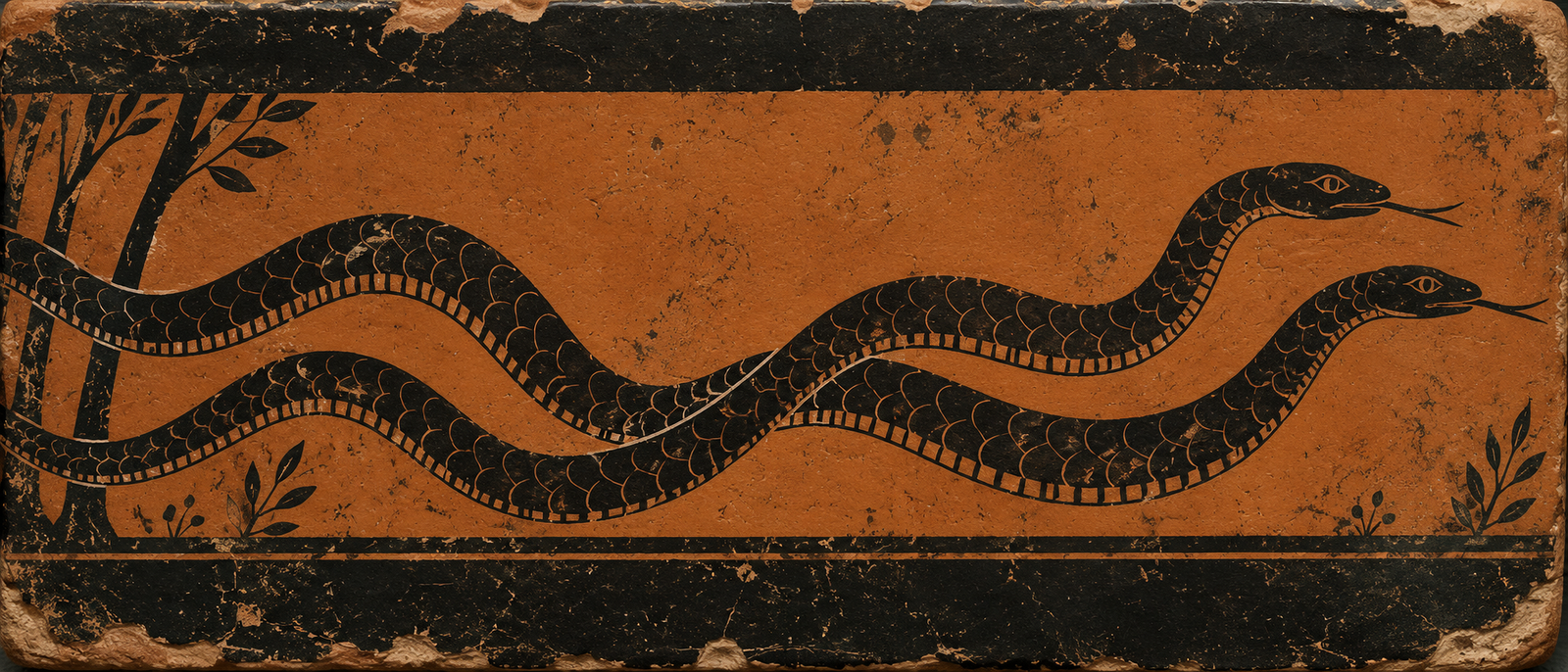
His skin began to harden while he stood beside her. He looked down at his arms. Dark scales spread across them, then over his chest. His legs drew together, and he sank towards the ground. For a little while his face remained his own.
He reached for Harmonia. She caught his hand.
He called to her while he could still make words. She knelt with him and felt his fingers changing against hers. Then his hand slipped away, and the sound he made came from a mouth that could no longer speak her name.
The others on the road drew back. Harmonia stayed. Cadmus turned his altered head towards her, and she put out her hand again. The scales were smooth beneath her palm. She knew him there, though she could no longer hear his voice.
She called on the gods to change her too.
Her hands went first. She watched them lose their shape against his body. Soon she was on the ground beside him, moving through grass that rose higher than either of their heads.
They went into the trees together. When people came upon them later, they stepped aside. The two serpents passed close by and did them no harm.
—
Receive the next work
Subscribe free to receive new work from the House of Cadmus Library by email.
More from the Library


See Also
A concise and impartial dictionary of absence, promises, quarrels, ordinary objects, and the troublesome instability of words.

The City of Service
The temple we inherit is a building from which almost all necessity has been removed. Nothing must be brought for it to continue being what we call a temple. The sanctuary asks nothing of us. Stone is good at this kind of independence.
A living temple was otherwise.
Water had to come in. So did grain, cloth, oil, aromatic substances, fuel. The things required for worship arrived because someone carried them across a threshold.

Houses of Wood, Light, and Smoke
Some of Angkor’s most intimate ruins do not rise above the ground at all. They are postholes, low mounds, hearths and ponds: durable traces of a domestic city built largely from things that decay. To restore that city is to see Angkor not only as stone, but as wood, smoke, water, repair, and people living within calling distance.