

What Stone Brings Forth
A small mystery in the carvings of Ta Prohm, and the moment a serpent, a garland and a makara changed the way I saw the temple.
I have walked past these mouths for years.
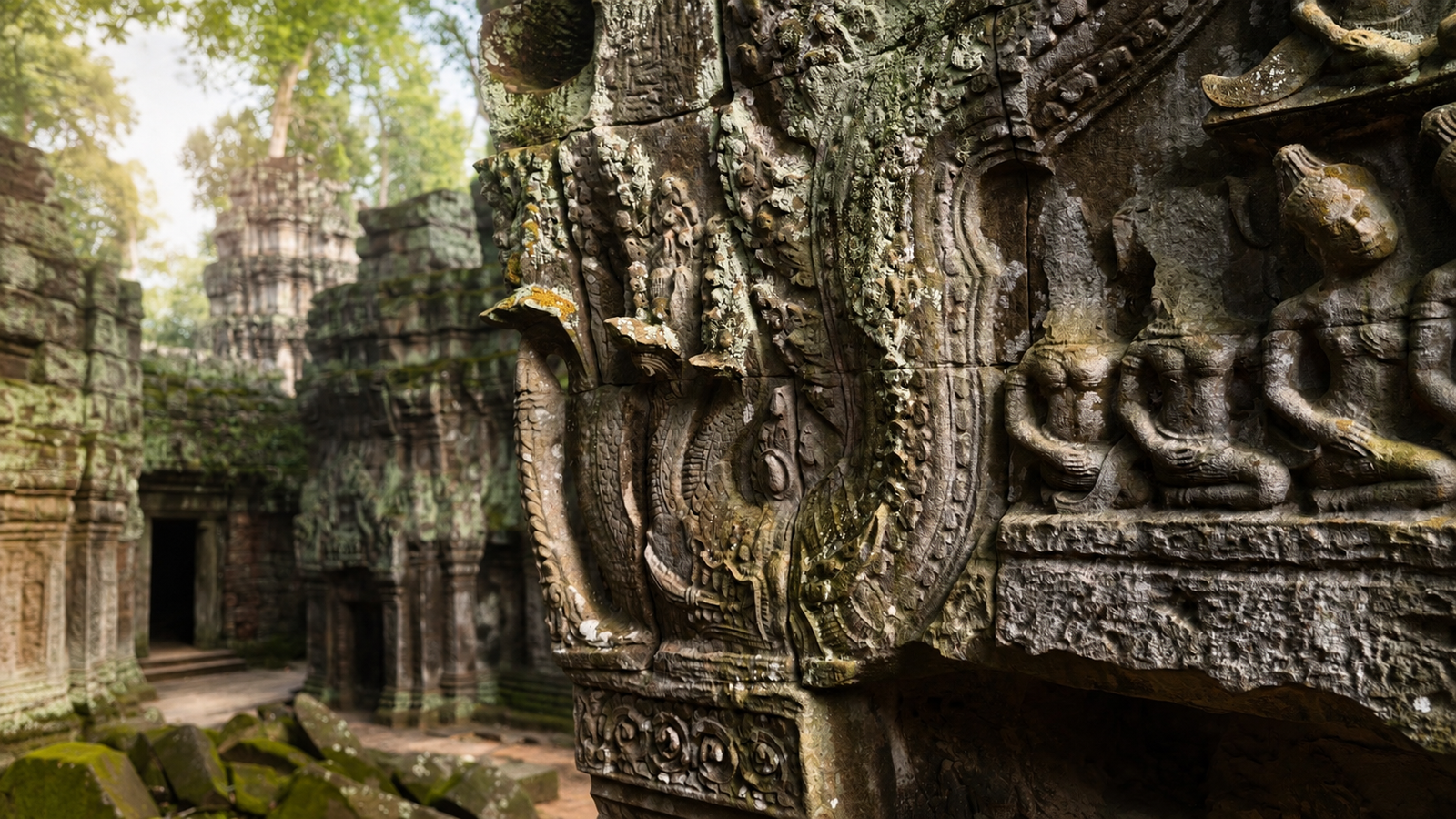
They occupy the corners of pediments throughout Angkor: stone nāgas projecting from the architecture, their bodies bending away into the carved borders around them. They are so much a part of the visual language of the temples that, after enough years, the eye can acknowledge them without really stopping.
At Ta Prohm this morning, I stopped.
Something appeared to be hanging from the mouth of one of them.
Once noticed, it was impossible not to see. A long, segmented form descended from beneath the jaw, one rounded shape following another until the whole thing resembled an extraordinary tongue.
Or, less elegantly, something the serpent was regurgitating.
That was my first thought. There seems little point in improving it after the event.
I moved closer.
The stone was alive with lichen. Pale green colonies occupied the recesses of the carving; darker growth gathered beneath the projecting surfaces. Centuries of rain had softened everything. Scales had begun to resemble leaves, leaves had become small swollen forms, and the old distinctions between one element and another were slipping away.
The strange thing beneath the serpent's mouth had suffered especially. Whatever delicacy it once possessed had been worn almost smooth.
But it was not a tongue.
It was a garland.
A surviving sandstone antefix from the Khmer cultural world, made around 1100 and now in the Norton Simon Museum, preserves the convention much more clearly. There a nāga quite unmistakably holds a jewel garland in its mouth. The museum interprets the garland as an offering towards the sacred image within the temple and links it with the nāga's associations with treasure, fertility and abundance. (Norton Simon Museum)
I looked again at the serpent at Ta Prohm.
Nothing in the stone had changed, of course.
And yet everything had.
The succession of worn knobs became flowers, beads, perhaps jewels. What had appeared bodily became ornamental. What I had taken for something being expelled began to look like something being offered.
This is one of the quiet pleasures of learning something while standing in front of the thing itself. Knowledge does not always close a question. Sometimes it sends you back to the stone with better eyes.
And when I looked again, I noticed another mouth.
Only a little farther along the same tower was a makara.
The makara refuses the tidy zoology we would like to impose upon it. It belongs to the imaginative world of water and fertility, but its body borrows freely from creatures that should not coexist: something of crocodile, fish, elephant, serpent, sometimes lion. Khmer sculptors inherited the form and transformed it repeatedly.
And makaras have a wonderful habit.
Things come out of them.
In Khmer architectural ornament there are makara-toraṇa compositions in which nāgas or other beings emerge from the makara and become part of the surrounding frame. Adalbert Gail's study of serpent imagery at Angkor records precisely this combination of makara and nāga within Khmer architectural ornament. (Angkor Database)
Standing beside this one, however, the terminology suddenly seemed less interesting than what the sculptor had actually done.
A mouth had become a beginning.

The creature did not end at its teeth. Something continued from it.
And once I began looking in that way, the whole piece of architecture altered.
The nāga curved into the border of the pediment. The border became vegetation. Leaves curled towards bodies; bodies lengthened into architectural lines. Garland, serpent, foliage and stone seemed less like separate things placed beside one another than different states through which a single form was passing.
Creature became ornament.
Ornament became architecture.
Architecture brought forth leaves.
Perhaps we sometimes make these temples too easy to understand by naming everything.
Nāga.
Makara.
Garland.
Pediment.
The names matter. I want to know them. But names also draw boundaries around things that the sculptor seems to have delighted in allowing to flow into one another.
Stand close enough to Khmer carving and those boundaries become remarkably unstable.
A serpent becomes a balustrade long enough to cross water. Lotus petals gather beneath the weight of towers. Vegetal scrolls produce gods and animals among their foliage. Monsters open their mouths and release other forms into the architecture around them.
The temple is built, certainly.
But everywhere its stone behaves as though it has grown.
At Ta Prohm, that thought becomes particularly difficult to escape.
The temple was dedicated in 1186 under Jayavarman VII, and the centuries since have brought another kind of growth into intimate contact with the one imagined by its sculptors. (Apsara Authority)
Lichen does not respect iconographic boundaries.
It spreads across serpent and garland alike. It settles into the cuts that once defined scales. Moss gathers beneath projecting jaws. Tiny living forms occupy the carved foliage until, in places, it becomes difficult to tell whether one is looking at a leaf made by a sculptor or a leaf-shaped territory being reclaimed by something alive.
There is an easy story to tell about Ta Prohm.
Nature returned.
The forest invaded.
Roots overwhelmed architecture.
It is a powerful story, and anyone who has stood beneath the great trees here understands why it persists.
But look closely at these carvings and it becomes too simple.
The temple was already full of growth.
Long before roots crossed its galleries, leaves were unfolding from stone. Serpents became borders; borders became vines. Creatures opened their mouths and other forms emerged.
The forest did not introduce this language.
It answered it.
I looked once more at the strange pendant beneath the nāga's jaw.
My first thought had been wrong. It was not a tongue, nor something the serpent was trying to rid itself of. It was a garland, worn by centuries until flowers, jewels and scales had almost become indistinguishable.
Yet I found myself grateful for the mistake.
Had I recognised it immediately, perhaps I would simply have named it and walked on.
Instead, for a few minutes, something did not make sense.
And because it did not make sense, I looked.
Lichen had settled into the old cuts. Green life occupied the garland bead by bead, continuing in its own way what a hand in sandstone had begun more than eight centuries before.
The sculptor made stone bring forth leaves.
Now the leaves have begun to answer.
—
Receive the next work
Subscribe free to receive new work from the Lucas Varro Library by email.
More from the Library


See Also
A concise and impartial dictionary of absence, promises, quarrels, ordinary objects, and the troublesome instability of words.

The City of Service
The temple we inherit is a building from which almost all necessity has been removed. Nothing must be brought for it to continue being what we call a temple. The sanctuary asks nothing of us. Stone is good at this kind of independence.
A living temple was otherwise.
Water had to come in. So did grain, cloth, oil, aromatic substances, fuel. The things required for worship arrived because someone carried them across a threshold.

Houses of Wood, Light, and Smoke
Some of Angkor’s most intimate ruins do not rise above the ground at all. They are postholes, low mounds, hearths and ponds: durable traces of a domestic city built largely from things that decay. To restore that city is to see Angkor not only as stone, but as wood, smoke, water, repair, and people living within calling distance.