

The City of Service
Before sunrise, a temple is mostly stone and darkness.
The doorways are there, the galleries, the sanctuary at the centre, but little yet separates one surface from another. Carvings withdraw into shadow. A threshold is only a darker line across the floor. What remains most strongly is mass: blocks laid one upon another, walls enclosing walls, stone holding the night.
It is easy, standing there now, to imagine that this stillness belongs to the place.
It does not.
The temple we inherit is a building from which almost all necessity has been removed. Nothing must be brought for it to continue being what we call a temple. The sun may rise upon empty galleries. Rain may run from the roofs. Leaves may gather along a wall. The sanctuary asks nothing of us. Stone is good at this kind of independence.
A living temple was otherwise.
Food and water, cloth and fuel, substances required for worship: none appeared by themselves at the sacred centre. Someone brought them. Someone made them ready. Fire had to be tended. Doors and storehouses watched.
What appears to us now as still architecture was once crossed continually by such small necessities.
Not spectacle.
Work.
Some of it belonged close to the sacred image. Priests and officiants attended the rites by which a deity was approached and honoured. Around them were other forms of service: people preparing what the rites required, guarding what had been stored, tending what would be needed again tomorrow. Duties repeated according to established rhythms, some divided between alternating periods of service, so that the temple’s life depended not upon a single ceremony but upon return.
The sacred did not free the temple from the ordinary world.
It bound the temple to it.
Stone remains before us in extraordinary quantity; actions do not. A wall may stand for eight centuries while the lifting of a jar lasts only a moment. A threshold survives; the thousands of crossings that gave it purpose disappear. Repetition, however necessary, leaves little that the eye can recognise.
So the temple becomes quieter as it grows older.
We mistake the quiet for its nature.
Yet somewhere behind the surviving architecture lies another condition: not noise exactly, nor crowds, nor the imagined bustle of a modern workplace, but continual attendance. Things being done because they were needed. Duties ending only to begin again. Stone had permanence; life around it had rhythm.
And each morning, before the sanctuary could receive what the day required of it, the temple had to become ready once more.
—
Readiness required matter.
Rice first, perhaps, because there is almost nothing remarkable about rice until one considers how much had to happen before a portion of it could be placed before a god. It began elsewhere, beyond the sanctuary and its enclosing walls, in fields where grain was grown and gathered. It arrived not as sacred substance but as food still requiring work: carried, stored, husked, sorted, cooked.
Only then could it enter another order of use.
We are accustomed to thinking of an offering as a finished thing — a bowl set down, a flower placed, a flame already burning. But an offering begins long before the moment in which it is offered. Someone must turn what the earth provides into something fit to be given.
At Angkor, this work could be extraordinarily ordinary.
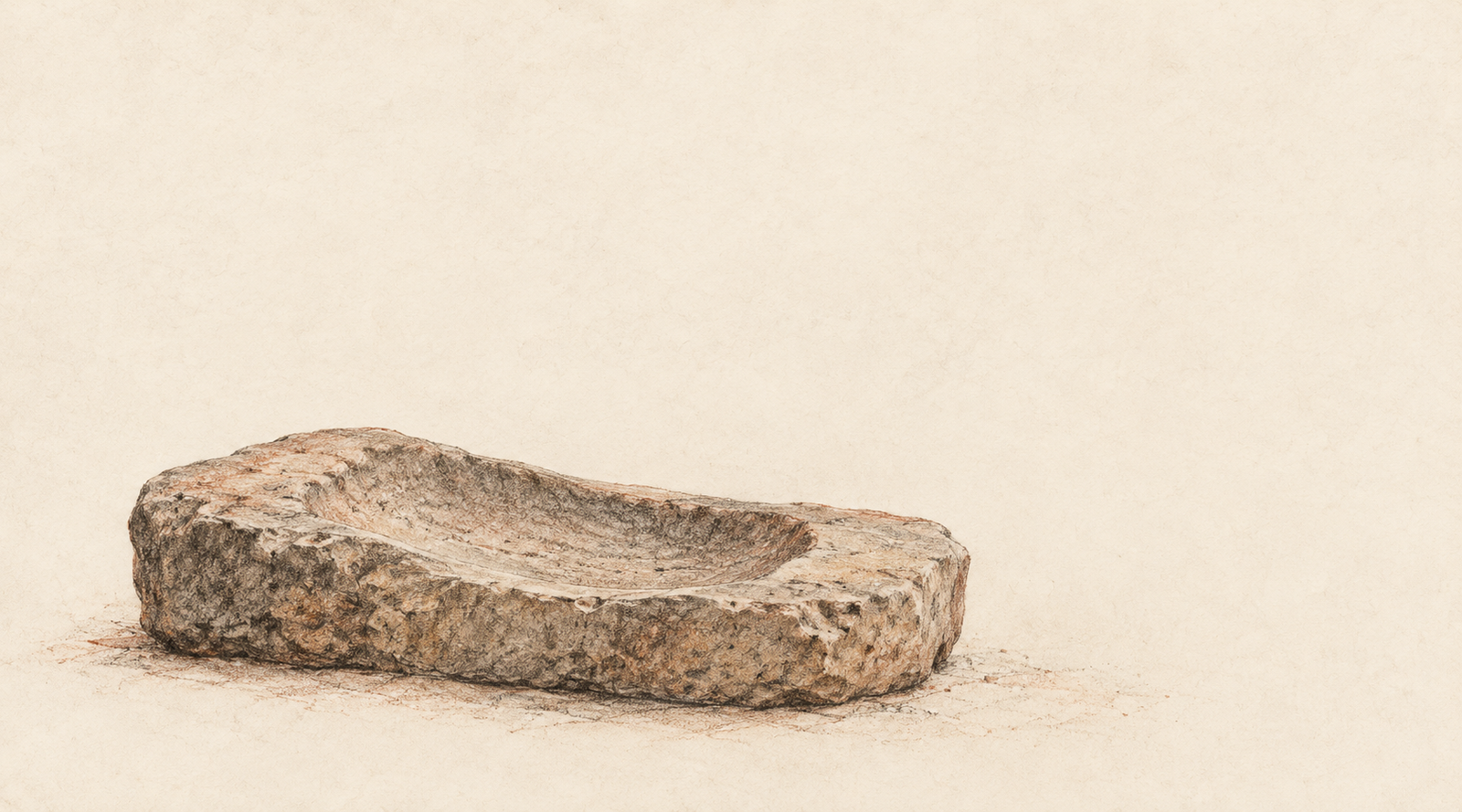
Heavy sandstone trays were used for grinding aromatic substances. Turmeric, ginger, long pepper, cardamom and other materials were crushed and worked beneath stone until their fibres broke down and their oils were released. Nothing about the action itself was ceremonial. The weight had to be pushed. The substance had to yield. The same movement repeated until what had been root, seed or bark became paste or powder.
Stone upon plant.
Pressure, release.
And from that labour came substances suitable for anointing, fragrance, incense, the intimate attentions paid to a sacred image.
Even light had to be made.
A lamp in a dark sanctuary is easily absorbed into the atmosphere of the place. We see the flame and think of devotion, perhaps, or mystery. Yet the flame depended upon something much less mysterious. Oil or clarified butter had to be supplied. A wick had to catch. What burned away had to be replaced.
The sacred flame survives only by being fed.
Behind the oil and clarified butter stood animals that had to be kept alive and tended. The path from herd to sanctuary was longer than the final lampful allows us to see; pasture lies behind the flame.
This is one of the peculiar powers of the surviving temples: they make the sacred appear almost immaterial.
Stone gives that impression. Stone is dry, hard, enduring. It has outlasted food, cloth, smoke, oil, leaves, flowers, the touch of wet hands. What remains can therefore seem purified of the perishable substances upon which worship once depended.
But the living sanctuary was not purified in this way.
It was entered by the world.
Some things were consumed. Some burned. Some spoiled. Some were poured away. Their impermanence was not incidental to sacred life. It was precisely why they had to be prepared and offered again.
A sacred image might stand at the centre, apparently complete in itself, while around it innumerable acts made worship possible. None possessed the permanence of stone.
Yet without them, the temple could not have lived as a temple.
The bowl before the god was never only a bowl.
Behind it lay grain, fire, labour, distance.
And hands.
—
The hands were not interchangeable.
Some belonged to priests who knew the names and rites by which a deity was approached. Others to people who taught, recited, guarded, stored, ground, carried, tended animals, played music, danced. A great temple gathered different forms of knowledge around itself, and with them different degrees of authority, obligation and nearness to the sacred centre.
To call all of this labour is accurate, but insufficient.
A priest entering the sanctuary did not perform the same work as a woman crushing aromatics against stone. A guard at a doorway occupied another place again; so did the keeper of cattle beyond the more immediate ritual space. Each stood somewhere within the same larger order, but not at the same distance from its centre.
There were people whose authority came from learning: teachers, ritual specialists, officiants entrusted with forms of knowledge not open to everyone. There were people whose skill was embodied rather than textual. Musicians played for ceremony. Dancers performed before the gods. Others prepared the substances without which those ceremonies could not proceed.
The dancer makes the distinction especially clear.
We meet her most easily now in stone. She survives beautifully there: poised, adorned, held forever in the instant before movement becomes movement. It is tempting to see only grace.
Yet within the living temple, dance was not merely something beautiful added to sacred life. It could itself be an act of service.
Her beauty was not outside the working life of the temple. Performance belonged within it. Music, movement, ritual, preparation — categories that modern eyes separate easily — could gather around the same sacred obligation.
Some service required strength. Some required memory. Some required trained gesture. Some demanded vigilance or repetition. Some brought a person closer to the sacred image; others kept necessary things moving at a distance from it. The temple depended upon all these differences without making them equal.
It was a hierarchy as well as a community of functions, and the evidence preserves its titles, ranks, duties and affiliations. It also preserves words whose meanings resist easy translation. The Old Khmer term khñum, for example, has often been rendered simply as slave. But the people attached to temples under that name occupied forms of dependence more complicated than the word suggests. Some were service personnel or agricultural dependants; their relationship to the institution cannot be reduced cleanly to either modern employment or chattel bondage. That uncertainty prevents us from turning the temple into something too familiar.
Nor can every act of service be softened into voluntary devotion. Obligation, inheritance, rank, dependence, prestige and sacred purpose could occupy the same human arrangement.
We do not know what each person felt about the place assigned to them, nor should we pretend to.
But we can see that the temple ordered people as surely as it ordered stone.
Access, knowledge and duty differed; some roles carried honour and proximity, others burden. The temple was not simply full of people. It was full of relations: priest and dancer, grinder and guard, teacher and herdsman, lives held at different points within the same structure of service.
Most of those lives are difficult to recover now.
The stone has kept the dancers more beautifully than the guards. It has kept gods better than grinders. Titles survive where faces do not. Duties remain in inscriptions after the bodies that performed them have gone.
Yet even those distinctions are enough to change the silence.
A sanctuary once required more than devotion in the abstract. It required people who knew what to do, and people whose lives, in very different ways, were bound to doing it.
—
The temple did not end at its walls.
The stone enclosure concentrates the eye. It persuades us that what matters lies within it: tower, sanctuary, image, offering.
The inscriptions point elsewhere.
Great foundations such as Ta Prohm and Preah Khan were associated not simply with those who lived or served close to their sanctuaries, but with large populations and thousands of settlements assigned to their support. The exact numbers demand caution; royal records could magnify abundance as readily as count it. But their scale makes the wider reach unmistakable.
These were not tens of thousands of people crowded behind temple walls.
They were dispersed.
A village could be bound to a sanctuary whose innermost rooms most of its inhabitants would never enter. Fields, herds, settlements and storehouses belonged to a geography of support extending far beyond the monument itself.
Distance did not mean separation. Obligation crossed it.
Goods moved towards temples. Duties attached people to sacred foundations in ways that could involve status, inherited responsibility, dependence, protection, religious purpose and command. We should be wary of giving all those relations one modern name. They were neither simply donations freely offered nor wages exchanged for labour.
But they were real claims upon human effort.
A temple of great splendour required the continuing capacity to draw resources and work towards itself. Harvests had their seasons; animals required care; journeys between settlement and storehouse took time. Obligations had to be fulfilled again because the need did not end after one ceremony.
None of this diminishes the temple; it gives the temple weight.
The towers still rise. The carved lintels remain intricate. A sanctuary may still seem to gather the world towards a single point. Yet once the lines of dependence become visible, that apparent concentration begins to open again.
Behind the stone stand fields.
Beyond the fields, settlements.
Between them, paths along which substances and obligations moved.
—
And stone is what remained.
Survival gives weight to whatever survives. Walls endure. Doorways endure. Pedestals, channels, grinding stones, carved figures: enough remains to make the temple seem complete, if damaged.
The work that made it complete has gone.
A threshold keeps no record of the feet that crossed it. A grinding stone may preserve the hollow worn into its surface, but not the hands that leaned into the weight. A channel cut through a sanctuary wall may still show where water once passed.
The water itself is nowhere.
This is a different kind of disappearance from the wooden city around the temples.
There, materials vanished.
Here, actions vanished.
A lamp consumed its fuel. Food disappeared in use. A floor kept clear carried no lasting image of the person who cleared it. The better such actions fulfilled their purpose, the less there might be for us to find.
Even the dancer survives more readily in stone than in movement.
Her carved counterpart can remain for centuries: hip turned, hand raised, jewellery held against the body as though nothing has changed since the chisel left the surface. But the dance for which such bodies were trained existed only while it was being performed. Music ended with the sounding of it. Gesture passed into the next gesture and was gone.
Stone preserved the pose.
Not the dance.
We have titles for some who served, duties recorded in inscriptions, objects whose use can still be understood. Such fragments matter enormously. They allow the vanished institution to come back into view.
But they are fragments.
A vessel lifted again the next day. A store watched through another night. An obligation answered because the sanctuary’s need had returned with morning.
A functioning temple depended upon recurrence.
Recurrence is almost invisible to archaeology.
Perhaps this is why the surviving monuments exert such authority over the imagination. Stone presents itself all at once. Labour does not. The wall stands before us; the accumulated acts that sustained life around it must be recovered slowly, indirectly, from what the wall cannot tell us by itself.
The silence of the temple is therefore real.
But it is late.
Stand now in an empty gallery and nothing needs to happen. No keeper must return because yesterday’s vigilance is no use today. No store must be watched. No ceremony depends upon someone arriving before it begins.
The stone has been released from necessity.
That release is what we mistake for permanence.
Yet once the work has been restored to the imagination, the emptiness changes. A threshold is no longer only an opening in masonry. A worn stone is not only stone. The spaces between sanctuary and enclosure no longer feel vacant simply because the people who crossed them cannot be named.
Their actions have disappeared.
Their necessity has not.
The temple stands quietly now.
But it no longer stands alone.
—
Receive the next work
Subscribe free to receive new work from the Lucas Varro Library by email.
More from the Library

What the Dark Remembers
An unnamed creature follows a strangely familiar scent through a dark forest. An original tale of hunger and dread by Lucas Varro.


See Also
A concise and impartial dictionary of absence, promises, quarrels, ordinary objects, and the troublesome instability of words.

Houses of Wood, Light, and Smoke
Some of Angkor’s most intimate ruins do not rise above the ground at all. They are postholes, low mounds, hearths and ponds: durable traces of a domestic city built largely from things that decay. To restore that city is to see Angkor not only as stone, but as wood, smoke, water, repair, and people living within calling distance.