

The Long Return IV — Helen, Menelaus, and the Sea-God’s Word
Homer’s Odyssey retold in clear, grave, story-forward prose.
There are houses where grief is loud.
Menelaus’s house was not one of them.
Telemachus saw that before he understood it. He saw it in the polished threshold, in the clean fall of cloth over the benches, in the servants who moved as if every cup had long ago been assigned its rightful hand. He saw it in the bronze catching the late light and returning it calmly. He saw it in the horses standing outside, brushed and watered after the road, while men within the palace spoke of marriage, kinship, gifts, and the future as though the past had agreed to remain behind them.
It was a rich house. Even a boy who had grown among the rooms of Odysseus could see that. Gold shone where a poorer man would have been satisfied with clean wood. Silver flashed at the rims of bowls. The walls held the warmth of lamplight before the lamps had been lit. Everywhere there was evidence that the master of the house had come home with treasure enough to make return visible.
That was the first danger of it.
A ruined house tells the truth more easily. A beautiful one has choices.
Peisistratus, Nestor’s son, stood beside Telemachus with the self-possession of a young man who had been raised among good horses, good meals, and long stories. If he was impressed by Sparta, he was wise enough not to show it too much. Telemachus, who had already learned that shame could grow in a hall like mould, tried to hold his own face still.
The servants looked at them. Strangers were always a question before they were guests. But Menelaus had not become poor in the long years after Troy, and his house had not forgotten the old law. They were received before they were explained.
That matters.
A house reveals itself by what it gives a stranger before asking his name.
Water was brought. Hands were washed. Food was set before them. Wine was mixed. Menelaus, red-haired still though weather and kingship had worked upon him, came forward with the grave courtesy of a man who knew both the value of ceremony and the foolishness of trusting it too completely.
He was celebrating marriages that day: his son’s and his daughter’s. The house was full of the preparations by which families pretend that the world begins again. Garments lay folded for departure. Gifts had been counted. Horses were being harnessed. Women moved between rooms with cloth over their arms. Men spoke too loudly in the way men do when they are trying to keep tenderness from becoming visible.
Menelaus looked at the two young travellers and saw, first, only what hospitality required him to see: dust from the road, youth, noble bearing, the need for food.
“Eat first,” he said. “Questions can wait. A hungry man gives poor answers, and a host who hurries him is worse than hunger.”
This was a better welcome than Telemachus had known in his own house for many years. He lowered his eyes quickly, because gratitude can be almost as exposing as grief.
They ate. They drank. They sat in the recovered splendour of Sparta while servants crossed the floor with bread and meat and cups bright enough to hold a second image of the room inside them.
Then, because no rich house is content to remain merely rich, one of the attendants began to speak of the treasure Menelaus had gathered on his long wandering home. There was gold from here, silver from there, vessels from lands whose names sounded less like places than like rumours. Menelaus listened, and for a moment the old weariness came through his face like a crack through polished stone.
“Yes,” he said. “I have many things.”
No one contradicted him.
He looked over the room, over the cups, the bronze, the folded cloth, the servants, the sons and daughters whose futures were being arranged beneath his roof.
“Much of what I have,” he said, “came by grief. A man may fill his house that way. It does not mean he has been fortunate.”
The room altered. Not visibly. No cup fell, no servant stopped moving, no guest cried out. But Telemachus felt the air change, as one feels weather change before rain touches the skin.
Menelaus spoke then of the men who had not come home from Troy, and of those who had come home only to find that home had prepared another wound for them. He spoke of Agamemnon, great king of men, returning to murder under his own roof. He spoke of long delays, broken ships, sea-roads that opened and closed like hostile mouths. He spoke carefully, as a man may speak of horrors he has folded many times and stored in a drawer, knowing exactly where the creases are.
And then he spoke of Odysseus.
Not first. That would have been too much. Not loudly. That would have made the name cheaper than it was. He came to it as one comes to a grave slightly apart from the others.
“No man suffered more for us,” Menelaus said. “And no man’s house has been made to wait more cruelly for news. Odysseus was always difficult to praise properly. Praise one part of him, and another part steps from the dark and proves you have not understood him.”
Telemachus bent his head.
It was not much. A boy may lower his face for many reasons: respect, modesty, the shadow from a lamp. But Menelaus had spent too many years watching men hide what had wounded them. He saw.
Peisistratus saw as well. Friendship has many forms, and one of the better ones is knowing when to speak for someone who cannot safely speak for himself.
“Lord Menelaus,” he said, “this is Telemachus, son of Odysseus.”
The name entered the room and took its place there.
Menelaus stared at the young man. Not rudely. More as one might stare at a door thought sealed and now found open. In Telemachus’s face he looked for the man he remembered: not because sons are copies, which they rarely are, but because the grieving are always tempted to make the living carry the dead.
Then Menelaus rose and took Telemachus by the hand.
“Child,” he said, and the word was not diminishing. It was full of all that had been taken before Telemachus was old enough to refuse it. “Your father was dear to me.”
That was enough. Telemachus covered his face with his cloak.
It is a strange thing to weep for a man one barely remembers. Stranger still to weep because someone else remembers him too well.
Menelaus did not hurry him. The better sort of host knows that grief, once seated, must be allowed to finish its first drink.
They might have remained there, with the men silent and the servants moving more softly, if Helen had not entered.
She came from her chamber with women behind her, carrying herself as if the room had been expecting her even before anyone knew she was on her way. She was no longer the young woman for whom men had crossed the sea. Or perhaps she was, in some deeper and more troubling way, still exactly that woman, and age had not removed the danger but clarified it.
Beauty is often less powerful than composure. Beauty asks to be seen. Composure decides what seeing will cost.
Helen stood beneath the light and looked at the stranger who had hidden his face. Then she looked at Menelaus. Then back again.
“There is no need to ask whose son he is,” she said.
Her voice was calm. That was what made the room listen.
“I have seen that shape of brow before. The eyes are not the same, but the silence is. This must be Odysseus’s son.”
Telemachus lowered the cloak. He had been named by men before. He had been mocked by men, dismissed by men, measured and found convenient by men. But Helen named him as if she were recognising a pattern in woven cloth.
Menelaus let out a breath that might almost have been laughter if it had not carried so much sorrow.
“You see truly,” he said.
Helen sat. A servant set a chair for her, then a footstool. The old order of things arranged itself around her without needing command. She looked at Telemachus not with pity, which would have been unbearable, but with an exactness that made pity unnecessary.
“You came searching for news,” she said.
Telemachus could not quite answer.
“I came,” he said at last, “because my father has been gone too long, and in Ithaca men have begun to behave as if absence were death.”
Menelaus’s face hardened at that. Helen’s did not. Or if it did, the change was too slight for the room to claim.
“Absence is useful to the greedy,” she said. “It gives them room.”
No one answered her. There are sentences that arrive already complete.
Menelaus ordered that the guests be honoured properly, and for a while the room returned to its outward pattern: cups filled, bread broken, meat served, servants crossing and recrossing the floor. But the name of Odysseus had been spoken, and no wealth in the house could cover it again.
After the meal, when wine had made conversation possible but not yet careless, Helen began to tell a story.
It was not the story Telemachus expected. That was another of its dangers.
She did not speak of the ships first, or the walls, or Paris, or the long shame that had brought so many men to Troy. She spoke of a beggar.
“He came into the city in rags,” she said. “Beaten-looking, foul with dust, shoulders lowered, face altered. The Trojans saw a poor ruined thing. That was their mistake. Men often see rags and think the person inside them has become simple.”
Menelaus watched her.
Telemachus watched them both.
Helen’s hands rested in her lap. They did not move as she spoke.
“I knew him,” she said. “Not at once. Odysseus was never easy to know when he had decided against being known. But something in him remained held back even from his disguise. Other men wear lies badly. Odysseus wore one as if he had made it for himself that morning.”
There was admiration in her voice. That troubled Telemachus more than accusation might have done.
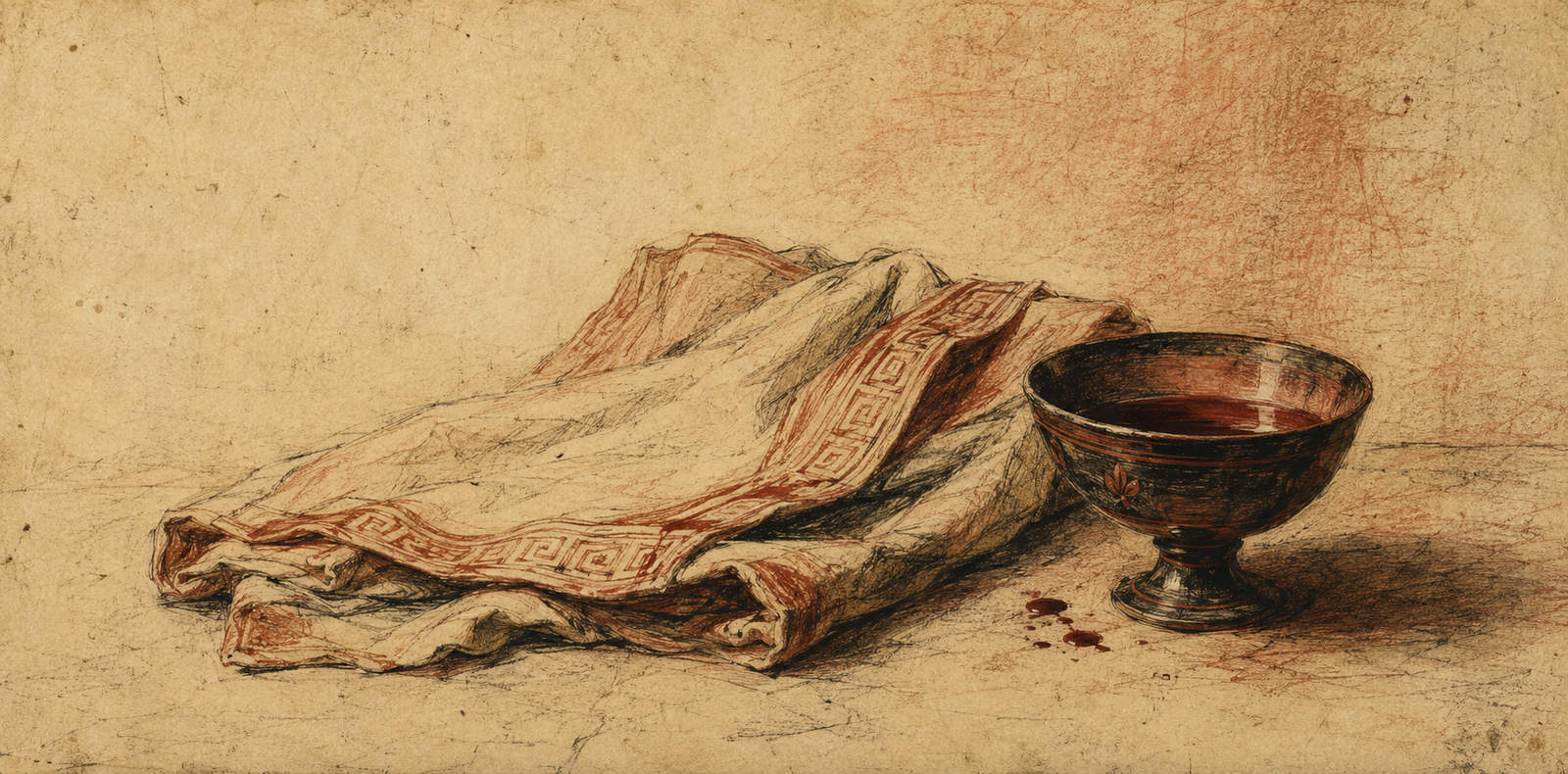
“I bathed him,” Helen said, and the room seemed to tighten slightly around the words. “I clothed him. I swore not to betray him. He told me what the Greeks intended. Then he went back through the city and killed men before he returned to the ships.”
She paused.
“He was patient,” she said. “That is the thing I remember. Not brave. Many men at Troy were brave, some from courage and some from stupidity, and at a distance they looked the same. Odysseus was patient. He could make himself small enough to survive the room he had entered.”
Telemachus heard this and tried to place it beside the father he had imagined.
The imagined father had been broad-shouldered, bright in armour, unmistakable. The father in Helen’s story entered enemy cities as a beggar, hid inside his own ruin, and was recognised by a woman whose name had broken the world.
That was harder to love.
It was also harder not to believe.
Menelaus smiled then, but not with pleasure.
“Yes,” he said. “He was patient.”
Helen turned her face toward him.
A husband and wife may speak for years without touching the centre of the wound between them. Then a single word steps too close, and all the old furniture is there again.
“You remember another patience?” she asked.
“I remember the horse,” Menelaus said.
No one moved.
He took his cup but did not drink.
“We were inside it,” he said to Telemachus. “Packed in the dark with our knees cramped, our breath held, every man smelling the fear of every other man. There is no glory in being hidden inside wood. Songs may improve it later, but songs were not there. We were there. And Odysseus was there.”
Telemachus leaned forward despite himself.
“The Trojans dragged the horse in. They rejoiced over it. They stood around the thing that would undo them and called it victory. That is the kind of error gods permit when a city is ready to fall.”
His eyes shifted, not quite to Helen.
“And then your hostess came.”
Helen’s face did not change.
“She walked around the horse,” Menelaus said. “Not hurriedly. Not like a madwoman, whatever later singers may prefer. She knew something. Or suspected. Or wanted to know. She began to call to us in the voices of our wives.”
Telemachus felt cold move through him.
“One by one,” Menelaus continued, “she used their voices. So well that men in the dark forgot where they were. One almost answered. Another put his hand to his mouth as if to hold his own soul inside him. And Odysseus—”
Here Menelaus did smile, but it was no longer tired. It was sharp with memory.
“Odysseus clamped his hands over the mouth of the man beside him and held him there. Hard. Long enough that silence was saved.”
He drank then.
“So yes. He was patient.”
The room had become too beautiful.
Telemachus looked from Menelaus to Helen and understood very little, except that both stories could not sit together peacefully, and yet in this house they had been made to do so.
What stayed with him first was not the horse, or Helen’s voice outside it, or even the thought of men hidden in the dark. It was his father’s hand over another man’s mouth.
That was a strange thing to inherit.
Not the armour. Not the fame. Not the praise that men gave once danger had passed far enough away to become generous. A hand in the dark. Silence forced into another body so that all of them might live.
Helen’s Odysseus had trusted her. Menelaus’s Odysseus had survived her. Each story made the teller bearable to themselves. Each story made Odysseus necessary.
And where, in all of this, was the man himself?
A son wants the father to become clearer with every report. Telemachus was learning the opposite. Each true memory made Odysseus less simple. He was brave, yes. Loved, yes. Dangerous, certainly. Faithful in some ways. False in others. A man who could enter a city as no one and come out carrying the future of armies. A man whose name filled rooms in which he was not present.
Fame did not preserve him.
It multiplied him.
Helen lifted her cup. For the first time that evening, something like weariness touched her mouth.
“There has been enough weeping,” she said.
From a small box she took something and let it fall into the wine. No one stopped her. Perhaps they had seen this before. Perhaps the house had long ago accepted certain mercies because it could not endure all its memories without them.
The wine was poured.
Telemachus drank, because he was young, and because he was a guest, and because grief had tired him. The cup was warm from his hand. The taste was deep, dark, honeyed, and after a while the edges of the room softened.
It was not happiness that came.
It was distance.
That, too, can be mistaken for peace.
Menelaus spoke again after the cups had passed.
“You came for news,” he said. “You shall have what I know, though knowledge from the sea is never cleanly given.”
Then he told them how he had been held far from home in Egypt, with his men hungry and hope wearing thin. How the ships stood useless. How the wind refused them. How a daughter of the old sea helped him with pity or strategy — Menelaus himself could not say which, and perhaps gods and their children often do not distinguish. How he and his men lay hidden beneath seal-skins, sick from the stink, waiting for the ancient one who knew the deep roads of water.
Proteus.
The name entered the room like tidewater.
Menelaus did not make the tale grand. That made it stranger. He spoke of holding fast while the sea-god changed beneath his hands: lion, serpent, leopard, water, tree. Forms arrived and vanished. Terror altered shape faster than a man could name it. But Menelaus held on.
This was the lesson the sea had taught him: not always to strike, not always to command, but sometimes to hold through transformation until truth grew tired of escaping.
At last the god spoke.
He spoke of the deaths of men who had thought themselves beyond ordinary danger. Ajax lost. Agamemnon betrayed in his own house. Others delayed, scattered, swallowed by consequences they had not foreseen when Troy was still standing and everyone believed the hardest part was ending.
Then he spoke of Odysseus.
Telemachus forgot the cup in his hand.
“Alive,” Menelaus said.
The word was small. There should be larger words for such things, but there are not.
“Alive,” he said again. “Held on an island by a goddess. No ship. No companions. No road beneath his feet. He longs for home, the old one said. But longing does not make timber. It does not raise wind. It does not loosen a goddess’s hand.”
Telemachus sat very still.
He had imagined death so often that life should have felt like release. Instead it opened another room of suffering.
His father lived.
His father was trapped.
His father wanted home.
His father could not come.
Joy came with teeth in it.
Menelaus saw enough of this in the boy’s face and grew gentle.
“This is hard news,” he said. “But it is not the worst news.”
“No,” Telemachus said.
His voice was rough.
“No. It is not the worst.”
That night they gave him a bed in the rich house of Menelaus. Clean linen. A cloak folded near him. A lamp lowered but not put out. Beyond the walls, Sparta settled into the sounds of an ordered home: doors closing, servants whispering, horses shifting in their stalls, someone laughing once in another chamber and then remembering the hour.
Telemachus lay awake longer than Peisistratus, though the wine had softened the grief in him and the road had tired his body.
Alive.
The word would not sleep.
It kept changing shape, as Proteus had changed shape in Menelaus’s hands: hope, delay, wound, command. His father had not vanished into the clean country of the dead. He remained somewhere in the world, breathing, wanting, unable to cross the water between his longing and his house.
For the first time, Telemachus understood that searching for his father might not end with finding him. It might only begin another form of waiting.
Far from Sparta, Ithaca was not asleep.
The suitors had stayed late in the hall. They often did. It was one of the powers they had claimed without naming it: the right to make evening last as long as their appetite required. A table still stood uncleared. Bread had been torn and left. A cup lay on its side near the foot of a bench, not broken, only emptied and forgotten, which was almost worse. The servants had withdrawn as far as they could without seeming to abandon the room.
Someone had brought the news badly.
News is often damaged by the mouth that carries it. It had come first as rumour, then as mockery, then as a fact no one could push aside. Telemachus had gone. Not to a neighbour’s field, not to some loyal man’s hut, not to sulk where a boy might be found and laughed back into obedience. He had gone across the sea. He had taken ship in the night and asked his questions in the houses of kings.
At first they laughed.
Of course they laughed. They had laughed at him in the assembly. They had laughed at his anger, his tears, his attempt to make old forms obey him. Laughter was the easiest tool in that room, and they had used it so often on Telemachus that their hands reached for it without thought.
But laughter did not hold.
One by one, it thinned. A man would begin some remark about the boy and the sea, or the boy and his nurse, or the boy returning with a beard and a king’s staff, and the words would fail before they became as amusing as he had expected. Something had happened that did not fit the shape they had given him.
Telemachus had acted without asking them.
That was the offence beneath all the others.
Antinous sat with one arm along the back of a bench, watching the room discover what he had already understood. He was not the loudest man at every moment. That was part of his danger. There are men who need noise in order to rule, and men who use the noise of others until silence becomes useful.
“He found a ship,” one of the suitors said.
“He found men willing to row it,” said another.
There was a pause after that.
No one liked the shape of the sentence.
A boy alone is one thing. A boy whom other men will follow is another.
Antinous reached for the fallen cup near his foot, set it upright on the table, and looked at it as though restoring order to a cup were the same as restoring order to the house.
“He should have asked permission,” he said.
It was a small sentence, almost laughable, and no one laughed.
Because it named what frightened them.
Not that Telemachus had gone. Not even that he might return with news. But that he had discovered the one thing every unlawful power fears: that its authority depends on being obeyed as if it were lawful.
“He has gone looking for his father,” Eurymachus said, more lightly than the words deserved.
Antinous looked at him.
“No,” he said. “He has gone looking for witnesses.”
That settled the room.
Outside, beyond the walls of the palace, Ithaca had its own night-sounds: dogs turning in dust, wind moving through dry grass, the low sea touching the rocks without concern for human plans. Inside, the men leaned closer.
The ambush did not become itself all at once. It entered by degrees, as shameful things prefer to do. A question about when Telemachus might return. A second question about which water he must cross. A third about how many men a small ship could carry without drawing notice. No one said murder while murder was still choosing its seat among them.
Antinous spoke of a ship waiting in the narrow passage. He spoke of darkness, and timing, and men who could keep their mouths shut if their shares were large enough. He spoke with the practical calm of someone arranging transport, not death.
This was also part of his danger. He could make evil sound like household management.
By the time the servants were sent away entirely, the thing had a shape.
Telemachus would come home from asking whether his father lived, and men from his father’s hall would wait for him on the road back.
They did not speak of Penelope.
Men like that often forget that a house has ears where women are afraid.
The news reached her by way of a servant who had first tried not to know it. She came late, after the hall had quietened and the women’s rooms had entered that strained silence which is not rest but listening. Her hands were wet from some unfinished task. Penelope noticed that first. Water moved down the girl’s wrist and darkened the edge of her sleeve.
“What is it?” Penelope asked.
The servant opened her mouth. Closed it.
That was when Penelope stood.
“What is it?”
The girl told her in pieces. Telemachus. The ship. The suitors. The narrow water. Antinous’s name came last, though Penelope had known it before it was spoken.
For a moment she placed one hand against the wall, not because she was weak, but because the world had moved and the wall had not.
This should not be misunderstood. Penelope was not fragile. Fragility would not have survived those years. She had lived with uncertainty until it became part of the furniture. She had learned how to speak to men she despised without giving them the satisfaction of seeing her hatred. She had woven and unwoven time itself. She had kept the house from falling by making delay into a form of governance.
But a son is not a strategy.
A son is the body the future has chosen.
She went to her chamber with her women around her, though no company could reach the place where the fear had opened. She thought of Odysseus, who had gone and gone and gone until absence had become the nearest thing to proof. She thought of Telemachus as a child at her knee, then as a boy standing too straight in the hall, then as a young man secretly boarding a ship because no one in his father’s house had left him any safer form of courage.
The house had eaten years.
Now it had opened its mouth for the son.
Penelope uncovered her hair and lifted her hands.
The prayer would not come in order. Athena’s name came first, then Odysseus’s, then the boy’s, then Athena’s again. She promised nothing grand. Fear leaves little room for grandeur. She asked that the sea remember the child kindly. She asked that the road home be hidden from cruel eyes. She asked that if Odysseus still breathed anywhere under the sun, some part of his strength might stand near the son who had gone looking for him.
Then the words failed.
Her women stood with her. None of them corrected the silence.
At last sleep came, though it was not the sleep of peace. It was the body taking what the mind could no longer defend.
In that sleep a likeness stood before her: familiar enough to be received, strange enough to be trusted. The voice was gentle, but it did not flatter grief.
“Take heart,” it said. “Your son is not alone.”
Penelope, even in dream, did not become a fool for comfort.
“Will he live?” she asked.
The shape before her did not turn the night into certainty. Gods rarely give that kind of mercy. It gave her what the night could bear.
“He has a guide,” the voice said. “He has a road. The men who hate him do not hold all the dark.”
When Penelope woke, the danger had not changed. The suitors had not repented. The ship had not vanished from the narrow water. Antinous had not become merciful in the night.
But her breathing had steadied.
That, sometimes, is the mercy given: not rescue, but enough breath to remain standing until morning.
Across the sea, Telemachus slept under Menelaus’s roof with one word still changing shape inside him.
In Ithaca, men began to make plans for the road home.
—
Receive the next work
Subscribe free to receive new work from the The Hospitable Dark Library by email.
More from the Library


See Also
A concise and impartial dictionary of absence, promises, quarrels, ordinary objects, and the troublesome instability of words.

The City of Service
The temple we inherit is a building from which almost all necessity has been removed. Nothing must be brought for it to continue being what we call a temple. The sanctuary asks nothing of us. Stone is good at this kind of independence.
A living temple was otherwise.
Water had to come in. So did grain, cloth, oil, aromatic substances, fuel. The things required for worship arrived because someone carried them across a threshold.

Houses of Wood, Light, and Smoke
Some of Angkor’s most intimate ruins do not rise above the ground at all. They are postholes, low mounds, hearths and ponds: durable traces of a domestic city built largely from things that decay. To restore that city is to see Angkor not only as stone, but as wood, smoke, water, repair, and people living within calling distance.