

What War Leaves Behind in Beautiful Rooms
A Long Return reader’s guide on Helen, Menelaus, memory, and the polished aftermath of Troy.
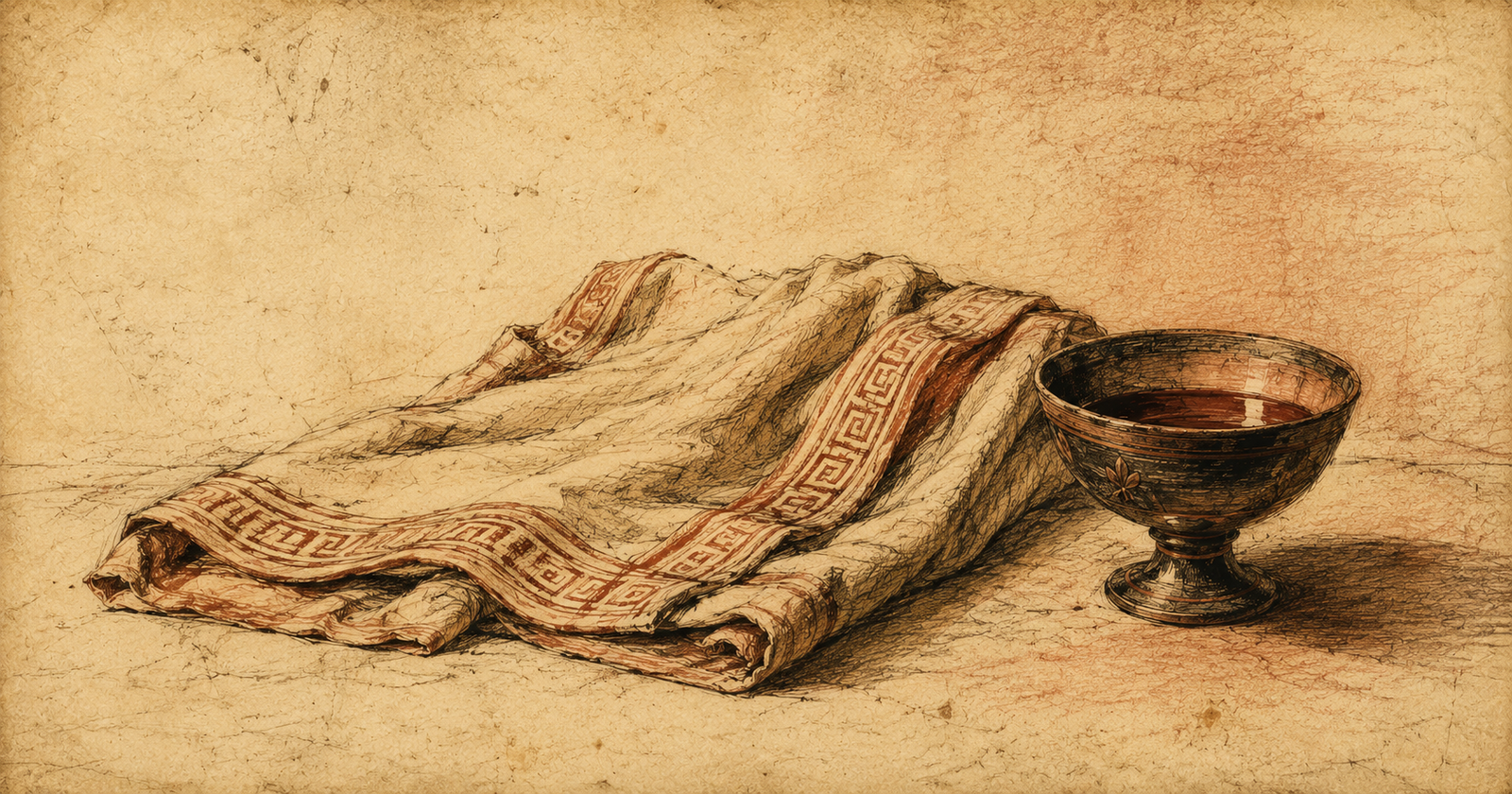
War does not always leave a house in ruins. Sometimes it leaves the cups polished, the garments folded, the marriages arranged, the servants moving quietly through rooms where everyone has learned what not to say. Sometimes the house survives so completely that a stranger might mistake its order for peace.
That is part of the unease of Sparta in The Odyssey.
When Telemachus arrives at the house of Menelaus, he does not enter a scene of visible devastation. He enters splendour. Menelaus has come home. Helen is there. Wealth has gathered around them from the long wandering after Troy. The household is active with wedding preparations, future alliances, proper hospitality, cups, horses, cloth, gifts, food, and all the formal signs by which a great house announces that it has endured.
But endurance is not innocence.
Ithaca, by contrast, is openly disordered. Its wound is easy to see. Men eat what is not theirs. The son is humiliated in his own hall. Penelope holds the house together by delay because no other form of authority has been left to her. Ithaca’s corruption has the bluntness of appetite. Sparta is different. Sparta has recovered its surfaces. That makes it harder to read.
The great subtlety of this episode is that Menelaus’s house is not false. Its hospitality is real. Its generosity to Telemachus matters. Menelaus is not pretending to have suffered; he knows exactly how much of his wealth came by grief. The house is not a lie. It is something more difficult: a place where grief has been made habitable.
That is one of the things war leaves behind. Not only widows, graves, broken ships, or the names of men who did not come home. It leaves rooms in which the returned must go on arranging life around what cannot be repaired. It leaves ceremonies that must continue because houses do not survive on sorrow alone. It leaves people who can speak of terrible things calmly because they have had years to learn where the words belong.
Menelaus is one form of that aftermath. He has returned with treasure, but the treasure has not simplified him. His memory of Troy is full of the dead. He remembers Odysseus with affection, but affection does not bring Odysseus nearer. He can tell Telemachus that his father was beloved, necessary, patient, brilliant, and still the boy leaves each sentence with less certainty than he had before. Praise, in this room, does not restore the father. It multiplies him.
Helen is the more dangerous form of the same aftermath.
The familiar temptation is to make Helen into a solved figure: guilty woman, tragic woman, seducing woman, abducted woman, beautiful cause of war, victim of divine machinery, ruinous prize, misunderstood queen. The ancient poem does something more disturbing. It lets her speak with composure.
Her composure matters. She does not enter as confession. She does not ask the room to forgive her. She recognises Telemachus by likeness and silence. She tells a story of Odysseus entering Troy in disguise, filthy, beaten-looking, and almost perfectly hidden. In her version, she perceives him, shelters him, swears not to betray him, and becomes intimate with the secret on which Greek survival depends.
It is a story in which Helen is perceptive, controlled, and useful.
Then Menelaus tells another.
He remembers the wooden horse: the Greek warriors hidden inside, the Trojans rejoicing around the instrument of their own destruction, Helen circling it and calling to the men in the voices of their wives. It is one of the coldest memories in the poem because it does not need an accusation attached to it. Menelaus does not have to say what Helen nearly caused. The story says it for him. Inside the horse, Odysseus saves the Greeks not by a glorious act of battle, but by forcing silence onto a man who is about to answer the voice he loves.
The two stories do not cancel each other. That is their power.
Helen’s Odysseus trusted her. Menelaus’s Odysseus survived her. Both memories may be true, and both are arranged in ways that help the teller remain standing inside the room. Homer does not pause to adjudicate between them. The marriage continues. The cups are poured. The beautiful house holds both accounts without resolving the wound between them.
That, too, is what war leaves behind: not only memory, but competing memories that have learned to live under the same roof.
For Telemachus, this is an education more unsettling than simple grief. He has come looking for news of his father. What he receives first is not news but versions. Nestor has already given him one Odysseus: a man among old kings, part of the dangerous aftermath of Troy. Helen gives him another: the disguised man recognised by her inside the enemy city. Menelaus gives him another still: the man in the horse, holding another man’s mouth shut in the dark so that silence can save them all.
A son wants the father to become clearer with every report. Telemachus is learning the opposite.
This is one of the most psychologically exact movements in The Odyssey. Odysseus is absent from the poem’s present action, but his absence does not make him simple. It makes him proliferate. In Ithaca, he is rumour, property, vacancy, the legal absence on which the suitors feed. In Pylos, he is remembered through the general sorrow of return. In Sparta, he becomes a figure inside other people’s self-defence. Every survivor has an Odysseus. Every memory is partly witness and partly arrangement.
Fame does not preserve the absent intact. It makes them available.
That is a hard lesson for a son. Telemachus is not only searching for whether Odysseus lives. He is learning how little of a famous father can belong to the child left behind. By the time Menelaus gives him the answer he came for, Telemachus has already been prepared to understand that the answer will not be enough.
The drugged wine matters here.
Helen’s nepenthe is often remembered as a marvel, a beautiful strangeness from Egypt, a potion that makes grief stop. But in the room at Sparta, it is also a social instrument. The wine does not heal sorrow. It makes sorrow bearable in company. It allows conversation to continue. It keeps the room from being swallowed by what the room contains.
There is mercy in that. There is also danger.
A house that cannot soften grief may break under it. A house that can soften grief too easily may begin to mistake composure for peace. This is the frightening delicacy of Sparta: it has not denied the wound, but it has learned how to lower its voice. Helen’s cup is therefore not merely a magical object. It is one of the governing images of the episode: grief made socially possible, memory dimmed enough for ceremony to continue, pain reduced not into false happiness but into usable form.
Then Menelaus tells of Proteus, and the episode gives its deepest image of truth.
Proteus is not only an adventure in Menelaus’s past. He is the shape truth takes in this book. The old sea-god will not speak simply. He must be seized and held while he changes: beast, water, tree, terror, refusal. Only the man who can endure those changing forms receives the word he needs.
This is exactly what Telemachus must do with his father.
He cannot seize Odysseus directly. He cannot make the absent man stand still. He can only hold the changing forms offered by others: Helen’s Odysseus, Menelaus’s Odysseus, Nestor’s Odysseus, Ithaca’s Odysseus, the imagined father of his childhood, the dangerous father of adult memory. If he lets go too soon, he receives only confusion. If he holds on, something may speak.
What speaks is the word he came for.
Alive.
It is mercy, but it is not release. Odysseus lives, but he is held far away. He longs for home, but longing does not build a ship. He has survived, but survival has become another chamber of delay. For Telemachus, the news is therefore almost unbearable in its doubleness. His father has not vanished into death; he remains somewhere under the same sun, breathing and unable to return.
In a simpler story, that would be consolation. In The Odyssey, it is the next wound.
This is what war leaves behind in beautiful rooms: not only grief, not only treasure, not only stories polished by repetition, but children sitting among their elders and discovering that the absent cannot be gathered back into one version. Telemachus comes to Sparta for news. He receives it. His father lives.
But life, in The Odyssey, is not yet return.
It is only the next shape longing takes.
—
Receive the next work
Subscribe free to receive new work from the The Hospitable Dark Library by email.
More from the Library


See Also
A concise and impartial dictionary of absence, promises, quarrels, ordinary objects, and the troublesome instability of words.

The City of Service
The temple we inherit is a building from which almost all necessity has been removed. Nothing must be brought for it to continue being what we call a temple. The sanctuary asks nothing of us. Stone is good at this kind of independence.
A living temple was otherwise.
Water had to come in. So did grain, cloth, oil, aromatic substances, fuel. The things required for worship arrived because someone carried them across a threshold.

Houses of Wood, Light, and Smoke
Some of Angkor’s most intimate ruins do not rise above the ground at all. They are postholes, low mounds, hearths and ponds: durable traces of a domestic city built largely from things that decay. To restore that city is to see Angkor not only as stone, but as wood, smoke, water, repair, and people living within calling distance.