
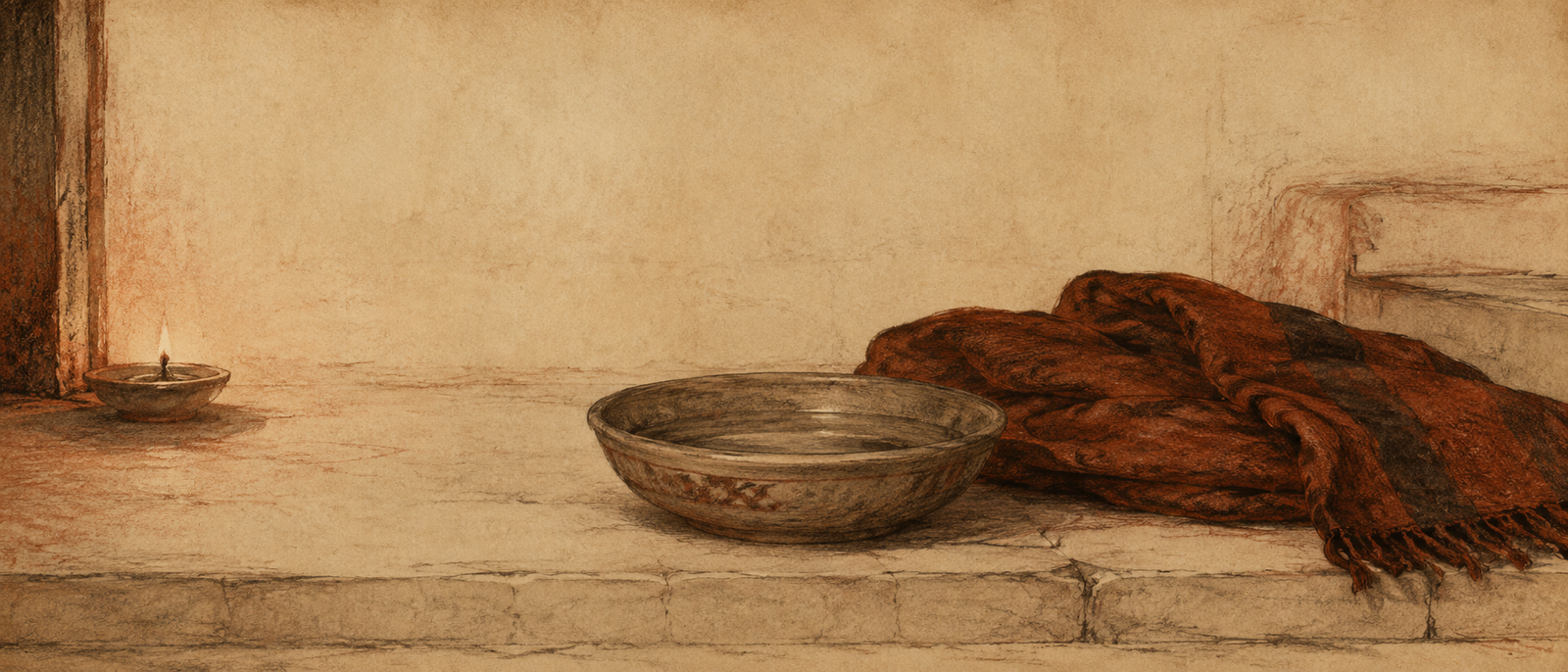

The Long Return VII — The Palace of Alcinous
A stranger enters a good house, and learns that true hospitality knows when not to ask his name.
The cloak sat strangely on him.
It was clean, and that was the first strangeness. It carried no salt, no splintered smell of raft-wood, no torn edge from the sea. It had not stiffened around his shoulders in a storm. It had not dried against him beneath a hostile sun. It belonged to rooms, to storage chests, to women’s hands, to a house where cloth was folded before it was needed and brought out when a stranger had nothing left.
Odysseus wore it carefully.
A man who has been naked among reeds learns the dignity of cloth very quickly. He also learns its danger. The girl had given it before asking his name. That was mercy. But the same garment would carry him into her father’s city, and whoever recognised it might begin asking questions before he had secured the right to answer them.
He walked alone from the grove.
Behind him, the river moved under its low banks. Ahead, the road lifted toward the city of the Phaeacians, where the houses stood above the harbour and the smoke of evening rose cleanly into the air. Nausicaa had gone before him with her maids and the mule-cart, taking the washed clothes home by the road that would bring no gossip to her door. She had told him where to wait, whom to approach, what to say, and which name mattered most when he entered the palace.
Not the king’s first.
The queen’s.
This, too, Odysseus carried carefully.
He had learned long ago that houses do not always reveal themselves by their roofs or gates. A poor hut may keep a better law than a palace. A splendid hall may be rotten at the table. A man may call himself host while waiting only to strip the guest of his story, his goods, or his life. Odysseus knew this. War teaches a man how to read walls. Wandering teaches him how to read thresholds.
So he paused before entering the city.
It was not fear, exactly. Fear had already done its work and been survived. This was the older caution of a man who has been preserved by intelligence more often than by strength. He stood in the dimming light, clothed by a stranger’s kindness, and looked toward the place where his next hope lived.
Then the goddess came to him.
Not as thunder. Not as brightness. The gods are not obliged to announce themselves in forms convenient to mortal understanding. Athena came as a young girl carrying a pitcher, the sort of child who might have been sent for water and kept a little longer outside than her mother intended. She stood at the road’s edge and looked at him without surprise.
“Child,” Odysseus said, because that was the form she wore and a wise man honours even a disguise, “will you show me the way to the house of Alcinous? I am a stranger here.”
The girl tilted her head. There was no fear in her, which should perhaps have been the warning.
“I will show you,” she said. “It is my father’s way also. But walk quietly beside me, and do not speak to those you pass. These people do not love every stranger. The sea gives them enough of its own, and they trust their ships more readily than men who come without one.”
Odysseus bowed his head.
It is a hard thing for a king to be led by a child through an unknown city. It is harder still when the child is a god.
They walked together.
Athena cast a mist around him, not heavy enough to blind, but enough to make him pass through the city as a thought passes through sleep. Men moved near him and did not turn. Women carried baskets and did not pause. Children shouted beside walls, and the stranger went unseen among them.
This was favour.
It was also loneliness.
He passed the harbour first. The Phaeacian ships lay drawn in or moored close, dark and curved and ready for water. They were not like the broken thing he had lashed together under Calypso’s trees. These ships had the look of animals that knew their own paths. Ropes hung in neat coils. Oars lay ready. Hulls were kept clean.
Beyond the harbour the city rose in clean lines. Walls caught the last light. Doorways opened onto courtyards where lamps were already being lit. Nothing in the place yet told him whether it was kind. But it was ordered, and after the sea, even order could look like mercy.
He thought, briefly, of Ithaca.
He did not let the thought remain.
The girl led him through the streets until the palace stood before them.
It was a great house, but not great in the way of fortresses. It did not seem to say, Keep out. It seemed to say, Enter properly. There is a difference, and any traveller worth the road knows it. Bronze gleamed along the walls where the light found it. Doors stood tall and fitted well. The polished floor inside caught fire from the lamps.
To one side lay the gardens.
Pear and pomegranate, fig and olive, vine and tended earth: all had been given their place. Fruit ripened there as if the year itself were better governed than elsewhere. Odysseus stood before it and felt, for one moment, the old claim of cultivated earth.
A garden is not home.
But it reminds a man that home is not merely walls.
The child with the pitcher stopped before the entrance.
“Go in,” she said. “You will find them feasting. Do not hesitate. Pass by the men. Go to Arete first. Take her knees in supplication. If she looks kindly on you, you may yet see your own land again.”
“Arete,” Odysseus said.
“Daughter of noble blood, wife of Alcinous, honoured by her people. She is not loud in the house. Remember that when you enter.”
A lesser man might have asked how a child knew so much about palace order. Odysseus had survived by not asking certain questions too soon.
“I will remember,” he said.
The girl looked at him then, and for a breath the road seemed too small for her.
“Do,” she said.
Then she was gone.
The mist remained around him.
Odysseus stood at the threshold of the palace and listened.
Inside, the feast was still moving. He heard men’s voices, the rise and fall of talk made easier by wine, the small order of servants crossing the hall, the sound of cups set down and lifted again. There was no brawl in it. No hunger without limit. This house knew how to eat. That, too, is a form of knowledge.
He stepped inside.
No one turned.
He passed the men where they sat, princes and elders and those whose names mattered in the island. Their cloaks were good. Their hair was oiled. Their hands had not recently fought weather, rope, or salt. Some laughed. Some leaned toward one another in talk. Some lifted cups. The hall was bright with fire and metal, but under that brightness Odysseus saw the form of the room: where the king sat, who near him, who was listened to, who was indulged, who was ignored, which servants crossed freely, which moved with their eyes lowered.
He had entered many rooms in his life: as king, as captain, as enemy, as petitioner, as the man whose name opened gates, as the man whose name would have ruined him had it been known. Before anyone spoke, he understood this one.
Power did not sit in one chair only.
Alcinous was there, of course. No one could mistake him. He had the ease of a man accustomed to being obeyed without having to test the fact every hour. But near him sat Arete, and the room held its shape around her in a quieter way. She did not need to compete with the king’s place. That was precisely why her own was visible. A house in which power must shout is not yet a well-ordered house.
Odysseus moved past the men.
The mist fell from him.
The hall saw him all at once.
Silence came quickly, and not because anyone commanded it. One moment there was conversation, and the next there was a stranger in the middle of the room: broad-shouldered, sea-worn, newly clothed in garments that did not belong to him, his face marked by exhaustion and self-command.
He did not look first to Alcinous.
He went to Arete.
There are gestures so old that even men who have forgotten mercy recognise them. Odysseus knelt and put his hands to the queen’s knees. He bowed his head. The hall held still.
“Queen,” he said, “I come to you after much suffering. I do not know your house, except that I have been told it is a house where mercy may be found. I ask for passage home. I ask for help to reach my own land, if the gods have not made that impossible. I have been long from those who are mine.”
That was all.
It was not the speech of a man trying to win admiration. It was too spare for that. He did not name Troy. He did not name Ithaca. He did not speak of ships lost, men drowned, gods offended, islands escaped, or the bed that stood in his house and could not be moved by any hand but his own. He put only the necessary thing before her.
I have suffered.
I ask for home.
The room waited.
There are houses in which such waiting becomes cruelty. This was not one of them.
An old man rose. He was one of the elders, Echeneus, old enough to remember that custom is not ornament but bone. He looked at Alcinous and spoke with the authority of age, which is sometimes tolerated in courts because everyone knows it will not last forever.
“Alcinous,” he said, “this is not well. A stranger sits in the ashes, and we sit with cups in our hands. Raise him. Seat him. Let bread be brought. After that, let us ask what must be asked.”
Alcinous heard him.
A bad king resents being reminded of the law in his own hall. A good king rises quickly enough that the reminder becomes part of the house’s honour.
Alcinous stood, took Odysseus by the hand, and raised him from the floor.
“Stranger,” he said, “sit beside me.”
His own son moved to make room. A chair was brought. Servants came forward with water, with bread, with meat, with wine. Someone placed a basin before the guest so that his hands could be washed before he ate. No one asked his name. No one demanded the story from his mouth while hunger still stood between his ribs.
The house received the body first.
Odysseus ate.
He ate as a controlled man eats when he has known what it is to have no food: not greedily, because pride remained; not delicately, because hunger was real. Bread steadied him. Wine warmed the place where fear had been sitting. The hall slowly resumed its breath.
Alcinous poured to the gods and spoke of the stranger as one already under the house’s protection. He wondered aloud whether a god had entered among them, for the gods sometimes came to test mortal tables, and no sensible household liked to be found wanting when divinity arrived hungry.
This was pious, and perhaps also practical.
Odysseus listened and kept his face still.
“No god sits before you,” he said at last. “Do not make me greater than I am. I am a man. If suffering is proof of anything, it is proof enough of that. I have known sorrow in full measure. Feed me as a man, and help me as a man, if your heart allows it.”
The words settled well.
There is a kind of humility that is only pride dressed for bad weather. This was not that. Odysseus could perform many things, and sometimes he performed them too well, but exhaustion had made him plain for the moment. He did not need to look divine.
He needed a ship.
Alcinous was pleased with him.
“Then as a man you shall be helped,” the king said. “Tomorrow we will gather the lords of the Phaeacians. We will prepare a ship and men to carry you over the sea. No stranger who comes to my house in need shall be kept here against his will. If home is what you seek, homeward you shall go.”
A dangerous promise, though no one in the hall yet knew how dangerous.
The Phaeacians were generous people, and generosity can be costly when gods are keeping account. But that reckoning lay elsewhere. For now, the words opened a space in Odysseus that had been closed for many days.
A ship.
Not a raft cut with his own hands. Not driftwood under a storm. Not swimming until the body lost its argument with the sea.
A ship, crewed by men who knew these waters, sent by a king whose house had fed him before it knew his name.
He bowed his head.
“If you do this,” he said, “may the gods give you joy in your houses, children at your tables, and peace in your land. May each of you find your wife and children well when the day’s work is done. I can ask no greater blessing for any man, because I have lacked it long enough to know its worth.”
The hall heard him.
For a moment the bright palace seemed to grow quieter around the word wife, though perhaps that was only Odysseus hearing himself. A man may speak a blessing meant for others and find it has cut his own mouth as it leaves.
Arete had not yet spoken.
She had watched him eat. She had watched him answer. She had watched the garment he wore.
Good hospitality delays questions.
It does not forget them.
When the cups had passed again and the first hunger of the room had been answered, she turned her gaze fully on him. There was nothing sharp in it. That was what made it impossible to evade.
“Stranger,” she said, “I will ask what I must ask. Who gave you those clothes?”
The room shifted.
Not much. Just enough.
Odysseus felt the cloak again on his shoulders.
The garment that had covered his nakedness now stood up as witness. This is how objects behave in old stories. They wait quietly until the moment comes when they know more than anyone has said.
Arete continued.
“I know the work of those hands. I know the fold of that cloth. It came from this house. Tell me how you came by it, and how you came to our land.”
There it was.
Not accusation. Not suspicion. The precise question, asked at the proper time by the person entitled to ask it.
Odysseus understood the danger at once.
If he answered carelessly, he could wound the girl who had saved him. If he spoke too fully, he could seem to have been brought too closely under her protection. If he withheld too much, the queen would know he was shaping the truth, and a shaped truth, in a palace, is often treated as a lie unless it is shaped with enough skill.
He began with the sea.
He told them of the island where the goddess had kept him, though not everything about the keeping. He told them he had longed for home. He told them he had built a raft because no ship had been given him. He told them of the storm, of the broken timbers, of the days in the water, of the river that received him when his strength had almost gone.
He did not make himself grand in the telling. Not yet.
There would be time for stories. There would be too much time, perhaps, once the singer found the wound in him and pressed it. But here, before Arete, he kept to the line between truth and necessity.
“I slept among leaves,” he said, “ashamed and grateful to be alive. In the morning your daughter came to the river with her companions. She did not flee when it would have been easy to flee. She gave me food, and oil, and clothing. She told me the way to the city. She told me to come here and place myself before you.”
Nausicaa’s name remained safe in the room because of how he spoke it.
He did not linger on her courage in a way that would make men smile. He did not praise her beauty. He did not make her kindness sound secret. He placed her conduct under the law of the house: she had recognised a stranger, helped him, and sent him to her mother’s authority. It was the truth, and it protected her.
Alcinous frowned a little, but not in anger.
“My daughter should have brought you here herself,” he said. “You came to her in need. She might have led you openly.”
Odysseus answered quickly.
“Do not blame her. She offered to bring me with her maids. I refused. I feared the talk of men. I am a stranger, and strangers carry trouble in the eyes of those who do not know them. I thought it better to come apart.”
This was not wholly true.
It was better than truth in one respect: it was generous.
Nausicaa had foreseen the talk. She had instructed him herself. But Odysseus took the caution into his own mouth and made it his decision. There are moments when a lie preserves the truth more faithfully than a careless fact.
Arete heard him.
So did Alcinous.
The king’s face cleared. If he understood the courtesy, he did not expose it. That, too, was a form of hospitality.
“Then you have done well,” Alcinous said. “And she has done well. The gods have brought you to a house that will not turn you away.”
He leaned back and looked at the stranger with the open boldness of a man whose generosity had begun to please him.
“If I had my wish,” he said, “a man such as you might remain here, take a wife among us, receive a house and wealth, and become one of our own. But no man should be held from the place he loves. I will not keep you. Tomorrow, after the people are gathered and the ship is made ready, we will send you onward. Even if your home lies farther than any land our ships have known, we will carry you.”
Odysseus thanked him.
He did not say what passed through him then.
He did not say that he had already been offered a kind of remaining, and that it had nearly killed the story inside him. He did not say that a goddess had offered him deathless ease and that he had chosen instead the hard small hope of smoke rising from his own land. He did not say that every kind offer now had a shadow behind it, because comfort had worn a beautiful face before and called itself mercy.
He only lowered his head.
“That is a noble gift,” he said.
The feast ended slowly after that, as feasts do when the necessary thing has already happened and men continue for a while out of habit. Wine was poured. Prayers were made. Servants moved with quieter steps. One by one the lords of the Phaeacians rose from their places and went out through the shining doors into the night.
Odysseus remained.
Arete ordered a bed prepared for him. Fine coverings were brought, and cloaks laid out, and a place made ready beneath the portico where the night air could pass but not trouble him. Women carried the bedding with practical care. They did not stare. That was another kindness.
When all was set, they led him there.
The palace had grown quieter. Its earlier brightness gathered now into smaller pools of lamp-flame. The metal on the walls no longer blazed but held low warmth, as if the house were banking its own fire for morning. Somewhere beyond the court, water moved in the garden. Somewhere nearer, a servant’s feet crossed stone and faded away.
Odysseus stood beside the bed.
There had been nights when he would have called this luxury beyond hope. There had been nights when a hollow under leaves had been enough. There had been nights when he had expected no bed again except the sea-floor. Yet the sight of prepared bedding struck him more deeply than the palace walls had done.
A bed means someone expects the body to continue.
That is no small expectation for a man who has lately been argued over by gods and waves.
He touched the edge of the covering.
For one foolish instant — and wise men are not spared foolish instants — he thought of another bed. Not this one, made ready by servants for a guest whose name had not yet been given. The other. The fixed one. The rooted one. The bed that held the secret of his marriage and the proof of his house. The bed no servant could move. The bed around which the whole end of his return, though he did not know it fully yet, was already waiting.
He let his hand fall.
Not yet.
The servants withdrew. The hall lay behind him. The king slept somewhere within his own well-ordered house. The queen, who had asked the right question at the right hour, kept her own counsel. Nausicaa was hidden in the women’s rooms, perhaps waking still, perhaps thinking of the stranger who had come from the river and gone where she had told him to go.
For the first time in many days, no wave struck him.
No goddess watched him from a cave.
No branch scratched his face in sleep.
A roof stood near. Bread had been placed in his hands before his name was demanded. A bowl of water had received him before his story was required.
That was mercy.
Odysseus lay down.
—
For paid subscribers, I have added a Workroom note on the making of this instalment: the cloak that became the seed, the danger of explaining hospitality too soon, and the ending that had to become quieter.
—
Receive the next work
Subscribe free to receive new work from the The Hospitable Dark Library by email.
More from the Library


See Also
A concise and impartial dictionary of absence, promises, quarrels, ordinary objects, and the troublesome instability of words.

The City of Service
The temple we inherit is a building from which almost all necessity has been removed. Nothing must be brought for it to continue being what we call a temple. The sanctuary asks nothing of us. Stone is good at this kind of independence.
A living temple was otherwise.
Water had to come in. So did grain, cloth, oil, aromatic substances, fuel. The things required for worship arrived because someone carried them across a threshold.

Houses of Wood, Light, and Smoke
Some of Angkor’s most intimate ruins do not rise above the ground at all. They are postholes, low mounds, hearths and ponds: durable traces of a domestic city built largely from things that decay. To restore that city is to see Angkor not only as stone, but as wood, smoke, water, repair, and people living within calling distance.