
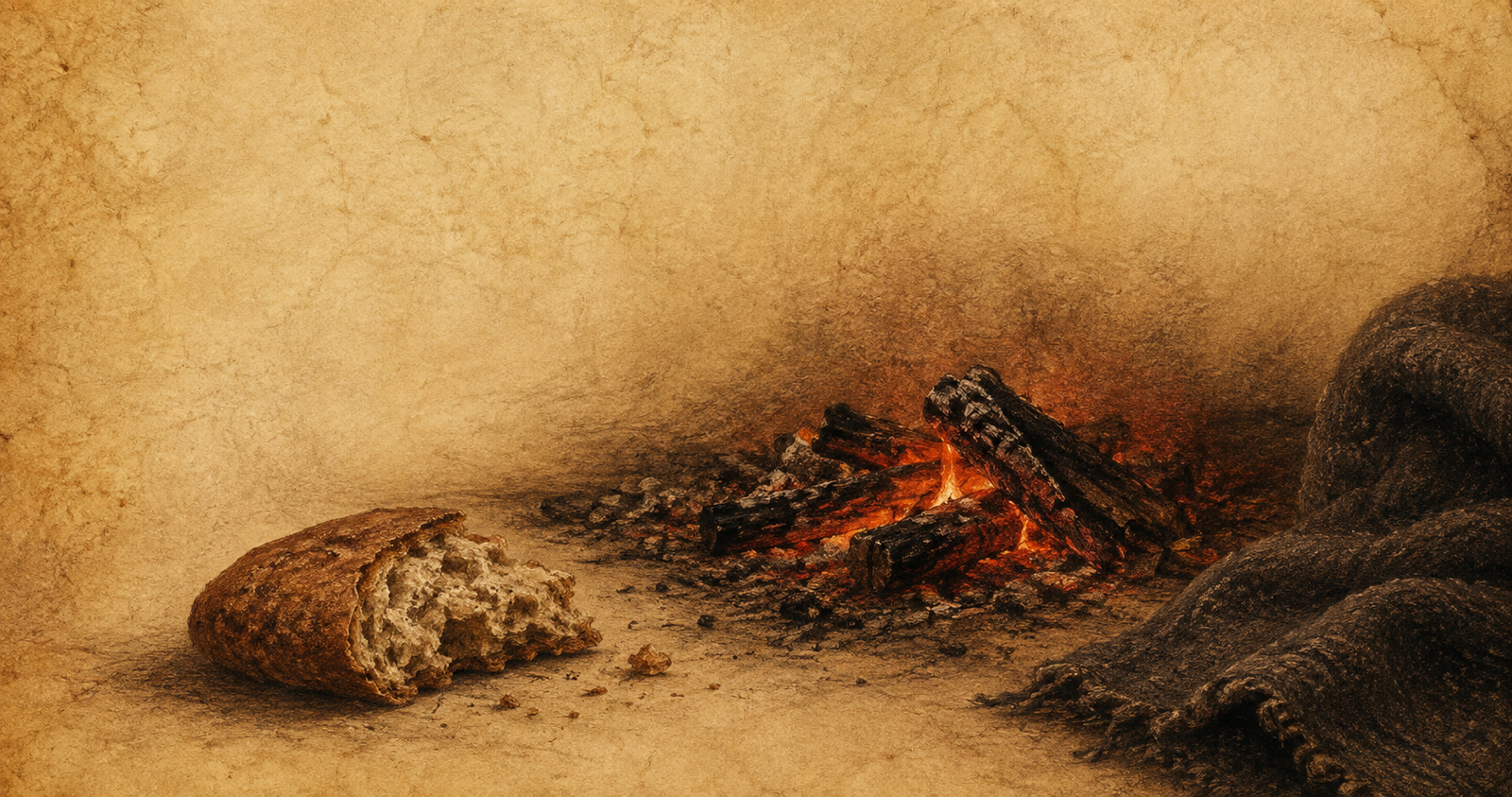

The Long Return XIV — In the Swineherd’s Hut
Homer’s Odyssey retold in clear, grave, story-forward prose.
The dogs saw him first.
They came from behind the wall in a rush of teeth and dust, four great animals bred to keep wolves from the pigs and strangers from the yard. For a moment Odysseus—who had survived storms, giants, witches, the dead, and the long malice of a god—was in genuine danger of being torn apart outside a swineherd’s hut.
He dropped his staff and lowered himself, gathering the rags of his cloak close. A raised stick might only have made the dogs fiercer.
A man shouted.
A stone struck the ground beside the nearest dog, then another. The pack scattered.
The man who had thrown them came running from the enclosure, still carrying in one hand a strip of ox-hide he had been cutting for sandals. He was broad from work rather than youth, weathered by sun and rain, with the look of someone who had spent more of his life outdoors than under a roof.
He swore at the dogs until they retreated, then turned to the stranger.
“Another moment and they would have had you.”
He held out a hand.
“Come inside.”
He did not ask a name, or where the stranger had come from, or what he wanted. He simply led him through the gate.
The place was rough but ordered.
A high enclosure had been built for the pigs from stones dragged together by labour that no poet would ever remember. Thorn branches lay along the top. Pens stood within, and the smell of animals, smoke, leather and damp earth lived everywhere. The hut itself was small, furnished by a man who possessed little and used everything.
Eumaeus put down the hide he had been working and spread a bundle of brushwood for the stranger. Over it he laid a goatskin.
It was the skin on which he usually slept.
“Sit,” he said. “A guest should not stand while his host has anything to offer.”
Then he turned to the fire.
Odysseus sat.
He had entered palaces where servants washed a guest before the guest had spoken. He had eaten from gold bowls beneath carved roofs while musicians played. He had seen tables where wine seemed never to end.
There was no gold here. There was barely enough room for two men to sit comfortably beside the fire.
Eumaeus took two young pigs from the herd, prepared the meat, set aside the portion due to the gods, and put the rest to roast. He cut bread and poured wine into a wooden cup.
Only when the food had been placed before the stranger did he begin to speak.
“Eat first.”
Odysseus obeyed.
For some time there was only fire, meat, bread and the sound of pigs moving beyond the wall.
Then Eumaeus said, “You must forgive the meal.”
Odysseus looked at what had been given him. “There is nothing here requiring forgiveness.”
The swineherd gave a short laugh. “There would be more if my master were here.”
Odysseus did not move.
Eumaeus turned a piece of meat above the flame.
“He had wealth enough once. Sheep. Goats. Cattle. Pigs. More than most men on Ithaca, and more across the water besides. He knew how to keep a household.”
The fire settled.
“Now the best of it goes to the palace.”
“The palace?”
“The men eating there.”
Eumaeus said this without heat at first, which was worse.
“They send for the fattest animals. We raise them. They eat them. Another disappears, then another. They drink his wine. They sit beneath his roof. They make promises over his wife.”
His hand tightened around the spit.
“They call themselves suitors.”
Odysseus drank.
“And your master?”
The swineherd looked at him.
“Dead.”
The word entered the hut and remained there.
Odysseus lowered the cup. “You know this?”
“No.”
Eumaeus gave the fire a small, bitter smile.
“That is the trouble.”
He pushed another piece of wood into the embers.
“If a man dies before witnesses, grief at least knows where to stand. There is a body. A grave. A stone. A year may be counted from something.”
He looked towards the doorway.
“But when a ship fails to return, everything remains possible for too long.”
Odysseus said nothing.
“At first we waited. Then we heard stories. One man had seen him in this country. Another had heard his name in that one. A sailor knew someone who had eaten with someone whose brother swore Odysseus was alive.”
Eumaeus shook his head.
“Hope can make a household foolish.”
There was no accusation in the words. Only fatigue.
“My mistress believed longer than most. Perhaps she still believes, in some part of herself. The boy grew up believing because children have little choice about what they inherit.”
“Telemachus.”
Eumaeus looked at him sharply. “You know the name.”
“I have heard of Ithaca.”
“That is not the same thing.”
“No.”
For a moment the swineherd studied him, then let the matter go.
“My master would have looked after me,” he said after a while. “That is what I know. He would have given me land. A house. Perhaps a wife, if the gods had not found some objection. I had served him well. He knew it.”
Odysseus stared at the fire.
He had thought of Ithaca through ten years of wandering: his bed, his wife, his son, the harbour, the slope of the land, smoke rising from home.
He had not often thought of the life a swineherd might have lived if his king had returned when kings were supposed to return.
Absence grows differently in every room.
“What kind of man was he?” Odysseus asked.
Eumaeus gave him a strange look. “You ask many questions about a dead man.”
“I have known dead men worth asking about.”
That answer satisfied him.
“He was not easy.”
Odysseus almost smiled. “No?”
“No. He could be proud. Too clever when cleverness was not required. He liked being obeyed.”
“Kings sometimes do.”
“They do.”
A pause.
“But he noticed things.”
“What things?”
“Work.”
Eumaeus looked down at his hands.
“Most men notice a task only when it has not been done. Odysseus noticed when it had.”
Odysseus found it difficult to answer immediately.
Eumaeus mistook the silence for nothing.
“He should have come home.”
“Yes,” Odysseus said.
The swineherd looked again towards the doorway.
“He should have.”
Outside, evening was gathering.
After a while Odysseus said, “Your master is alive.”
Eumaeus did not react.
“I have heard news of him. He will return.”
The swineherd reached for the wine.
“I would advise you not to say that at the palace.”
“I say it because it is true.”
“Men have said it before.”
“I am not those men.”
“No.”
Eumaeus handed him the cup.
“You are hungrier.”
Odysseus looked at him.
The swineherd’s face was not unkind.
“That is how it works. A wandering man learns the name of the house he has reached. He learns what grief lives there. Then he gives the grief something it wants.”
His voice remained calm.
“He says the husband lives. He says the son prospers. He says the lost ship was seen. Perhaps he gains a cloak. Perhaps a meal. Perhaps the widow listens.”
“What if the news is true?”
Eumaeus tore a piece of bread.
“Then truth will survive my disbelief.”
He cut another piece and passed it across.
Then he refilled the stranger’s cup.
After a while he asked, “Who are you, then?”
Odysseus said he was from Crete.
His father, he claimed, had been a wealthy man who had loved many women and left too many sons behind him. He had received less than the others and discovered early that he preferred ships and spears to fields.
“At Troy,” he said, “I fought under Idomeneus. I was no great lord, but I had men of my own.”
Eumaeus watched him.
“When the war ended, I lasted less than a month at home. The walls of my own house began to feel smaller than a ship.”
“That happens to fools,” Eumaeus said.
“So I discovered.”
He sailed for Egypt with nine ships. His men broke discipline there, raided farms, stole cattle and wine, and ignored him when he ordered them back to the shore. By morning the people of the land had gathered against them. Men died among the fields. Others were taken.
“And you?”
“I threw down my spear.”
Eumaeus raised an eyebrow.
“I embraced the knees of their king.”
“A proud beginning.”
“It kept me alive.”
There were years in Egypt after that, and another voyage under a Phoenician merchant who promised friendship while planning to sell him. Before either promise or betrayal could reach its proper conclusion, a storm broke the ship apart.
The stranger survived again.
Eventually, he said, he reached Thesprotia. There the king had received him and told him that Odysseus was alive. The missing king had gathered wealth and gone to Dodona to seek the will of Zeus before deciding whether to return openly or in secret.
“He is coming home,” Odysseus said.
Eumaeus had listened without interrupting for some time. Now he poured more wine.
“The first half was better.”
Odysseus raised an eyebrow. “You believe none of it?”
“I believe you have suffered.”
“That is something.”
“It is.”
“And the rest?”
Eumaeus looked almost apologetic.
“I think you want me to hope.”
Odysseus felt, unexpectedly, that he had been seen more clearly than he wished.
“I want you to know.”
“No.”
The swineherd shook his head.
“You want a bed tonight. You want food tomorrow. Perhaps you want me to remember you kindly if you go to the palace.”
Odysseus began to speak, but Eumaeus lifted one hand.
“It does not matter.”
The words stopped him.
“You are here.”
He gestured to the bread.
“You were hungry.”
Outside, the other swineherds were returning.
Their voices came first, then the heavier noise of animals being moved into the enclosures. The evening filled briefly with shouting, grunting, gates and footsteps: the ordinary confusion of work being finished before dark.
When the men entered the hut they glanced at Odysseus.
Eumaeus said only, “He is a guest.”
More food was prepared.
Eumaeus divided the meat carefully: one portion for the gods, one for each man, one for the stranger. Odysseus received the best share.
One of the younger men looked at it.
Eumaeus looked back.
The younger man looked elsewhere.
Odysseus almost laughed.
They ate.
The hut warmed, and wine passed from hand to hand. For a little while the world became very small.
There were no ships.
No palace.
No suitors.
No gods planning anything.
No war remembered correctly or incorrectly.
Only several tired men eating after work.
Night thickened.
Rain began, tapping first against the roof and then harder as the wind changed.
The men drew nearer to the fire.
Cold found its way through the rags Athena had given Odysseus. Eumaeus had not noticed.
Or perhaps he had.
Odysseus disliked asking.
There were many things he would do to survive that were harder than asking. He had begged before. He had supplicated queens. He had clung naked to foreign shores.
Still, a man keeps certain vanities long after circumstances have made them ridiculous.
“There was a night at Troy,” he said.
Eumaeus groaned softly.
“Another one?”
“A short one.”
“That would be new.”
The younger swineherds laughed.
“It was bitterly cold,” Odysseus continued.
“There are cold nights everywhere.”
“This one was worse.”
“They always are in stories.”
Odysseus glanced at him. The swineherd’s mouth had almost become a smile.
“There was a soldier who had gone out without a cloak.”
“A fool.”
“Yes.”
“Was this soldier you?”
“No.”
“Then perhaps he truly was a fool.”
Odysseus allowed himself the smallest smile.
“The men lay outside the walls. The wind came down hard enough that no one slept. The soldier shivered. He had armour, weapons, everything a man might require to fight a war except the one thing he actually needed.”
“A cloak.”
“A cloak.”
“And what did he do?”
“He lay there freezing. Odysseus was nearby.”
At the name, the warmth in the hut altered slightly.
“He understood what was wrong, but he did not simply give the man his own cloak.”
Eumaeus snorted. “That sounds like him.”
“So he invented a message. Said someone must run back to the ships. Urgent business. One of the men volunteered.”
“Without his cloak?”
“He left it behind.”
Eumaeus stared at him.
“And the freezing soldier?”
“Used it.”
For a moment there was silence.
Then one of the younger men laughed.
Eumaeus shook his head.
“That is the longest way I have ever heard a man ask not to freeze.”
Odysseus spread his hands. “I was speaking of Troy.”
“Of course.”
Eumaeus rose, crossed to where the bedding was kept and lifted a heavy cloak.
It was not new.
It was thick.
He put it around the stranger’s shoulders.
“There.”
Odysseus drew it closed. The wool held warmth almost at once.
“Your story was worth that much.”
“I am glad.”
“Do not become proud.”
“I will try.”
“No one believes that.”
The laughter in the hut was quiet and brief.
Then the men began preparing for sleep.
Eumaeus made the stranger a place close to the fire, laid down skins, added another covering, checked the embers and the door. The younger men settled inside.
Odysseus lay beneath the borrowed cloak while rain pressed steadily against the roof.
Eumaeus gathered his own things. He took a coarse cloak, pulled it around himself and reached for his spear.
“You are going out?” Odysseus asked.
The swineherd looked surprised.
“The boars are outside.”
“In this weather?”
“They are still outside in this weather.”
Odysseus said nothing.
“The others can sleep here. Someone should be near the animals.”
He opened the door.
Cold air entered at once, bending the fire towards it.
Eumaeus stepped into the rain.
The door closed behind him.
For some time Odysseus remained awake.
He could hear the weather and, beyond it, the faint restless movement of the animals.
He pulled the cloak closer around himself.
The fire settled.
Outside, Eumaeus kept watch.
—
This instalment forms part of The Long Return, Homer’s Odyssey retold in clear, grave, story-forward prose.
Previous: The Long Return XIII — The Stranger Comes Ashore
Next: The Long Return XV — The Prince Returns
Reader’s Guide: The Poor Man’s House and the True Law of Welcome
—
Receive the next work
Subscribe free to receive new work from the The Hospitable Dark Library by email.
More from the Library


See Also
A concise and impartial dictionary of absence, promises, quarrels, ordinary objects, and the troublesome instability of words.

The City of Service
The temple we inherit is a building from which almost all necessity has been removed. Nothing must be brought for it to continue being what we call a temple. The sanctuary asks nothing of us. Stone is good at this kind of independence.
A living temple was otherwise.
Water had to come in. So did grain, cloth, oil, aromatic substances, fuel. The things required for worship arrived because someone carried them across a threshold.

Houses of Wood, Light, and Smoke
Some of Angkor’s most intimate ruins do not rise above the ground at all. They are postholes, low mounds, hearths and ponds: durable traces of a domestic city built largely from things that decay. To restore that city is to see Angkor not only as stone, but as wood, smoke, water, repair, and people living within calling distance.