
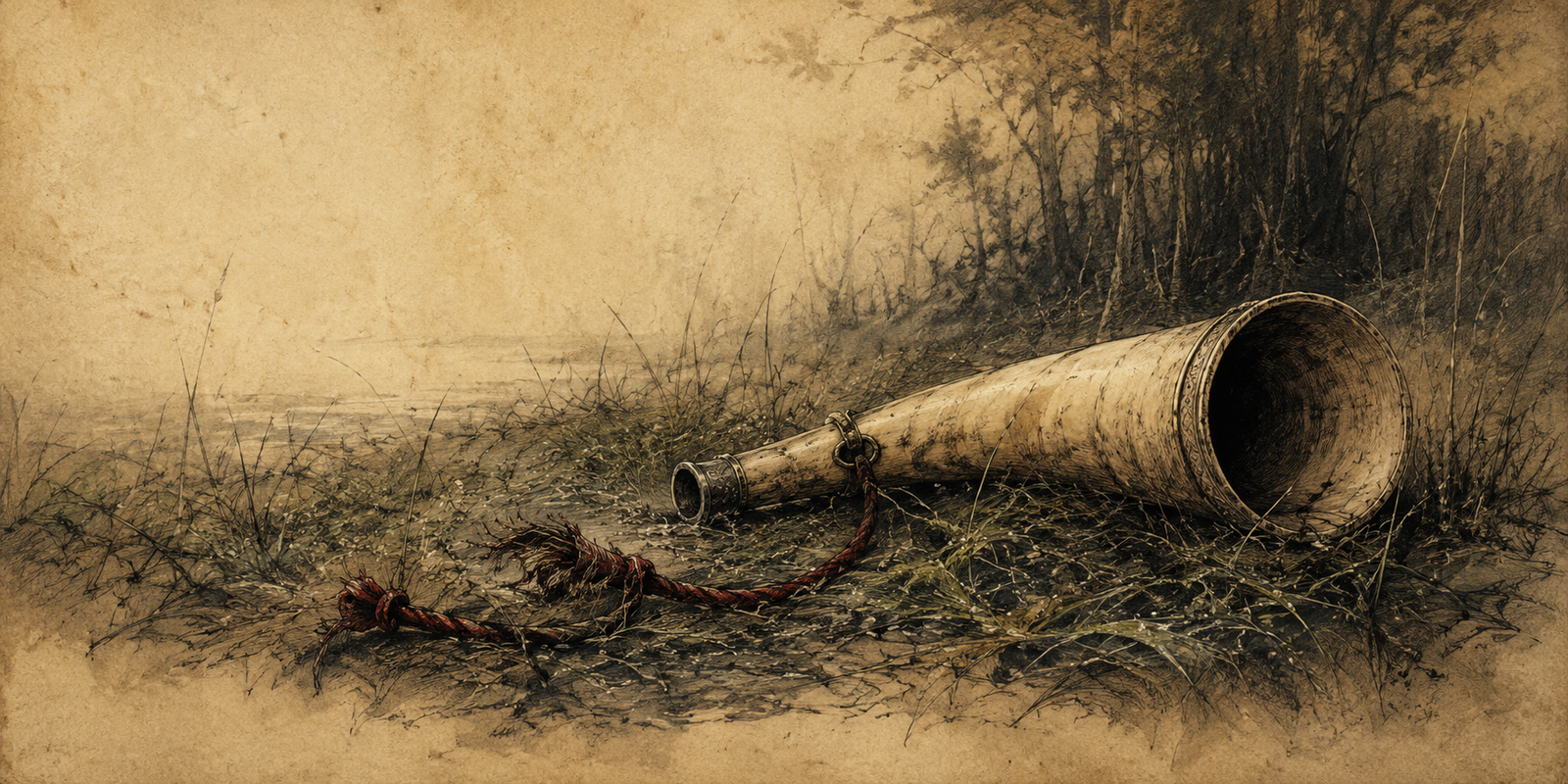

Actaeon — The Stag in the Clearing
A warm, grave retelling of Actaeon’s myth, where forbidden sight becomes transformation, terror, and the failure of recognition.
At dawn, before the heat rose and made the stones glare white, Actaeon went out with his friends and his dogs.
There are mornings that seem to promise no harm. The light comes thinly over the hills. The grass keeps the night in it. Men speak softly at first, because the world has not yet decided whether to wake. Then someone laughs, and the dogs hear it, and the day breaks open.
Actaeon loved that hour.
He loved the cold wetness on his ankles as he crossed the meadow. He loved the leather darkened by dew, the creak of straps, the smell of dogs and crushed thyme and old horn. He loved the way the young men gathered around him with sleep still in their faces, pretending not to be boys and not yet old enough to know the difference. He loved the dogs most of all.
This is not a small thing to say.
A hunting dog knows a man in a way most men do not know one another. It knows the sound of his breathing when he climbs. It knows the weight of his hand on its head. It knows whether his whistle means patience or release. It knows when he is angry before he has wasted a word on anger. It knows the name he gives it and, better still, the name beneath the name: the shape of his body in the world.
Actaeon had raised some of them from pups.
There was Theron, broad-chested and solemn, who had never wasted strength where patience would do. There was Lykos, all ribs and hunger, who strained against the strap as though the whole forest had insulted him personally. There was Melas, black-eared, clever, disobedient in the exact way clever creatures often are. And there was little Argia, not little any longer, though Actaeon still called her that, because he remembered when she had slept with her paws folded under her chin in the corner of his father’s hall.
She was the first to hear the stag.
Her head lifted. Her ears fixed forward. One paw rose from the grass and did not come down.
Actaeon saw it and smiled.
“Not yet,” he said.
The dog trembled with the offence of obedience.
The others laughed.
They were young enough to think the world belonged to those who entered it early. They had eaten bread before sunrise and drunk watered wine from a skin passed hand to hand. Their cloaks were damp at the hem. Their knives were clean. Nothing in the morning warned them to be afraid.
Why should it have?
The forest had received them many times before.
They knew its outer paths, its clearings, its watercourses, the places where boar had turned up the earth, the slopes where deer came down at evening. They knew which tree held the scar from last year’s spear. They knew where one could cross the stream without wetting the thigh. They knew which rocks hid snakes when the sun grew warm.
Actaeon knew all this without thinking of it as knowledge. It was simply the shape of the world under his feet.
He entered.
The hunt began cleanly.
A stag had passed in the night. Its track cut through the low sedge near the stream and climbed towards the darker ground above the meadow. The dogs lowered their noses and read what the men could only guess. Then the line tightened, the bodies leaned, the first cry rose sharp into the morning, and everything moved.
There is a kind of joy that belongs only to pursuit. It is older than cities and more dangerous than men admit. The body forgets its griefs. The mind narrows beautifully. Every sound matters. Every broken twig becomes speech. The world, which usually arrives in confusion, suddenly gives itself as a single sentence.
There.
Go.
Now.
Actaeon ran with the others, but more quietly. He had been taught well. His grandfather had put a small horn in his hands before he was strong enough to draw a bow and told him that a hunter who made too much noise was only announcing himself to what he would never catch. His father had taught him the dogs. His mother, who disliked hunting and said so with the calm of someone no one expected to obey, had taught him to wash before returning to the house.
“You bring the forest in with you,” she used to say. “Leave some of it where it belongs.”
At first, the track held.
The stag had gone up through a cut between two stones, over the ridge where the pines grew close, then down into a hollow where the air kept cool even after midday. The dogs followed eagerly, too eagerly. Twice Actaeon called them back. Twice Lykos pretended he had not heard. Twice Actaeon’s voice brought him round.
That pleased him.
It is pleasant to be obeyed by strength.
By the time the sun stood clear of the hills, the young men were spread across the upper wood. One had slipped and muddied his shoulder. Another had lost the pin from his cloak and sworn great oaths against the branch that had taken it. A third had begun a song no one wanted finished. The stag, if it was the same stag, had become cleverer than any of them liked.
The forest thickened.
Not suddenly.
The change came by small withdrawals. The birds quietened one kind of note and took up another. The air stopped moving in the usual direction. The smell of dogs and men thinned beneath something greener, older, wet at the root. The path which had been plain enough when they entered it began to remember other paths. One oak looked very like another. The stones gathered moss. The light seemed to arrive not from above but from between leaves, broken and uncertain.
Actaeon stopped to listen.
Behind him, the others were somewhere down the slope, calling to one another. Their voices came through the trees in pieces. He could hear two of the dogs, then none. His own breath. The horn at his belt touching his thigh. Water, perhaps.
He turned towards it.
The sound led him down through laurel and young beech. The ground softened underfoot. Once a branch caught the red cord at his belt, the cord by which the horn was tied, and he freed it impatiently without looking back. The water was clearer now, not loud, not rushing, but falling somewhere close by in a thin silver thread.
He should have called to the others.
He did not.
There was no reason, at least no reason a man could have given. He was not hiding from them. He had no secret purpose. He only wanted, for a moment, to see the water before the dogs found him again and the day became noise.
He came through the leaves into a clearing.
The world he knew stopped at the edge of the shade.
There was a pool, small and dark, fed by a fall of water slipping down stone. Laurel leaned over it. The grass around it was untrampled. No hoof had marked the mud. No man’s sandal had broken the moss. The air was so still that even the insects seemed to have been dismissed.
Figures stood there.
Not women, though that was what his startled mind reached for first. Attendants. Nymphs. Their arms were lifted in alarm. One had turned towards him with water running from her hands. Another gathered a cloth. Another moved at once, not to flee, but to shield.
And in the centre, half in shadow, stood Artemis.
There are sights the eye receives before the soul has consented to them.
Actaeon saw white shoulder, wet hair, the dark line of a brow, the astonishment of divine privacy broken. He saw no more than that.
He saw too much.
He stopped as a man stops at the edge of a grave he did not know had been dug before him.
The goddess looked at him.
If she had cried out, he might have fled sooner. If she had cursed him in rage, he might have understood himself accused. If she had reached for a weapon, fear might have saved him from thinking.
But she did none of these things.
She only looked.
In that gaze, the forest arranged itself correctly around her. The pool was not a pool. It was a threshold. The clearing was not a clearing. It was a room. The shade was not shade. It was a door he had opened without knocking.
Actaeon lowered his eyes.
It was too late.
“My lady,” he said.
Or tried to say.
His voice came rough, young, useless.
One of the attendants made a sound, small and afraid. Artemis lifted her hand, and the sound ceased.
No bow stood near her. No arrow was needed. A god’s anger does not always require a weapon. Sometimes the sentence is already present in the offence, waiting only to be spoken.
Actaeon had hunted all morning.
He had entered the forest with dogs, horn, straps, companions, skill, appetite, and all the bright permissions of his sex and station. He had followed tracks through shade. He had read the broken fern. He had lifted his face to the air and searched for what did not know it was being pursued.
Artemis looked at him, and he understood — not in words, not yet — that there are places where a hunter is only another creature with feet.
She took water in her hand.
It fell across him like cold rain.
“Then let them see you,” she said.
That was all.
No speech about guilt. No explanation. No appeal. The old stories are often more terrible for their brevity.
At first Actaeon thought he had been spared.
He staggered back. Leaves struck his face. His hands lifted instinctively, but his hands were wrong. Too narrow. Too light. He tried to catch the branch beside him and could not. The world leapt away from him. His balance rose. His breath came hard and hot through a mouth that was no longer shaped for speech.
He stumbled into the shade.
Panic is not dignified. Actaeon, who had been praised since boyhood for steadiness, crashed through the undergrowth like a thing already wounded. His body folded and sprang beneath him. His ears filled with the forest. Every sound came too sharply. His heart beat everywhere.
He tried to call.
Nothing human answered.
A harsh cry broke from him, thin and wild, and the horror of that sound drove him forward faster than fear itself.
He had antlers.
He saw them when he broke from the trees and came, for one dizzy instant, to a strip of sun where a little stream crossed stone. In the water below him there was a stag’s face: dark eye, trembling nostril, branching crown.
Beautiful, if one did not know.
He knew.
That was the punishment.
Not the body alone.
The knowing.
For a moment, because the mind clings absurdly to habit, he thought of his companions. They would see. They would know him. Someone would call his name and undo this, or fail to undo it but stand beside him in the failure. Theron would know. Argia would know. Dogs knew more than men. Dogs remembered what words forgot.
Then he heard them.
The pack had found the scent.
It came first as music.
That is another cruel thing. What terrified him now had delighted him an hour before. The same cries. The same rising excitement. The same answering calls from dog to dog through the trees. Lykos in front, high and fierce. Melas cutting lower to the left. Theron slower, certain. Argia giving that sharp double note she made when the track was fresh.
Actaeon turned towards the sound.
He tried to speak their names.
His throat gave him only the voice Artemis had left him.
The dogs came through the trees like joy released.
They saw a stag.
The young men heard the cry and shouted from below. Someone laughed. Someone called Actaeon’s name, not in fear, but in triumph, as though summoning him to share the luck.
“Actaeon! This way!”
He ran.
He did not want to. That was the last humiliation. The body chose life even when the mind knew the life had been misnamed. It leapt ditches, tore through thorns, climbed where no man could have climbed so quickly. Branches struck his flanks. The horn at his belt was gone; no, not gone — he had no belt, no horn, no hand to reach for either. The red cord had torn somewhere behind him in the wood.
He ran past stones he knew.
Past the pine where his father had once waited with him in winter.
Past the hollow where Melas had found his first boar track and sneezed with pride.
Past the place where, as a boy, Actaeon had fallen and split his lip and sworn he would never cry out over so small a wound.
He was crying out now.
The dogs answered.
No creature loves the hunt more honestly than a hound. There is no malice in it. That is why it is unbearable. They were not cruel. They were not faithless. They were doing exactly what he had taught them to do. Every morning he had praised them for it. Every day he had made them better at this very obedience.
Theron came close enough that Actaeon saw the white at his muzzle.
For one second — one only — the old dog slowed.
Actaeon lowered his head, not as a stag lowers its head, but as a man might bow to an old friend.
Then Lykos cried from behind, and the pack closed.
What happened after need not be followed closely.
The forest heard it. The young men heard it and came too late, breathless and bright with the terrible success of the hunt. They found the dogs in the clearing below the ridge, restless, confused by their own victory.
They found no Actaeon.
At first they joked.
Then they called.
Then they called again.
By afternoon the laughter had gone out of them. By evening, they had searched the slopes, the streambed, the pine hollow, the old track towards the meadow. They found the torn place in the laurel where something had passed in terror. They found prints too deep and wild for an ordinary deer. They found the small dark pool where the moss had not been touched.
They did not understand it.
That was a mercy of a kind.
Near the edge of the lower grass, where the forest opened and the meadow began, one of the younger men found Actaeon’s hunting horn.
It lay half-hidden in the wet green, as though set down there by a hand that meant to return for it. The cord had snapped. A length of it remained tied to the horn, darkened where the dew had entered the fibres.
The boy lifted it.
“Shall I blow?” he asked.
No one answered him.
The dogs had gone quiet by then.
Even Lykos.
Especially Argia, who sat with her head low, looking into the trees as if waiting for a whistle she could not understand she had already lost.
—
Receive the next work
Subscribe free to receive new work from the The Hospitable Dark Library by email.
More from the Library

See Also
A concise and impartial dictionary of absence, promises, quarrels, ordinary objects, and the troublesome instability of words.

The City of Service
The temple we inherit is a building from which almost all necessity has been removed. Nothing must be brought for it to continue being what we call a temple. The sanctuary asks nothing of us. Stone is good at this kind of independence.
A living temple was otherwise.
Water had to come in. So did grain, cloth, oil, aromatic substances, fuel. The things required for worship arrived because someone carried them across a threshold.

Houses of Wood, Light, and Smoke
Some of Angkor’s most intimate ruins do not rise above the ground at all. They are postholes, low mounds, hearths and ponds: durable traces of a domestic city built largely from things that decay. To restore that city is to see Angkor not only as stone, but as wood, smoke, water, repair, and people living within calling distance.