
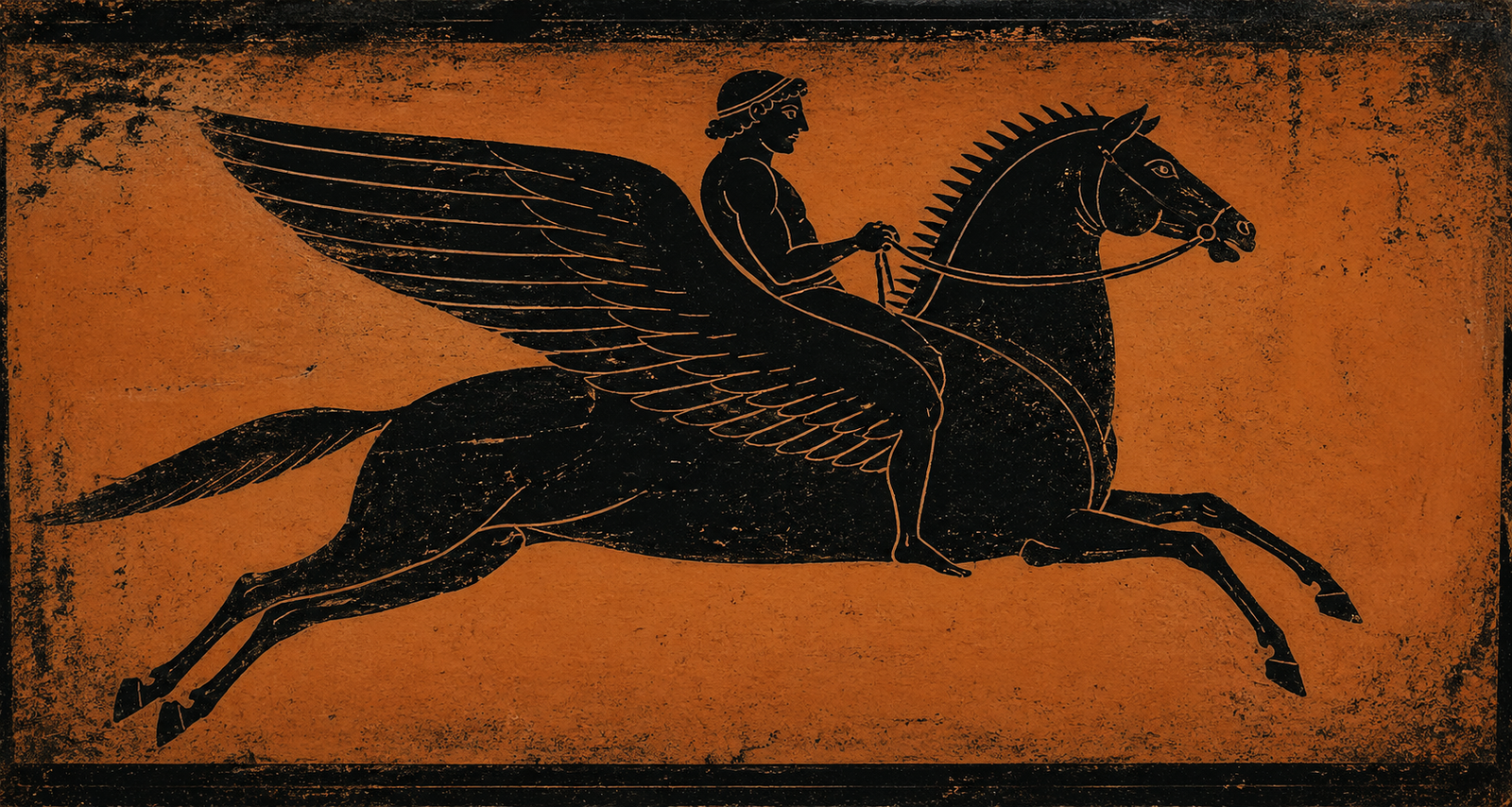

Bellerophon and the Borrowed Height
The man who mistook permission for possession.
Bellerophon carries his own death in a sealed letter, rises by the back of Pegasus, and learns that the sky does not keep what it permits.
—
He had not always been called Bellerophon.
Names came after acts. They did not descend cleanly from the father’s house, or rest harmlessly on the tongue. A name could arrive from blood. It could fasten itself to a man and make every later road narrower.
In Corinth he had been Hipponous.
Then a man died.
The traditions do not keep the dead man’s name steady. Some call him Belleros. Some give another name. It hardly matters to the living body that has to carry the consequence. One man had fallen. Another had been remade.
After that, Hipponous was gone.
Bellerophon went out from Corinth with death behind him and pollution on him. He came to Proetus, king of Tiryns, for cleansing. The king received him. Water was given. Blood was answered by rite. A place was made for him beneath the roof.
That was the first danger.
A man purified is not a man made simple. A guest is not merely a guest. Once received, he stands beneath a law that protects him and binds the house that has taken him in. He eats where he may not be struck. He sleeps where the roof itself has become witness.
Proetus knew this.
So did the house.
The woman saw him there.
Anteia, some said. Stheneboea, others. The name shifted, but the pressure did not. She watched the young man who had come stained and been made clean enough to remain. She saw the strange brightness that follows a body not yet settled after violence.
Perhaps she desired him.
Perhaps desire had already become a form of accusation.
He refused her.
No god cried out. No omen blackened the lintel. No sword was drawn.
Only speech moved.
That was enough.
She went to Proetus and placed another shape upon the guest. She said he had reached toward her in violation. She made his refusal into an injury against the house. She put a charge where desire had failed.
Proetus listened.
He had taken the man in. He had purified him. He could not kill him at the table, nor in the chamber, nor beneath the protection he himself had granted. To murder a guest outright would stain the hand too visibly. It would make the king’s own roof accuse him.
So Proetus chose the cleaner evil.
He wrote.
The signs were sealed. The message was made for another king’s eyes. Bellerophon was summoned, and the folded thing was placed into his hand.
“Go to Lycia,” Proetus said. “Carry this to Iobates.”
Bellerophon took it.
He did not open it. Perhaps he could not read the marks. Perhaps he honoured the seal. Perhaps the law of kings required him to carry what he was given.
So he went east with his own death against his body.
The road did not announce it. Dust rose. Light struck the backs of stones. The land opened and closed beneath him. He ate. He slept. He crossed thresholds. At his side, or under his cloak, or in the keeping of his hand, the sealed signs travelled with him.
Behind him, Proetus’s house remained clean of direct blood.
Ahead of him, Lycia waited.
Iobates received him with the old courtesy. The stranger was given food before the message was read. Nine days, some said, he was honoured. Nine days the death-letter lay silent while the man it condemned sat under another roof and drank from another cup.
Only after the guest-law had tightened around them both did Iobates break the seal.
He read.
The signs told him to kill the bearer.
He looked at Bellerophon. The young man had eaten in his hall. He had crossed the threshold as guest. Once more the law stood between a king and the easy act. Once more murder could not enter by the front door.
So Iobates sent him to the Chimera.
It was not called an execution.
That was the point.
A man sent to die does not always meet death directly. Sometimes he is given a task. Sometimes he is given height.
The beast lived where men could not draw near without learning the shape of their own limits. Lion in front, serpent behind, goat rising from the middle; not a thought, not an emblem, but a body wrong in several directions at once. Its breath made the air dangerous. Its fire entered the ground. It left blackened stone where grass had been.
Iobates spoke as though he were assigning labour. A king may do that. He may name death as service and send a man away with honour on his tongue.
The task stood before Bellerophon with no human opening in it. Refusal would mark him. Obedience would send him toward fire. Survival, if it came, would have to enter from elsewhere.
There are moments when a man has already been sentenced, but the sentence has not yet found its instrument.
He went to seek Pegasus.
The horse was not born for him.
That must be said first.
Pegasus did not enter the world in answer to a hero’s need. He did not wait in the shape of reward. He had sprung from an older violence, from divine and monstrous blood, from the severed place where beauty and terror had once been joined. His wings were not decoration. His body did not promise companionship. He was an immortal force shaped like an animal and moving by a law no mortal hand had made.
Bellerophon could not seize him by wanting.
The seer told him to sleep in Athena’s precinct. He went there with the impossible labour before him and the sealed death behind him. Night entered the temple. The stones cooled. The man lay down where men lie down when waking strength has reached its end.
In the dark, the goddess gave him the bridle.
Gold, the story says.
Not wealth-gold. Not ornament. Gold like command. Gold like limit. Gold beaten into a shape by which the ungovernable might be approached without being owned.
When Bellerophon woke, it was beside him.
He took it in both hands.
At Peirene, Pegasus came to water.
The spring held the morning in broken light. The horse lowered his head. Wing and shoulder moved under a skin no human stable had ever kept. His mane stirred before the wind touched the trees. His breath left the water trembling.
Bellerophon approached with the bridle.
There was no tenderness in the first meeting. There was measure. Breath. The hard pause before refusal. The horse raised his head and the air changed around him. Bellerophon felt the mortal smallness of his hand.
Still, he held the gold.
The winged horse felt the human nearness and the divine metal. Between them a narrow permission opened.
Not conquest.
Not ownership.
Permission.
The bridle went on.
Pegasus lifted his head.
Then the earth changed.
It changed first beneath Bellerophon’s feet, then beneath his whole body, then beneath the world. He mounted, and the horse rose. Ground fell away. Trees shrank. Fields became pattern. The road he had travelled with the death-letter disappeared into the wider skin of the land.
For the first time, the man condemned by signs moved where signs could not follow.
He rode to the Chimera.
The beast knew the ordinary geometry of death. Foot first. Then shield. Then spear lowered through smoke and heat. It knew the pace of approach, the distance at which bodies hesitate before flame, the narrow courage by which lines break and close again.
Pegasus undid that arithmetic.
Bellerophon did not meet the beast in the old sequence. He came from above the range in which terror had prepared itself. Once, on the first descent, the heat rose so violently that the horse swerved mid-air and Bellerophon felt the leather burn hot against his palm. The Chimera turned upward too late. He saw the lion-front rear beneath the goat’s heaving back; saw the snake-tail lash blindly through smoke; saw, for an instant, the opening at the join where one order of body had been forced onto another.
His spear went there.
That was enough.
The monster fell.
The land did not become innocent when she fell. It merely became passable again.
Bellerophon returned alive.
Iobates looked at him and understood that one attempted death had failed. A king who cannot kill by one labour may invent another. He sent him against the Solymoi.
Bellerophon went.
Pegasus carried him above men whose weapons had been made for the level of human bodies. They looked up and saw the rider where no rider should be. Spears lifted. Shields turned. Dust broke. Men fell.
Again he returned.
Iobates sent him against the Amazons.
Again the horse rose. Again the distance between earth and air became judgement. Those who stood below could be brave and still be unreachable from above. Courage does not close every gap. Skill does not answer every height.
Again he returned.
Then Iobates chose men from Lycia and set them in ambush. The best men, men whose families knew their footfall, men who had names in their own houses. They hid in the place where a returning hero might be taken by surprise.
Bellerophon came.
Not all deaths are public enough to become legend. Some happen in a fold of land, in dust, under the brief confusion of shouting. When it was over, none of those chosen men returned.
Bellerophon returned alone.
By then the truth had begun to change its clothing. The man sent to die had become the man death could not keep. The guest marked for destruction had become a power in the king’s country. Iobates read the pattern and yielded to it. He showed Bellerophon the letter. He gave him his daughter. He gave him honour, land, inheritance.
Thus a sentence became a throne.
The law had saved him by complicating murder. The letter had sent him into danger without naming danger aloud. A king’s fear had turned death into labour. A goddess had placed a bridle beside his sleeping hand. An immortal horse had borne him above fire, above warriors, above ambush.
Again and again, what should have destroyed him became the step beneath his foot.
Something altered in Bellerophon’s riding.
Not at once. Not so that companions could have named the day. But repetition changed relation. The bridle, once felt as a temporary concession, began to feel like proof. The fact that Pegasus returned became, in the human account, evidence of belonging. The horse’s repeated endurance of weight was misread as acceptance of order. Each successful landing hardened the interface. Each answered command trained the body to expect answer. What had begun as alignment under pressure started to resemble right.
Men helped him misread the change, because men always hurry to rename repeated permission as right. They said the horse was his. They said no beast like that had ever borne another rider so long. They said what success always teaches listeners to say: that what has happened often enough must now be natural.
Bellerophon still made the error.
But by then he was hearing it aloud.
Pegasus still fed where he chose. Pegasus still held in the body that same alertness to departure. Pegasus still belonged more fully to height than to hand. Yet Bellerophon, lifted above ordinary men often enough, began to live in a changed scale. The earth below no longer corrected him quickly enough. Distance fell away beneath him. Cities became arrangements. Roads became lines. Mountains lost some of their authority when they could be crossed in sunlit silence. A mortal body can survive many victories; it is less well made for sustained exemption from ground.
The thought came as such thoughts always come: not with full confession of its absurdity, but clothed in continuity.
If this height has borne me so far, why not farther?
If walls, beasts, armies, and distances have yielded, why should the upper order remain closed?
If the horse has answered beneath me through all these proofs, why should he not answer once more where the path simply continues upward?
No herald announced the decision. No council approved it. Such acts ripen in the narrowing space where correction has grown rare. Bellerophon made ready as for another ascent, but the preparation was cleaner than war requires. The armour was chosen. The leather checked. The horse bridled. The body mounted with practised force. No enemy stood waiting on a mountain shelf. No smoke marked the place of task.
This was not commission.
It was extension.
Morning was clear. That matters. The day did not threaten. No storm warned him back. The world offered visibility, and visibility often resembles permission to those already inclined to overread.
Pegasus launched strongly. They rose over fields, over stone-cut roads, over the diminishing pattern of rivers. Villages became pale interruptions in green and dust. Cattle were no longer beasts but moving specks. Temples flattened into bright geometries. Bellerophon leaned with the climb and asked for more.
At first nothing in the horse denied him.
This is another part of the cruelty. Refusal does not always come at the boundary one imagines. For a while the old conjunction held. Wingbeat followed wingbeat. Air cooled. Breath changed in the chest. The ground became less world than recollection. Bellerophon’s hands, accustomed now to governing through contact, kept the line upward.
Then the scale altered.
There is a height at which earthly riding ceases to provide useful knowledge. Weight feels different there. The body loses the reassuring argument of nearness to ground. Wind no longer moves across the face as weather moves; it becomes a more continuous pressure, less local, more absolute. Sound thins. The horse beneath is still animal, still muscle and lung and bone, but the body feels less like mounted force and more like an attachment under strain.
Pegasus knew this before Bellerophon did.
The first signs were physical. The neck tightened. The mouth hardened against the bit. One wingstroke lost its symmetry and recovered. The back beneath the rider gathered itself not for continued ascent but for decision.
Bellerophon answered wrongly.
Used to resistance as something to ride through, he drew harder. He put insistence into thigh and hand. He asked upward again, not reading the body beneath him as warning, but as obstacle.
That is the whole tragedy in one movement: the translation of warning into impediment.
Olympus did not open.
The gods did not need to assemble. No great voice was required. No thunderbolt crossed the whole sky to dignify him.
Zeus sent the small thing.
A gadfly.
It came where grandeur could not defend against it. A little body, a sting, a point of divine refusal. Pegasus felt it and reared. Wing, muscle, light, bridle — everything altered at once.
The ascent broke.
Bellerophon lost the back of the horse.
For a moment he was neither earthbound nor admitted.
Only falling.
The body does not understand immediately. For a fragment of time Bellerophon still moved as if riding, muscles answering to a back no longer there. Then air took him fully. The horse, relieved of weight, struck upward and aside with a clean violence impossible under burden. White body. Wings widening. Distance opening.
Bellerophon dropped.
What follows in such moments is not wisdom. It is body. Arms seeking what is absent. Mouth open against air. The ground below returning too fast from abstraction into fate. Height, which had seemed almost a property of the pair, revealed itself again as distance between a mortal body and impact.
He did not die cleanly.
That also belongs. A lesson too swiftly paid becomes convenient to those who tell it. Better the longer aftermath, the body not granted the dignity of immediate ending. He struck earth hard enough to break what had once held saddle and spear without failure. Whether thorn-bush, slope, or rock first took him varies by telling; the truth is only that ground reclaimed him without gentleness. Bone gave. Flesh tore. Breath left and returned badly.
When he woke, the sky above him was ordinary again.
No horse crossed it. No wing-shadow passed over the light. The air smelled of dust and broken plant-stems and blood beginning to darken in heat. He tried to rise and found the world would not accept command from him any longer. A body after great impact is a harsher kingdom than any enemy’s land. It does not negotiate.
It announces.
So the man remained, and the horse did not.
This is where poorer tellings begin to moralise. They say pride. They say lesson. They say the gods punish overreach. All this is true at the level of convenience and false at the level that matters. The deeper law is stricter: Bellerophon mistook recurrent access for rightful possession. He treated what had been lent in use as if it had passed into title. He confused successful relation with a change in the order of things.
Pegasus did not become less himself because he had carried a man through many victories. Height did not become human property because human hands had learned, for a while, how to travel inside it. The pair were real, but the reality was temporary, conditional, and asymmetrical. Bellerophon’s ruin lay not in touching the higher force, but in reading the touch as conversion.
Afterwards men found him, or said they did. Some spoke of a plain. Some of wandering. Some of a body kept alive beyond honour, limping under the memory of what no longer descended to meet him. It is fitting that the end remains various, because after the fall the tale’s centre had already closed. The essential event was complete. Whatever life remained belonged to consequence.
Pegasus went elsewhere.
He did not remain below as proof of human advancement. He did not enter stable, dynasty, or breed. He was not converted into legacy.
He returned to unpossessed height.
And Bellerophon, who had once ridden above monster, wall, and mountain, remained under the law he had mistaken for exemption: that a mortal may ride what exceeds him, may even for a time align with it so closely that the world below appears conquered, yet still not own the force that carried him there.
The sky does not keep what it permits.
It lends.
Then it withdraws.
—
This tale belongs to the Bellerophon & Pegasus chamber.
—
Receive the next work
Subscribe free to receive new work from the House of Cadmus Library by email.
More from the Library

See Also
A concise and impartial dictionary of absence, promises, quarrels, ordinary objects, and the troublesome instability of words.
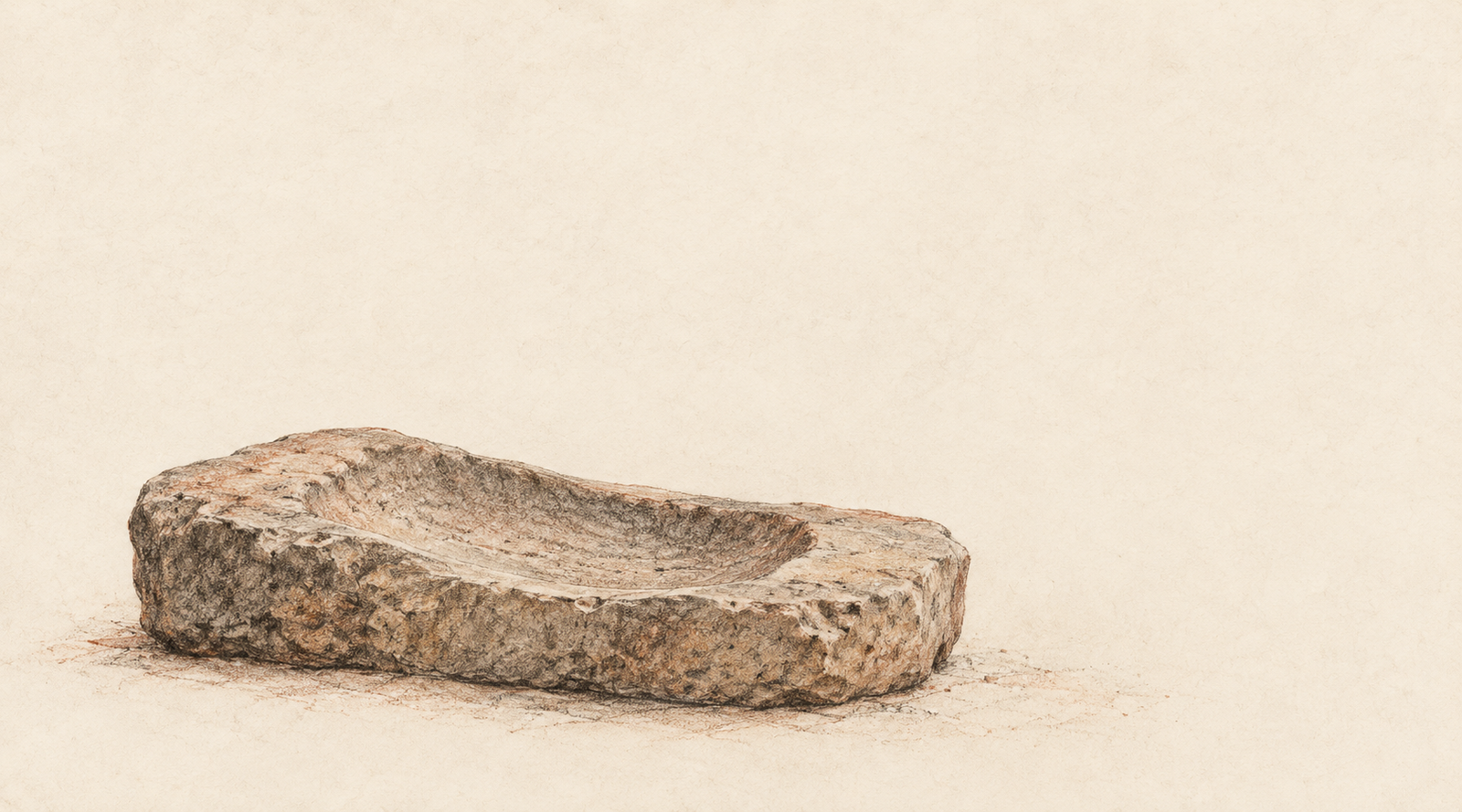

The City of Service
The temple we inherit is a building from which almost all necessity has been removed. Nothing must be brought for it to continue being what we call a temple. The sanctuary asks nothing of us. Stone is good at this kind of independence.
A living temple was otherwise.
Water had to come in. So did grain, cloth, oil, aromatic substances, fuel. The things required for worship arrived because someone carried them across a threshold.
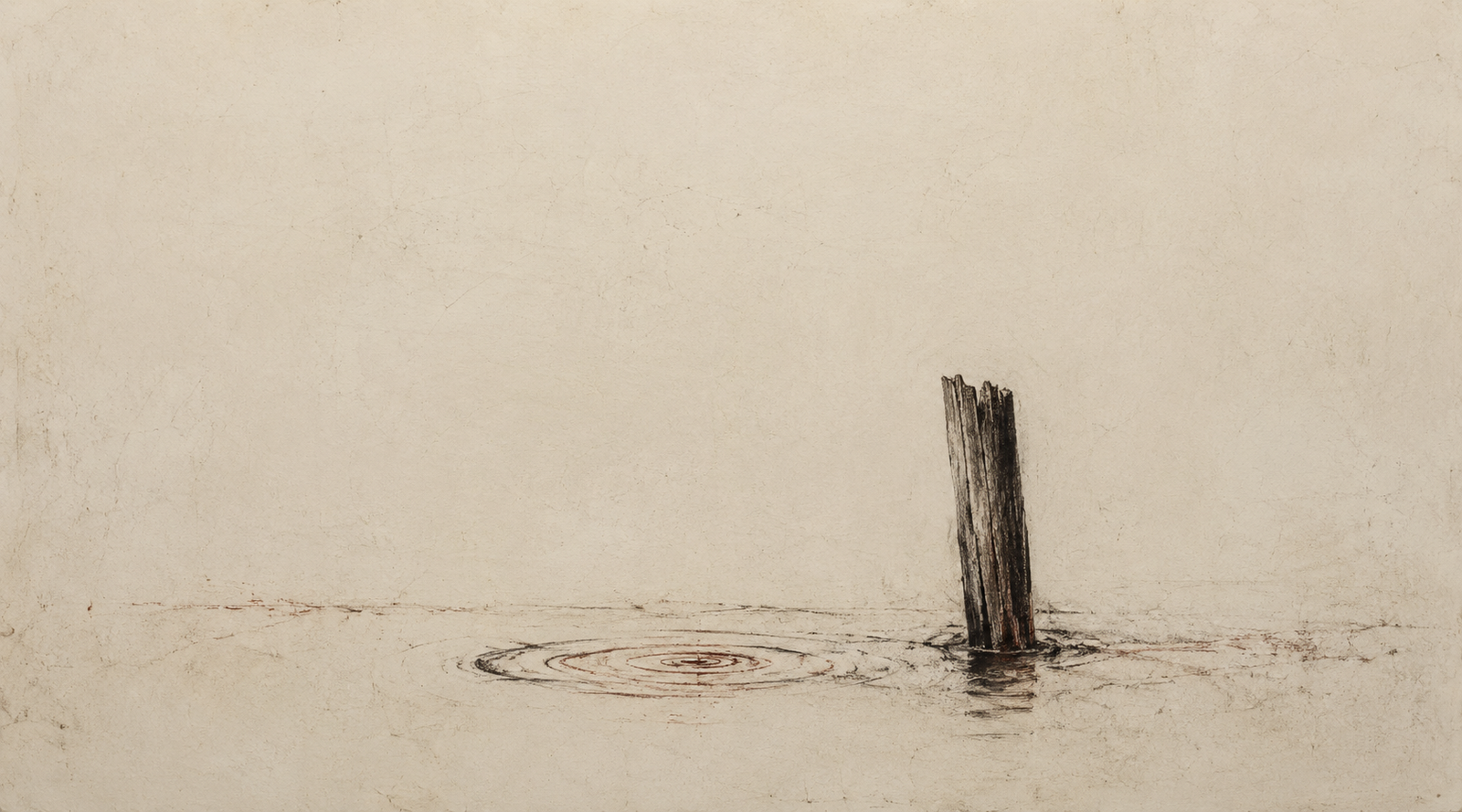

Houses of Wood, Light, and Smoke
Some of Angkor’s most intimate ruins do not rise above the ground at all. They are postholes, low mounds, hearths and ponds: durable traces of a domestic city built largely from things that decay. To restore that city is to see Angkor not only as stone, but as wood, smoke, water, repair, and people living within calling distance.