
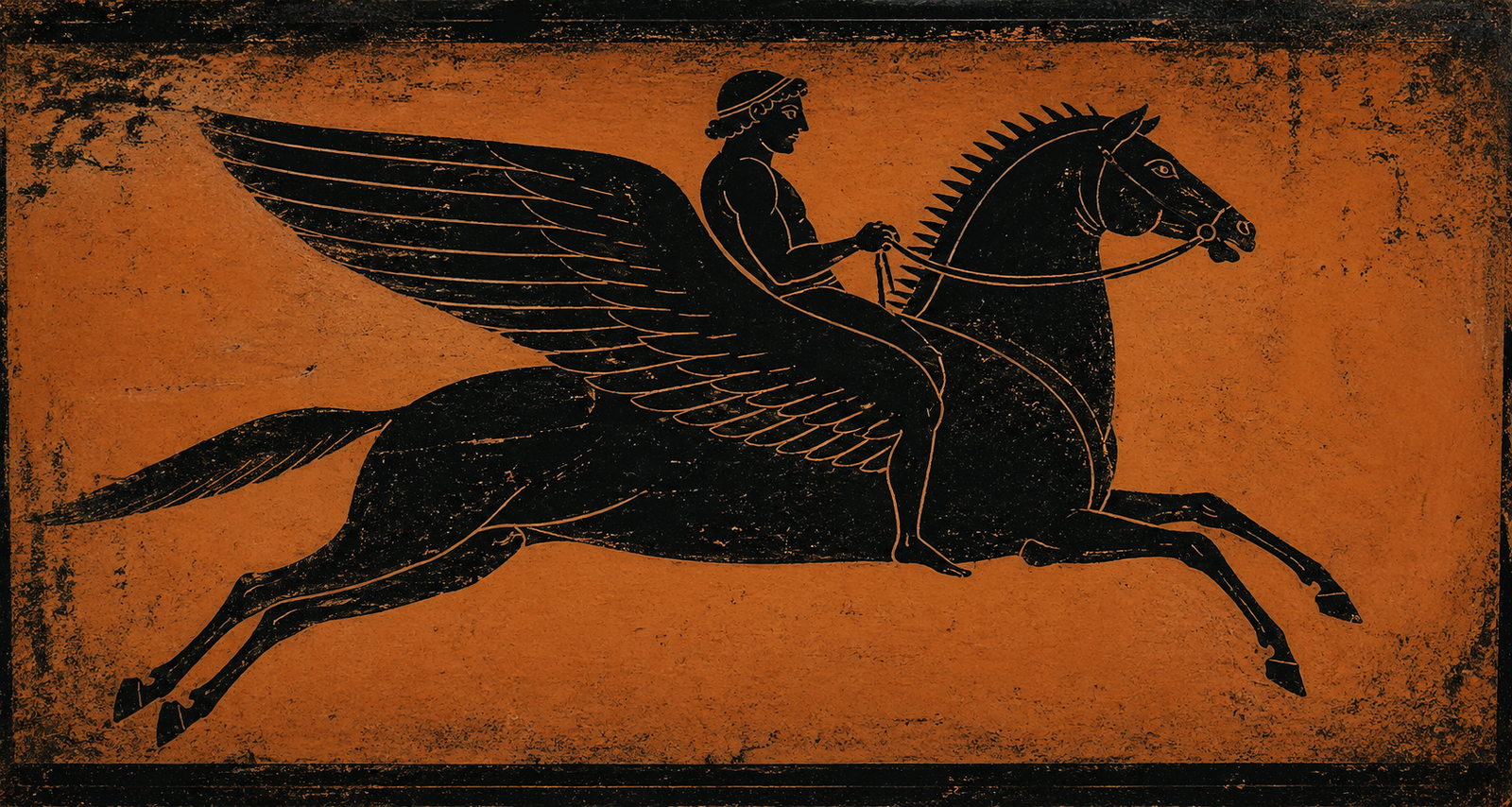

Bellerophon, Pegasus, and the Danger of Borrowed Height
On the death-letter, divine assistance, and the mortal who mistook being carried for belonging above.
This piece belongs to the Bellerophon & Pegasus chamber.
Bellerophon is often remembered as the hero who rode Pegasus and fell through pride. The older pressure is more severe: a death-letter, the laws of hospitality, divine equipment, and a mortal who mistook being carried for belonging above.
—
Bellerophon is usually remembered in a single bright image: the hero on the winged horse.
It is a difficult image to resist. Pegasus lifts the whole story into the air. He gives the myth speed, splendour, and a clean emblem: horse and rider rising above the world, monster beneath, Olympus above. In many later tellings, that image becomes almost the whole inheritance. Bellerophon tames Pegasus, kills the Chimera, grows proud, tries to fly to the gods, and falls.
That version is not false. It is only too clean.
The inherited myth is stranger than the emblem. It is not simply a tale of heroic ascent punished by divine jealousy, nor merely a moral anecdote about pride. Its deeper structure is built from homicide, purification, guest-law, false accusation, written death, delegated murder, divine equipment, impossible tasks, and a final separation between the mortal who rides and the immortal thing that can continue without him. Pegasus matters immensely. But the horse is not where the pressure first begins.
It begins, more severely, with a man already marked.
Bellerophon belongs to the Corinthian royal house. He is generally called the son of Glaukos and the grandson of Sisyphos, though strong traditions give him Poseidon as his true father. Even before the tale moves, then, his identity is divided between mortal inheritance and divine possibility. His original name is often given as Hipponous. He becomes Bellerophon after killing a man — accidentally, in the usual account — though the dead man’s name itself shifts from one version to another. Belleros, Deliades, Peiren, Alcimenes: the tradition cannot quite hold the body still.
That instability matters. The hero’s famous name is not an ornament. It is an aftermath. Before Pegasus, before Lycia, before the Chimera, Bellerophon is already a man whose identity has been remade by death.
He flees Corinth and comes to Proetus for purification. At this point the myth enters one of its most important structures: xenia, the sacred law of guest-friendship. Bellerophon is not simply a fugitive received by a king. He is a polluted man made into a guest, and therefore someone dangerous to host but dangerous also to harm. The king who receives him is bound by a law older and more serious than convenience.
Then Proetus’s wife desires him. Homer calls her Anteia; later sources more often call her Stheneboea. Bellerophon refuses her, and she accuses him falsely of attempting rape. That is the charge which turns the guest into a target. Yet Proetus will not kill him. He cannot, or at least will not, commit the direct violation. So he sends Bellerophon away to Lycia, to Iobates, carrying a sealed message.
This may be the most Cadmean object in the whole myth: the death-letter.
The letter contains signs instructing Iobates to kill the bearer. In Homeric language, they are “dire, life-destroying symbols.” This is a startling detail, and it is often passed over too quickly because Pegasus is waiting in the wings. But the myth becomes darker when we pause there. Bellerophon carries the written form of his own destruction. He is protected by the very law that has forced violence into writing. Murder has not disappeared; it has become mediated. It has become legible. It has become a message.
That is the hidden severity beneath the adventure.
Iobates, too, does not simply kill Bellerophon. He imposes tasks. The Chimera must be slain. The Solymoi must be defeated. The Amazons must be overcome. An ambush of chosen Lycian warriors must be survived. The common heroic pattern is present: the impossible labour, the monster, the warrior peoples, the proof of excellence. But beneath it lies a more uncomfortable structure. These are not innocent tests. They are attempted executions made acceptable by indirection.
Heroism, in this myth, is born inside someone else’s reluctance to murder openly.
The deepest fault line in the tradition concerns Pegasus himself. In later and more familiar accounts, Pegasus is central. Bellerophon is advised by the seer Polyidus to sleep in Athena’s temple. The goddess appears in a dream and gives him a golden bridle. When he wakes, the bridle is there; with it he tames Pegasus at the spring of Peirene. Mounted on the immortal horse, he defeats the Chimera from above, using arrows and a spear tipped with lead that melts in the monster’s burning throat. From the air he can defeat enemies who cannot reach him. Height becomes strategy.
Yet the Homeric account of Bellerophon’s Lycian labours does not make Pegasus central in this way. That omission is not a minor inconvenience to be smoothed over. It changes the myth’s balance. In one inheritance, Bellerophon is the hero caught in the machinery of guest-law, false accusation, royal fear, and impossible tasks. In another, he is the rider of a divine horse, the man whose victories depend on a supernatural elevation that will later tempt him beyond the human limit.
Both versions are powerful. They are not identical.
The later Pegasus tradition gives the tale its unforgettable vertical form: earth, air, Olympus, fall. It also clarifies something morally and structurally important. Bellerophon does not simply overpower the world. He succeeds through aids that are not wholly his. The bridle comes from Athena. Pegasus is not a mortal horse broken by human strength, but an immortal being born from Medusa’s blood and linked through Poseidon to a larger divine field. Even Bellerophon’s paternity may point beyond the human. His victories are therefore never purely his own.
That is where the usual “hubris” reading needs correction.
It is true that Bellerophon becomes a warning against presumption. At the height of his fortune, he attempts to fly to Olympus and take his place among the gods. Zeus sends a gadfly; Pegasus rears; Bellerophon is thrown down. In simplified form, this becomes a neat moral lesson: pride rises, pride falls. But the myth is sharper than that. Bellerophon’s error is not merely that he thinks too highly of himself. It is that he misreads the nature of what has carried him.
Divine assistance is not divine status.
Bellerophon has been lifted repeatedly: by birth, by royal reception, by purification, by the refusal of kings to kill him directly, by impossible tasks that become occasions of glory, by Athena’s bridle, by Pegasus’s wings. The very structure of his life teaches him ascent. Again and again he survives because another force, another law, another being, another object makes survival possible. When he turns at last toward Olympus, he is not committing a random act of arrogance. He is following the logic of his own miseducation.
The terrible irony is that the lesson has been false all along.
Pegasus can carry him above the Chimera. Pegasus can carry him above armies. Pegasus can carry him through the field of heroic impossibility. But Pegasus cannot make him belong among the gods. The horse is not proof that the rider has changed species. The bridle is not ownership of the boundary. The gift is not the giver’s rank transferred into mortal flesh.
The end of the myth is consequently more severe than the fall itself. A spectacular fall would be easy; almost too satisfying. Bellerophon’s punishment is not simply impact. He falls into a thorn bush, crippled and blinded in some accounts, and spends the remainder of his life wandering alone on the Aleian Plain, avoiding the paths of men. Pegasus enters Olympus without him and becomes the bearer of Zeus’s thunderbolts.
There, the myth makes its final distinction.
The immortal horse goes upward. The mortal rider remains below.
This is why Bellerophon should not be reduced to a decorative horse-and-monster tale. Pegasus is indispensable, but only if we understand what he does to the structure. He is not merely the means of triumph. He is the test that triumph conceals. He makes visible the danger of borrowed height.
Nor should the Chimera be treated as a mere obstacle in an adventure sequence. She is the labour through which Bellerophon learns the power of elevation. From above, he can do what would be impossible from the ground. The lead melting in the monster’s throat is a brilliant detail because it joins intelligence to violence: the monster’s own fire completes the weapon. This is not Heraclean brawn. It is technical, aided, angled, almost engineered.
Bellerophon’s greatness is real. The myth does not ask us to pretend he is weak, foolish, or fraudulent from the beginning. He kills what others cannot kill. He survives what is designed to destroy him. He is recognised, married into kingship, made heir. A flattened moral reading would make him simply arrogant. The older pressure is more troubling because it allows his excellence to stand.
The problem is not that he has no greatness. The problem is that greatness, aided by gods, can become unreadable to the one who bears it.
This is why the false accusation and death-letter cannot be treated as detachable preliminaries. Without them, the myth becomes a clean rise-and-fall structure. With them, it becomes a study in how a man is pushed into heroic stature by systems that wish him dead but cannot kill him openly. The guest becomes a bearer of signs. The condemned man becomes a monster-slayer. The intended victim becomes heir. Then the elevated man mistakes the pattern of survival for a summons beyond mortality.
The tale keeps turning on misrecognised status.
Bellerophon is guest and target. Polluted man and purified man. Mortal prince and possible son of Poseidon. Bearer of a death-letter and future heir. Rider of Pegasus and not a god. Each condition is unstable, double-edged, prone to catastrophe if read wrongly. That is the real inheritance modern summaries often lose. Myth does not always move by character lesson. Often it moves by position: where a body stands, under what law, carrying what object, bound by what relation, misnamed by what desire.
Bellerophon’s tragedy is not that he rises. It is that every stage of his rise is conditional.
The point is not to strip away Pegasus in favour of some drier, older core. It is to restore proportion. The winged horse belongs to the myth’s afterlife because he reveals something essential. But he should not be allowed to erase the letter, the guest-law, the false accusation, the machinery of indirect death, or the final plain. Bellerophon is not simply a man who wanted too much. He is a man carried too high by powers whose terms he did not understand.
That is why Pegasus must leave him.
The closing image is not horse and rider in union, but their separation. The immortal thing continues into Olympus. The man who tried to follow is left below, wounded, sightless, avoiding human tracks. The myth does not need to shout its moral. It has already arranged it in space: bridle and letter, wing and thorn, Olympus and plain.
Bellerophon’s story begins with a name made from death and ends with a pathless man under the hatred of the gods. Between those points lies one of Greek myth’s most dangerous clarifications: to be lifted is not to be admitted; to be aided is not to be transformed; to ride the winged horse is not to become worthy of the sky.
—
Next in this chamber: Bellerophon and the Borrowed Height.
—
Receive the next work
Subscribe free to receive new work from the House of Cadmus Library by email.
More from the Library


See Also
A concise and impartial dictionary of absence, promises, quarrels, ordinary objects, and the troublesome instability of words.

The City of Service
The temple we inherit is a building from which almost all necessity has been removed. Nothing must be brought for it to continue being what we call a temple. The sanctuary asks nothing of us. Stone is good at this kind of independence.
A living temple was otherwise.
Water had to come in. So did grain, cloth, oil, aromatic substances, fuel. The things required for worship arrived because someone carried them across a threshold.

Houses of Wood, Light, and Smoke
Some of Angkor’s most intimate ruins do not rise above the ground at all. They are postholes, low mounds, hearths and ponds: durable traces of a domestic city built largely from things that decay. To restore that city is to see Angkor not only as stone, but as wood, smoke, water, repair, and people living within calling distance.