

The Gorgons: Medusa, the Shield, and the Danger of Looking
After Perseus has survived Medusa, we can ask what a Gorgon really is.
After the Tale
Now that Perseus has looked into the shield and survived what no one was meant to survive, we can turn back and ask a dangerous question.
What was a Gorgon?
Not simply a monster. Greek myth has plenty of monsters, and many of them are easier to understand. A lion with impossible hide. A boar sent to ruin a kingdom. A bull-man hidden in a labyrinth. A giant with one eye.
The Gorgons are stranger.
They are not only dangerous because they are strong. They are dangerous because of looking.
To see a Gorgon directly is to be destroyed. That is why Perseus cannot fight Medusa as he might fight another monster. He cannot simply run at her with a sword. He cannot lock eyes with her. He cannot even look at her in the ordinary way.
A Gorgon changes the rules of courage.
The Short Answer
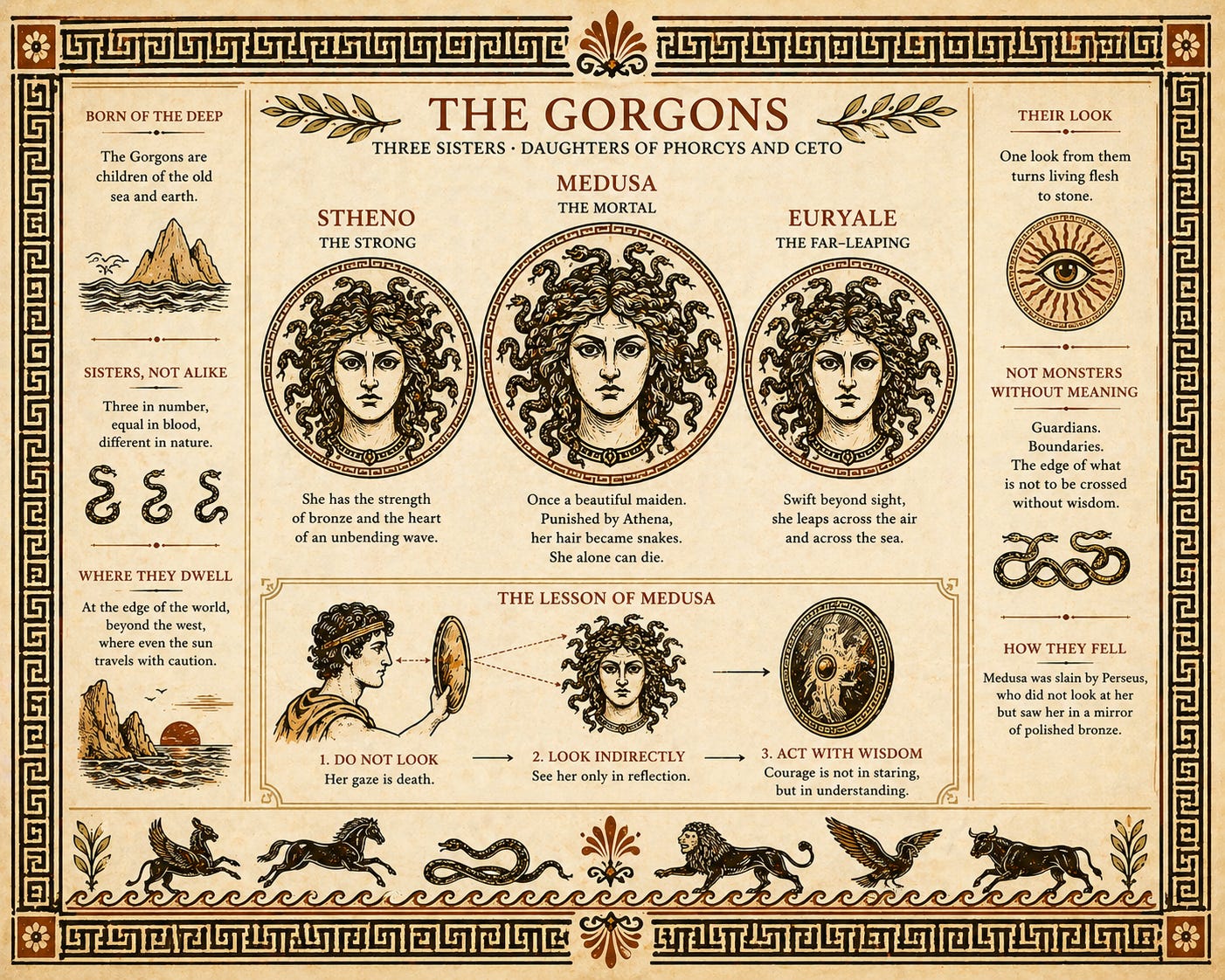
The Gorgons are three monstrous sisters in Greek myth: Stheno, Euryale, and Medusa.
Their names are old and fierce. Stheno suggests strength. Euryale suggests a wide-roaming power. Medusa’s name is connected with guarding or ruling, though by the time Perseus meets her, she is most famous for being deadly to behold.
In many tellings, two of the sisters, Stheno and Euryale, are immortal. They cannot be killed. Medusa is mortal, which is very unfortunate for Medusa, because it means she is the one Perseus is sent to find.
The Gorgons are often imagined with snakes for hair, terrible faces, and a gaze that turns living beings to stone.
This is why Perseus needs help from Athena. A hero cannot win this sort of encounter by ordinary bravery. Ordinary bravery would get him killed almost at once.
What the Tale Showed You
In Perseus and the Shield of Athena, Medusa is not just an enemy at the end of the road. She is the shape of the impossible task.
Perseus has been sent against something no one expects him to survive. That is important. The people who send heroes on quests are not always kind, and the gods, when they help, often help in very exact and difficult ways.
The Tale shows the most important rule about Medusa:
Do not look directly.
That rule may sound simple. It is not.
When danger is near, people often want to stare at it. They want to understand it completely. They want to prove they are not afraid. Greek myth is not always impressed by this. Sometimes it says: if you look wrongly, you lose.
Perseus survives because he learns another way of seeing.
The shield allows him to look by reflection. It lets him face the monster without giving the monster his eyes.
That is not cheating. That is wisdom.
And wisdom, in this story, is the difference between a hero and a statue.
What Else the Myths Say
The Gorgons belong to the older, stranger edges of Greek myth. They are not comfortable household monsters. They come from a world of sea-deities, ancient powers, and beings that do not fit neatly among gods, mortals, or beasts.
Their parents are usually named as Phorcys and Ceto, old sea powers connected with the deep and dangerous places of the world. This means the Gorgons are not random creatures wandering about for no reason. They belong to a family of ancient, unsettling beings.
The Greeks did not always tell Medusa’s story in exactly the same way.
In some older tellings, Medusa seems to have been born monstrous, one of three terrible sisters. In later stories, people sometimes said that she had once been beautiful and had been changed by Athena after a terrible wrong connected with the goddess’s temple.
For The Greek World, the important thing is this: Medusa is both monster and warning. She belongs to fear, punishment, beauty ruined, divine anger, and the terrible power of sight.
Greek myth often refuses to make such things tidy.
That is one reason the myths last.
Family, Origins, and Strange Connections
The Gorgons are connected with other strange beings in the old Greek world.
Their parents, Phorcys and Ceto, are linked to the dangerous sea and to many monstrous children. In Greek myth, the sea is not just water. It is a place where old powers hide, where shapes change, where ships vanish, and where things may rise that no one on land properly understands.
The Gorgons also have a strange connection to Pegasus.
In many tellings, when Perseus kills Medusa, the winged horse Pegasus springs from her. So does Chrysaor, whose name means something like “golden sword.” This is one of those moments when Greek myth gives you no time to say, “Wait, what?” It simply happens, and the world becomes stranger.
Pegasus will matter in other stories later.
That is how Greek myth works. One monster’s ending may become another hero’s beginning. One impossible task may release a winged horse. One shield may carry a terrible face into future battles.
The stories are tied together by threads the reader only sees slowly.
Signs and Symbols
The Gorgons are remembered through powerful signs:
Snakes — not merely as frightening creatures, but as living, moving signs of danger.
The staring face — sometimes shown full-front, unlike many Greek figures in profile. The face meets the viewer directly.
Stone — because the Gorgon’s gaze turns life into stillness.
The shield or mirror — because reflected sight is the only safe way to see Medusa.
The Gorgoneion — the Gorgon head used as a protective sign. The Greeks sometimes placed this frightening face on shields, armour, buildings, and objects, as if terror itself could be turned outward to guard what mattered.
This is one of the strangest things about the Gorgons.
A monster’s face could become protection.
Fear could be made to stand at the door and frighten worse things away.
Why This Matters Later
The Gorgons matter beyond the story of Perseus because they teach one of the old rules of Greek myth:
Not every danger can be faced in the same way.
Heracles may wrestle.
Theseus may enter the labyrinth.
Odysseus may lie, scheme, and listen at doors.
Perseus must look without looking.
Each hero has to learn the right shape of courage for the danger in front of him.
The Gorgons also matter because Medusa does not vanish when Perseus leaves her cave. Her image remains. Her head becomes part of Athena’s own terrifying power. The monster Perseus defeats becomes a sign carried into other stories, other shields, and other fears.
That is very Greek.
Nothing powerful is ever only finished.
One Thing to Remember
A Gorgon is not only something terrible to see; she is a warning that some fears must be faced indirectly.
—
Receive the next work
Subscribe free to receive new work from the The Alexander Series Library by email.
More from the Library

See Also
A concise and impartial dictionary of absence, promises, quarrels, ordinary objects, and the troublesome instability of words.

The City of Service
The temple we inherit is a building from which almost all necessity has been removed. Nothing must be brought for it to continue being what we call a temple. The sanctuary asks nothing of us. Stone is good at this kind of independence.
A living temple was otherwise.
Water had to come in. So did grain, cloth, oil, aromatic substances, fuel. The things required for worship arrived because someone carried them across a threshold.

Houses of Wood, Light, and Smoke
Some of Angkor’s most intimate ruins do not rise above the ground at all. They are postholes, low mounds, hearths and ponds: durable traces of a domestic city built largely from things that decay. To restore that city is to see Angkor not only as stone, but as wood, smoke, water, repair, and people living within calling distance.