
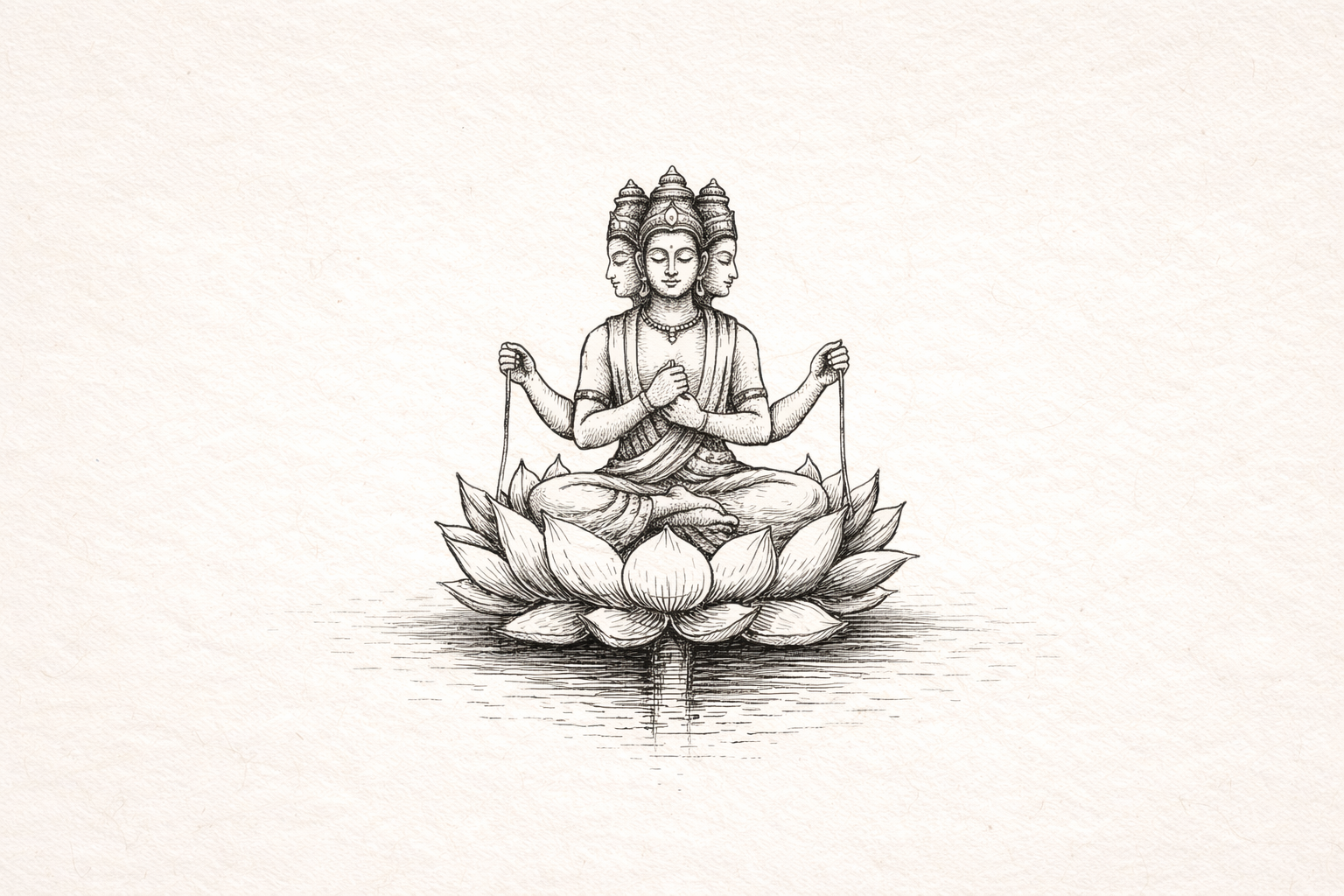

Fires of the Old World II — Lotus-Birth
The lamp had been trimmed, and the oil stood still as held breath. Outside the door the night insects stitched their small, ceaseless music; inside there was ember-scent and cool air. A child lay half-asleep beneath a woven cloth; an old woman warmed her palms over ash and listened. The house was nothing grand — reed, timber, soot — yet the dark beyond it felt wide as water. In such a night, stories do not arrive like guests. They rise like smoke.
Listen.
Before there was counting, before there was name, there was the Sleeping God.
He did not lie as men lie, with knees drawn and ribs complaining. He lay as a mountain lies beneath cloud: whole, unhurried, complete. Around him the waters rolled — black, deep, unmeasured — touching him as reverently as lips touch a shrine. The world had not yet learned edge or direction. It was only water and the slow pulse of a presence so immense that even the dark was gentle in its shadow.
And in that presence, a lotus seed waited.
It was no bigger than a grain caught beneath a fingernail, no heavier than a thought not yet spoken. It rested at the Sleeping God’s navel, as though the body itself had kept a secret there. The seed held everything in its silence: lamp and ash, coil-scale and measuring cord, the first taste of breath.
Time went past as it does when no one is watching. The waters shifted their shoulders. The deep kept its patience.
Then the lotus seed warmed.
Not with fire, but with quiet will. The seed swelled. It drank the ocean without diminishing it. Slowly, with a tenderness that did not ask permission, it opened.
A stalk rose.
It rose from the navel of the divine like a column drawn from the centre of silence. It rose straight through the black waters, unwavering. The waters did not resist it; they made way, as though they had been waiting for this exact ascent. The stalk carried a pale strength, the kind found in reeds and vows — something that will not yield merely because the world is wide.
Up it went.
Past distances without names. Past depths that had never been sounded. Past the place where a fish might one day learn fear. Past the place where a serpent dreamed — coiled into patience, scale upon scale — though no eye had yet been made to witness it.
At last, where the dark thinned a little, the lotus blossomed.
It unfolded as if it had been practising for ages. Petal after petal opened, each one a pale curve, each one a promise made visible. In its heart, cradled as in a small, perfect bowl, sat a being with four faces and four calm, unhurried hands.
Brahma opened his eyes.
The first thing he saw was lamp-light that had not yet been lit. The second was ash that had not yet cooled. The third was the curve of a measuring cord, slack in the palm of a world not yet measured.
He sat upon the lotus as a judge sits: not severe, not kind, simply present. He breathed in, and his breath did not move air — because air had not yet been made — but it moved possibility. He looked in four directions, and in each direction there was only water and dark, and the Sleeping God below, unseen.
Brahma did what a maker must do.
He asked a question.
Not aloud. There was not yet the habit of sound. He asked it with the whole of his being, as a bell asks to be struck, as a river asks to run.
Where am I?
The question did not echo. There was nothing for it to strike. It became, instead, a cord thrown into the deep.
Brahma leaned forward. He gripped the lotus stalk with one hand. The stalk was cool and firm, living and steady. He pressed his other palm against the petal’s smooth edge, as though to assure himself the seat was real. He looked down along the stalk, and the dark below drank his gaze.
His four faces shifted — one after another — each one searching, each one failing to find boundary. It was like being asked to look four ways at once into one single emptiness. The stalk vanished into blackness, and the sight of it pulled at him.
Still, he descended.
He moved down the stalk as a climber moves down rope — careful, deliberate. The lotus above him closed into distance. The waters around him were cold as polished stone. He passed through layers of dark that thickened like cloth. He passed through silence that had weight.
The first trial came without warning: the waters thickened until they were almost solid, pressing against him like sleep. His limbs slowed. His breath — though breath was not yet a thing — felt stolen. Brahma tightened his hold, and in his palm the stalk held, unbroken, faithful.
The second trial came when the dark itself began to speak.
Not in sentences. In lures.
It offered him endings. It offered him certainty. It offered him a bottom — something he could touch and declare finished. In that speaking dark, he felt the first temptation: to name what he had not yet understood.
Brahma did not answer it. He kept moving.
The third trial was the worst, because it felt like kindness.
A warmth rose in the water, gentle as a hearth, and with it came the sensation of home — of something already completed, already safe. In that warmth Brahma’s hands loosened. His faces softened. The stalk, for an instant, felt unnecessary, like a tool forgotten after the work is done.
Then the warmth sharpened. The kindness showed its edge. Brahma understood: it was not home. It was sleep — another layer of the Sleeping God’s vast dreaming.
He tightened his grip again, and the lotus stalk cooled in his hands as though approving.
Down he went.
Lower.
The stalk continued. Brahma’s fingers began to ache with the first ache ever felt. His shoulders burned with the first labour. In his chest the question grew heavier, dragging behind him like a net.
At last, in exhaustion that felt like the edge of creation, Brahma paused. He clung to the stalk, his limbs trembling. He turned his faces downwards again, and poured his gaze into the deep.
He expected to see the Sleeping God.
He expected to see the navel from which the stalk rose, the source of his seat, the anchor of this ascent and descent.
But the dark did not thin. It did not open. It did not grant him bottom.
It only widened, immense and indifferent, as though it could go on for ever.
He looked down and found no bottom.
For a breathless instant, there was no up, no down, no centre. The lotus stalk beneath his hands felt suddenly slender, a mere thread in an ocean that might swallow even gods.
And the consequence landed not as thought, but as body.
Brahma’s arms shook. His grip slipped a finger’s width. Cold water struck his belly like a slap. His four mouths opened at once; no sound came. Yet the waters around him trembled, as if they had heard an unspoken cry.
In that shaking, the lotus stalk quivered. A drop of water, clinging to it, slid down and fell. Brahma watched it vanish into the dark, and the vanishing was absolute.
Then, far above — so far it felt like a remembered direction — he sensed the lotus’s pale patience. He sensed the lamp that had not yet been lit. He sensed the ash that would one day cool after offerings. He sensed, most clearly, the measuring cord waiting to be stretched.
And he understood, without comfort and without sermon:
If there was no bottom, then bottom would have to be made.
Brahma turned.
He climbed.
Not in triumph. Not in certainty. He climbed like a craftsman returning to the bench after learning the cost of his task. Each movement was work. Each lift of hand and foot was a vow made with muscle.
At first the waters fought him.
The thick sleep returned, pressing at his shoulders. His forearm cramped; his fingers went numb. Once his hand slipped again, and the stalk rasped his palm and tore a thin line of skin. The sting of it was bright and clean, and it woke him fully. He held harder.
Then the waters began to change.
They did not grow brighter, but they grew less hostile. The thickness loosened. The speaking lures fell quiet, as if shamed by his refusal. The false warmth slid away, leaving a cleaner cold.
At last, the lotus appeared above him — pale against the endless night, like the first hint of dawn.
Brahma climbed onto it. He sat again in the heart of the bloom. His limbs were wet. His hands were scraped by the stalk’s subtle fibres. He lifted one palm and saw the faint red mark where his grip had burned into skin — the first proof that even makers must pay.
The lotus held him without question.
Brahma reached beside him, and in the lotus’s heart he found what had been waiting: a thin cord, soft and strong, coiled like a sleeping serpent in miniature. He lifted it. It was cool as moonlight. It felt like fairness, like measure, like the calm that comes after fear.
With the cord in his hands, Brahma began the first act of making.
He did not speak. He did not declare. He did not explain.
He simply stretched the cord between two points in the dark.
Where the cord tightened, distance was born.
He stretched it again, and direction followed: this way, not that way. Up, not down. Here, not there.
He stretched it a third time, and the waters, obedient to that measured tension, began to gather into shape. Currents learned to turn. Depth learned to become floor. A place learned to be a place.
Above, Brahma imagined a lamp. Not as lesson — an actual flame held steady against wind. The lamp’s heat gathered at the centre of his chest like a coal.
Below, he imagined ash. Not yet cool, not yet grey — the thing that remains after offering. That ash fell, silent as blessing, into the waters and gave them weight.
Hours passed. Or ages. The difference did not matter yet.
Brahma worked with the cord until his hands remembered purpose. The marks on his palms deepened, and those marks became a kind of record. Each measure he made became boundary. Each boundary became possibility. The first question — Where am I? — did not vanish. It widened, and in widening it became a world.
At last, exhausted, Brahma sat back on the lotus and looked out in four directions.
There was still darkness. There was still water. But now the water had the faintest rise and fall of order, like breath finding rhythm. The dark had begun to hold space rather than swallow it.
Brahma held the cord in his lap, and the cord lay there like a tame serpent, like a promise kept. He closed his eyes for one long moment, and in that moment he tasted the truth of his labour: it had cost him fear, and it had cost him the mark of that fear on his hands.
When he opened his eyes, he did not smile. He did not frown. He simply began again.
—
In the reed house, the old woman’s hands cooled. The lamp’s flame steadied. The oil shone like a small, patient sun.
The child stirred beneath the cloth. Without opening her eyes she asked, drowsy as smoke, “Grandmother… why is the world so deep?”
The old woman did not answer with words. She only placed one warm palm on the child’s back, as if to anchor her to the earth that had been made. The other hand hovered above the ash, feeling its last faint heat. A little grit clung to her skin; she rubbed it away with her thumb.
Outside, the night remained vast. But it had a centre now. It had measure. It had ground.
The embers softened into ash.
—
Receive the next work
Subscribe free to receive new work from the Lucas Varro Library by email.
More from the Library

See Also
A concise and impartial dictionary of absence, promises, quarrels, ordinary objects, and the troublesome instability of words.
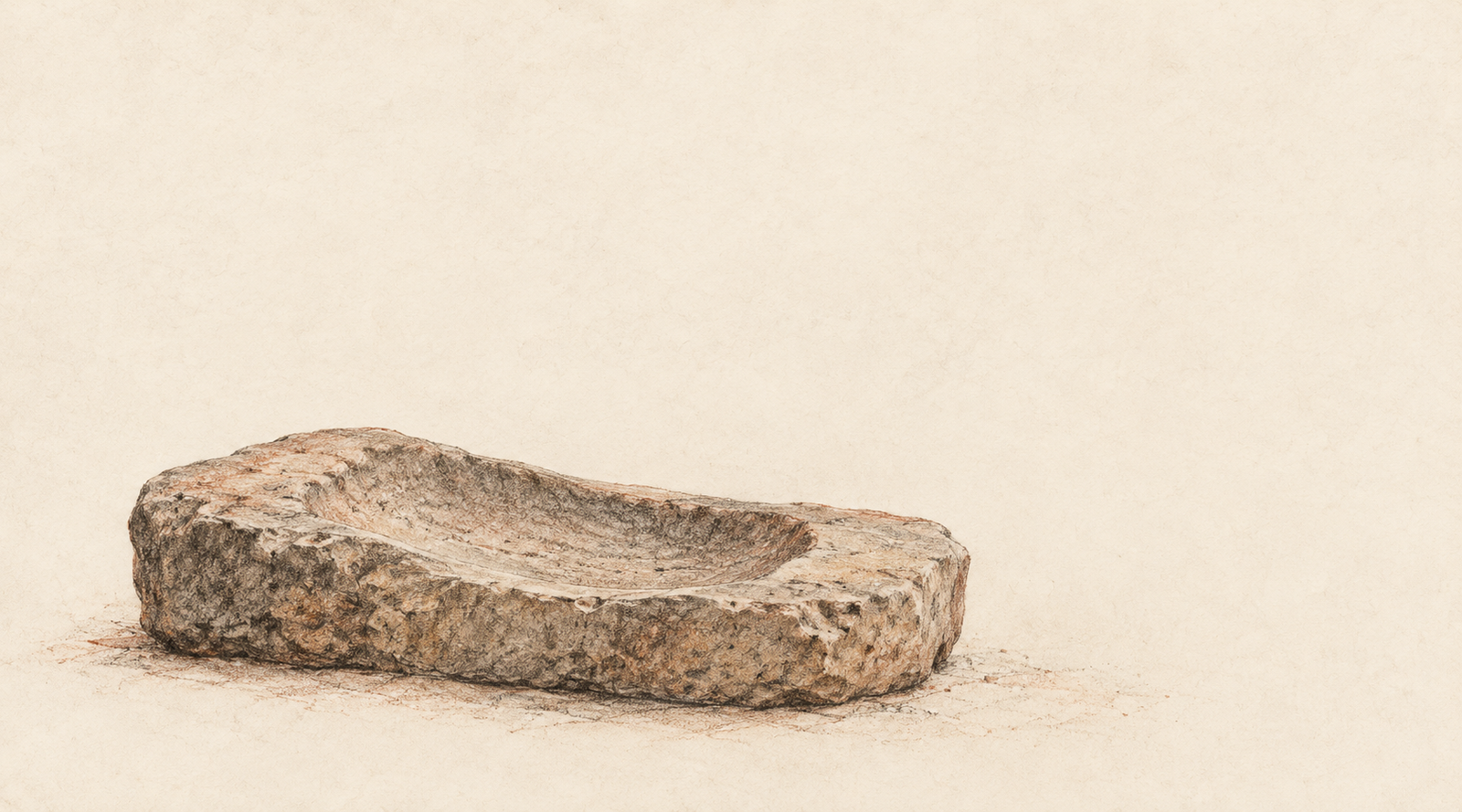

The City of Service
The temple we inherit is a building from which almost all necessity has been removed. Nothing must be brought for it to continue being what we call a temple. The sanctuary asks nothing of us. Stone is good at this kind of independence.
A living temple was otherwise.
Water had to come in. So did grain, cloth, oil, aromatic substances, fuel. The things required for worship arrived because someone carried them across a threshold.
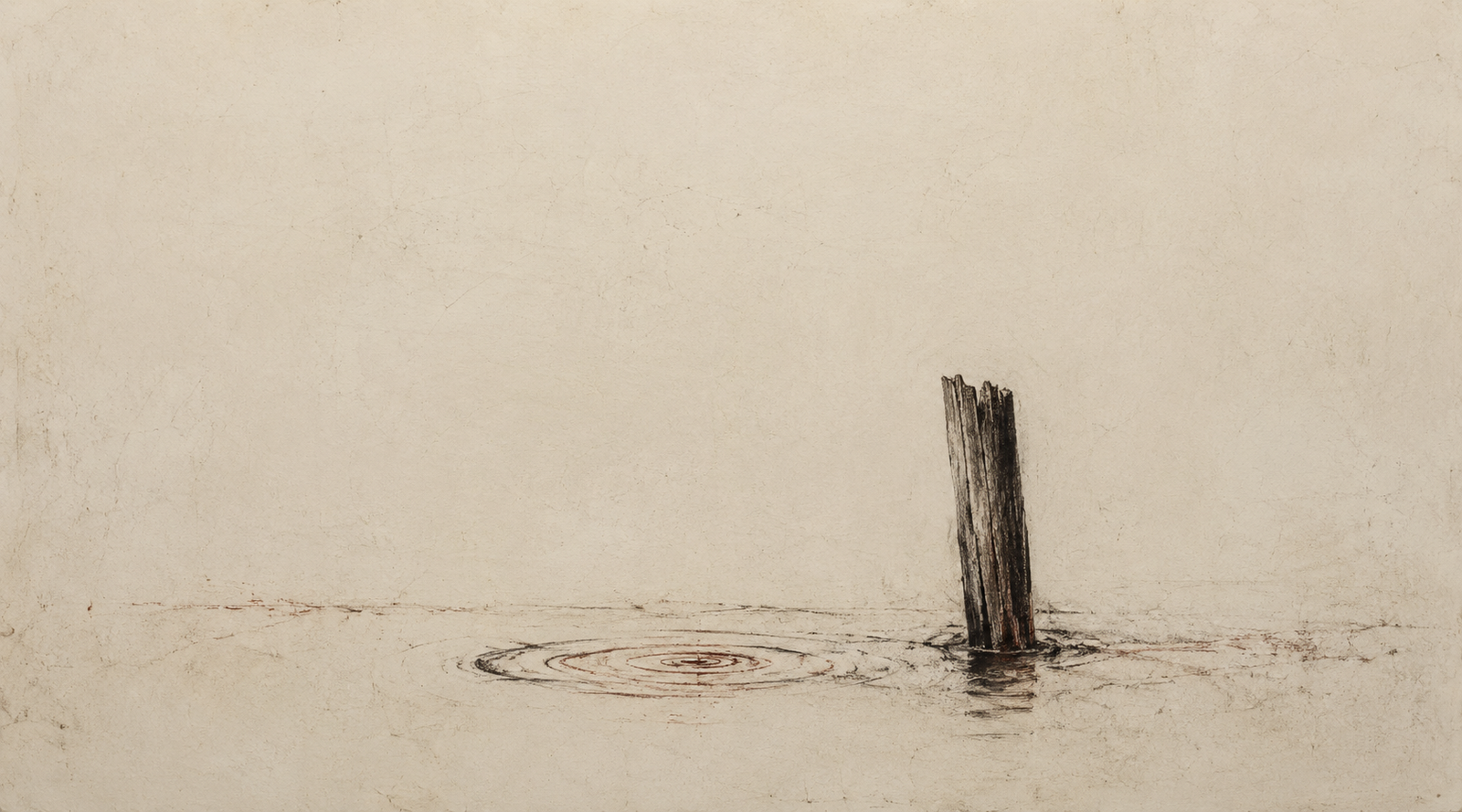

Houses of Wood, Light, and Smoke
Some of Angkor’s most intimate ruins do not rise above the ground at all. They are postholes, low mounds, hearths and ponds: durable traces of a domestic city built largely from things that decay. To restore that city is to see Angkor not only as stone, but as wood, smoke, water, repair, and people living within calling distance.