
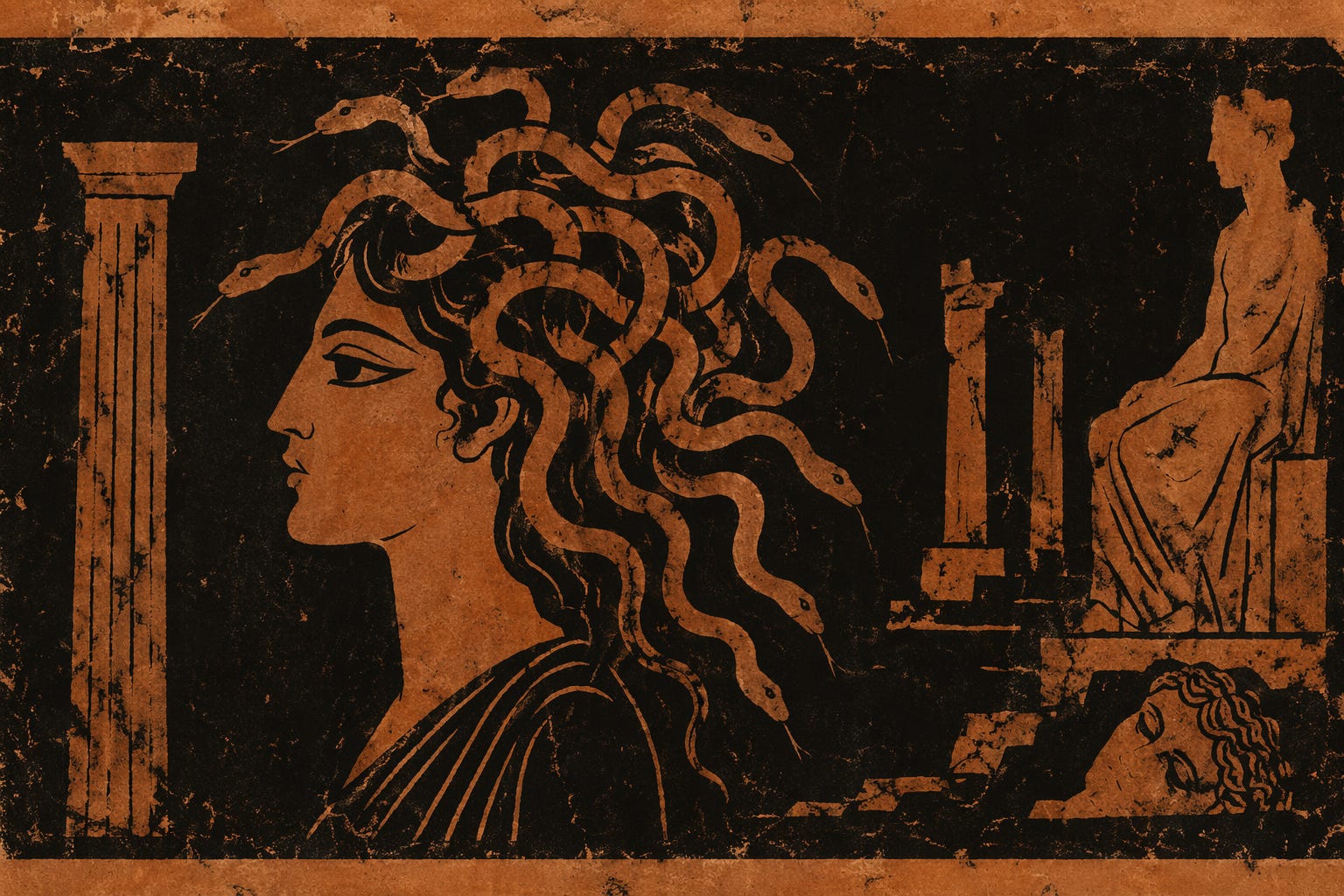

Medusa — The Mirror of Silence
A voice from the broken sanctuary
Before they named me otherwise, I kept order.
I knew the floor by its veins, the altar by its chipped edge, the bronze basin by the way it answered water with a dim, patient light. Morning began before dawn had fully entered the sanctuary. Oil first. Then wick. Then flame coaxed upward until the dark gave back the shape of column, lintel, wall. Smoke rose in a line so fine it seemed less a thing than a correction made to air.
I learned to move without waste.
The cloths were folded and refolded. The vessels were rinsed and set mouth-down on stone. Ash was gathered before it could scatter. Water was carried in both hands. If I crossed the hall while others prayed, they did not turn. I was glad of that. Reverence lives by not drawing itself forward. I thought holiness a matter of exactness: a swept floor, a steady lamp, a body taught to kneel before it is taught to speak.
There was bronze enough in the sanctuary to hold a face, if one cared to look. I did not often look. A mirror is only useful when it returns what is needed: whether the lamp-smoke has marked the cheek, whether the hair has come loose, whether the goddess’s image in polished metal still stands clear and undisturbed. I kept my own face as I kept the vessels—clean, serviceable, unremarked.
So I believed.
The goddess looked past me, which I took for favour. Stone need not turn toward the hand that tends it. It is enough that the hand does not fail. I learned the grammar of service in silence: lift, pour, polish, bow. Knees to floor. Cloth to bronze. Flame to wick. Every motion repeated until repetition became a kind of peace.
If there was beauty in me then, it arrived as weather arrives on water: seen more by others than by the surface itself. I felt it only in the slight pause before men spoke, in the way eyes lingered too long and then withdrew as though burned by their own staying. I did not mistake that for power. Attention is not power. Attention is a hand extended from the dark. It can bless. It can take.
The sanctuary held both possibilities and called itself pure.
I knew the smell of myrrh, cedar smoke, olive oil. I knew how cold the marble ran before sunrise, how quickly the basin clouded if not dried, how the first light entered from the eastern side and touched the floor before it touched the altar. I knew the weight of the bronze mirror and the shallow bowl used for washing. I knew how long a flame may gutter before it fails.
I did not yet know how long silence can hold after holiness has been broken.
It did not begin with thunder.
No omen split the air. No cry rose from the inner chamber. The columns remained upright. The lamp still burned. The basin held water. What came entered under the shape of authority, and authority is often the last thing questioned in a sacred place.
I remember the floor first.
Its cold through the skin of my knees.
I remember the bronze vessel at my side giving a small sound when struck—not loud, only enough to prove the world had not gone numb. I remember the smell of oil thickening as the flame bent. Not wind. Not draft. Will. Something in the room changed not by weather but by decision, and the sanctuary, which had taught me order, did not prevent it.
I will not make a spectacle of the moment.
Stone was beneath me. Smoke above me. A hand where no hand had the right to be. The altar near enough to touch. The goddess near enough to see. I looked toward her because that is where I had been trained to look. Marble gave me profile, not face. The turn-away was slight. It was enough.
What breaks in such a moment is not only the body.
Place breaks.
Order breaks.
The floor remains floor, the altar remains altar, the lamp remains lit, and yet the law that held these things in relation is revised in an instant by a stronger will. The sanctuary did not collapse. That was part of the injury. Nothing announced itself except the fact that nothing intervened.
Afterward, the room still stood.
The bowl had rolled and settled against the base of a column. Oil had darkened one patch of stone. The wick burned lower. Smoke leaned and unleaned in the air. My breath returned in pieces. The body returned more slowly.
No one entered.
No thunder followed. No judgement split the lintel. The goddess kept her height. The walls kept their silence.
The first shame was not mine. It entered from outside and sought a vessel. It found me because I was there.
What came after moved quickly, as such things do when power wishes to hide its own face. The story reached me before the change completed itself. Not innocence broken. Not sanctuary defiled. Not witness abandoned.
Curse.
That was the word sent forward to do the work. It travelled faster than truth and asked less of those who spoke it. Curse could close the matter. Curse could place the stain in the body that bore the wound and leave untouched the hand that made it.
The air altered before the flesh did.
Lamps seemed to burn lower, though I trimmed them as before. Petitioners left offerings farther from where I stood. Eyes slid past me, then caught, then dropped. The bronze mirror lost its usefulness. Once, lifting it to wipe away smoke from its face, I saw not disfigurement but disturbance—as if the surface had ceased to know how to return a human likeness without resistance.
My hair changed first in sound.
At night, before sleep took hold, I heard a dry stirring near the skull, like reeds moved by a current too slight to see. When I woke, strands lay across my shoulders with a weight not wholly theirs. The scalp felt tender, then fevered, then occupied. I touched it once and drew back. Not from pain. From recognition that the body had begun to answer a sentence already spoken elsewhere.
Skin hardened in places where no labour had hardened it before. The back of the neck learned a new alertness. The eyes ached. Light struck them and did not settle as it once had. The mouth held the taste of metal after water. When I crossed the sanctuary, sound seemed to alter around me—not silence, but a more careful use of it.
They no longer let me tend the inner flame.
They did not say why.
The cloths were taken from my hands. The basin lifted before I reached it. Another girl, younger, more frightened, carried water where I had carried it. She would not meet my face. I watched her move with the precision I had once prized and felt, for the first time, that order can be crueler than panic. Panic at least confesses rupture. Order continues as if nothing has been touched.
When they sent me away, the sanctuary did not protest.
Threshold.
Stone underfoot giving way to earth. Columns behind. Open ground before. The change in air was immediate. Outside, wind moved without permission. Dust did not need to be gathered; it went where it pleased. The body, once disciplined by enclosure, had to learn another law.
The serpents came fully after exile.
Not at once, not theatrically, not in the manner of tale-tellers who love a transformation more than its cost. They emerged by increments. A tightening at the roots of the hair. A living pressure along the scalp. Then motion with intent not borrowed from the neck beneath it. They did not arrive as ornaments of horror. They arrived as consequence: the body taking into itself what had been forced upon it and refusing to remain legible by the old design.
Their sound was quieter than fear imagines.
Not the constant hiss men later claimed, but a low, dry attending. They moved when the air changed. They lifted before I did. They sensed what approached before I named it. I learned their weight. I learned the slight pull they gave when turning toward disturbance. I learned that they slept, if it was sleep, in brief coils against the skull and woke more easily than mercy.
By then I no longer sought bronze.
Water was enough.
Even there the face came altered, though not always in the same way. Sometimes the eyes seemed unchanged and all the difference lay in the stillness around them. Sometimes the mouth was mine and the brow no longer mine. Sometimes the water trembled before I did, as if refusing the labour of returning me. I stopped asking for one true likeness. Whatever had happened in the sanctuary had not ended in the sanctuary. It had entered the means by which the world could be seen.
Men came.
Not in crowds. In ones and twos at first. Curiosity, bravado, pity, appetite, command—each wearing a different face, each convinced it had come for its own reason. They crossed the outer ground with weapons, with coins, with words prepared in advance. Some meant to subdue. Some to witness. Some only to prove themselves immune to rumour.
I do not know when the gaze first completed itself.
There was no bolt, no visible issuing-forth. The change had been preparing in me long before another body stood close enough to receive it. A man entered the broken precinct where I had taken shelter among stone and scrub. He called out before he saw me clearly. I remember that. The confidence of a voice going ahead of the body. Then he stopped.
Not because I raised my head in triumph. Not because the serpents struck. Not because a spell was uttered.
He stopped because what met him did not bend.
I looked.
He did not move.
What passed between us was not attack. It was return. He had come bearing whatever he bore—hunger, fear, entitlement, the old belief that a woman alone in a ruined place must be either spoil or spectacle. The gaze gave it back before he could lay it elsewhere.
I watched the body fail in stages.
Breath held first. Then the small corrections by which balance is maintained. Then the hand, still around the weapon, forgetting how to continue its intention. The face changed least. That is what was worst. The face remained capable of knowing while the rest of him entered stillness. Stone rose through him not as crust but as verdict already present in the posture he had brought.
After that there were others.
A hand raised to strike. A knee caught at the edge of bending. A mouth open on a word that would not finish.
They called this monstrosity.
It was easier than saying recognition.
I did not rejoice.
Stone gathers around a body with terrible patience. To watch it once is enough. To watch it many times is to feel the world harden in parallel. The serpents learned the approach of men before I did and lifted their heads with a weariness I came to share. Not pity. Pity hollows. Something sterner. The knowledge that what comes again will again refuse to know itself until it is too late to turn away.
Ruined walls became my sanctuary after the true sanctuary failed.
There, columns broken at the top still cast evening shadow. There, wind entered without cleansing anything. There, lizards moved across old carved faces and nested in mouths once made for hymn. The statues that gathered were not arranged. They stood or knelt or half-turned wherever their last impulse had fixed them. Rain marked them. Salt worked into them. Bird-droppings whitened shoulder and brow. Time did what time does, but never enough to undo the instant that had claimed them.
Sometimes I walked among them after sunset.
Bare feet on stone, then dust, then stone again. The serpents quiet. The sky draining of colour. A hand half-raised beside me. A mouth open on an unfinished word. Eyes that would not close. In such company one learns how complete silence can become when it is no longer reverence but consequence.
But neither was I what they named me.
Monster is a convenient mouth for the frightened. It places the break at a distance.
Names did not alter the body.
The serpents remained.
The eyes remained.
The fact remained that those who came carrying domination in one form or another could not bear to meet what stood before them and stayed.
I was silence before I was remade by it.
Now silence keeps another office. It does not hide. It waits. It knows how long a body may hold itself upright before truth enters the limbs. It knows how stone begins—not at the skin, but in the failure of whatever once moved easily beneath it.
The broken sanctuary behind me, the lesser sanctuary of ruins around me, the bodies held in their last refusal: these are not justice. Justice would have required intervention at the altar. What remains is something harsher and more exact.
Witness.
Not accusation shouted into the air. Not vengeance adorned as virtue. Only this: what was done was done; what was named falsely was named falsely; and when the world comes near without having reckoned with either fact, it hardens where it stands.
I do not ask to be believed.
The stone believes enough.
The ruined columns keep their measure. The statues keep their gestures. The serpents lift and settle with the cold. Night enters. Morning returns. Wind moves dust across the feet of men who thought themselves in motion and are now instruction.
I remain.
Not as plea. Not as warning.
As what was made when sanctity failed to protect the body that served it, and the body, unable to lay that failure down, became the place where others could no longer endure what looked back.
—
—
Receive the next work
Subscribe free to receive new work from the House of Cadmus Library by email.
More from the Library

See Also
A concise and impartial dictionary of absence, promises, quarrels, ordinary objects, and the troublesome instability of words.

The City of Service
The temple we inherit is a building from which almost all necessity has been removed. Nothing must be brought for it to continue being what we call a temple. The sanctuary asks nothing of us. Stone is good at this kind of independence.
A living temple was otherwise.
Water had to come in. So did grain, cloth, oil, aromatic substances, fuel. The things required for worship arrived because someone carried them across a threshold.

Houses of Wood, Light, and Smoke
Some of Angkor’s most intimate ruins do not rise above the ground at all. They are postholes, low mounds, hearths and ponds: durable traces of a domestic city built largely from things that decay. To restore that city is to see Angkor not only as stone, but as wood, smoke, water, repair, and people living within calling distance.