

Fires of the Old World III — The Ocean-Rope
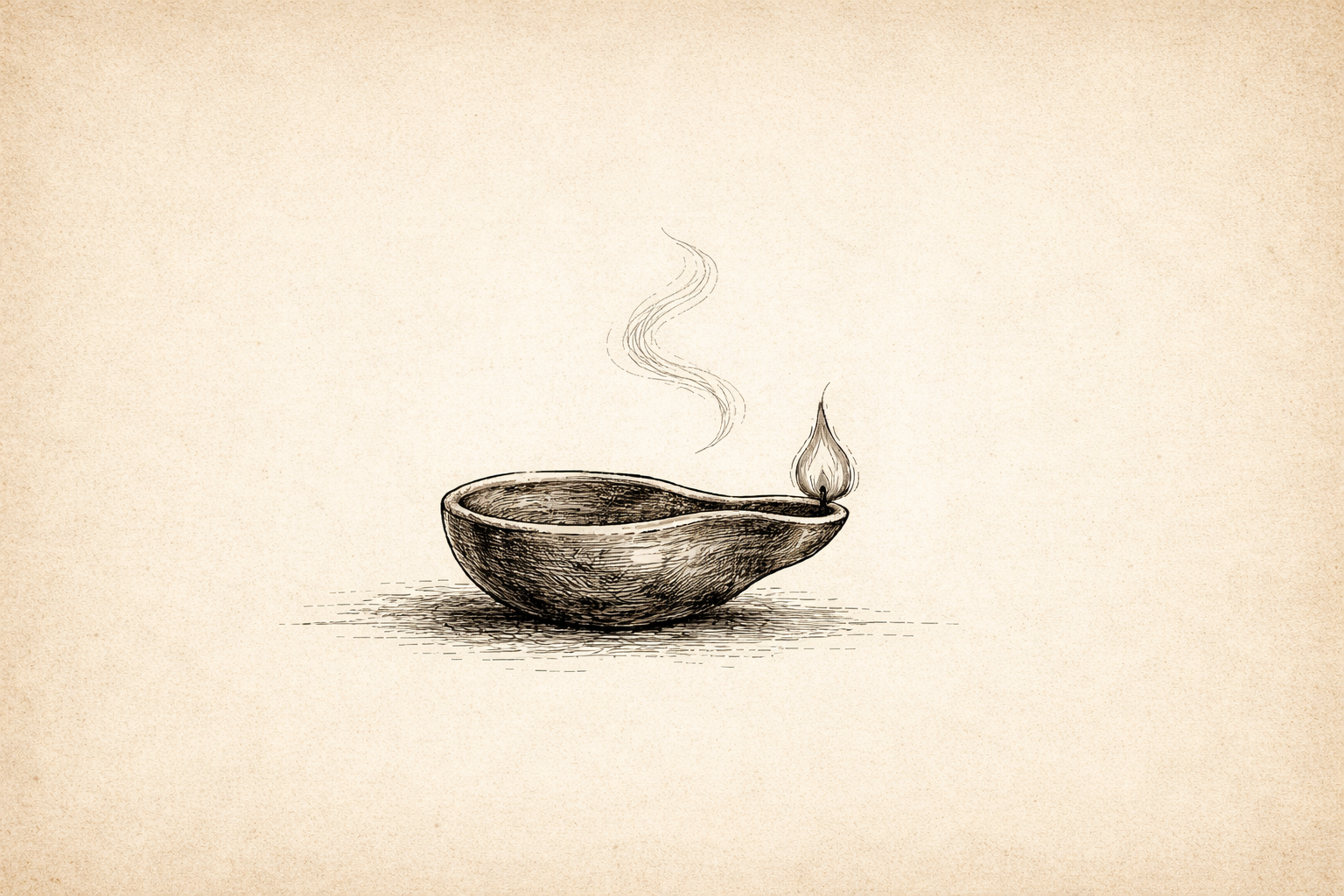
The oil in the little clay lamp was low, and the flame bent whenever the night breathed. Outside, wind moved through dry grass with a sound like cloth being folded. Your grandmother sat close enough that you could smell smoke in her hair, and the faint salt of sweat from the day. The fire clicked and settled. A kettle hissed once, then went quiet again. She warmed your hands between her palms, as if testing how much fear you were carrying, and she said, “Listen. This is an old one. This is the ocean-rope.”
They tell it as a warning.
They tell it as comfort.
They tell it because it happened.
In the beginning of that beginning, the gods and the demons were tired in the same way: not tired of work, but tired of being unsteady.
The gods had light, but it slipped.
The demons had strength, but it spoiled.
Both felt time pulling at their ankles.
So they came to the shore where the world is always arriving, and they stood before the Milk Sea — pale as poured moonlight, cold as a held bowl. There was no throne there, no temple. Only salt-crust stone and the wide hush of water that does not care for names.
“Give us what lasts,” the gods said.
“Give us what cannot be stolen,” the demons said.
The sea did not answer. It only moved, and foam licked the rock like a tongue tasting a dish.
Then someone — no one agrees who — said the thing that turned the night.
“We will churn it.”
A few of the younger ones smiled, because the word sounded like butter and hearths. The older ones did not smile. They knew churning means pressure. It means heat. It means what comes loose.
You cannot churn without a stick.
You cannot churn without a rope.
You cannot churn without a bargain.
So they went for a mountain.
They found Mandara, heavy and proud, rooted into the world like a nail driven deep. The gods went first, because they were polite about taking. They bowed and asked the mountain to lend its spine.
Mandara answered by being what it was: weight, stone, silence.
The demons laughed.
“If you want it,” they said, “drag it.”
So gods and demons laid their hands to rock. Skin burned. Nails tore. Sand ground under palms. There was no glory in it, only the blunt stubbornness of bodies refusing to stop. Mandara shifted one inch, then another. The world gave a low groan, as if waking unwillingly.
“Hard,” your grandmother said softly. “It was always hard at the beginning.”
They hauled the mountain across plains and gullies, across places where beasts fled at the sound of approaching weight. They hauled until their breath came as one rough chant.
At last they reached the Milk Sea.
Mandara stood at the edge like a stranger, its shadow falling over pale water. The ocean did not retreat. It did not welcome. It waited.
Now they set the mountain into the sea.
Mandara sank.
For one breath, all of them stared, stunned. Stone does not float. Mountains do not stand on foam.
The mountain went down like a thrown hammer, and the Milk Sea swallowed it without even a gulp.
The demons roared with laughter. “Fine,” they said. “Churn the bottom.”
The gods looked at one another, and something like shame passed between them. They had thought the world would behave because they had planned.
Then the sea’s surface bulged, slow as a rising back.
A great turtle rose beneath Mandara, vast and calm, its shell broad as an island. It took the mountain’s weight as if accepting an old duty. The water around it steamed with effort, and still the turtle’s eyes stayed half-closed, as if listening to a song only it could hear.
The mountain steadied.
Now they needed a rope.
Not hemp. Not hair. Not braided vine. Nothing made by hands would hold a mountain against an ocean.
So they went searching for what coils.
They found the naga king asleep under an old banyan whose roots drank from underground springs. His body was looped in circles like a black river tied into knots. His scales caught starlight and did not give it back. His breath smelled of wet stone.
His name, when spoken aloud, made birds go quiet.
Vasuki.
The demons wanted to seize him. The gods wanted to ask. Both wanted the same thing, in different tones.
They stepped to the edge of his sleeping.
A little god — no larger than a child, no older than a spark — walked forward with a clay lamp cupped in both hands. The flame shook as he walked. He set the lamp on a root where moonlight could not reach it, and he waited until the flame steadied.
Then he spoke Vasuki’s true name.
Not the name of praise.
Not the name of fear.
The name that is only the name.
The naga king’s eyes opened.
Old eyes. Deep-water eyes. Eyes that had watched roots grow and kings fall.
He lifted his head. The roots creaked under his weight. The lamp flame bent towards him, as if drawn.
“What do you want?” Vasuki asked.
No one lied. This was not a place for lies.
“We want your body,” the demons said.
“We want your strength,” the gods said.
Vasuki watched the lamp. He watched the little god’s hands — steady and respectful. He watched the sea behind them, pale and patient.
“You want to make me rope,” he said.
“We will return you,” the gods promised.
“We will make you famous,” the demons promised.
Vasuki gave a slow, dry laugh.
“I have no need of your fame,” he said. “I have lived under the earth since before your first quarrel.”
Then he leaned down until his breath warmed the lamp glass, and the flame stretched thin.
“I will do it,” he said. “But you will not do it the way you would.”
Silence.
“You will keep a lamp burning for me on the shore,” Vasuki said, “until the churning ends. Not as tribute. As witness.”
The little god nodded, face solemn as a vow.
“And you will not pull from both ends as if I am nothing but fibre,” Vasuki said. “You will choose your ends, and you will accept your cost.”
“Agreed,” the oldest god said.
Vasuki’s tongue flicked once, tasting the air for weakness.
“One more,” he said.
The demons spat in the sand.
“When the first thing rises,” Vasuki said, “you will not throw it back and pretend it did not happen.”
The sea moved behind them, as if it had heard its name.
“We will accept what comes,” the gods said.
The demons did not answer.
Vasuki held their silence in his eyes until it became agreement.
Then he lowered his head again. The bargain was sealed. Not with ink. With presence.
They took him.
Not like thieves. Like men lifting a beam that will crush them if they lift wrongly.
His coils were heavy. His scales tore skin. His cold seeped into wrists and made fingers stiff. Still they lifted, still they carried — because once you speak a true name at a threshold, you cannot pretend you are still outside.
At the Milk Sea they wrapped Vasuki around Mandara, his body coiling the mountain like a black ribbon around a spindle. Where his scales rubbed rock, sparks of pale fire flashed and died. The lamp on the shore burned, watched by the little god whose hands did not tremble.
Then came the choosing.
Who takes the head.
Who takes the tail.
Who tells himself the choice is only practical.
The demons seized Vasuki’s head. They wanted command. They wanted the first pull, the first claim. Their fingers slid on slick scale as they gripped his jaw and neck.
The gods took the tail, and some of them were relieved. They told themselves it was the safer end. They told themselves it was the humble end.
Vasuki said nothing. His eyes did.
“Begin,” the oldest god said.
They pulled.
The rope tightened.
The coils bit.
The mountain groaned.
The Milk Sea began to turn.
At first it was slow, almost gentle. The ocean moved in wide circles, as if remembering an old dance. Foam rose like cream. The air smelled sweet, and a few gods smiled, because sweetness makes fools.
The demons heaved, muscles corded, teeth bared. The gods leaned back, feet skidding on wet stone, shoulders burning.
Vasuki’s body stretched. His scales hissed against rock. He did not scream. Kings do not give their pain away for free.
Then heat came.
It came as friction. It came as strain. It came as the price of turning the world’s oldest milk with a mountain’s spine and a living rope.
Vasuki’s breath sharpened.
The air near his mouth thickened. A sour taste spread over tongues.
The demons at his head began to cough. They spat into the sea and swore.
“Pull,” they shouted, furious at their own discomfort, as if pain were an insult rather than a warning.
They pulled harder.
Mandara spun faster. The Milk Sea whirled. The turtle beneath bore it without complaint, but the water around its shell frothed like rage.
The lamp flame on the shore bent sideways, and still it did not go out.
Then the first thing rose.
Not a jewel.
Not a blessing.
Not a song.
A dark stain surfaced, as if the sea had bruised. It gathered itself into a thick black swell. It was not smoke, though it moved like smoke. It was not water, though it poured. It was something older than bitterness — something that lives below the place where milk becomes sweet.
The demons saw it and recoiled. The gods froze with their hands still on the tail.
The poison rose, and the air turned wrong. It stung the throat. It made eyes stream. It made tongues swell with dread.
The little god by the lamp did not step back. Tears ran down his cheeks, and he still held the flame’s place with his stare.
Someone whispered, “This is not what we wanted.”
And then, plain as a nail in wood:
Poison came first. Always poison comes first.
The demons gagged. Their hands slipped on Vasuki’s head, and pride cracked into panic. One fell to his knees, coughing into the sand. The spittle that hit the ground smoked faintly, as if the earth itself wanted to flinch away.
The gods tried to retreat, but the rope was tight. The mountain was spinning. The ocean was turning. You cannot step politely away from what you have set in motion.
The poison rolled towards the shore. Stones at the waterline darkened beneath its breath.
“Throw it back!” the demons shouted.
“Stop the churning!” the gods cried.
But stopping is not simple. Momentum had already entered the sea. The turtle already bore the mountain. Vasuki already held the coils. What is begun at a threshold does not end because you regret your appetite.
The poison licked towards the lamp.
The little god’s eyes widened, and for the first time his hands shook.
It was then the oldest god lifted a measuring cord — plain cord, knotted for length. He held it out over the surf, as if he could bind what cannot be bound.
He spoke a name that made the air grow still.
Shiva.
Not as doctrine.
Not as explanation.
As someone who hears.
No answer came.
Then someone was at the water’s edge.
The gods had not seen him approach. The demons had not heard footsteps. He was simply there, bare feet in wet sand, watching the poison rise as if it were an animal he knew.
He did not look at them. He did not ask what they had done.
He stepped forward and knelt.
The poison reached for him. The air shuddered.
Shiva touched the surface with two fingers. Then he lifted his hand to his mouth and drank — without theatre, without pride. Like a man taking on a duty he did not ask for.
The poison did not vanish. It travelled.
You could see it in the way his throat tightened. You could see it in the way the skin at his neck darkened, as if night had chosen to nest there. His jaw clenched once. His eyes closed briefly, as if feeling the weight of an ocean’s bitterness.
Behind him, the lamp flame steadied.
The demons stared, and their fear began to look like shame. The gods stared, and their gratitude began to look like debt.
Shiva swallowed.
He stood.
For a moment, none of them moved. Even the churn seemed to falter, as if the world had paused to notice what had been borne. Then Mandara groaned, and the turning resumed, because the bargain had been made, and the sea had more to give.
“Now,” Shiva said, voice low, “pull.”
The demons hesitated, eyes on his darkened throat. The gods tightened their grip on the tail, feeling the rope’s living muscle beneath their palms.
Vasuki’s eyes met Shiva’s, and something passed between them — recognition, perhaps. Or simply the relief of being seen as more than a tool.
They pulled.
The Milk Sea turned again, bright and thick. Foam rose in curling waves. The air, scrubbed by Shiva’s acceptance, became breathable once more. It still carried a faint sting, like memory on the tongue.
And then gifts began to come.
A lotus surfaced first — pale, closed, its petals tight as a fist. It bobbed in the churn like a promise refusing to open too soon. The little god by the shore reached down and lifted it, and it did not drip milk but something colder, like dew gathered under stone. He set it beside the lamp, and the flame leaned towards it.
Then ash came — soft, grey, drifting in a small ring that broke apart and gathered again. It clung to wet rock and marked it, quiet as a smudge on skin.
Last, a bright thing rose — the gleam of a jewel turning in foam. The demons lunged. Their fingers closed on nothing. The jewel slipped away again, because water does not reward grasping.
The churn went on.
Hours passed.
Or days.
Time is soft in such stories.
Skin split and healed and split again. Hands became raw. Shoulders cramped. Breath came harsh and steady.
At last, the sea began to calm. The foam sank. The turtle beneath Mandara shifted, and a long sigh travelled through the water, as if the world were setting down a burden.
“Enough,” Shiva said.
The word fell like a door closing.
The demons released Vasuki’s head as if it were hot. The gods loosened their grip on his tail. Vasuki’s body slid off Mandara in heavy coils, and the mountain’s stone was scored with bright lines where scale had rubbed rock.
Vasuki lay on the shore breathing slowly, each breath a long river-draw through lungs that had held too much heat.
The little god lifted the clay lamp and carried it towards him. The flame was small now, but alive. He held it near Vasuki’s face.
Vasuki’s eyes half-opened. In them, the lamp flame became a star.
“You kept witness,” Vasuki said.
“We did,” the little god whispered.
Vasuki’s gaze slid past him to the gods and demons standing in damp exhaustion.
“And the first thing?” he asked.
The little god swallowed. His throat still remembered sting.
“We did not throw it back,” he said. “We could not.”
Vasuki held that answer in silence until it became true enough to rest on.
Then he began to move. His coils drew towards the banyan’s shadow. His scales dragged sand into small ridges. Every inch of his retreat was heavy with earned dignity.
The demons watched him go, and none of them mocked. The gods watched him go, and none of them bowed, because some debts cannot be paid in gestures. They can only be carried.
On the return from the shore, the path felt suddenly steep, though there had been no hill before. Feet slipped on wet rock. Calves cramped with cold. One demon stumbled and scraped skin on stone. He hissed and kept walking, because pride does not like to limp in front of witnesses.
The gods moved more slowly. You could see in their shoulders that they had learnt something their faces could not yet admit.
Shiva stood at the waterline until the last foam settled. Then he wound the measuring cord into a simple coil and laid it down on the stone, as if setting aside a tool after work.
The little god held up the lotus.
“For you,” he said.
Shiva looked at it. He did not smile. He did not refuse. He touched the closed petals with one fingertip, and the lotus opened at once — not dramatically, but as if it had been waiting for a hand that did not take.
Inside was no jewel you could name. Only a softness of light, like dawn held in a cup.
Shiva nodded once, and walked away.
The lamp by the shore burned down to a puddle of oil. Its flame thinned, then winked out. The little god gathered the cooled clay, and his fingers came away grey with soot.
He carried that soot back with him, cupped like an offering.
—
Your grandmother stopped speaking and let the fire make its own small noises. The kettle clicked as it cooled. The lamp flame on your table leaned towards the wick, hungry and faithful.
You swallowed. Your mouth had gone dry, as if you had tasted something bitter in the story.
“So the first gift was poison,” you said.
Your grandmother nodded.
“And someone drank it,” you said, quieter.
She reached into the ash bowl by the hearth and pinched a little grey powder between her fingers. She rubbed it gently on the back of your hand, leaving a soft mark — cool and gritty.
“Yes,” she said. “Because some churning cannot be stopped. Only borne.”
You stared at the grey smear on your skin. It looked like nothing. It felt like dust. And yet it made you think of a dark swell rising in milk, and a throat turning night to keep others breathing.
Outside, the wind folded the grass again. Inside, your grandmother adjusted the lamp wick with a careful twist. The flame steadied. The room returned to its ordinary warmth, altered in a way you could not explain.
She blew softly across your knuckles, and the ash lifted in a tiny cloud before settling again.
“Sleep now,” she said.
And on your hand, where the tale had landed, the last thing that remained was ash.
—
Receive the next work
Subscribe free to receive new work from the Lucas Varro Library by email.
More from the Library


See Also
A concise and impartial dictionary of absence, promises, quarrels, ordinary objects, and the troublesome instability of words.

The City of Service
The temple we inherit is a building from which almost all necessity has been removed. Nothing must be brought for it to continue being what we call a temple. The sanctuary asks nothing of us. Stone is good at this kind of independence.
A living temple was otherwise.
Water had to come in. So did grain, cloth, oil, aromatic substances, fuel. The things required for worship arrived because someone carried them across a threshold.

Houses of Wood, Light, and Smoke
Some of Angkor’s most intimate ruins do not rise above the ground at all. They are postholes, low mounds, hearths and ponds: durable traces of a domestic city built largely from things that decay. To restore that city is to see Angkor not only as stone, but as wood, smoke, water, repair, and people living within calling distance.