

Fires of the Old World I — The Coiled Cradle
This is an old story.
Keep silence until it finishes speaking.
The lamp had been lowered until its flame spoke softly to the oil, and the hut breathed in the night’s cool air. Outside, the river moved without hurry, carrying silt like a slow thought. Inside, the reed mat held the warmth of bodies, and the clay floor kept its damp scent of earth and rain.
Listen now. The world was not yet busy with names. It had not learned the itch of counting. It had not learned hunger.
Before dawn learned where to stand, there was only the black kindness of the deep.
In that deep lay the first stillness, wide as silence and gentle as sleep. No shore yet held it. No tree yet remembered it. It was water without edge, and dark without fear, and in its patient middle the Sleeping God rested as if the whole of being were a lullaby.
He did not lie on stone. There was no stone.
He did not lie on earth. There was no earth.
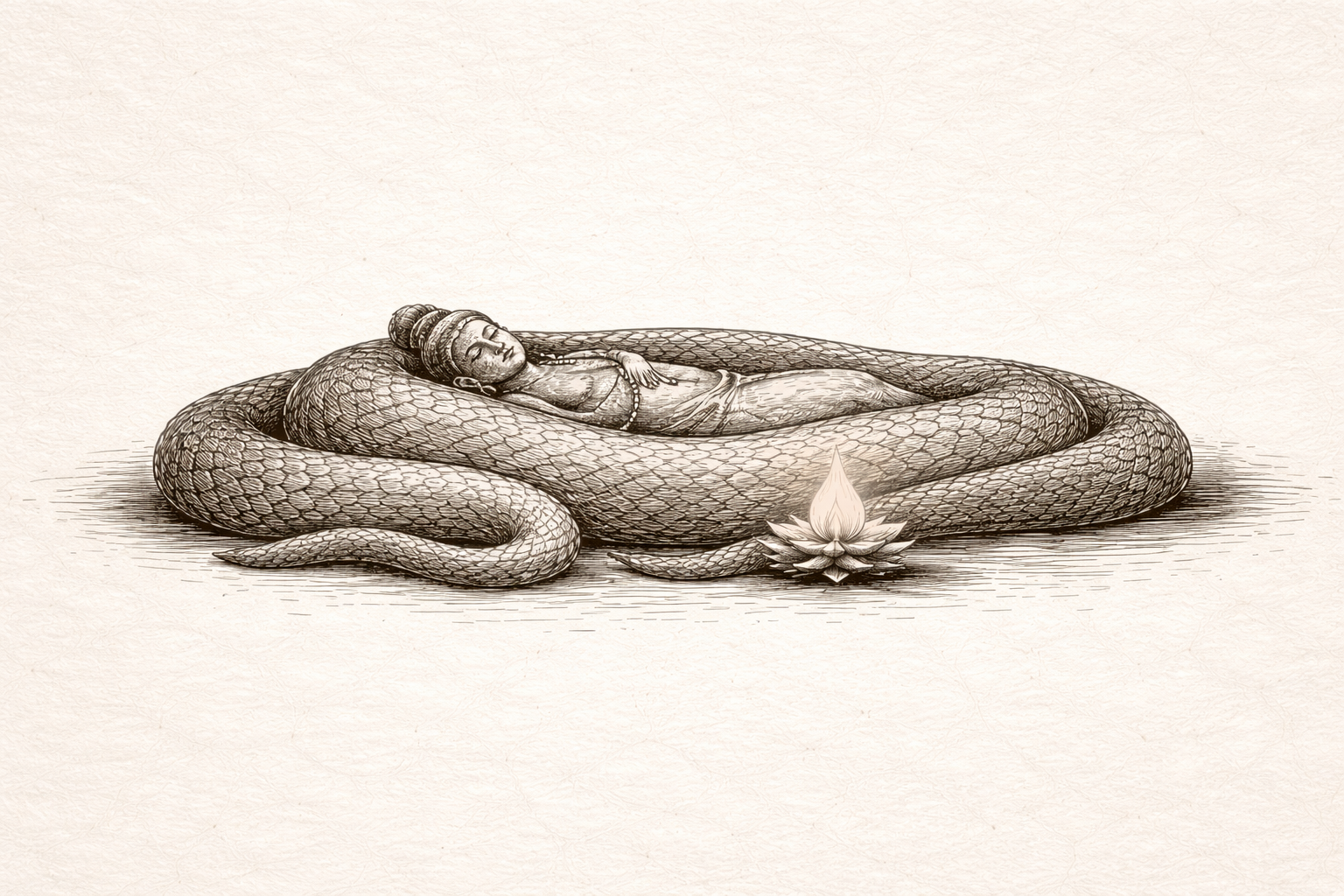
He lay upon coils.
Ananta, the great naga, held him — coil on coil, scale on scale — an unending cradle made of living patience. Each scale was cool as river-pebble. Each curve was a vow not to let the god fall into wakefulness too soon. The serpent’s body rose and dipped like breath that had not yet become breath, and the god’s weight was answered by that living bed.
At the edge of the coils, a lotus-lamp floated — no wick, no hand, no glass. It was simply a small steady light, as though mercy had been remembered in the middle of nothing. Its glow made the nearest scales shine like wet iron, and the god’s skin took the faint colour of pearl.
The Sleeping God’s eyes were closed, and because they were closed, the deep remained quiet. His hands were open. In his palm, ash lay like soft grey snow, though nothing had yet burned. And near his wrist, looped loosely as if it had always been there, a measuring cord rested — thin, pale, patient — coiled upon a coil, waiting.
Time, if it existed, did not dare to make a sound.
And then something moved along the outer coil.
It was not a storm. Not yet. It was a restlessness with feet, tasting the hush, testing what could be tested.
A figure came, walking where no path was, and standing where no floor had been laid. He was tall the way hunger is tall when it has been fed too long on itself. His skin held the colour of old brass. Around his throat hung a charm made of bone and thread, and at his belt a knife slept, patient.
He looked at the lamp. He looked at the lotus. He looked at the ash, and the cord.
Then he looked at the Sleeping God, and the look was not reverence.
It was appraisal.
Ananta’s head rose, just a little, a wave lifting its crest. The naga’s tongue tasted the water. A sound moved through the coils — not words, but warning, like the first tightening of rope.
The figure smiled anyway.
“I am only passing,” he said, and his voice was smooth as oiled wood. “I heard the deep was quiet.”
“It is quiet because he sleeps,” Ananta replied. The naga’s voice did not travel; it arrived. “Pass.”
“I will,” the figure said. “But I have never seen such a cradle.”
“Then do not touch it.”
The figure’s eyes flicked to the measuring cord, and his smile thinned.
“A cord,” he murmured. “In a world that has not begun.”
“It is not yours.”
“Nothing is mine,” the figure said lightly, and then added, softer, “yet.”
Ananta’s coils drew in, the cradle firming beneath the god as if bracing itself. The lamp’s small glow seemed to narrow, watchful.
“Name yourself,” the naga said. “If you wish to speak further, name yourself.”
The figure’s smile held. “Names are heavy,” he said. “And this is deep water.”
“Then be silent.”
But silence, to the restless, feels like insult.
The figure stepped closer along the serpent’s outer ring. The scales were slick with the deep’s cold; they shone under the lamp like armour that had never known battle. His bare foot pressed down, and the scale beneath it did not yield. Ananta did not flinch. He held.
“I will not wake him,” the figure said. “I would not dare.”
“You dare enough to stand here.”
“I am curious,” the figure replied, and his voice dropped into something almost tender. “I wonder what dreams he keeps.”
Ananta did not answer. Some questions are bait.
The figure reached for the measuring cord.
Not to take it — so he would have sworn.
Only to touch it.
His fingers hovered. The cord lay pale against the dark scale, as harmless as string. His fingertip lowered.
And the lamp’s glow trembled.
Ananta’s coils tightened with a sound like a slow, enormous inhale.
The figure paused. He glanced up, and his eyes held the bright, empty confidence of those who believe the world is made for them to test.
“What is it for?” he asked softly. “The cord.”
“It is for measure,” Ananta said.
“Measure of what?”
Ananta’s gaze did not move from the hovering hand. “Of what will become.”
The figure’s fingertip touched the cord.
For an instant it felt like nothing.
Then it felt like the weight of every boundary that would ever be drawn.
He jerked his hand back, sharp as a child burned by a cooking pot, and the deep shuddered — just once — as if the Sleeping God’s dream had shifted.
A faint sound came from the god’s mouth. Not speech. Not even breath. Only the smallest loosening of stillness, like a knot beginning to ease.
The figure froze.
Ananta’s head rose higher now, and the naga’s eyes were no longer patient. They were old. They were absolute.
“You have brought your restlessness into his cradle,” the naga said.
“I did not —” the figure began, and stopped.
The lamp’s light fell across the Sleeping God’s open palm. The ash there seemed to lift, as if remembering wind. The lotus, beside the lamp, turned its face slightly, though there was no current.
The figure swallowed. His throat moved. For the first time, fear walked along the edges of his confidence.
Ananta spoke again, and this time the words carried the weight of law.
“Speak your true name,” the naga said, “or leave before the dream breaks.”
The figure’s mouth tightened.
“My name is not —” he began.
The Sleeping God’s eyelids did not open, but the darkness around them deepened, as if his closed eyes were doors and something heavy stood behind them.
The figure’s hand went to the charm at his throat. Bone and thread were small things here.
He tried to laugh. It came out thin.
He tried to step back. The coil beneath him rose, gently, refusing him the gift of easy retreat.
The world, still unborn, listened.
The figure’s lips trembled once, quickly, like a flame caught by a draught.
He whispered, at last, the thing he had guarded even from himself.
“My true name is Kala.”
The deep answered.
Not with thunder. Not with fire. With recognition.
It slid over him like cold water finding skin. It settled behind his ribs. It touched his teeth from the inside. And his cleverness dimmed, just slightly, as though a lamp had been shaded.
Ananta’s coils did not tighten further. They simply held.
The lotus-lamp burned steady.
And the Sleeping God, still asleep, moved his hand.
Just a little.
The ash in his palm drifted and fell, not down — only through the dark, like a blessing turned to dust. A few grains settled on Kala’s wrist. They were weightless. Yet he felt them as weight.
Then, from the measuring cord, one loose end lifted, as if drawn by a hand that had not yet decided to be a hand. It looped, slowly, around Kala’s fingers.
Not hurting. Not merciful.
Exact.
Kala’s breath caught. He stared at the pale cord around his hand.
He pulled.
The cord yielded an inch.
Then held.
It resisted without force. It resisted with inevitability.
Ananta spoke, and the naga’s voice was quiet now, almost gentle — gentle in the way cliffs are gentle when they do not move.
“The first breath did not belong to us.”
Kala went very still.
He understood what his restlessness had almost done. He had almost stolen the beginning for his own appetite. He had almost made the first gift a theft.
The deep — the deep that had been kind — was now keeping account.
Kala looked down at his hand, at the cord and the ash-grains on his wrist.
“Let me go,” he whispered.
“Go,” Ananta said. “But go measured.”
Kala’s eyes flashed — anger, shame, hunger braided tight — then flicked to the Sleeping God’s face. The god remained asleep, perfect and unreadable, and yet the whole deep seemed to breathe around him, as if the sleep itself were a vow the water had sworn to keep.
Kala’s shoulders sagged.
He stepped back along the coil, moving as if the scales were sacred. The cord moved with him. The charm at his throat swung once, a small pale arc. At his belt, the sleeping knife caught a thread of lamplight, and lost it again.
At the edge of the glow, Kala paused.
He looked back once.
The lotus-lamp floated still. The lotus itself was turned towards the Sleeping God, as if attending him.
Ananta’s head had lowered, but not into sleep. Into watch.
Kala raised his cord-bound hand, and the ash-grains on his wrist glimmered faintly in the lamp’s light.
Then he stepped out of the glow and vanished into the deep, taking his restlessness with him, dulled by measure.
For a long time, nothing changed.
The Sleeping God slept on.
The naga’s coils held.
The lamp burned. The lotus waited.
And somewhere beyond the reach of the glow, Kala moved through the unborn world with a cord around his fingers and a memory of ash on his skin, learning — against his will — the first lesson of beginnings: that not everything is taken.
At last, in the heart of that deep, the Sleeping God’s chest rose and fell.
Once.
A breath.
It did not belong to us.
It belonged to the world.
The lamp’s flame in our hut gives a small sigh and steadies, and the cool air on your skin feels suddenly like a promise. Outside, the river carries its silt as it always has, patient and unshowy. Inside, the reed mat holds us, the clay floor keeps its damp scent, and the story returns to where it began: oil, hush, darkness that can be kind — lamp.
—
Receive the next work
Subscribe free to receive new work from the Lucas Varro Library by email.
More from the Library

See Also
A concise and impartial dictionary of absence, promises, quarrels, ordinary objects, and the troublesome instability of words.

The City of Service
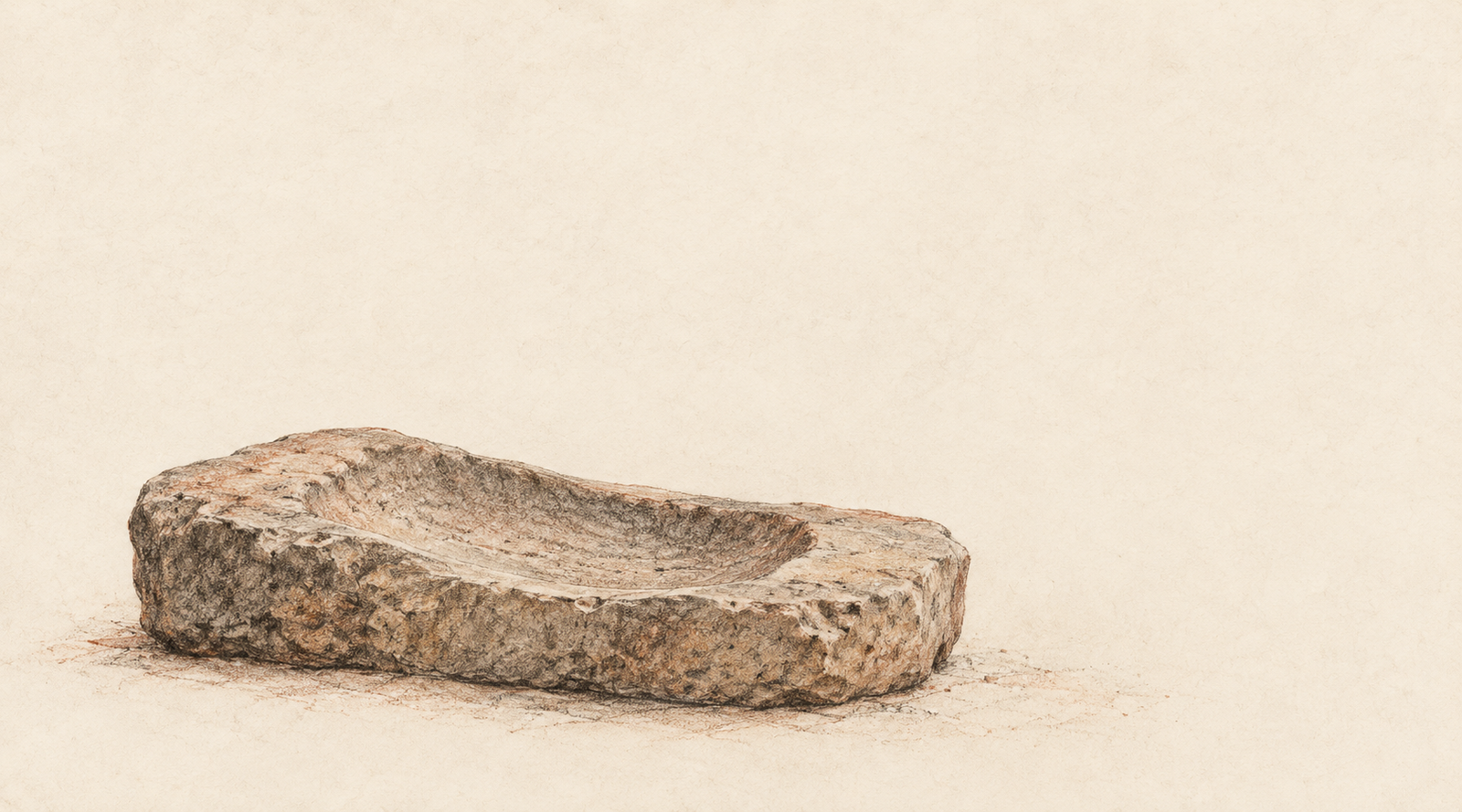
The temple we inherit is a building from which almost all necessity has been removed. Nothing must be brought for it to continue being what we call a temple. The sanctuary asks nothing of us. Stone is good at this kind of independence.
A living temple was otherwise.
Water had to come in. So did grain, cloth, oil, aromatic substances, fuel. The things required for worship arrived because someone carried them across a threshold.

Houses of Wood, Light, and Smoke
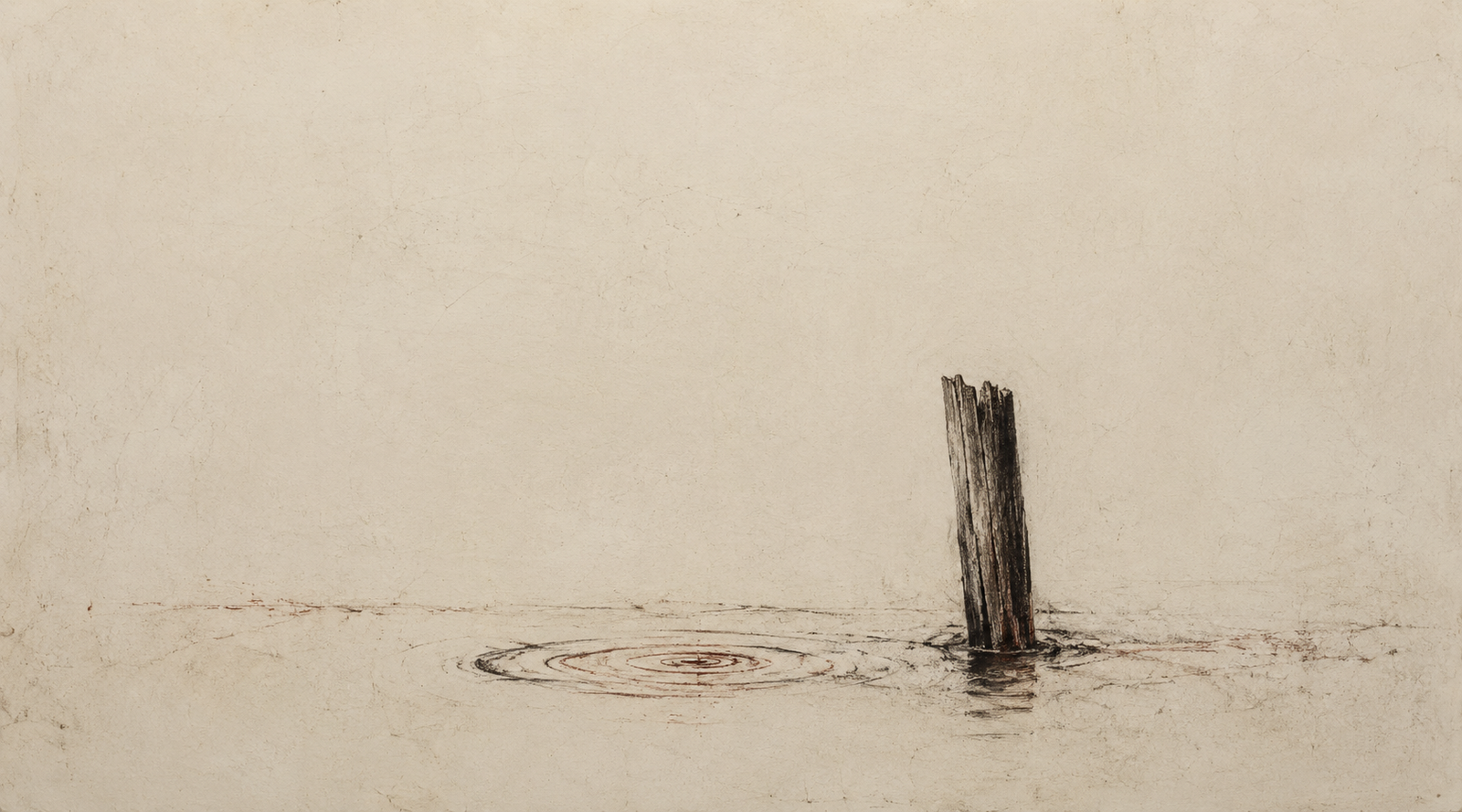
Some of Angkor’s most intimate ruins do not rise above the ground at all. They are postholes, low mounds, hearths and ponds: durable traces of a domestic city built largely from things that decay. To restore that city is to see Angkor not only as stone, but as wood, smoke, water, repair, and people living within calling distance.