
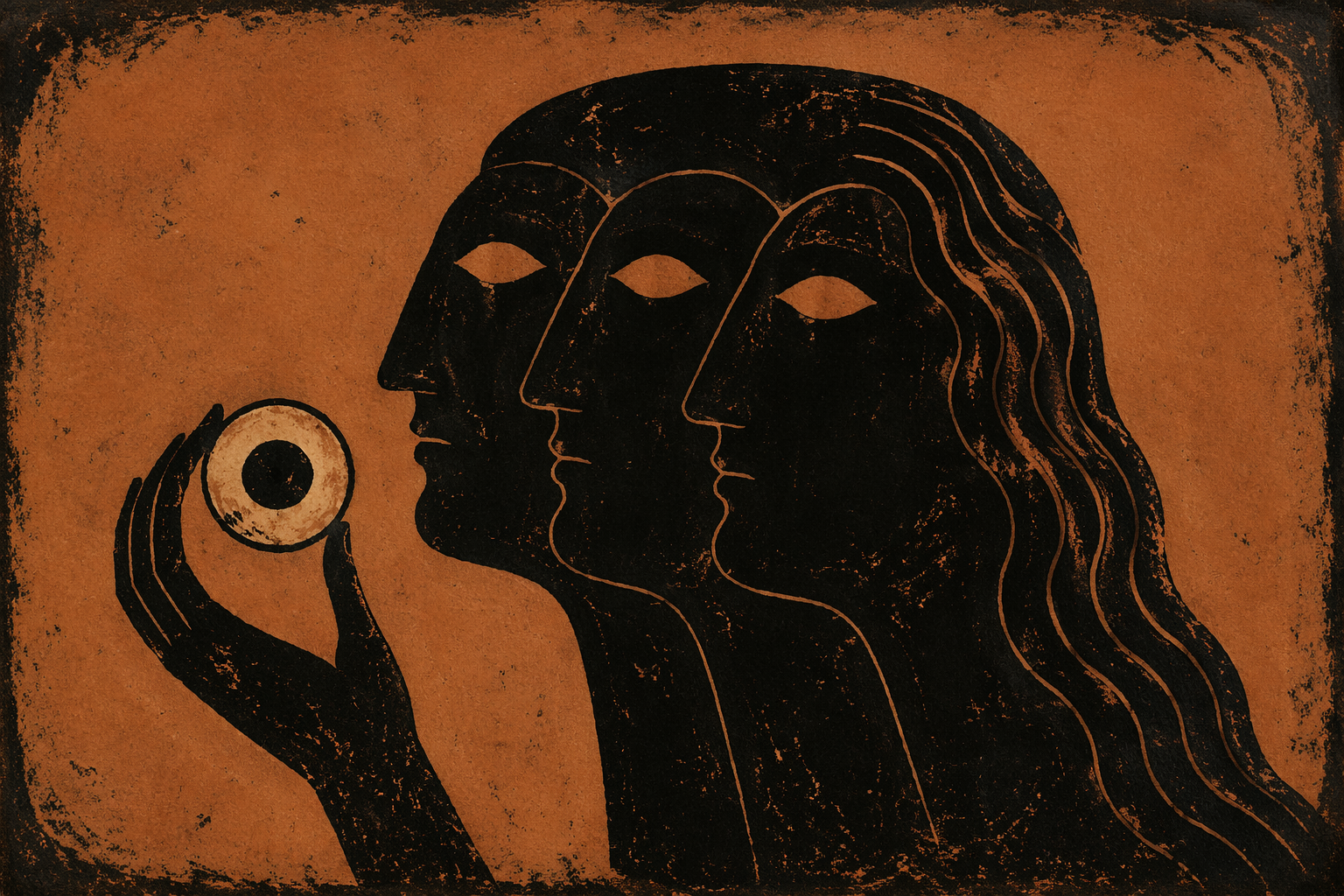

The Graeae — The Sharing of Sight
On shared necessity and the exposed interval
There are conditions under which no creature is permitted to keep what it requires.
The Graeae belonged to such a condition from the beginning.
Not merely old. Not merely strange. They were born already under reduction, as though time had entered them before breath and taken from them in advance what other beings lose by degrees. Their hair bore the colour of ash not because ash had touched it, but because something in them had always lain after burning. Their skin held no season. Their mouths had the patient economy of bodies long instructed in scarcity. They did not possess enough between them to be called whole in the manner of other living things. One eye. One tooth. Passage in place of ownership. Turn in place of claim.
They lived where the land had already withdrawn its welcome.
Rock, wind, salt. A ledge cut by old weather. A hollow where the air moved but did not soften. Nothing there admitted comfort. The stone had edges but no invitation. The sea below was not near enough to serve, only near enough to salt the air and mark each surface with slow abrasion. They inhabited that margin as if margins were the only places in which such a law could hold: not city, not sanctuary, not field, but a threshold where even the horizon seemed unwilling to complete itself.
They did not walk much. Their world was organised not by distance but by sequence.
One held the eye. One waited for it. One waited behind that waiting.
Sight among them was not a faculty but an office. It passed hand to hand according to need, though need was too simple a word for what governed the exchange. Need can be spoken as if the body asks and receives. This was not that. The one with the eye did not merely see for herself. She stood for the others. She named the ground. She warned of the edge. She turned her face towards the sound of water and told its temper. She looked into the mouths of the wind and distinguished weather from approach. She watched the hand extended toward her and judged the moment of relinquishing.
Then the transfer.
That was the point upon which their world depended.
Not possession. Not sight itself. The handover.
A hand moved through dimness. Fingers opened. Another hand, practised by long privation, found what it had learned to find without seeing. The eye crossed the interval. For one instant it belonged to no one. In that instant all order narrowed to trust, timing, and the body’s memory of where another body would be.
Then receipt. Socket. Breath resettled.
The tooth moved likewise, though with less ceremony and a more immediate urgency. Hunger did not visit them as appetite visits the well-provided. It came as labour. Food had to be broken down by turn. The mouth that held the tooth worked while the others waited with the stillness of those to whom waiting is not delay but structure. When the tooth passed, it crossed the same dark interval: hand, air, hand. They had long since learned not to hurry the movement. Speed was for creatures who could afford to lose things.
Their speech was spare and exact.
Not because they were wise. Not because age had refined them into utterance. Words simply cost too much when one lived by passing the necessary from one body to another. They did not narrate. They instructed. Closer. Hold. Now. Higher. Edge. Mouth. Wait.
At times one of them would hold the eye longer than the others preferred.
Not out of vanity. That too would have been too human a surplus. But the one who saw was always under a pressure unknown to the others in that moment. To have the world before you, however meagrely, is to feel at once the violence of its withdrawal. The rock takes shape. The ledge declares itself. The sky, however bleached, becomes a measurable thing. To return from that to waiting is not easy. One learns restraint, but restraint does not remove the body’s brief astonishment at contour.
So the others listened for delay.
Delay had a sound. A breath too long held after looking. The faint adjustment of fingers around the globe. Silence where the hand should already have moved.
Then the rebuke, sharp and practical.
Not accusation. Correction.
For no one among them was innocent of the same temptation.
Their sisterhood, if it can be called that, did not resemble the mutual adornment of common tales. They were bound not by tenderness but by system. This did not make them loveless. It made love, where it existed, inseparable from discipline. To pass the eye at the proper moment was care. To return the tooth cleanly to the waiting hand was care. To name the stone truly. To warn before the gust. To keep the rhythm by which the others could continue. This was what remained when every softer excess had long since been eroded.
They had lived so long within the law that they no longer distinguished between nature and practice.
It was simply the world: that no one should keep what all required; that whatever enters the hand must leave it; that perception itself arrives only by submitting to its own surrender.
Creatures who live under abundance tell themselves that what is necessary belongs where it rests. The Graeae knew otherwise. What is necessary belongs to the movement.
The day of interruption did not arrive with omens.
No cry from the sea. No darkening fit to be remembered. The weather remained of a piece with itself: hard light diffused by a high pall, wind moving salt across stone, the horizon diminished by distance and glare. One of them held the eye. She had turned her head towards the westward brightness and narrowed the lid against it. Another waited with her palm already raised, not in impatience but in sequence. The third sat slightly apart, mouth loosened in the manner of one whose turn had recently passed and would come again.
Then a sound.
Not loud. Cloth or leather against rock. The kind of sound that means approach only after the second occurrence. The one with the eye lifted her chin. The socket saw what the others could not yet know: a young man, not splendid but held together by purpose, moving with that economy peculiar to those who have been told that one error will cost them more than their own life.
He was armed, though the weapon mattered less than the manner in which he advanced.
Not charging. Not announcing himself. Not reverent either. He came as one enters a mechanism whose operation must be understood quickly if one is to live through touching it.
The hand waiting for the eye remained extended.
“Closer?” asked the second.
The first did not answer at once.
The figure had stopped just beyond the distance at which a grasp becomes likely. He watched them, but not with revulsion. The common sort recoil first and then recover into cruelty. This one did neither. He looked as if he had been warned already that pity is a poor instrument and that disgust wastes time.
“What stands there?” asked the third.
The first measured him.
A youth, perhaps. A traveller by equipment, though travel alone did not account for the compression in him. A petitioner, if one judged by destination. A thief, if one judged by need. Not yet a danger, if danger is defined by what the body cannot still interrupt.
“Someone seeking what he lacks,” she said.
It was not enough.
All three knew this. The second hand remained open.
“Pass,” said the second.
The first drew back slightly.
This was not the first stranger to come in want of knowledge. Their place gathered such visitations as barren trees gather crows. Some came with offerings. Some with threats. Some with the stupidity of those who think age and strangeness are the same as weakness. Most departed with less certainty than they had brought. The Graeae knew paths. They knew names of places that had slipped from gentler tongues. They knew where the world narrowed and where passage might still be forced. They were not guardians in the high style of story. They simply persisted where others failed to remain.
The stranger moved one pace nearer.
The one with the eye saw his attention flick, not to her face, but to her hand.
That was the first true warning.
He had understood.
Not everything. Not yet. But enough. He had seen that the thing by which they governed relation to the world was not rooted, not owned, not fixed within any one skull as sight is meant to be. He had seen movement. He had seen procedure. He had seen the one point at which necessity becomes vulnerable: when it is between bodies.
The second hand remained waiting.
The first could have held the eye longer. This would have been a breach. Not a large one, perhaps. A moment only. But systems such as theirs are not destroyed first by violence. They are strained by hesitation.
She began the pass.
Even then the act retained its old dignity. Fingers uncurling. Palm turning. The moist globe released into air.
The stranger moved.
Not with heroic flourish. Nothing in him expanded. He contracted further, entered the interval, and took the eye before the waiting hand received it.
It was done in less than a breath.
The second hand closed upon emptiness.
For an instant no one spoke.
The absence struck before comprehension. The body knows loss first as failed expectation. The hand had risen to meet weight and found nothing. Fingers closed, then opened again, searching the air with a shame almost greater than pain. The one who had surrendered the eye made a sound that did not become a word. The third had already turned towards the vacancy between them, as if sound itself might reveal where sight had gone.
The youth stepped back.
He did not flee at once. He knew enough not to confuse possession with safety. The eye rested in his hand, small and terrible in its simple fact. Wet. Exposed. An object no grander in appearance than any fleshly organ, yet altered now by removal into a thing more dangerous than a blade.
The Graeae changed.
Not in shape. Shape is the language of lesser marvels. Their alteration occurred in relation. The rhythm that had held them together broke and did not immediately re-form. Each body reached into the old sequence and found the link missing. The first extended her hand to reclaim what she had already released. The second moved towards where the pass should have concluded, still obedient to a structure no longer there. The third rose too quickly, misjudged the ground, and struck stone with her knee. Breath caught. Fingers spread. Mouth open, toothless, suddenly more naked in its need than any scream could have made it.
“Return it,” said one.
The command carried no force beyond habit.
He did not answer.
Perhaps he had been instructed already in what these sisters were. Perhaps he had only guessed and now saw fully the dependence he had exploited. It hardly matters. His silence was tactical. Words would have restored the scene to negotiation, and negotiation presumes the continuity of order. He had broken order. He required from them what only brokenness could now yield.
The Graeae did not immediately yield.
One turned towards the sound of him but did not speak. Another’s hand closed and opened again on empty air, as though refusal might still restore sequence by gesture alone. The third remained on one knee, breathing through her mouth, her face set not in pride but in a hardness older than pride.
Their resistance did not come from dignity. Dignity is too polished a word. They resisted because their whole existence had trained them to keep necessity moving within the proper circle. To place sight into the hand of an outsider and then purchase its return with speech was not exchange. It was violation translated into terms of use. Yet what choice remained? Without the eye they could not re-enter the old law. Without the old law they were no longer merely deprived. They were disordered.
Then he asked what he had come to ask.
Not with threat. Not with haste. He spoke as one already committed to the use he had made of them and unwilling now to waste it.
The route. The names. The way towards what lay beyond their knowledge and required it. His voice was controlled, but not cold. One heard in it the strain of one who does not wish to become cruel and has already accepted that wishing will not exempt him.
One tried to advance towards the sound of him.
She took three careful steps, hands out, feet testing the rock’s memory. This had been possible before. They were not helpless in blindness. Long practice had taught them the shape of their ledge, the measure of their hollow, the way wind altered at the drop. But practice relies on known relation. The stranger had changed the air. His position could shift. Her sisters, moving in alarm, no longer held their ordinary places. She reached not for him but for the arrangement by which she understood where anything might be.
She found only another’s shoulder, too late, too hard.
Both recoiled.
The youth did not move in to strike. That, too, is important. A baser tale would make violence here the proof of danger. It was restraint that carried the greater force. He let them feel the extent of his advantage. He stood just beyond reach and held in his palm the small withheld world.
The second knelt on the stone and began to search with both hands, absurdly, as if the eye might have dropped. Fingertips ran over grit, fissure, cold surface. She made no sound now except breath. The third, still on one knee, turned her head from side to side with an intensity that would have looked like listening to the unwary. It was not listening. It was the body trying to remember the old office of seeing and finding no means by which to perform it.
The first said the names at last.
Not because he deserved them. Not because bargains sanctify theft. She said them because the law by which they had lived left no room for permanent interruption. Once the sequence is broken, all action bends towards whatever may restore movement, even if restoration comes mutilated and late.
One by one she gave the necessary things.
Not embroidered. Not prophecies. Directions. Places. What lies where. What must be sought. The youth heard and held silence between her clauses, as if afraid that speech from him might jolt the information loose before it settled in memory. When she had finished, the wind passed through the hollow and for a moment no one moved.
Then he cast the eye back.
Not gently. Not cruelly. Simply in haste.
It struck stone before flesh.
The sound was small and sickening.
All three lunged towards it. That was the ugliest moment: not the theft, not the bargaining, but the scramble after return. Hands collided. Nails caught skin. One found the eye and clutched it too hard from terror that the others might wrench it away before socket and world were rejoined. She turned from them, bent over her own cupped palm, and set the globe back into place with a trembling care far greater than she had ever shown in the old sequence.
Then sight.
Rock. Wind. Her sisters. The ledge. The diminishing figure of the youth already departing along the hard margin of the shore.
She could have called after him. She did not.
What accusation could alter what had been proved?
The others reached for her at once. Not for comfort. For turn. The old need reasserted itself with terrible speed. Pass. Now. Enough. Their system, though broken, still compelled obedience. She held the eye too long, then knew she held it too long because now delay had changed its nature. Once delay had been temptation. Now it was fear.
If she relinquished it, the stolen interval would open again in memory between her fingers and the next hand.
She passed it.
The movement succeeded. Hand. Air. Hand.
But success had altered.
The second received it with a flinch, as though the empty instant still waited hidden inside the transfer. When she later passed it to the third, the third closed too early, nearly knocking it from the line of movement altogether. They corrected. Repeated. Restored, outwardly, the old procedure. Yet every pass now contained an intrusion that was no longer present but could not be excluded. The body had learned that the interval was not merely precarious. It was accessible to another will.
By evening they had settled again into something like order.
The tooth resumed its round. The eye went on from hand to hand. One named the weather. One found the hollowed place where water sometimes gathered. One watched the dark arrive over the sea in long diminished bands. They continued in the old motions because there was nothing else to do.
But nothing had returned.
Before, the eye had moved through air like a necessity so ancient no force would think to interrupt it. Now each transfer exposed what had always been true and what they had been permitted, by repetition, to forget: that sight was never theirs in the manner of possession, only theirs in the manner of trust; that trust is not a substance but an action renewed; that whatever must cross open space between one living hand and another can be taken.
Night thickened.
The one who held the eye last before darkness delayed the final pass.
No one rebuked her.
Below, the sea went on spending itself against stone without memory or repair. The ledge kept its cold. The hollow admitted the wind and returned nothing. At length she surrendered the eye into the waiting hand of her sister, and in the brief span where it belonged to neither of them all three felt the wh
ole of their life narrow once more to that exposed transit.
Not one eye.
Not one tooth.
The sharing itself.
—
—
Receive the next work
Subscribe free to receive new work from the House of Cadmus Library by email.
More from the Library

See Also
A concise and impartial dictionary of absence, promises, quarrels, ordinary objects, and the troublesome instability of words.

The City of Service
The temple we inherit is a building from which almost all necessity has been removed. Nothing must be brought for it to continue being what we call a temple. The sanctuary asks nothing of us. Stone is good at this kind of independence.
A living temple was otherwise.
Water had to come in. So did grain, cloth, oil, aromatic substances, fuel. The things required for worship arrived because someone carried them across a threshold.

Houses of Wood, Light, and Smoke
Some of Angkor’s most intimate ruins do not rise above the ground at all. They are postholes, low mounds, hearths and ponds: durable traces of a domestic city built largely from things that decay. To restore that city is to see Angkor not only as stone, but as wood, smoke, water, repair, and people living within calling distance.