
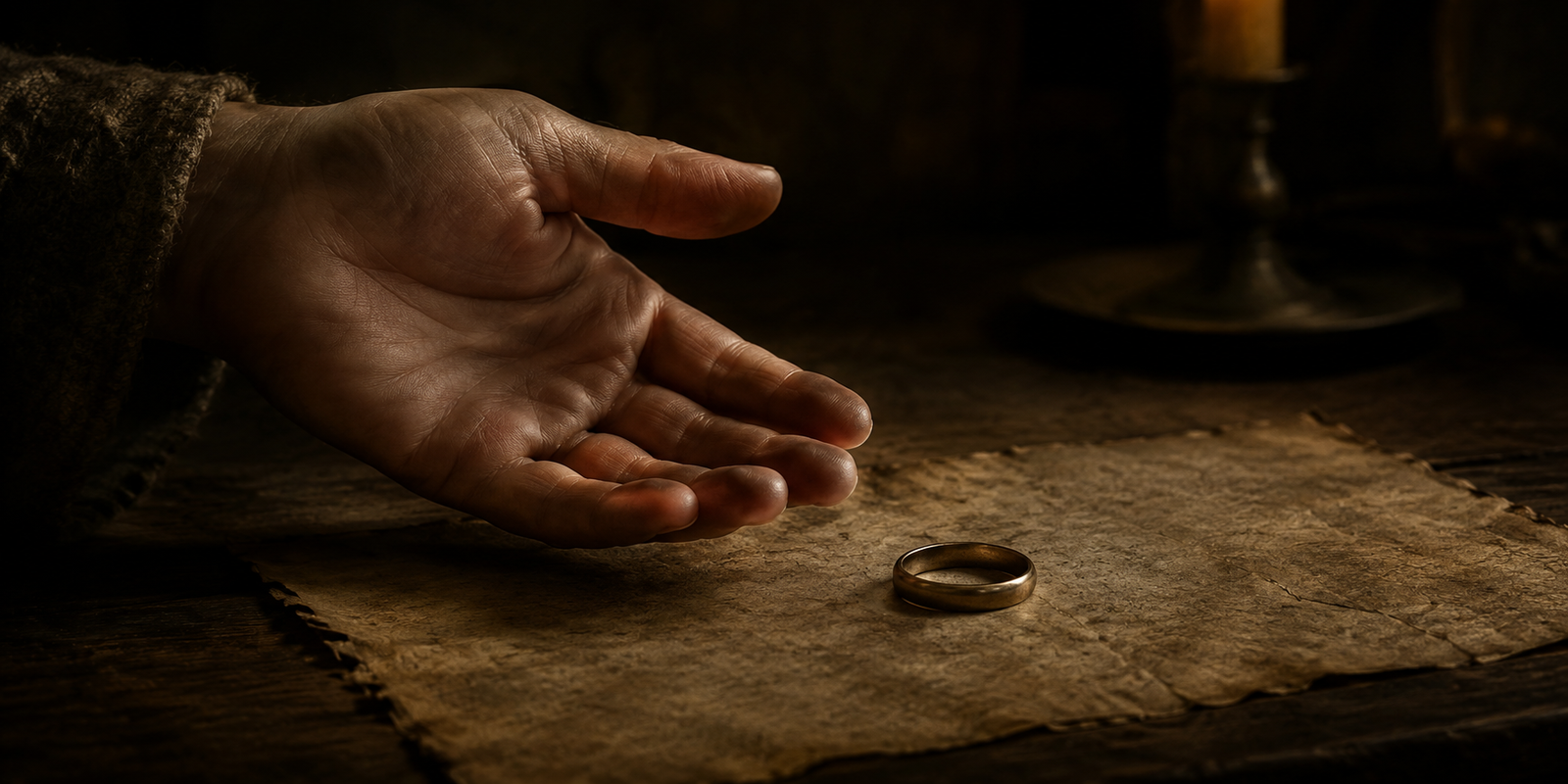

If Gandalf Took the Ring
Power, pity, and the danger of righteous domination
There is a moment in Bag End when the fate of Middle-earth rests not on a battle, a prophecy, or a kingly claim, but on a hand that does not close.
Frodo offers the Ring to Gandalf because he is frightened, and because the offer appears reasonable. Gandalf is wise. Gandalf is powerful. Gandalf has already become, in Frodo’s imagination, the one who knows what to do when everyone else is lost. If the Ring is too great for a hobbit, then surely it should be given to one who has spent long years opposing the Shadow. The gesture is almost innocent. Frodo is not trying to tempt him. He is trying to be relieved.
That is why Gandalf’s refusal matters.
He does not refuse because the Ring would be useless to him. He refuses because it would be useful. He does not say that he is too weak to wield it. He understands that he is too strong to be trusted with it. The Ring would come to him by the road most open in his heart: pity, the desire to protect the weak, and the wish for strength to do good. His danger is not that he secretly longs to become Sauron. His danger is that he might wish, with terrible sincerity, to save everyone.
This is the first thing the scene reveals. The question is not whether Gandalf, taking the Ring, would immediately become a cackling tyrant, a monstrous parody of himself, a grey pilgrim suddenly robed in obvious darkness. Tolkien’s terror is subtler than that. Gandalf as Ring-Lord would be frightening because he would not cease, at once, to be Gandalf. He would retain wisdom, compassion, patience learned over long labour, and the memory of his mission. He might still speak of healing. He might still oppose cruelty. He might still call many things good by their rightful names.
And then, slowly or swiftly, those good things would cease to ask permission.
The Ring does not merely offer power. It offers desire released from the discipline of love. It is not a weapon lying on a table, morally neutral until lifted by a hand. Elrond gives the formal judgement at the Council: the Wise cannot use the Ruling Ring, because it belongs to Sauron, is altogether evil, and would set whoever mastered him upon his throne. The phrase matters. Not merely Sauron’s seat. Sauron’s throne. The Ring does not transfer strength while leaving the soul untouched. It carries a grammar. To use it is to accept that grammar: command, mastery, the will made effective over others.
That is why the Ring tempts each person according to the shape of the self.
Boromir sees the Ring as a weapon for a desperate hour. His temptation is political and martial. Gondor is failing. Mordor is gathering. The West is weary. Why should such a weapon be left unused when the Enemy himself has made it? In Boromir’s imagination, the Ring would give him command. Armies would gather. Mordor would be driven back. A strong man, fearless enough and ruthless enough, could take the perilous thing and turn it against its maker. The fantasy is not petty. It is grand, urgent, patriotic, and almost persuasive.
That is precisely what makes it dangerous.
Boromir does not begin with a desire to serve Sauron. He begins with a desire to save Minas Tirith. The Ring enters there. It does not need to invent selfishness from nothing. It only needs to enlarge an existing pressure until necessity becomes a crown. Boromir’s tragedy is not that he wants evil. It is that he wants victory more than he trusts the moral shape of victory. He believes, for a moment, that the difference between Mordor and Gondor lies chiefly in the hand that holds the weapon.
Tolkien will not permit that comfort.
The weapon is already a form of obedience. It teaches the hand how to close.
Galadriel’s temptation is more luminous, and therefore more terrible. She does not imagine herself as a mere general. She imagines majesty. Beauty. Reverence. A queen set in the place of the Dark Lord, not dark but brilliant, adored and dreadful, loved until love becomes despair. Her vision is not the brutal machinery of Mordor. It is dominion transfigured into splendour. She would not make ugliness triumphant. She would make beauty compulsory.
This is one of Tolkien’s deepest insights into power. It does not always tempt the noble by offering them base things. It may offer them the chance to enthrone what they already love. The healer may be tempted to abolish all wounds by force. The teacher may be tempted to compel wisdom. The queen may be tempted to make beauty inescapable. The wise may be tempted to rule for the sake of the unwise. The Ring is most dangerous when it comes disguised as the fulfilment of one’s highest calling.
Then comes Sam.
Sam’s brief bearing of the Ring is one of Tolkien’s quietest mercies, because it proves that humility is not immunity. Sam is not Boromir. He has no dream of banners, captains, and the glory of command. He is not Galadriel. He does not imagine himself adored beneath the terror of his own radiance. His virtues are plain, earthy, and domestic: loyalty, courage, gardening, love of growing things. Yet the Ring finds even these. It shows him Samwise the Strong, hero of the age, and a Mordor remade into a garden under his command.
The vision is almost comic until it is not.
A garden is a good thing. Fruit is good. Flowers are good. The healing of a wasted land is good. But the Ring does not offer Sam the patient labour of tending soil. It offers him command. The valley blooms because he wills it. Armies gather because he summons them. The gardener becomes a lord of gardens, and that is already the corruption. What should be loved into life is ordered into life. What should grow is commanded to flourish.
Sam is saved, in part, by his littleness: by his memory of his own measure, his hobbit-sense, his knowledge of the actual garden behind Bag End. The Ring inflates him, but it cannot quite make the inflation believable to him for long.
With Gandalf, the danger is greater.
Gandalf’s pity is larger than Sam’s garden. His wisdom is larger than Boromir’s strategy. His majesty, though hidden beneath grey robes and road-dust, is of an order beyond ordinary kingship. He is one of the Wise, sent into Middle-earth under conditions of restraint, not to dominate the wills of Elves and Men, but to counsel, kindle, warn, and strengthen. His mission is persuasive rather than coercive. He is powerful, but his power has been deliberately humbled into guidance.
That humility is not incidental. It is the whole moral architecture of his task.
The Wizards do not come as conquering angels. They do not arrive in unveiled glory, overwhelming Sauron by superior force. They come embodied, limited, subject to weariness, error, delay, misunderstanding, and death. Their strength must work through counsel, friendship, endurance, and hope. Tolkien identifies the peril of the incarnate Wizards as impatience: the desire to force others toward good ends, until the will itself seeks effectiveness by any means.
That is exactly the road the Ring would open before Gandalf.
Not hatred first. Impatience.
Not cruelty first. Efficiency.
Not wickedness first. The intolerable slowness of free creatures.
Imagine the temptation properly. Gandalf has watched ages of folly unfold. He has seen kingdoms weaken, alliances fail, counsel ignored, courage falter, and evil return in forms that the comfortable refuse to recognise. He knows more than those around him. Often, painfully, he knows better. How easy it would be, with the Ring, to make wisdom effective. To spare others the consequences of their blindness. To prevent the next Boromir from falling, the next Denethor from despairing, the next council from hesitating too long. To make the road straighter because the stakes are too high for wandering.
This is why Gandalf as Ring-Lord would be worse than Sauron in the precise sense Tolkien gives: not because he would be more openly malicious, but because he would remain righteous and become self-righteous, ordering things for “good” according to his wisdom. Sauron leaves good distinguishable from evil. His dominion is hideous, and those with eyes can name it. A world under Gandalf’s Ring-rule would be more spiritually suffocating because the language of good would remain. There would still be mercy, but mercy administered from above. There would still be justice, but justice without appeal. There would still be wisdom, but wisdom armed against dissent.
That is the horror: not a world in which evil calls itself evil, but a world in which good has become unanswerable.
Tolkien’s judgement that Gandalf would make good itself detestable is among the most frightening moral statements in the legendarium. It recognises something simpler accounts of power often miss. Evil does not always win by persuading people to love darkness. Sometimes it wins by making the light unbearable. It places goodness in the mouth of domination until those who suffer under it begin to hate the very words that once named hope.
Under Sauron, one can still long for freedom.
Under a righteous tyrant, freedom may be condemned as ingratitude.
This is where Faramir becomes indispensable. His refusal of the Ring is one of the quiet summits of The Lord of the Rings. He is not ignorant of war. He is not naive about Mordor. He is a captain of Gondor, brother to Boromir, son of Denethor, heir to a besieged civilisation. If anyone could make the argument from necessity, Faramir could. Minas Tirith is not an abstraction to him. It is home, duty, inheritance, and grief.
Yet he says that he would not take the thing even if it lay by the highway, not even if Minas Tirith were falling and he alone could save it by using the weapon of the Dark Lord for her good and his glory.
The greatness of that refusal lies in its refusal to separate means from ends. Faramir will not save the city by becoming the sort of man for whom the city would no longer be worth saving. He understands, or at least obeys before full understanding arrives, that there are triumphs that destroy the meaning of victory. Gondor saved by the Ring would not simply be Gondor preserved. It would be Gondor altered at the root, defended by the logic of Mordor.
Faramir’s refusal gives the human form of Gandalf’s wisdom. Gandalf sees further; Faramir stands nearer to the ordinary field of honour, fear, and national ruin. Both recognise that the Ring cannot be sanctified by need. Evil’s instrument cannot become holy because the desperate have reached for it with clean hands.
That is why the Quest must be what it is.
From one angle, the plan is absurd: carry the Enemy’s own Ring into the heart of his land and destroy it, not with the strength of the Wise, not with the armies of the West, not with some purer counter-magic, but by entrusting the burden to the small, the hidden, the breakable. Yet this absurdity is the moral logic of the story. Middle-earth cannot be saved by a stronger will seizing the machinery of domination. It can be saved only by the renunciation of that machinery.
The Ring must be unmade, not mastered.
This is why Gandalf’s refusal at Bag End is not merely a preliminary scene before the real adventure begins. It is one of the first victories of the War of the Ring. Before councils gather, before the Fellowship forms, before Moria, Lothlorien, Helm’s Deep, Minas Tirith, and the Black Gate, the war has already taken shape in a small room. Frodo offers relief. Gandalf refuses mastery. The hand does not close.
Everything depends upon that.
For if Gandalf took the Ring, he might indeed overthrow Sauron. This must be faced directly. Gandalf is not a harmless old counsellor whom the Ring could only deceive with fantasies. He is one of the Wise. He bears Narya. He stands against the Balrog. He returns from death with his power unveiled more clearly than before. He breaks Saruman’s authority with a word. The temptation is terrible because it is not ridiculous. A Ring-Lord Gandalf might win.
But that victory would be the catastrophe.
The danger is not that Gandalf would be unable to defeat the Dark Lord. The danger is that he might defeat him and become the answer to him. Another throne. Another will above all wills. Another order imposed upon the world.
The Shadow would move.
It would not be destroyed.
And because Gandalf’s rule would speak the language of goodness, the ruin might be harder to recognise. Roads would be safer. Councils would be more efficient. Follies would be prevented. Wars might cease, or seem to. Gardens might bloom where wastelands had been. The weak might be protected with a vigilance they had not requested and could not refuse. Much would be improved. That is the most terrible part.
A world can be made better until it is no longer free.
The question, then, is not whether Gandalf could have used the Ring for good. In the beginning, almost certainly, he would have tried. That is precisely why he cannot touch it. The will to use evil well is already the first concession. It assumes that goodness may borrow the form of domination and remain itself. Tolkien’s answer is no. Goodness cannot become coercive without ceasing, in some essential way, to be good.
This does not mean goodness is passive. Gandalf is not passive. He labours more than almost anyone in the story. He travels, counsels, confronts, rebukes, fights, falls, returns, and stands openly when the hour demands it. But his power is always disciplined by the freedom of others. He awakens courage; he does not manufacture obedience. He gives counsel; he does not replace conscience. He strengthens the small; he does not abolish their smallness. He does not save Middle-earth by possessing it.
That is why his refusal is so beautiful.
In another story, the wise old figure might be measured by the power he reveals at last. In Tolkien, Gandalf is measured also by the power he will not reveal, the power he will not take, the victory he will not purchase. His greatness is not only that he can stand before the Balrog, return robed in white, or break Saruman’s staff. His greatness begins earlier and more quietly: in the knowledge that there are forms of help which become possession, forms of wisdom which become tyranny, forms of pity which become command.
The Ring is most terrible when it offers the good person a way to do good without waiting for love.
Gandalf knows this. That is why he is afraid. Not only of Sauron. Not only of defeat. He is afraid of the version of himself that the Ring could make persuasive. He is afraid of a goodness no longer humbled by patience, no longer checked by consent, no longer willing to suffer the slowness of the free.
So he refuses.
The hand remains open.
And because it remains open, the road remains open too: dangerous, uncertain, wasteful by every standard of power, dependent on hobbits, mercy, endurance, pity, and the strange providence that works where domination cannot see.
Gandalf does not take the Ring.
That is one of the first ways Middle-earth is saved.
—
Receive the next work
Subscribe free to receive new work from the Mytharium Library by email.
More from the Library

See Also
A concise and impartial dictionary of absence, promises, quarrels, ordinary objects, and the troublesome instability of words.
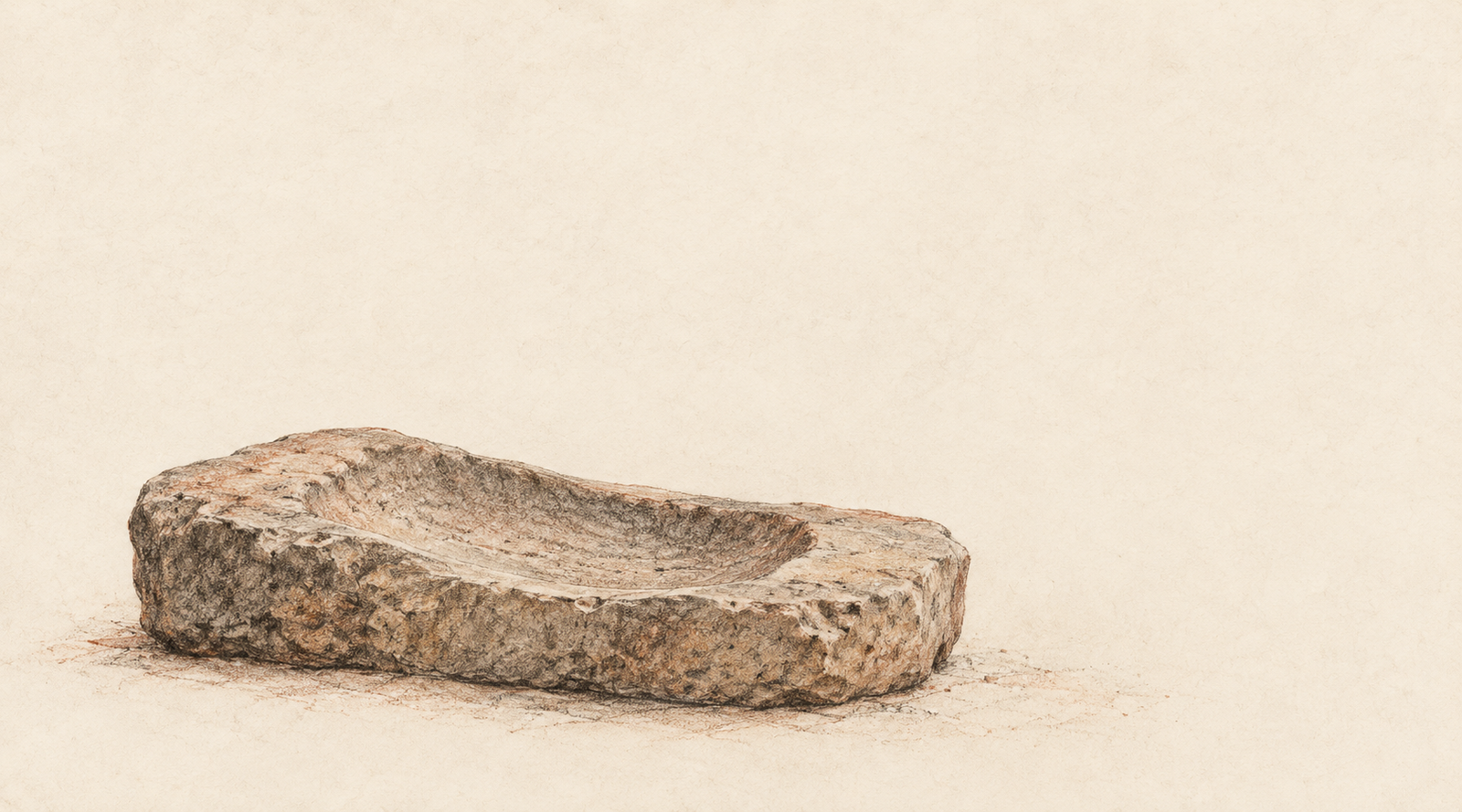

The City of Service
The temple we inherit is a building from which almost all necessity has been removed. Nothing must be brought for it to continue being what we call a temple. The sanctuary asks nothing of us. Stone is good at this kind of independence.
A living temple was otherwise.
Water had to come in. So did grain, cloth, oil, aromatic substances, fuel. The things required for worship arrived because someone carried them across a threshold.
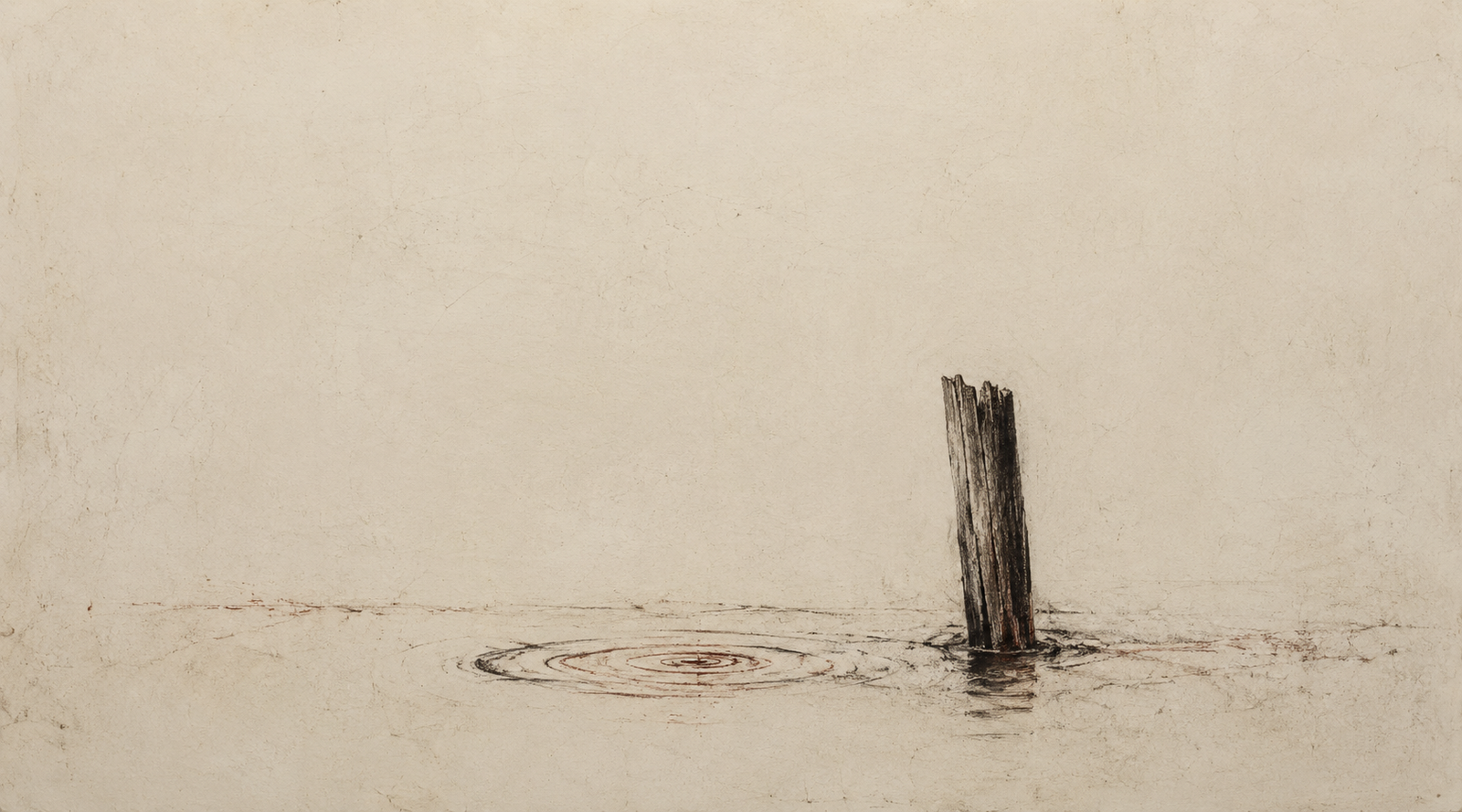

Houses of Wood, Light, and Smoke
Some of Angkor’s most intimate ruins do not rise above the ground at all. They are postholes, low mounds, hearths and ponds: durable traces of a domestic city built largely from things that decay. To restore that city is to see Angkor not only as stone, but as wood, smoke, water, repair, and people living within calling distance.