
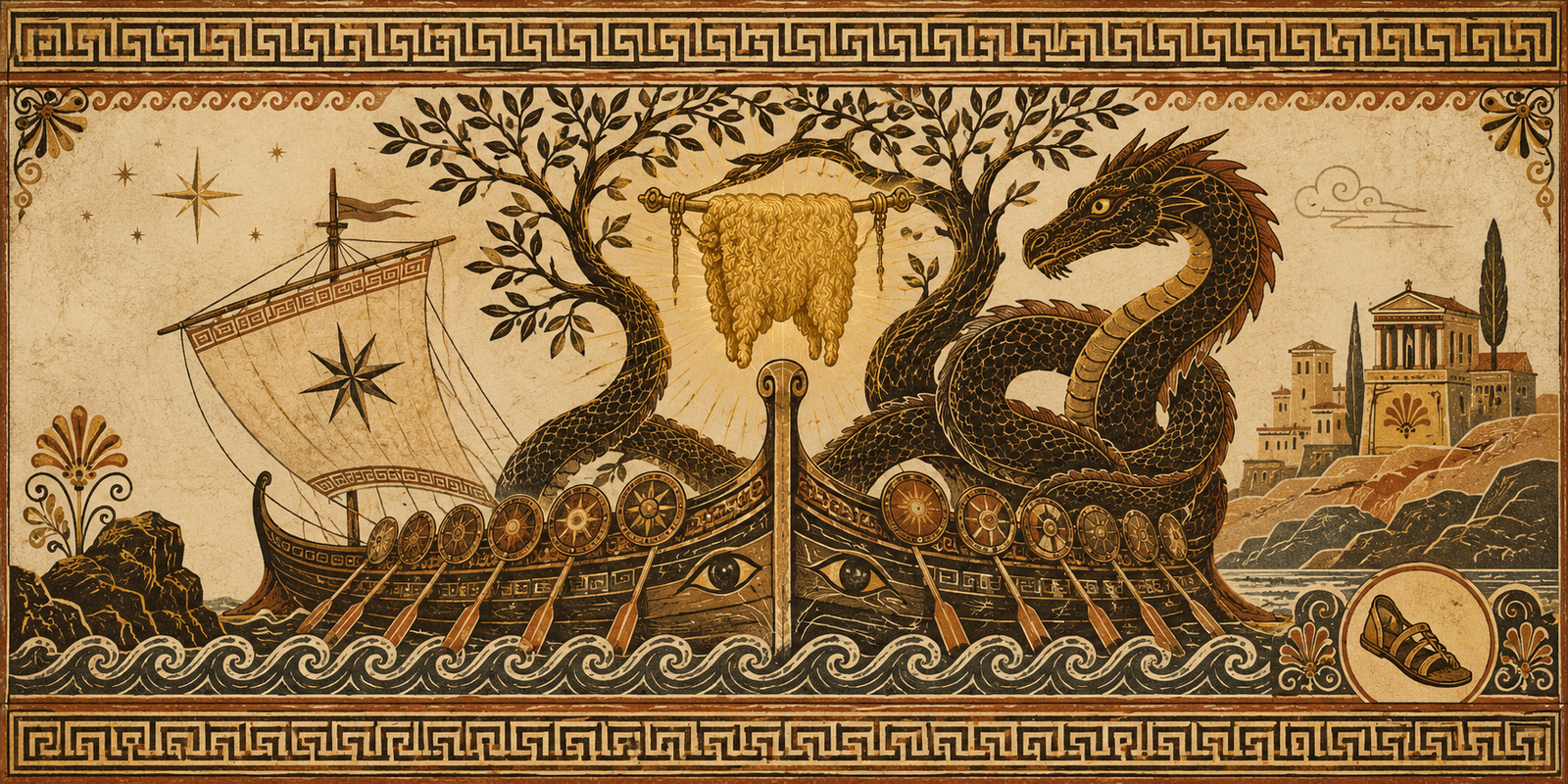

Jason and the Golden Fleece — A Greek Myth Retold for Children
A Greek myth retold with ships, dragons, impossible tasks, dangerous help, and the bright thing no hero can fetch alone.
Jason lost one sandal in a river.
This was irritating.
It was also, though Jason did not yet know it, extremely serious.
He had been on his way to Iolcus, where the king lived. The road ran down to the river, and the river was full from rain in the hills. It tugged at the stones. It worried at the banks. It made that busy brown sound rivers make when they have decided they are not merely crossing the land but arguing with it.
An old woman stood beside the water.
She was bent under her cloak. Her hair was grey. Her feet were small and unsteady on the mud. She looked at the river as if it had been put there personally to trouble her, which, to be fair, is how rivers often look to old women with tired knees.
“Will you help me across?” she asked.
Jason was young enough to be in a hurry, but not young enough to pretend he had not heard.
He gave her his arm.
The river took them at once. It pushed at his legs. It pulled at his cloak. The old woman was heavier than she looked, and not in the ordinary way. She leaned on him with the weight of rain, hills, old quarrels, and perhaps a little divinity.
Jason set his teeth and went on.
Halfway across, the water seized one of his sandals.
It slid from his foot, turned once in the brown current, and vanished.
Jason said nothing he would have wanted his mother to hear.
He brought the old woman safely to the far bank. She straightened. For one moment she did not look old at all. Her eyes were very bright.
“Thank you, Jason,” she said.
He stared. “How do you know my name?”
But she had already turned away along the road, and by the time he had taken three steps after her, she was gone.
That was the first strange thing.
The second strange thing was that Jason, barefoot on one side and shod on the other, went on to Iolcus.
He had not come for a feast. He had not come for a game. He had come because a house that should have known his father’s name no longer belonged to his father.
Aeson had once been king of Iolcus. He was Jason’s father. But Aeson’s half-brother, Pelias, had taken the throne and kept it. Jason had grown up away from the palace, away from the city, away from the sound of men speaking his family’s name with respect. He had been raised in the hills, where he had learned how to run, how to hunt, how to listen, how to sleep cold, and how to tell when a person was smiling with only the top of his face.
That last skill is very useful in Greek myths.
Especially near kings.
When Jason reached Iolcus, the city was full of sacrifice. Pelias had called the people together. Smoke rose from the altars. Bulls lowed. Servants hurried. Men in cloaks stood about pretending not to be afraid of the king while being very careful to laugh at the right moments.
Pelias stood near the altar.
He was not old, but he had the worn look of a man who had spent too long guarding something that did not belong to him. His crown sat well. His robes were rich. His hands were clean.
Then he saw Jason.
Or rather, he saw Jason’s feet.
One sandal.
One bare foot.
The colour in Pelias’s face changed.
There had been a prophecy, of course.
There is almost always a prophecy.
Pelias had been warned to beware the man who came to him wearing one sandal. This is the sort of warning that sounds ridiculous until a young man walks into your city with one foot bare and the other neatly shod.
Pelias looked at Jason.
Jason looked back.
The people looked at both of them and suddenly found the altar smoke very interesting.
“What is your name?” Pelias asked.
“Jason, son of Aeson.”
There was a small movement through the crowd, like wind through dry grass.
Pelias smiled.
It was not a comforting smile.
“Then you are my nephew,” he said. “You have been away a long time.”
“I have come home,” said Jason.
That was a brave thing to say. Not because the words were loud. They were not. But because they put the truth down in the middle of the city where everyone could see it.
Pelias heard the truth land.
Kings who have stolen things do not usually enjoy the sound of truth landing.
“And what do you want, Jason, son of Aeson?”
Jason looked at the palace. He looked at the city. He looked at the altar where Pelias stood making offerings to the gods as if the gods had not noticed him before.
“I want my father’s house restored,” he said.
A few people stopped breathing.
Pelias smiled more slowly.
“A noble wish,” he said. “Very noble. But kingship is not a cloak to be handed over because a young man has walked down from the hills with wet feet.”
“My feet are dry now,” said Jason.
This was not the wisest thing to say to a dangerous king.
It was, however, true.
Pelias’s eyes narrowed.
“You speak boldly.”
“I was taught to speak plainly.”
“Then let me speak plainly too,” said Pelias. “If you wish to prove yourself worthy of your father’s place, bring me the Golden Fleece.”
Jason did not answer at once.
Everyone in Iolcus knew of the Golden Fleece. Children heard of it before they were old enough to understand why adults lowered their voices when they spoke its name.
Long ago, a golden ram had carried two children away from danger. One child, Phrixus, had reached the far land of Colchis. There he had given thanks, and the ram’s fleece — bright, golden, and not quite like any ordinary thing in the world — had been hung in a sacred tree.
It was guarded.
Everything precious in Greek myth is guarded.
Sometimes by a god.
Sometimes by a monster.
Sometimes by a family who really should have learned better manners.
The Golden Fleece was guarded by a dragon that did not sleep.
It hung in Colchis, far beyond the seas Jason knew, on a shore so distant that many men could not say whether it belonged properly to the map or to the edge of a story.
Pelias knew this.
That was why he asked for it.
Kings in Greek myths often call something “a fair test” when they mean “a tidy way of getting rid of someone.”
Jason looked at him.
“If I bring it,” he said, “will you give back what belongs to my father?”
Pelias lifted his hands in front of the people.
“Bring me the Golden Fleece,” he said, “and we shall speak of kingship.”
This was not a promise.
Jason heard that.
The city heard it too.
But something had already begun. The words had gone out. The impossible thing had been named. And once an impossible thing has been named in a story, it has a habit of standing in the road until someone walks toward it.
So Jason said, “I will go.”
He did not say this because he was certain he could win.
Only a fool would have been certain.
He said it because his father’s house had been taken, because Pelias had set a death-trap in front of the whole city and called it honour, and because sometimes the only way through a bad king’s smile is to accept the task he thinks will destroy you.
But Jason could not go alone.
No one fetches the Golden Fleece alone.
First, he needed a ship.
Not a fishing boat. Not a trading vessel. Not one of those nervous little crafts that hug the shore and whimper whenever the sea clears its throat.
He needed a ship for heroes.
So Argus, the shipwright, built one.
He chose the timber carefully. He shaped the ribs. He fitted the planks so the sea would have to work hard to get in. The smell of fresh wood and pitch filled the shore. Men came down to watch. Boys came down to stare. Women stood with baskets on their hips and said, quite sensibly, that no ship needed to be that large unless it was going somewhere it had no business going.
The prow curved forward like a thought.
The oars waited in rows.
At the front was set a piece of sacred oak, for Athena herself had an interest in this ship. That was fortunate. A ship with a goddess’s attention is still in danger, but at least the danger has been noticed by someone competent.
The ship was named the Argo.
Then came the crew.
They came from valleys, islands, palaces, mountain paths, and households where their mothers probably wished they had chosen quieter friends.
There was Orpheus, carrying his lyre.
He had gone down into the dark once and returned with music still in his hands. When he stepped onto the Argo, even the ropes seemed to listen.
There were Castor and Polydeuces, brothers quick with horses, fists, and loyalty.
There were Zetes and Calais, who were said to have the North Wind in their blood and could move with an impatience that made ordinary men seem unfinished.
There was Lynceus, whose sight was so sharp that he could see what other men missed.
There was Telamon, broad-shouldered and ready to be offended on behalf of his friends.
There was Argus, because no sensible crew leaves behind the man who understands how the ship was made.
And there was Jason.
This was a difficult position.
He was not the strongest.
He was not the oldest.
He was not the most famous.
He was not even, if we are being honest, the one most likely to have useful advice about dragons.
But a captain does not need to be better than every person aboard at every task. A captain needs to keep the ship moving toward the thing everyone else agreed was impossible before they started.
That is hard enough.
The day the Argo launched, the shore was crowded.
The men pushed. The rollers turned. The ship slid toward the water. For one breath it seemed too large to move, too heavy, too much like a dream being asked to become wood.
Then the sea took her.
The Argo floated.
A cheer went up.
Jason stood at the prow and felt the deck lift beneath his feet.
Behind him lay Iolcus, Pelias, his father’s stolen house, and the river that had taken his sandal.
Before him lay the sea.
The oars dipped.
The Argo moved.
At first the voyage felt almost glorious.
This is one of the sea’s tricks.
The morning was bright. The sail filled. The oars rose and fell together. The heroes laughed. Spray struck their faces. Islands appeared and passed away. Dolphins came near the bow for a while, perhaps out of curiosity, perhaps because even dolphins enjoy watching humans attempt things.
For a few days Jason could almost believe that a quest was a fine thing.
Then the sea remembered what it was.
The sky lowered. Wind struck the sail. The oars jarred in the men’s hands. Rain needled their faces. The Argo climbed one black wave and fell down the other side as if the world had dropped away beneath her.
Men who had boasted on shore became quiet.
Men who had been quiet on shore became greener.
One man was sick over the side and said afterwards that it had been a prayer.
The ship groaned.
Jason gripped the rail.
He was afraid.
It is important to say that.
Bravery is not what happens instead of fear. Bravery is what happens when fear is standing very close and you still have something to do.
“Hold her steady!” Jason shouted.
The crew bent to the oars.
Orpheus began to play.
Not loudly. Loud music would have been foolish in that storm. He played as if he were placing a hand on the ship’s wild heart. The notes slipped between the crash of water and the roar of wind. The men heard them. Their rowing steadied. The Argo lifted her head.
The storm did not become kind.
But the crew remembered themselves.
After that, no one aboard believed the voyage would be easy.
This was an improvement.
A person who knows the sea is dangerous rows more carefully.
They passed islands where strangers watched from cliffs. They traded for water in harbours where no one spoke their language. They saw birds fly inland from empty-looking shores. They slept under stars so clear that even the most talkative heroes fell silent for a while.
Then they came to the rocks.
The sea narrowed between two great cliffs of stone. They did not stand still, as cliffs are generally expected to do. They drew apart, then crashed together again with a sound like mountains striking their teeth.
Boom.
The sea leapt white between them.
Boom.
Spray flew higher than the mast.
Boom.
The oarsmen stopped rowing.
No one had to tell them what these rocks did to ships.
“They crush anything that passes,” said Telamon.
Jason looked at the rocks. He looked at the water. He looked at the men behind him.
A captain sometimes gives orders everyone already understands.
A captain sometimes gives orders because no one else will say the thing that must be done.
“Lynceus,” he said, “watch the gap.”
Lynceus narrowed his eyes.
“Send a bird,” he said. “If the bird lives, we follow.”
They loosed a dove.
The dove flew hard between the rocks.
For one breath it vanished.
The rocks crashed.
A few tail feathers spun in the air.
But the dove came through alive.
The crew stared at the passage.
No one moved.
The rocks were already drawing apart again. Not far. Not for long.
Jason felt the moment hanging there, thinner than a thread.
If he waited until everyone was ready, the chance would close.
“Now,” he said.
The men still hesitated.
“Now!” Jason cried. “While the rocks remember the bird!”
The oars struck.
The Argo leapt forward.
Every man rowed. The ship drove into the narrow water. The rocks on either side began to move. The sound was not like thunder. Thunder is far away. This was the sound of stone deciding to become a wall.
“Row!” shouted Jason.
The Argo flew.
The rocks slammed behind them.
The stern shuddered.
A carved piece at the back splintered and was gone.
But the ship passed through.
The sea opened beyond.
No one cheered at first.
They were too busy breathing.
Then Telamon laughed, and because he had laughed, everyone else did too, though some of the laughter sounded a little close to weeping.
After that, even the sea seemed different.
They had passed a door.
The world on the far side did not feel like the world they had left.
At last, after days of rowing and sailing, after strange harbours and dangerous water, after arguments, repairs, prayers, blisters, and more meals of dried food than any hero should have to endure, they saw Colchis.
It lay at the end of the sea like a thought the Greeks had not finished thinking.
There were dark trees along the shore. A river moved broad and slow toward the sea. Beyond it rose the palace of King Aeetes.
And somewhere, somewhere beyond those trees, the Golden Fleece hung in its sacred grove.
Jason felt the whole ship grow quiet.
The quest was no longer ahead of them.
It was here.
King Aeetes received them in his hall.
He was a tall man, richly dressed, with eyes like someone who had already decided not to be impressed. His daughter Medea stood nearby. She was silent, watchful, and still.
Do not imagine her as soft because she was young.
Medea belonged to Colchis. She knew its gods, its herbs, its spells, its secret paths, and the temper of her father. She knew things Jason did not know. She knew, for example, that a polite king can be more dangerous than a raging one, because a raging king gives you warning.
Aeetes listened while Jason spoke.
He listened to the story of Pelias.
He listened to the claim.
He listened to the request for the Golden Fleece.
Then he smiled.
It was a better smile than Pelias’s, which made it worse.
“You have come a long way,” Aeetes said.
“We have.”
“And you have brought many heroes.”
“They chose to come.”
“How fortunate for them.”
Jason heard the trap in the words, but not yet the shape of it.
Aeetes leaned back.
“The Golden Fleece is sacred in Colchis,” he said. “It is not handed to strangers simply because they have a ship and a brave expression.”
The Argonauts shifted.
Jason said, “Name the task.”
Aeetes looked pleased. Men like Aeetes enjoy it when the person walking into the snare asks where to put his foot.
“Very well,” said the king. “Tomorrow you will yoke my bulls.”
There was a silence.
Medea’s eyes moved to Jason’s face.
Aeetes went on.
“They have bronze feet. They breathe fire. You will harness them to the plough. You will plough the field of Ares. Then you will sow the dragon’s teeth kept for that purpose. When the crop rises, you will finish the work.”
Jason was wise enough not to ask what sort of crop grew from dragon’s teeth.
He suspected he would not enjoy the answer.
“If I do this,” he said, “the fleece is mine?”
“If you do this,” said Aeetes, “you may take it.”
Again, it was not quite a promise.
Again, everyone heard that it was not quite a promise.
But again, the task had been named.
Jason bowed.
He did it well.
Only Medea saw that his hand was shaking.
That night, the Argonauts slept badly.
Some sharpened weapons. Some muttered. Some looked toward the dark line of trees and imagined dragons, which is not restful. Orpheus sat with his lyre in his lap but did not play. Even music must sometimes know when to wait.
Jason walked alone near the river.
He did not go far. A captain who wanders too far from his ship in a strange country is not mysterious. He is careless.
The reeds moved beside the water.
Medea stepped from the dark.
Jason turned.
She held a small box in her hands.
“You will die tomorrow,” she said.
This was not the kind of greeting people usually hope for.
Jason said, “Is that certain?”
“If you face the bulls as you are, yes.”
He looked at the box.
“And if I do not face them?”
“My father will have you killed another way.”
Jason was quiet.
Medea looked toward the palace. “The bulls are not ordinary beasts. Their breath burns. Their hooves strike sparks. No man can come near them by strength alone.”
“Then why are you here?”
“Because my father calls it a test, and it is not a test. It is a killing arranged with witnesses.”
Jason did not answer.
Medea opened the box.
Inside was a dark ointment that smelled of earth after lightning.
“Rub this on your body and your shield before dawn,” she said. “For one day, fire will not master you. Not entirely. Do not waste the day.”
Jason took the box carefully.
“And the teeth?” he asked.
Medea’s face changed. Not much, but enough.
“When you sow them, warriors will rise from the ground. They will be armed. They will hate whatever they see first.”
“That seems excessive,” Jason said.
“It is Colchis.”
“What must I do?”
Medea picked up a stone from the riverbank. It fit neatly in her palm.
“Throw a stone among them. Let each think another has struck him. Their anger will finish what your sword cannot.”
Jason looked at the stone.
It was such a small thing.
A stone. A trick. A warning. A box of dark ointment.
Not a sword from heaven. Not a thunderbolt. Not a god striding down with a shining command.
Just help.
Strange, dangerous, necessary help.
“Why are you doing this?” Jason asked.
Medea looked at him then.
For a moment she seemed very young, and much older than he was.
“Because I saw what was being done,” she said. “And once a person has truly seen a thing, it is hard to become blind again.”
She turned to go.
“Medea,” Jason said.
She stopped.
“Thank you.”
“Do not thank me yet,” she said. “Survive first.”
At dawn, the field of Ares waited.
So did the people of Colchis.
They gathered at a distance, which showed they understood the bulls very well.
King Aeetes sat in a high place with his cloak arranged around him. Medea stood behind him, still as a carved figure.
The Argonauts stood on the other side of the field.
No one spoke much.
In the middle of the field lay the plough.
Beyond it, behind a gate of black wood and bronze bars, the bulls stamped.
Jason had rubbed Medea’s ointment over his arms, chest, neck, and face. He had rubbed it over his shield. His skin prickled with it. It felt as if summer heat had been buried under his flesh and was trying to remember the way out.
The gate opened.
The bulls came.
They were enormous.
Their hides were dark. Their horns curved forward. Their hooves were bronze and struck sparks from the earth. Smoke leaked from their nostrils at first.
Then fire.
The crowd cried out and drew back, though they were already far away.
Jason lifted his shield.
The first bull charged.
The fire struck him.
For one terrible moment the world became heat.
He could not see. He could not breathe. His shield burned bright in front of him. The air roared.
Then the fire passed.
Jason was still standing.
His cloak was singed. His hair smelled dreadful. His hands hurt.
But he was standing.
On the shore, the Argonauts shouted.
Jason did not look at them.
The second bull came from the side.
Jason threw himself aside and caught the yoke rope. The rope tore through his palms. The bull dragged him through the dirt. Sparks flew. The animal’s great head swung. Jason rolled, braced his feet, and pulled with every part of himself that remembered the hills, the cold mornings, the hard training, the years spent becoming strong without anyone in Iolcus seeing it.
The bull turned.
Jason moved with it.
There are moments when strength matters, and moments when strength by itself is merely a good way to be thrown into a wall. Jason could not outmatch the bull. He had to feel when it pulled, when it twisted, when its rage carried it too far.
He used the first bull’s force to bring it toward the second.
The yoke dropped.
The bulls fought it.
Jason shouted. The Argonauts shouted back. The ground smoked beneath the bronze hooves.
At last, with a cry that tore his throat, Jason fastened the yoke.
The bulls were joined.
Now he had to make them plough.
This was not easier.
The field of Ares was hard, dry, and waiting. Jason seized the plough handles. The bulls lunged. The plough bit into the earth. The first furrow opened behind him, dark as a wound in the soil.
Across the field they went.
Fire streamed past him. Sparks leapt. Dust rose. The crowd became a blur. The plough bucked in his hands. Once he fell to one knee and felt the heat of a bronze hoof pass close enough to make the ground jump beside him.
He rose.
He went on.
Furrow after furrow.
Until the field was ploughed.
Then a servant of Aeetes brought the dragon’s teeth.
They were in a bronze bowl.
They looked too small to be dangerous.
Jason knew better by now.
He took them.
One by one, he cast them into the furrows.
For a moment nothing happened.
The wind moved across the field.
The bulls snorted smoke.
Somewhere, a child in the crowd began to cry and was hushed.
Then the earth stirred.
A hand broke through.
Then another.
Then helmets.
Then spearpoints.
Men rose from the soil.
Not living men as you or I would mean it. Earth-born warriors, hard-eyed and fully armed, came up from the furrows where the teeth had fallen. Mud slid from their shoulders. Bronze flashed. They turned their faces toward Jason.
All of them.
Jason remembered Medea’s words.
They will hate whatever they see first.
He took the stone from his pouch.
It seemed even smaller now.
The warriors advanced.
Jason threw.
The stone struck one helmet and bounced between them.
An earth-born warrior turned at once and struck the man beside him.
The man beside him struck back.
Another saw the blow and raised his spear.
Another shouted.
In a heartbeat the whole field became confusion.
Jason backed away.
He did not cheer.
There are victories that do not feel like cheering.
The earth-born warriors turned their anger upon one another. Dust rose. Bronze rang. Their own fury consumed the terrible crop that had sprung from the dragon’s teeth.
When it was done, the field was still.
Jason stood alone beside the plough.
Across the field, Medea let out the breath she had been holding.
King Aeetes did not clap.
His face had become the face of a man watching his own trap open and finding someone else still alive inside it.
Jason walked toward him.
“The task is done,” he said.
“So it is,” said Aeetes.
“The fleece.”
Aeetes looked past him toward the sacred grove.
“Tonight,” he said. “You may take it tonight.”
This time no one believed him.
Jason returned to the Argo with the eyes of Colchis on his back.
The Argonauts gathered around him. Some laughed. Some struck his shoulders. Some asked about the bulls all at once, which was not helpful. Orpheus looked at him for a long moment and said quietly, “You are alive.”
“Yes,” Jason said.
This was the most important fact about him just then.
But he did not rest.
Medea came before moonrise.
“We must go now,” she said.
Jason had expected this. He had also hoped, foolishly, that perhaps the king of Colchis might decide to become honest at the last moment. Hope is not always intelligent.
“My father will not give you the fleece,” Medea said. “He is gathering men. By morning your ship will be trapped in the river.”
Jason looked toward the dark trees.
“Then we take it tonight.”
The Argonauts armed themselves.
Medea shook her head.
“Not all of you. Too many feet. Too much sound. The grove is sacred, and the dragon hears what men wish it would not hear.”
“Then who?”
“You,” said Medea. “And me.”
Jason did not like that answer.
A brave man who enjoys walking toward a sleepless dragon in the dark has misunderstood either bravery or dragons.
Still, he went.
The grove lay beyond the palace fields, where the trees grew old and close together. The moon was thin. The path was narrow. Medea moved as if she had walked it in dreams. Jason followed, trying not to step on every twig in Colchis.
The air changed as they entered.
It grew cooler.
Older.
The noises of the palace faded behind them. No voices. No armour. No river. Only leaves, breath, and the quiet of a place that has been guarding something for a long time.
Then Jason saw the tree.
It stood in a clearing, black against the thin moon.
From one great branch hung the Golden Fleece.
Not yellow.
Not merely bright.
Golden.
It held what little light there was and returned it as if dawn had been folded and laid across the branch. It shone without flame. It was soft and terrible and beautiful, and Jason understood at once why kings wanted it, why gods had noticed it, why men had crossed seas for it, and why no sensible person should have tried to steal it.
Beneath the tree lay the dragon.
It was coiled around the trunk.
Its body was thick as a fallen pillar. Its scales were dark. Its head rested low, but its eyes were open.
They were not blazing.
That would have been easier.
They were watchful.
The dragon was not angry. It did not need to be angry. It had one task, and it had been doing that task for longer than Jason had been alive.
It watched the fleece.
It watched the clearing.
It watched Jason.
Jason stopped.
His hand tightened on his sword.
Medea touched his arm.
“No,” she whispered.
Very slowly she stepped forward.
She began to speak.
The words were not Greek. They were not any language Jason knew. They moved softly through the clearing, low and winding, like water finding its way under roots. Medea took herbs from her pouch and crushed them in her hands. Their scent rose sharp and green.
The dragon’s eyes narrowed.
Jason did not breathe.
Medea sang again.
The dragon shifted. Its coils rasped against the bark. Its head lifted, and for one awful moment Jason thought it would strike.
Medea did not step back.
Her voice changed.
It became lower.
The leaves above them trembled though there was no wind.
The dragon’s head lowered.
Its eyes were still open.
Then, slowly, slowly, the lids came down.
The grove seemed to exhale.
“Now,” Medea whispered.
Jason moved.
He crossed the clearing. Every step felt too loud. The dragon’s body lay near the trunk, vast and still. Jason could smell it: earth, scale, old heat.
He reached the tree.
The fleece hung above him.
For a moment he could not touch it.
He had crossed the sea for this. He had faced Pelias, the storm, the clashing rocks, Aeetes, the bulls, the field of teeth, and the dragon. But now that he stood beneath it, the fleece did not feel like a prize.
It felt like a thing with a story older than his hand.
Then he remembered his father’s house.
He remembered Pelias smiling.
He remembered the river taking his sandal.
He reached up.
The fleece came free.
It fell into his arms like captured sunlight.
The dragon stirred.
“Jason,” Medea said.
He ran.
The dragon’s eyes opened behind him.
Not fully.
Not yet.
But enough.
Medea turned and flung the last of her herbs into the air. The scent burst through the grove. The dragon’s head rose, slow and dreadful, fighting sleep.
Jason reached Medea.
Together they fled.
Behind them, the dragon’s body moved around the tree. Bark cracked. Leaves shook. The clearing filled with the sound of something enormous remembering its duty.
They ran harder.
Branches tore at Jason’s cloak. The fleece burned bright in his arms. Somewhere behind them a cry rose from the palace. Then another. Colchis was waking.
The Argo waited in the river-mouth.
The Argonauts saw the light of the fleece before they saw Jason.
“Cast off!” he shouted.
Men leapt to the ropes.
The ship lurched.
Oars dropped.
“Row!” cried Jason.
The oars struck water.
Once.
Twice.
Together.
The Argo moved.
Behind them came shouting. Torches flared along the bank. Men ran through the dark. Medea stood near the prow, her face turned toward the shore she was leaving. Jason held the fleece, and its light fell across the planks, the ropes, the hands of the rowers, the carved prow, the river-water breaking white beside the ship.
The Argo reached the open sea.
The wind took the sail.
Colchis drew back into darkness.
For a long time no one spoke.
Even Telamon was silent.
At last Orpheus touched the strings of his lyre.
Not a song of triumph. Not yet.
A low song. A rowing song. A song for the ship, the sea, the far shore behind them, the sleepless dragon, and the bright impossible thing lying across the prow.
Jason stood beside the fleece.
He was tired past boasting.
His hands were burned. His palms were torn. The river had taken one sandal long ago, but he could still feel the memory of that bare foot on the road to Iolcus.
He had not fetched the Golden Fleece alone.
No one could have.
But he had gone.
That mattered too.
He had stood before Pelias. He had crossed the sea. He had held the plough. He had listened when help came. He had reached up in the dark and taken the guarded thing from the sacred tree.
Behind him lay Colchis, waking in anger.
Before him lay the long sea home.
And on the prow of the Argo, bright against the dark, the Golden Fleece shone like dawn that had not yet decided where to rise.
—
Receive the next work
Subscribe free to receive new work from the The Alexander Series Library by email.
More from the Library


See Also
A concise and impartial dictionary of absence, promises, quarrels, ordinary objects, and the troublesome instability of words.

The City of Service
The temple we inherit is a building from which almost all necessity has been removed. Nothing must be brought for it to continue being what we call a temple. The sanctuary asks nothing of us. Stone is good at this kind of independence.
A living temple was otherwise.
Water had to come in. So did grain, cloth, oil, aromatic substances, fuel. The things required for worship arrived because someone carried them across a threshold.

Houses of Wood, Light, and Smoke
Some of Angkor’s most intimate ruins do not rise above the ground at all. They are postholes, low mounds, hearths and ponds: durable traces of a domestic city built largely from things that decay. To restore that city is to see Angkor not only as stone, but as wood, smoke, water, repair, and people living within calling distance.