
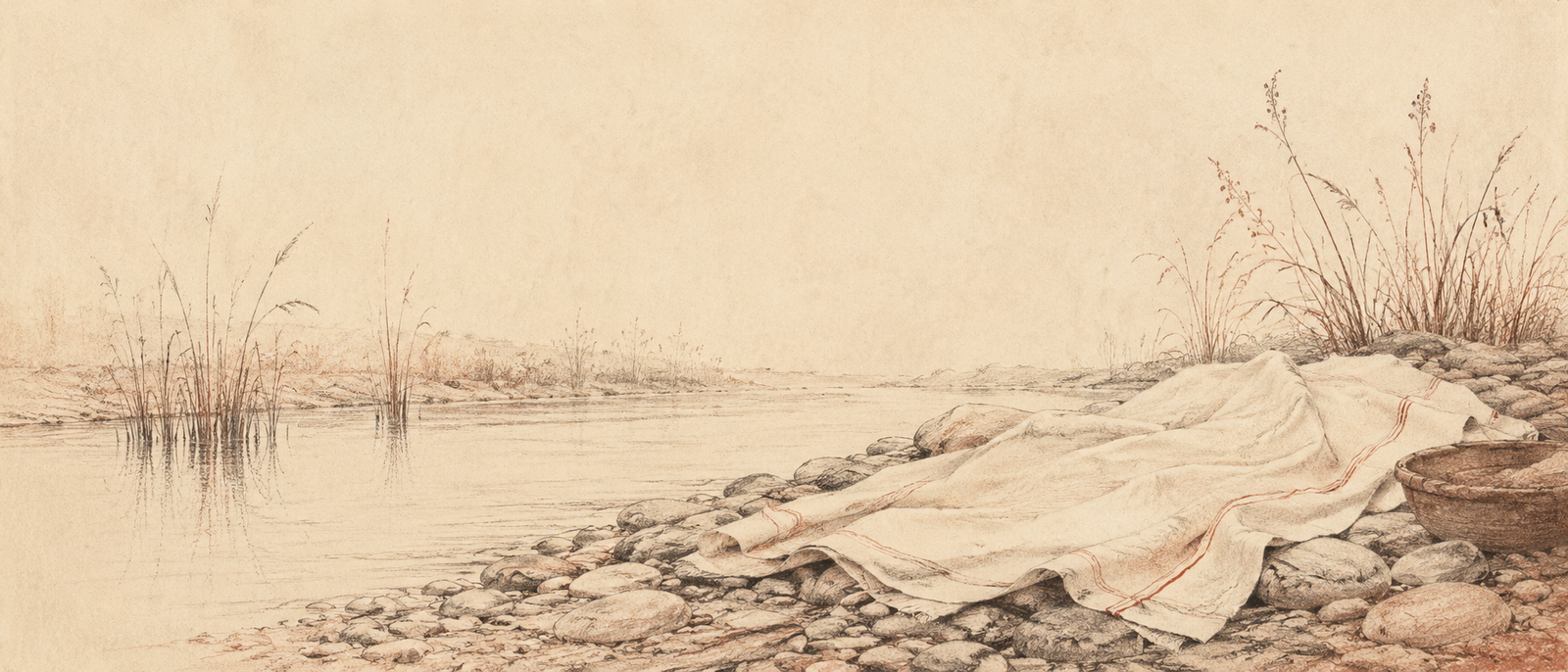

The Long Return VI — Nausicaa at the River
An Odyssey instalment on mercy, social intelligence, and the law of welcome before a stranger has a name.
The linen had not yet been washed.
That was the first trouble of the morning, before anyone had spoken of ships, strangers, gods, or the man sleeping under leaves near the river-mouth. In the house of Alcinous, where the floors were clean and the doors well fitted and the servants moved with the practised quiet of people who knew their work, there were still garments folded too long in baskets, cloaks that had taken the smell of cupboards, bright things dulled by use, and marriage-cloth waiting for water.
Nausicaa woke with this knowledge in her.
It had come to her in a dream, though dreams in those days were not always the loose and wandering things they are now. Some came like smoke from a tired mind. Some came from food and weather and the strange little anxieties of the day before. But some entered a sleeping room with a step of their own, and when they left, the air seemed changed.
In the dream, a girl she knew had stood beside her bed. She was one of the daughters of Dymas, near to Nausicaa in age, one of those friends whose speech could enter where a mother’s warning might be refused.
“Nausicaa,” the girl had said, “how can your mother have so careless a daughter? Your bright clothes are lying neglected. Soon enough you will need them. Soon enough your wedding will be spoken of. A bride must have clean garments ready, and those who go with her must be clothed honourably too. Ask your father for the mule-wagon in the morning. Take the maids to the river. Wash what must be washed.”
It was not a command exactly.
It was worse than that.
It was the kind of reminder that makes obedience feel like one’s own idea.
Nausicaa had half risen in sleep, and in the faint light before waking she saw the girl’s face shine more beautifully than any girl’s face had a right to shine. Then the figure was gone, and the house was only a house again: still beams, quiet walls, the breathing of servants nearby, and the morning waiting outside.
Athena, who had worn the friend’s face, went back into the immortal air.
Nausicaa lay still for a moment.
She was young enough for the word marriage to move through her like a bird startled from a tree, and old enough to know that no house remains a child’s house forever. She did not yet belong to another man’s rooms, but the thought of them had begun to gather around her: strange floors, strange servants, another woman’s cupboards, another hearth at which she would have to stand as though she had always known where everything was kept.
It was a great thing, marriage. The songs made it golden, because songs are sometimes charitable. But a girl with intelligence knew that marriage was also departure, arrangement, reputation, timing, linen, family speech, and the watchfulness of neighbours. It was not enough to be loved. One had to be seen rightly.
So she rose.
The house was beginning to stir. Light came low through the openings of the upper rooms, pale at first, then warmer where it touched the polished wood. Servants moved with jars and folded cloth. Somewhere below, a door opened onto the court, and a mule gave a soft impatient sound.
Nausicaa dressed carefully.
Not splendidly. Carefully.
There is a difference, and she knew it.
She went to her father.
Alcinous was already awake, as kings often are, though people imagine them idle because other hands carry out their wishes. He sat near the inner court where the first business of the day came to him: servants with questions, men with messages, household officers waiting for a look or a nod. He was a man accustomed to being obeyed without needing to make obedience loud.
Nausicaa stood before him.
“Father,” she said, “may I have the high wagon today, with the mules? There are clothes to be washed. Yours too, and my brothers’. You should not go among the people in garments that have lost their brightness. My brothers are young men. They go to the dance, and they care how they appear.”
This was all true.
It was not the whole truth.
She did not say: I dreamed of marriage. She did not say: I woke ashamed of neglected linen. She did not say: something came into my room and left me with a task.
A good father hears what is not said, at least when the gods have not clouded him entirely. Alcinous looked at his daughter and smiled a little.
“You shall have the mules,” he said. “And the wagon. The servants will make it ready.”
He did not tease her.
That was kindness.
Soon the mule-wagon stood in the court, its wheels tall, its bed laid with baskets. The maids brought out garments in armfuls: tunics, cloaks, sheets, soft cloth for the household, linen marked by use and needing river-water. They packed food too, for work at the river took a long day: bread, wine, things sweetened and folded away, and oil for washing after labour. Nausicaa’s mother gave her a flask with care, and the maids laughed among themselves because work done away from the house is never quite the same as work done under older eyes.
Then they went out.
The road from the palace led beyond the houses and fields to the river-mouth where fresh water ran down toward the sea. On one side there were open places for washing; on the other, low ground where the mules could graze. The river moved with the calm of a thing that had never needed to persuade anyone. It knew its path. It took the sky and broke it softly.
There the girls unharnessed the mules and let them feed. They lifted the baskets down. They carried the clothes to the water.
The work began.
They trod the garments in the river, pressed them under, rubbed them clean, lifted them shining and heavy from the current. They spread them over stones and grass where the sun could take them. White cloth flashed against the bank. Coloured hems brightened. The day opened.
Nausicaa worked with them. She was a king’s daughter, but in a well-ordered house rank does not always mean exemption from the work that proves the house alive. She held cloth in both hands and turned it in the water. She laughed when one of the younger girls splashed another and pretended innocence badly. She corrected a fold. She shook out a garment and laid it flat in the sun.
For a while, the world was nothing but river, cloth, sun, girls’ voices, mules cropping grass, and the ordinary pleasure of having done a necessary thing well.
When the washing was finished, they bathed and rubbed themselves with oil. They ate on the riverbank. Afterward, while the clothes dried, they took a ball and played.
No one watching from a distance would have thought that the return of Odysseus had drawn near to them.
The world had not paused for him.
A king was lost, a goddess was arranging, a ship had broken, and a man had slept under leaves after nearly dying in the surf. Still the linen had to dry. Still the girls threw the ball. Still the river went on carrying light between its reeds.
The ball flew from hand to hand.
Their voices rose. The river carried the sound a little way and broke it among the reeds.
Then the ball went astray.
Whether Athena turned it, or whether the girl who threw it simply misjudged her strength, no one can say with perfect certainty. The gods do not always need to make miracles when a small mistake will serve. The ball fell into the deep water, and the girls cried out together.
That cry passed over the bank, through the bushes, and into the sleep of the man hidden there.
Odysseus woke.
For a moment he did not know where he was. That had happened often enough now that he did not rise quickly. A man who has slept in many dangers learns to let his mind arrive before his body. He felt leaves against his skin. He smelled river-water, damp earth, and the salt that had dried into him. He heard girls’ voices.
Not men.
Not oars.
Not surf breaking over him.
Girls.
He remembered then.
The storm. The raft breaking. The long violence of the sea. The river’s mouth. The prayer. The leaves gathered into a bed because there had been no roof, no cloak, no fire, no human voice saying, “Come in.”
He had slept as animals sleep when exhaustion has driven fear below the body’s need.
Now morning had found him.
He listened.
The voices were not hostile. They were high and startled and alive. But he was alone, naked under the leaves, crusted with salt, his hair tangled, his body marked by the sea’s handling, and he knew very well what he must look like to anyone who saw him.
Need drove him forward. Shame held him back. Hunger spoke louder than both.
He rose slowly in the thicket.
The leaves fell away from him. He broke a branch from the brush, broad enough to hold before himself, because even a ruined man may remember modesty. He stood for a breath, gathering what remained of his judgement.
Should he go to them?
Should he wait?
Should he call out from concealment and risk seeming more terrible because unseen?
He could not remain where he was. He needed clothing, food, direction, the name of the land, and some path into human order. The sea had taken everything from him except the one thing that had saved him more than once: the mind that could stand back from fear and choose.
So he stepped out.
The girls saw him and fled.
Who could blame them? He came from the bushes like something thrown up by storm and not yet accepted back into the world of men. The salt had whitened him. His skin was scratched. His eyes were those of a man who had looked too long at death and not yet learned to look harmless again. The branch in his hand did not make him gentle. It only showed that he knew he was frightening.
The maids scattered along the bank and among the folds of shining cloth. One cried out. Another dropped what she had been holding. Their feet flashed over stones and grass.
Nausicaa remained.
Fear came to her, certainly. Courage without fear is only ignorance, and Nausicaa was not ignorant. She saw the man as clearly as the others did. She saw the salt, the exhaustion, the wildness, the need. She saw also that he had stopped at a distance. He did not rush. He did not reach. He stood as one asking permission even to be seen.
Athena strengthened her heart, but the heart was hers to strengthen.
Odysseus looked at her.
In another place, if he had come clothed and crowned into a hall, he would have known how to speak as a king to a king’s daughter. Here he was nothing: a stranger without proof, a man with no name he could safely offer, a body dragged from the edge of drowning. Yet speech remained to him, and with speech he might build the first plank between himself and safety.
He considered whether to clasp her knees.
It was the ancient gesture. A suppliant came low, touched the knees, asked protection. But he saw the girl before him, young, alone in command of younger girls, and understood that the right law might become the wrong act if he crossed the space too quickly.
So he stayed where he was.
“Lady,” he said, and his voice was rough from salt and sleep, “I come to you as a suppliant. Whether you are mortal or one of the deathless ones, I do not know. If you are a goddess, then Artemis is the one I would name, for your height and bearing and the company around you. If you are mortal, then blessed are your father and your mother, and blessed your brothers, who must feel their hearts warmed when they see you enter the dance. But most blessed of all will be the man who brings you home with gifts and calls you wife.”
Nausicaa listened.
This was praise, and it was dangerous, because praise from a desperate man may be only another kind of reaching. But there was discipline in it. He had placed honour around her without stepping toward her. He had seen her rank and named it. He had spoken as one who knew that a girl’s reputation was a house built of breath, and that one wrong breath could damage it.
He went on.
“I have suffered much. For twenty days the sea has driven me. Yesterday it broke me against this shore, and some god, I suppose, did not wish me dead yet. I know nothing of this land. I know no one here. Give me only a rag to cover myself, if you have one from the washing, and show me the way toward the town. May the gods give you what your heart desires: a good husband, a good house, and peace within its walls. There is no better thing on earth than a man and woman keeping one mind together in a household. It grieves their enemies and gladdens their friends, but they themselves know it most.”
He stopped.
It was a cunning speech.
It was also, inconveniently for anyone wishing to judge him simply, a true one.
Nausicaa looked at him and did not answer at once.
She knew, now, that he was no common wanderer. Or rather, she knew that if he was common, then the world was stranger than she had thought. His words had form. His need had dignity. There was command in him still, though it had no cloak to wear.
Then she spoke.
“Stranger,” she said, “you do not seem to me a bad man or a foolish one. Zeus himself gives fortune to men, both good and evil, as he chooses. You must endure what has been given to you. But now you have come to our land, you shall not lack clothing or anything else that is proper for a suppliant in need.”
She turned toward the girls, who had gathered at a distance, watching.
“Stop,” she called to them. “Why do you run because you have seen a man? Do you think he is an enemy? No hostile man comes here while the gods protect this country. We live far off, apart from the anger of others. This man is a stranger and in need. Strangers and beggars come from Zeus. A small gift is dear to them. Give him food and drink, and wash him in the river where there is shelter from the wind.”
The girls obeyed, though not all at once. Fear has to be called twice before it becomes duty. But they came back, ashamed of having run and relieved to be told what to do. They set out clothing for him, a tunic and cloak from the clean washing. They placed oil nearby. They brought food.
Odysseus watched them and understood that he had passed the first gate.
When they urged him toward the water, he drew back slightly.
“Let me wash alone,” he said. “I would be ashamed to stand unclothed among young women. The sea has left much salt and grime on me, and I must clean it away.”
That too was rightly spoken.
The girls withdrew.
Odysseus went down to the river. He set the branch aside at last. He washed the salt from his shoulders, his back, his hair. The river took what the sea had left. He rubbed himself with oil and put on the clothes the girls had given him.
Athena, who had not stopped watching, poured grace over him then. Not the shallow grace that belongs only to youth or ease, but the returning shape of a man who had been hidden under suffering. His shoulders seemed broader. His hair fell in ordered curls. His face, though worn by much endurance, took back something of its own authority.
He came from the river and sat apart on the shore.
The girls looked at him differently now.
Nausicaa looked too, and did not pretend she had not.
For one moment, before prudence returned, she saw what the gods had made visible. Not a husband. Not a promise. Only the shape of a man who had come very near to death and had not yet surrendered his beauty to it.
Then the moment passed back into the world that would have to be managed.
She turned to her maids and said quietly, though not so quietly that the story has lost the words, “Listen to me. This man has not come among us without the gods. At first he seemed poor and broken. Now he is like one of the immortals. I could wish for a husband such as this, if he were to dwell here and be pleased to stay.”
There it was: not a vow, not a romance, not the foolishness singers sometimes hang upon young women because they do not know how else to make them vivid. Only a thought passing through the room of her heart.
The door opened.
The door closed.
Then she told them to give him food.
Odysseus ate and drank. He did so with restraint, but hunger cannot be made courtly for long. He had not eaten as a man eats among men since before the storm, and food brought him nearer to himself. Bread, wine, oil, cloth: these are not small things after the sea has finished with a man. They are the first articles of civilisation. They say: you are not yet home, but you are no longer outside the human world.
Meanwhile the sun dried the last of the linen. The girls folded the garments and placed them in the wagon. The mules were harnessed again. The day had altered around them. What had begun as household work had become the first act of a stranger’s rescue.
But Nausicaa was thinking ahead.
Mercy had brought him out of the bushes. It could not, by itself, bring him safely through the city.
She knew her people. She knew the young men especially, their quick eyes, their idle tongues, the way they could make a story before a fact had found its feet. If she drove into town with a strange man walking openly beside her, the tale would arrive before she did. It would go from doorway to doorway, growing richer as it travelled. Someone would say she had found herself a husband. Someone else would ask where he came from. Someone would laugh. Someone would pretend concern. By evening, the truth would be the weakest thing in the city.
This was not cowardice in her.
It was knowledge.
So she went to Odysseus where he sat apart.
“Stranger,” she said, “if you wish my father to send you home, you must listen carefully. We are going to the city now. You will see the harbour and the ships, for our people are skilled with oars, and the sea is close to us. But you must not come beside me all the way. I would be blamed for it. There are insolent men among us, as there are everywhere, and they would speak if they saw me with you. They would say, ‘Who is this tall stranger following Nausicaa? Where did she find him? Is he to be her husband? Perhaps she has brought him from some ship, since no one near us is good enough.’”
She looked toward the road, not because she was afraid to meet his eyes, but because she was measuring the distance in her mind.
“I would blame another girl myself,” she said, “if she behaved so while her father and mother still lived. So do this. Follow with the maids, but keep behind. When we come near the city, there is a grove sacred to Athena, with poplar trees and a spring running through it. Wait there. Give us time to reach my father’s house. Then go into the city and ask for the palace of Alcinous. Anyone will show you. When you enter, do not first seek my father. Go to my mother. Her name is Arete. She sits by the hearth in the light of the fire, spinning purple wool, with her women behind her. My father’s chair is near hers. If she looks on you kindly, then there is hope that you will see your own land again.”
Odysseus heard all of this and marked it.
The girl knew the road, the city, the danger, the order of the palace, the true centre of power. She knew how mercy must move if it wished to arrive unharmed. She had given him more than clothing. She had given him a map through appearances.
He bowed his head.
Not too low, because he was still Odysseus. Low enough, because he was not a fool.
“May Zeus grant you honour for what you have done,” he said. “You have given help before asking who I am. That is no small thing.”
“No,” Nausicaa said, and there was the faintest touch of a smile in her. “It is not.”
Then she climbed into the wagon.
The maids took their places. The mules leaned into the harness, and the wheels began to turn over the road toward the city. Cloth lay folded behind her, clean from the river and warmed by the sun. Odysseus followed at a distance, as she had told him.
No one seeing them then would have understood the full arrangement of the scene. A king’s daughter returning from washing. Maidservants with baskets. A stranger walking behind. A city ahead, bright with walls and ships and its own laws of speech. A goddess somewhere in the light, satisfied for the moment. A man who had come through the sea and was learning, step by step, how to become a guest again.
The river went on behind them.
By evening, the garments would be back in their chests. The mules would be unharnessed. The girls would return to their rooms, and some of them would tell the story badly because most people do. Nausicaa would remember more than she said. Odysseus would stand before another threshold and gather his words again.
For now, he walked where he had been told to walk.
He had been washed.
He had been clothed.
He had been fed.
He had not yet been received.
—
Receive the next work
Subscribe free to receive new work from the The Hospitable Dark Library by email.
More from the Library


See Also
A concise and impartial dictionary of absence, promises, quarrels, ordinary objects, and the troublesome instability of words.

The City of Service
The temple we inherit is a building from which almost all necessity has been removed. Nothing must be brought for it to continue being what we call a temple. The sanctuary asks nothing of us. Stone is good at this kind of independence.
A living temple was otherwise.
Water had to come in. So did grain, cloth, oil, aromatic substances, fuel. The things required for worship arrived because someone carried them across a threshold.

Houses of Wood, Light, and Smoke
Some of Angkor’s most intimate ruins do not rise above the ground at all. They are postholes, low mounds, hearths and ponds: durable traces of a domestic city built largely from things that decay. To restore that city is to see Angkor not only as stone, but as wood, smoke, water, repair, and people living within calling distance.