
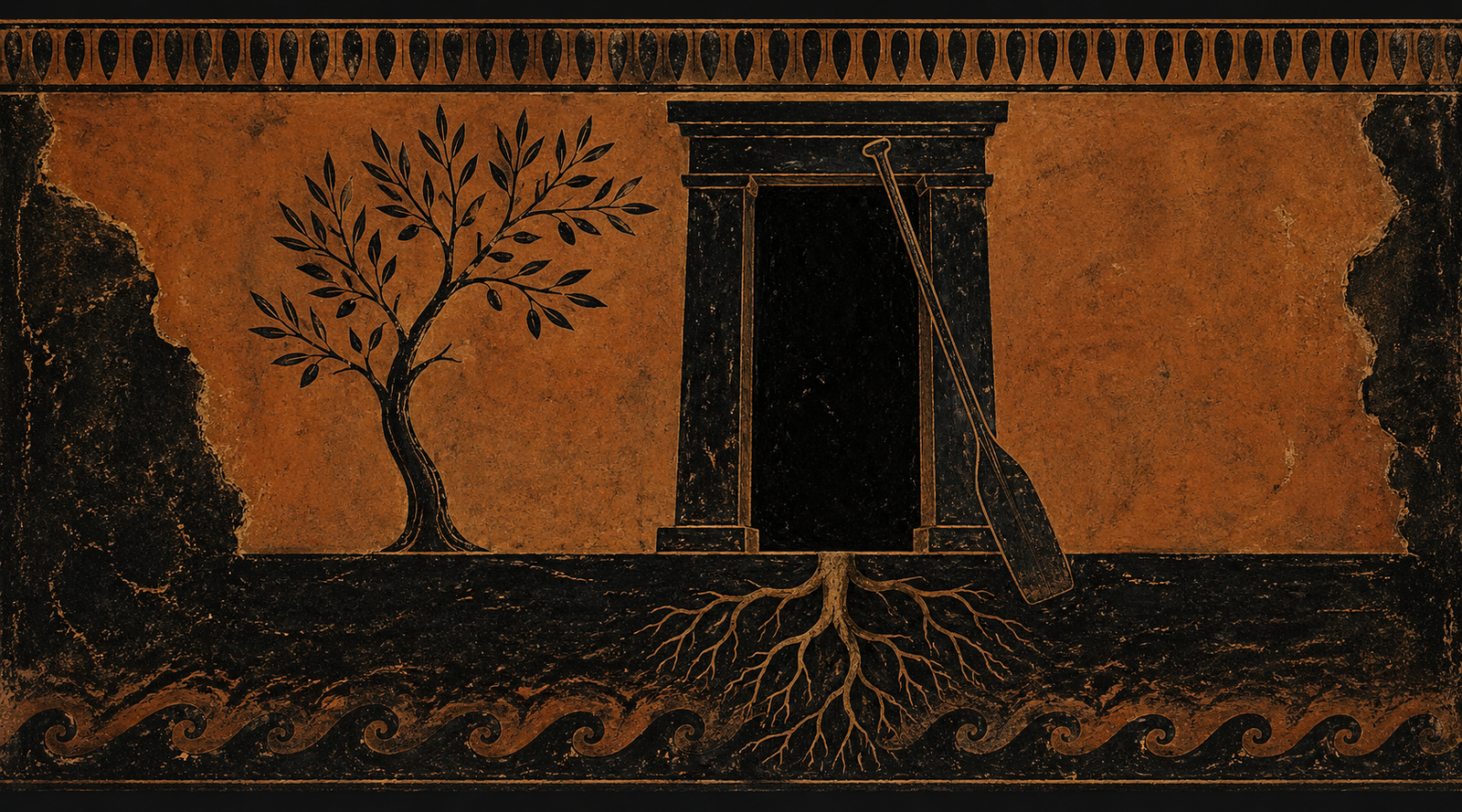

No Man Comes Home VI — The Oar That Could Not Belong
Tiresias gives Odysseus a prophecy stranger than the sea: carry an oar inland until it is no longer understood.
The oar had known water all its life.
That was the first thing.
Before prophecy touched it, before a dead man gave it a future stranger than any sea-road, before it was lifted from shipboard use into the burden of omen, it had belonged to hands, benches, rhythm, salt. It knew the pull of men rowing under command. It knew storm-light, harbour-shadow, the dull ache of repetition, the creak of wood against wood, the moment when many bodies become one motion because survival has narrowed them into obedience.
An oar is not an emblem to the man who rows.
It is labour.
It is the long bone of passage.
Odysseus had carried many things from Troy: scars, stratagems, losses, names of the dead, habits of command, the memory of cities made breakable by cunning. But the oar belonged to another order. It was not spoil. It was not glory. It had no song of its own. It did not dazzle. It did not ask to be hung in a hall.
It moved men across what would otherwise drown them.
That was enough.
Yet in the mouth of Tiresias, the oar became destiny.
The dead man spoke in the dark beneath the world, where every word had already passed through loss and therefore came without ornament. He told Odysseus what remained to be suffered: the cattle of the Sun, the anger of gods, the ruin of companions, the late return, the house in disorder, the men consuming his goods, the reckoning, the bed, the wife, the violence required before rest could even be imagined.
Then, after home, another journey.
That was the cruelty.
A man may endure the sea by believing that land will end it. Tiresias denied him that mercy. Even after Ithaca, even after the suitors, even after the bow and the bed and the old father’s tears, there would be one more road. Odysseus must take an oar and walk inland until he came among people who did not know the sea. People who had never salted food, never heard oars strike water, never seen ships with red cheeks drawn up on shore, never watched a sail fill like a lung under divine or mortal breath.
He must walk until someone met him and mistook the oar for a winnowing fan.
Then he would know.
Not home.
Not peace.
A sign.
The oar would have to become unrecognisable before the sea would release him.
This was the prophecy’s wound.
Odysseus listened among the dead and did not yet understand how far inland a man may have to carry what saved him.
The underworld was full of voices, but the oar was silent.
Objects often are, until their hour arrives.
He had gone below seeking a road home. He received instead a map of return’s insufficiency. The dead gave him more knowledge than comfort. They always do. Comfort belongs to the living, who still have time to make lies useful. The dead have shed usefulness. Their truths stand without hands to soften them.
The oar entered him there.
Not as wood.
As future weight.
For a while, the prophecy could remain prophecy. Men are skilled at leaving certain knowledge unused until it becomes unavoidable. There were still seas to cross, monsters to survive, companions to govern badly or well, hunger to restrain, songs to endure, storms to meet, disguises to enter, a house to reach. The inland road could wait beyond the impossible.
But waiting does not make a thing less certain.
It only gives it more time to darken.
The oar remained where oars remain: among men, in vessels, beneath hands, near water. It did its work without being strange. It entered the sea and left it. Entered and left. Entered and left. Nothing in its motion declared that one day it would be carried where its meaning failed.
That is how fate often moves.
Inside ordinary use.
No man looks at the tool in his hand and sees the burden it may become after the story has supposedly ended.
Odysseus did not love oars.
Men do not usually love what repeats their survival into soreness. They curse them, grip them, lean over them, sleep beside them, repair them, throw them down when land appears, take them up again when land proves temporary. Yet the oar knew him in a way no crown could know him. It had received his command through the bodies of others. It had carried his voice into motion. When he said row, the oars answered through men’s backs.
It knew the shape of his authority.
It also knew the cost.
An oar counts differently from a king. It does not count victories or names or justified losses. It counts strokes. It knows fatigue as number. It knows who faltered first, whose hands bled, whose breath roughened, who bent lower when danger rose behind the ship. It knows the difference between rowing towards home and rowing away from the consequences of a name shouted too soon.
It knows that command becomes rhythm in other bodies.
Perhaps this is why the prophecy chose it.
Not sword.
Not sceptre.
Not bow.
Oar.
The thing by which a leader’s will becomes labour in men who may never share his knowledge.
There are instruments of glory, and there are instruments of continuation.
The oar belonged to the second kind.
In the tale Odysseus told the Phaeacians, the oar did not yet stand at the centre. It waited beneath other marvels. Cyclops, goddess, dead, singing women, whirlpool, cattle, storm. Men listening to a tale prefer the things with teeth and voices. They remember the monster, the bed of the goddess, the blood trench, the song, the lightning. They do not remember the wood that carried the living from one danger to the next.
But the oar remembered.
It remembered the bag of winds opened within sight of home, and the terrible backwardness of almost-arrival becoming loss again. It remembered Circe’s island, where oars rested useless while bodies forgot their human form, and departure, when it came, was only another release into danger.
Above all, it remembered the Laestrygonians.
There harbour itself became trap. Ships drawn together for safety were made easy for destruction. Boulders fell. Water broke under falling stone. Men who had survived Troy vanished in the place where refuge should have held them. The fleet was reduced not by battle, nor by courage answered with courage, but by geography misunderstood too late.
It remembered the few who rowed away.
It remembered that survival often belongs not to the bravest, but to the vessel not anchored where doom can reach it.
Always departure after delay.
Always fewer hands.
The oar knew this about Odysseus: he was a man repeatedly released into continuation. Not peace. Continuation. Every island gave him a reason to stop or die or forget, and still some remnant of him returned to the instrument of passage.
That constancy might be called heroic.
It might also be called inability.
There are men who cannot cease because ceasing would require them to meet what motion has postponed.
The oar knew the difference less clearly than the sea did.
Wood is patient.
Water is not.
After the underworld, the prophecy travelled with him like a second shadow. He had seen his mother and learned that grief could die without losing its claim. He had heard Achilles prefer labouring life to lordship among the dead. He had watched the famous diminished by the plain condition of being no longer able to act. He had asked for home and been given, beyond home, the inland road.
That road had no sea on it.
This made it terrible.
Odysseus was not afraid of water in the manner of ordinary men. He feared it, yes, but as one fears a god whose moods one has survived often enough to recognise. The sea had grammar. Wind, cloud, swell, bird-flight, colour, smell, current, pressure in the joints, sound against hull. None of it guaranteed mercy. But it could be read.
Inland had another alphabet.
Dust. Furrow. Grain. Men whose hands knew ploughs, not ropes. Women shaking seed from husks. Children who might have seen rain but never foam. Old men for whom the word ship would be a story, not a shape. People to whom the oar would not be oar.
A thing wholly itself in one world may become absurd in another.
This was the humiliation awaiting the object.
And the man.
For what was Odysseus without the sea?
The question should not be answered quickly.
He was son of Laertes. Husband of Penelope. Father of Telemachus. King of Ithaca. Sacker of cities. Favourite and trial of Athena. Hated by Poseidon. Speaker of lies that preserved truth and truths that endangered all who heard them. He was many things.
Yet the sea had made those things move.
Without it, they stood exposed.
To carry an oar inland would be to carry the sign of a life into a country where that life could not explain itself. It would be to become a man translated poorly by the world he entered. It would be to discover whether identity survives the loss of the element that has kept it legible.
The oar would go first.
That was fitting.
A man may believe himself known by his own name, but often it is the objects around him that instruct others how to see him. Crown, cloak, sword, scar, bed, cup, dog, ship, oar. Remove the object from its proper world, and recognition begins to fail.
A winnowing fan.
The phrase waited with a strange patience.
Not a weapon.
Not a mast.
Not a sacred staff.
Not the rib of a ship.
Not the long arm by which men beat roads into water.
A winnowing fan.
An implement for grain. For harvest. For separating what can nourish from what must be blown away. The inland stranger would see not passage, but threshing. Not sea-labour, but earth-labour. Not danger crossed, but food prepared. The mistake would not be foolish. It would be faithful to another life.
That was the terror of it.
The oar would not be misunderstood by ignorance alone.
It would be understood correctly by a world in which Odysseus’s meaning had no authority.
He would have to accept the correction.
Perhaps that was why sacrifice followed.
Tiresias had said he must plant the oar there and make offerings to Poseidon. Ram, bull, boar. The god of the sea must be honoured where the sea was unknown. The anger that had followed the name from the Cyclops’ shore would have to be answered beyond the reach of waves.
This was not appeasement only.
It was translation.
Carry the sea-sign into earth-country. Let it be mistaken. Plant it. Give blood. Teach the inland ground that the sea has also had its claim on you. Teach the sea-god that your life is no longer only motion upon his element.
Then return again.
Even the inland road did not end the returning.
After planting the oar, after sacrifice, after the god’s anger had been turned or completed or named differently, Odysseus must go home once more. To Ithaca. To Penelope. To a death that would come from the sea or away from the sea, depending on how words are heard and which tradition a man trusts. A gentle death, perhaps, in old age, among a people prosperous around him.
The prophecy offered quiet.
It did not offer innocence.
No old age can remove what continuation has required.
The oar’s future lay beyond the twelve cantos and inside them.
That is the manner of certain objects. They appear once and cast shadow both ways. The bed waits from the beginning though it stands revealed only at the end. The bow hangs in silence until force must prove itself. The scar remains under skin until an old woman’s hand discovers what speech has withheld. The oar, too, waits: not for recognition, but for misrecognition.
It is the strangest of the witnesses because it must cease being understood before it completes its work.
The Phaeacians did not know this when they listened.
How could they?
They were people of ships. Their vessels moved like thought. They had no need to drag oars into symbolic exile. For them, passage was almost effortless, as if the sea respected their long intimacy and answered before being fully asked. To such people, an oar belonged exactly where it belonged. In the ship. Near the harbour. Under hands trained by water.
Odysseus knew more.
Or had been told more.
The story he was telling them carried a future they could not measure. They would take him home, and their ship would pay for it. Poseidon’s anger did not end with the Cyclops’ prayer. It travelled through all who made return possible. Even the generous become implicated when they help a cursed man cross the sea.
That, too, the oar knew.
A passage is never carried by one body only.
The rowers of the Phaeacian ship would not know the whole cost of what they did. Perhaps no rower ever does. They would bend to their work under a command that seemed honourable. They would carry the stranger home. They would leave him sleeping on Ithaca’s shore among gifts and then turn back towards their own land, thinking the work complete.
The sea would remember otherwise.
Command, hospitality, passage, concealment: none of these ends where human intention says it ends.
The oar is the instrument of that truth.
Still, before all later punishments, before inland prophecy, before the planting among strangers, before the final softening of Poseidon’s wrath, there was the simple object itself. Wood shaped to meet water. A blade for pulling against the element that resists and bears. A handle made for hands. A thing humble enough to be multiplied, necessary enough to disappear into use.
Odysseus would carry it alone one day.
That is the image.
Not the captain at the mast.
Not the king with bow in hand.
Not the beggar at the threshold.
Not the husband beside the bed.
The man walking inland with an oar over his shoulder.
A ridiculous figure, if seen without prophecy.
A sacred figure, if seen with it.
A man bearing the sign of the life that will not release him into a country where the sign has no power.
No army around him.
No companions at the benches.
No song to make the labour splendid.
No island bright with danger.
No goddess calling from a cave.
No monster to define him by opposition.
No suitors to make violence look like justice.
No wife testing him at the edge of truth.
Only road.
Dust.
Weight.
Wood.
And somewhere ahead, a stranger innocent enough to complete the omen.
What makes an object belong?
Use, perhaps.
Recognition, perhaps.
The hand that made it, the element that answers it, the labour it repeats until the body no longer distinguishes tool from rhythm. The oar belonged to the sea because the sea knew what to do with it. Men belonged to it when they bent under its demand. Ships belonged because they needed its stroke. Even Odysseus belonged to it insofar as he remained a man of passage, danger, command, and return delayed.
But prophecy loosened belonging.
It took the oar from use and made it question.
A question can travel farther than a tool.
When the inland stranger mistakes it, the oar will not have failed. It will have arrived. Its purpose will be completed by becoming other in another man’s eyes. The very misrecognition will prove that Odysseus has crossed beyond the world that made him.
That is the road no ship can take.
The sea can bring a man to shore.
It cannot teach him how to stand where the sea is meaningless.
For that, he must walk.
For that, he must carry the oar until it is no longer an oar.
Then plant it.
Then leave it.
This may be the hardest labour of all: not to survive with the instrument, not to command through it, not to cross by it, but to abandon it upright in foreign earth once its final meaning has been spent.
The object must stay where it does not belong.
So that the man may try to.
Perhaps that is what the dead meant.
Perhaps not.
Prophecy is not explanation. It is an image placed ahead of time. Men live towards it, darkly, thinking they are making choices until they arrive at the object that has been waiting to interpret them.
Odysseus had not yet walked that road.
In the Phaeacian hall, he was still telling what had happened before the final inward meaning of the oar could claim him. The listeners heard of islands and losses, of gods and monsters, of wit surviving force. They did not yet hear the silence after home, when the man who has returned must leave again carrying the tool by which return kept failing and becoming possible.
But the oar was already there.
Inside the prophecy.
Inside the ships.
Inside the hands of men who obeyed.
Inside the future body of the king walking away from the sea with the sea’s long memory across his shoulder.
The oar had known water all its life.
It would finish by teaching Odysseus the cost of land.
—
No Man Comes Home is a twelve-canto literary retelling of The Odyssey within The House of Cadmus: a poem of return, concealment, recognition, and the cost of surviving long enough to come home.
—
Receive the next work
Subscribe free to receive new work from the House of Cadmus Library by email.
More from the Library

See Also
A concise and impartial dictionary of absence, promises, quarrels, ordinary objects, and the troublesome instability of words.

The City of Service
The temple we inherit is a building from which almost all necessity has been removed. Nothing must be brought for it to continue being what we call a temple. The sanctuary asks nothing of us. Stone is good at this kind of independence.
A living temple was otherwise.
Water had to come in. So did grain, cloth, oil, aromatic substances, fuel. The things required for worship arrived because someone carried them across a threshold.

Houses of Wood, Light, and Smoke
Some of Angkor’s most intimate ruins do not rise above the ground at all. They are postholes, low mounds, hearths and ponds: durable traces of a domestic city built largely from things that decay. To restore that city is to see Angkor not only as stone, but as wood, smoke, water, repair, and people living within calling distance.