
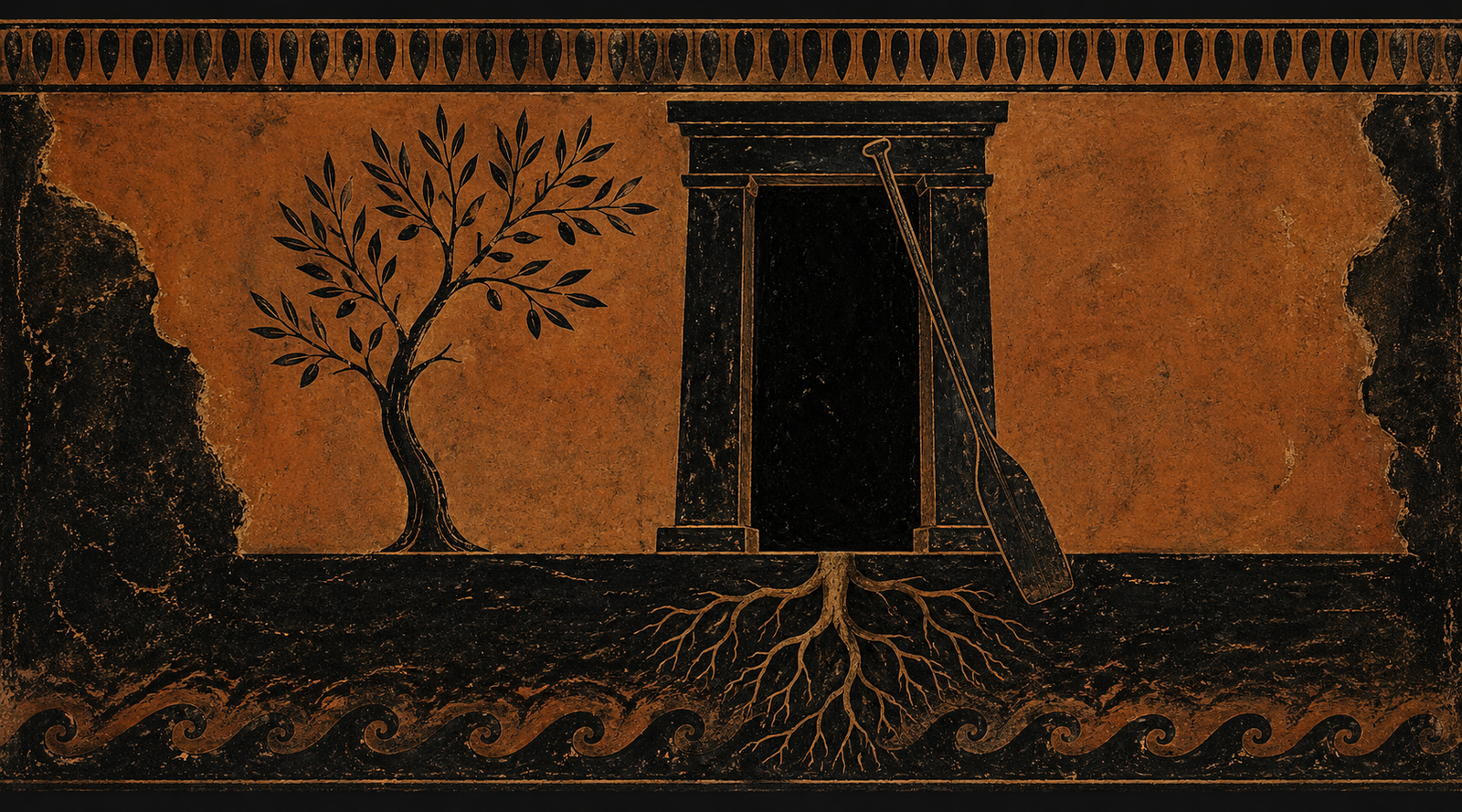

No Man Comes Home XI — The Woman Who Waited Without Waiting
Penelope refuses the easy ending and tests the returned man where fame, violence, and public proof cannot follow.
The nurse climbed the stairs with blood below her feet.
That is where joy found her.
Not in a clean house. Not after purification. Not when the dead had been carried out and the floor washed and the doors opened to the harmless light of ordinary morning. Joy came too early, as joy often does after violence, unable to wait for the world to be made worthy of it.
Eurycleia had seen the hall.
She had seen enough.
The suitors lay where appetite had ended. The bow had answered. The beggar had become the master. Telemachus stood beside him altered past boyhood. Faithful men breathed in the room where faithlessness had lost its voice. The house, which had spent years under unlawful noise, now held a silence too large to be called peace.
She went upward carrying the news.
Her old body climbed quickly because recognition had made it young in one place and terrible in another. She had known him by the scar. She had held the truth in her mouth and not released it. She had been commanded to silence by the child she had once washed. Now the hour had opened. Now speech, withheld until it burned, could become proclamation.
Penelope slept.
Not deeply perhaps.
Women under siege do not sleep as the safe sleep. They rest near waking, as houses rest near fire. Even dreams in such a woman learn caution. Yet Athena had given some covering, some necessary dark in which the body could be spared what the mind could not have endured while the hall was being remade below.
Eurycleia called to her.
Wake. Rejoice. The man you have longed for has come. Odysseus is here. The suitors are dead.
The words entered the room too violently to be believed.
Penelope did not rise into joy.
That was her wisdom.
A woman who has survived twenty years of false reports does not surrender to the first true one because it is true. Truth, arriving through the same door as lies, must submit to discipline. Hope had been used against her too many times. Stranger after stranger had brought rumours shaped for food, favour, pity, passage, payment, vanity. Even gods do not erase the education of endurance.
She looked at the nurse.
Perhaps with anger.
Perhaps with pity.
Perhaps with the exhaustion of one more demand upon belief.
Do not mock me, she said, or something harder than that. Do not shake my heart awake with madness. The gods may have killed the suitors. Some immortal may have entered the hall and punished their outrage. But Odysseus? No. He is far away. Or dead. Or held under the old refusal of the sea.
The nurse insisted.
The scar, she said.
I know the scar.
That was stronger.
Not enough.
Penelope had not survived by accepting what another woman’s hands had proved. The scar belonged to the body. She had known that body once. But twenty years are not answered by a mark on skin. A scar can prove history. It cannot prove the man history has made.
This is where many would have ended her labour.
The nurse had recognised. The son had recognised. The bow had recognised. The hall had recognised too late. Why should the wife not simply receive what all these proofs had prepared?
Because she was the one who had waited without becoming available to the first shape of return.
Because she knew the house from within its long injury.
Because she had kept Odysseus alive by refusing false completion.
She would not let even the true Odysseus become another false completion.
So she rose.
Not as a woman running to joy.
As a queen descending towards evidence.
Below, the hall had begun its terrible after-work.
Bodies removed. Orders given. The unfaithful called and judged. The air thick with what had happened and what could not be undone. Odysseus had stood in slaughter. Now he must stand in waiting.
This was new.
Men often endure danger more easily than suspense after victory. Battle gives the body purpose. Waiting gives the soul no instrument. The suitors were dead. The son knew him. The faithful knew him. The nurse knew him. The house had begun to turn back towards its master.
Still Penelope had not come.
Or rather, she had not yet arrived inwardly.
Odysseus washed.
The body that had entered as beggar was cleansed of the shape required for judgement. Blood, grime, poverty’s garment, the marks of concealment — these could be set aside. Athena touched him again. Beauty returned, not as youth restored, but as authority made visible. He stood more greatly in the room. The body became legible to those who needed signs.
That, too, Penelope would resist.
She came down.
The room changed.
Not as when the bow sounded. Not as when the first arrow entered the throat of appetite. Not as when the scar rose under the old nurse’s hand. This change was quieter and more dangerous. The hall, which had just witnessed force, now entered the jurisdiction of a woman who had survived by not yielding jurisdiction.
Penelope stood apart.
She looked at him.
No one spoke well into that silence.
Telemachus, young still, could not bear it. He had already accepted the father. He had seen the body revealed. He had stood beside him in violence. His own life had been rearranged by recognition and command in a single day. To him, his mother’s stillness seemed cruelty, perhaps coldness, perhaps womanly delay past decency.
He rebuked her.
Or nearly did.
Mother, he said, your heart is hard. Here is the man. Here is my father. No woman would sit apart from a husband returned after such suffering. No woman would withhold herself so.
He was wrong in the way young men are often wrong after surviving the first ordeal: they mistake the violence they have endured for knowledge of all other forms of endurance.
Penelope heard him.
She did not answer as a wounded mother. She answered from somewhere older than his impatience. My child, she said, my heart is bewildered. I cannot speak to him. I cannot ask. I cannot look fully. If this is truly Odysseus, we two have signs between us which others do not know.
Signs.
Not display.
Not public proof.
Not the scar the nurse had touched.
Not the bow the suitors had failed.
Not the son’s need.
Not the goddess’s favour.
Signs between us.
Odysseus heard.
Perhaps he smiled.
Not with amusement. With recognition of the adversary who was also wife. He understood then, if he had not already, that the final threshold would not be forced by slaughter, nor opened by beauty, nor crossed by proclamation. The woman before him was not another hall to be taken. She was the one who had kept the inner door.
He told Telemachus to leave her.
Let your mother test me.
A lesser man might have been insulted.
Odysseus was not lesser.
He had tested every house by entering it hidden. Now the house, through Penelope, would test him in return.
Yet even he did not fully know the form the test would take.
That mattered.
For once, concealment did not belong to him.
After the necessary arrangements, after the noise made to hide the slaughter from the island, after song and dancing were commanded so that passers-by might think a wedding had occurred rather than judgement, after appearances were set like guards around truth, the hall became smaller around husband and wife.
The dead suitors had not yet become public fact.
The living marriage had not yet become private truth.
Between these two concealments, Penelope moved.
She did not rush to him.
She sat across from him, near the fire perhaps, within sight and not within surrender. She studied the face that had been given back by gods, sea, time, violence, and rumour. She looked for the man and found signs of too many men: beggar, stranger, king, killer, old lord, sea-worn survivor, the remembered husband under layers no memory had prepared her to read.
This is the difficulty of long fidelity.
It preserves the beloved by refusing substitutes.
Then the beloved returns as someone no fidelity imagined fully.
Odysseus spoke first perhaps.
Or she did.
The order matters less than the distance.
He named the years. He named suffering. He named gods. He may have spoken with impatience, because even endurance has pride in it. He may have asked whether her heart was iron. He may have felt, beneath longing, the old anger of a man whose last proof has not been accepted after every other proof has cost blood.
This, too, should not be softened.
Odysseus had waited to be known.
Penelope had survived by not knowing too soon.
Their virtues opposed each other in the room.
She listened.
Then she turned to the nurse.
Bring out the bed for him, she said. Place it outside the bridal chamber. Let him rest there.
The sentence entered the room quietly.
It was almost nothing.
That was its power.
No accusation. No cry. No challenge named as challenge. A practical instruction. A woman arranging sleep for a man not yet received. A bed to be moved.
Odysseus broke.
Not into tears.
Into truth.
There are places where speech can no longer remain strategic because an object has been touched too deeply. The bed was not furniture. It was the secret architecture of the marriage. He had made it himself from the living olive rooted in the ground. Around that rooted trunk he had built the chamber. One post could not be moved unless a man cut through what made the room itself true.
Who moved my bed?
His anger rose with the old force.
Not because of property.
Because the impossible had been spoken as if it were ordinary.
He described it then. The tree. The root. The shaping. The chamber built around it. The labour known to no one but himself, Penelope, and one old servant. He spoke not as bard, not as beggar, not as captain arranging danger, not as king judging men, but as the man who had once made a place where two lives could be joined to something living and immovable.
The bed answered.
Not aloud.
Objects seldom need voice when they have been rightly made.
Penelope knew.
The test had reached the place no impostor could occupy. Not the body’s scar. Not the public bow. Not fame. Not beauty restored by a goddess. The secret of the bed required memory, craft, marriage, and the rooted world beneath the house. It was not proof that he had returned unchanged.
It was proof that the man before her had once entered the deepest truth of their life together.
That was enough.
Not everything.
Enough.
Penelope’s strength left its post.
She went to him.
The movement should not be made small by calling it yielding. She did not surrender. She arrived where the test had allowed arrival. The woman who had held the house by refusing false completion now completed the refusal by accepting the true sign.
She wept.
He held her.
Or she held him.
After twenty years, such distinctions fail.
They were not young. They were not restored to the first night. They were not purified of all that had happened in absence. But the room that had stood inside her like a sealed chamber opened enough for breath to enter.
He had come through storm.
She had come through waiting.
Both had been altered by the forms of survival that kept them from being destroyed.
This is why the embrace could not be simple.
The house did not vanish.
Blood remained below.
The son remained changed.
The servants waited under judgement.
Laertes still grieved apart.
The families of the dead would rise with morning.
The gods had not finished making use of them.
But for that hour, the bed’s truth stood between them and the devouring incompleteness of all other proofs.
Athena lengthened the night.
Not to erase time.
To give it room.
The goddess who had driven action now protected duration. This was mercy of another kind. Not rescue from danger, not strategy, not disguise, not courage placed in the young, not beauty restored to the ruined body. Time. A widening of night around two people whose recognition had arrived too late for haste.
They spoke.
At last.
Not everything. No life can empty twenty years into one night without breaking the vessel that receives it. But enough to begin. He told of storm, island, goddess, cave, dead, song, loss, ship, shore, swineherd, son. Perhaps he told it differently here than in the Phaeacian hall. He did not need to make himself famous. He did not need to win passage. He did not need to charm kings. He did not need to arrange glory around danger.
Yet even here, he could not be wholly transparent.
The habit of concealment does not leave because love has opened its arms.
Penelope told of the house. Of the suitors. Of the loom. Of days woven and nights undone. Of Telemachus growing inside a wound. Of rumours endured and refused. Of men who made appetite sound like impatience. Of loneliness governed so long it had become almost indistinguishable from rule.
Perhaps she did not tell everything either.
Waiting has its concealments too.
There are griefs a woman does not offer immediately even to the man for whom they were suffered.
So they spoke beside the rooted bed, each telling enough to make a bridge, each keeping back what could not yet bear crossing. This was not failure. It was the beginning of recognisability after too much survival.
Outside the chamber, the night held its stretched breath.
Inside, the old tree remained what it had always been: not symbol first, but wood, root, post, proof, labour made domestic. The living thing around which the room had been built had outlasted war, absence, appetite, false courtship, concealment, and slaughter. It had not moved.
That was the answer Penelope required.
Not because immobility is peace.
Because something must remain rooted if two altered people are to begin again.
Before dawn, Odysseus remembered the prophecy.
Even then.
The bed had answered the marriage, and already another road stood beyond it. Tiresias had told him: after the suitors, after Penelope, after the acts that would seem to complete return, he must carry an oar inland until its meaning failed. The knowledge entered the chamber like a draft under the door.
He told her.
He had to.
The wife who had tested the bed could not be spared the road beyond it. To conceal that would be to begin the restored marriage by making it another strategy. So he spoke of the inland journey, the oar, the stranger who would mistake it, the sacrifice to Poseidon, the death that might come later, gently perhaps, from the sea or away from it.
Penelope listened.
There are women who receive prophecies after all other burdens and do not cry out because the soul has learned where sound is useless.
She had waited twenty years for his return.
Now return itself contained departure.
This was not surprise.
Only the old wound changing shape.
Perhaps she touched the bed then.
Perhaps not.
The room knew.
The long night moved towards morning despite the goddess’s kindness.
All mercy ends somewhere.
They slept, if sleep came, not as the innocent sleep, and not as those who have solved the world. They slept near one another with the dark around them and the rooted proof beneath them, while the house below held death and the island beyond prepared consequence.
Penelope had not been conquered by recognition.
She had required it to descend into the one place where fame could not follow and violence could not speak.
There, beside the bed that could not be moved, she received the man.
Not the legend.
Not the beggar.
Not the king fresh from slaughter.
Not the name shouted across water.
The man, as far as any man can be received after twenty years of becoming difficult to know.
That was her victory.
And his.
Not peace.
Recognition.
—
No Man Comes Home is a twelve-canto literary retelling of The Odyssey within The House of Cadmus: a poem of return, concealment, recognition, and the cost of surviving long enough to come home.
—
Receive the next work
Subscribe free to receive new work from the House of Cadmus Library by email.
More from the Library

See Also
A concise and impartial dictionary of absence, promises, quarrels, ordinary objects, and the troublesome instability of words.

The City of Service
The temple we inherit is a building from which almost all necessity has been removed. Nothing must be brought for it to continue being what we call a temple. The sanctuary asks nothing of us. Stone is good at this kind of independence.
A living temple was otherwise.
Water had to come in. So did grain, cloth, oil, aromatic substances, fuel. The things required for worship arrived because someone carried them across a threshold.

Houses of Wood, Light, and Smoke
Some of Angkor’s most intimate ruins do not rise above the ground at all. They are postholes, low mounds, hearths and ponds: durable traces of a domestic city built largely from things that decay. To restore that city is to see Angkor not only as stone, but as wood, smoke, water, repair, and people living within calling distance.