
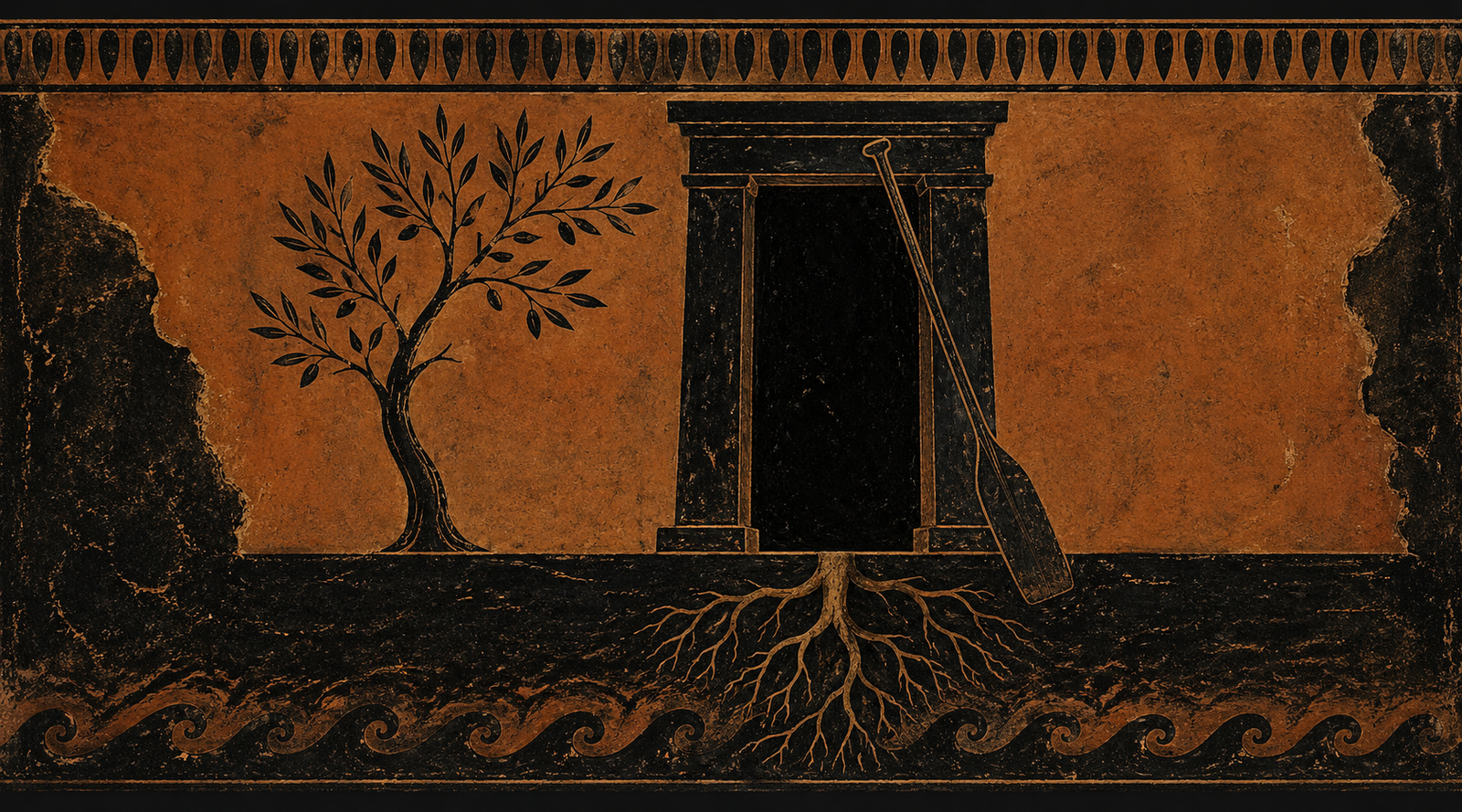

No Man Comes Home XII — The Long Work of Morning
After recognition, vengeance, and reunion, Odysseus must face the harder labour of being known.
Morning came because even gods cannot lengthen night forever.
It entered slowly.
Not as forgiveness. Not as peace. Light has no such authority. It came over the island, over the harbour, over the fields, over the roofs where men and women would soon learn that the old order had returned wearing blood. It came into the palace where the floor had been washed and still remembered. It touched the doors that had been barred, the tables that had been overturned, the bow that had ceased speaking, the bed that had answered what no public proof could answer.
Odysseus woke beside his wife.
That was true.
It was not the whole truth.
Beside him lay Penelope, who had received him only after making recognition descend into the rooted place no impostor could reach. Around them stood the chamber built upon the living olive, the room where marriage had once taken form before war, sea, gods, appetite, and absence entered the house. The bed had not moved.
Everything else had.
The night had given them time, but not innocence. It had allowed speech, embrace, sleep perhaps, tears perhaps, and the first difficult offerings of story. It had not restored the dead. It had not unmade the suitors’ fathers. It had not returned Telemachus to boyhood. It had not removed the inland road from prophecy. It had not taught Odysseus how to be known without first measuring danger.
Morning began the work night could only delay.
He rose.
A husband leaving bed after twenty years should be a tender thing.
This was also strategy.
The world outside the chamber had not accepted him merely because Penelope had. The house had been reclaimed, but the island had not yet borne the knowledge. Men had died. Their kin would gather names around grief and make those names useful. Families do not receive justice as justice when their sons lie dead. They receive loss first. Explanation comes later, if it comes at all.
Odysseus knew this.
He had made widows before.
He dressed.
Not as beggar now.
Not as splendour either.
There is no true garment for the morning after vengeance. A king must appear, but appearance cannot solve what action has done. Cloth may cover the body. It cannot cover consequence.
Penelope watched him perhaps.
Or looked away.
Their recognition had crossed the bed, but recognition is not possession. She had received the man as far as a man may be received after twenty years of becoming difficult to know. Now she had to watch him leave the room again, not for war, not yet for the inland road, but for the unfinished business of return.
This, too, was marriage.
Not the embrace only.
The seeing of what must still be borne.
Telemachus waited.
He had stood beside his father in the hall. He had helped close the doors. He had obeyed through insult, concealment, revelation, and violence. Now the morning found him altered in a way no sleep could soften. There are thresholds a son crosses without movement. He had crossed one in the hut when the father became flesh. He had crossed another in the hall when flesh became command. He stood now where childhood could see him no longer.
Odysseus looked at him.
The son did not ask to be praised.
Perhaps he wanted it.
That is another wound.
A father returned from absence owes more than he can pay. The son has carried the house through shame, sailed for news, returned under threat, received recognition as command, and stood beside the violent restoration of the name. What word could answer this? Well done? My son? You are a man? Such words are small cups for such water.
Odysseus gave orders.
Because that was what the morning required.
The women were shut within. The loyal men were gathered. Eumaeus and Philoetius remained near, no longer merely servants but witnesses who had held the line where rank alone would have failed. Eurycleia moved through the house carrying knowledge that had passed through throat, scar, silence, tears, and proclamation. The unfaithful had been judged. The faithful had not thereby been made whole.
A house after judgement is not clean.
It is only less false.
They went out to Laertes.
That road had been waiting since the underworld.
Odysseus had heard of his father among the dead before he saw him among the living: an old man worn down by grief, lying sometimes in ash and sorrow, having exchanged the authority of the house for the poor kingdom of endurance. Laertes had not been killed by absence. He had been thinned by it. There are fathers who outlive sons in fact and yet live as if bereaved because uncertainty has made mourning permanent.
The orchard held him.
That was fitting.
Old men often return to earth when public life has become too cruel to inhabit. Trees do not ask for explanations. They respond to care, season, pruning, weather, neglect. They grow or fail by laws older than reputation. Laertes had gone among them, carrying the broken continuation of the line in his body.
Odysseus came near and did not immediately reveal himself.
Even now.
Even here.
The habit held.
He saw his father in poor clothing, marked by labour and age, grief set into the body beyond ornament. He saw what absence had done to the man who had given him life and name and land. This should have been enough to break all disguise.
It was not.
Or not at once.
Odysseus tested him.
This is hard to forgive.
It may also be hard to separate from the man who had come home. He had tested strangers, servants, son, wife, hall, bow, scar, bed, and door. Now he tested the father whose sorrow had already proved more than any speech could require. Concealment had become not merely tactic, but posture. A way of approaching love without standing defenceless before it.
So he made another story.
Another stranger. Another distance. Another fiction around the name.
Laertes received the blow of false report as old grief receives new grief: not as surprise, but as deepening. He mourned the son still absent before the son standing near him. Dust and sorrow returned to him. The old body bent under what it believed it had already learned to carry.
Then Odysseus could not continue.
There is a limit even to the man of concealment.
Not always where one hopes.
Not always soon enough.
But somewhere.
He spoke the truth.
Not by the scar first. Not by the bow. Not by the bed. Here another proof was needed. He showed the old wound perhaps, but more than wound he gave the trees: the orchard’s memory, the boyhood gift, the named trees Laertes had once given him when he was small enough to receive land as wonder rather than burden. Pear trees. Fig trees. Olive trees. Vines. The living inventory of a father’s gift to a son.
Laertes knew.
Recognition entered the old man like strength returning by violence.
He embraced him.
Or nearly collapsed into him.
The distinction does not matter.
A father can become childlike before the returned son, and the son can become boy again for one breath before the weight of all he has done returns to his shoulders. They held each other among the trees, where inheritance had once been counted in saplings and names, not blood and consequence.
This recognition was different from Penelope’s.
The bed had tested marriage.
The orchard tested lineage.
A wife knows the secret two lives built inwardly. A father knows what he once placed in the child’s hands before the child became dangerous to history. Laertes did not ask whether Odysseus had returned unchanged. Old fathers know better. He asked, by receiving him, whether the line still had a living body through which grief might stop falling into silence.
For a moment, it did.
Then news moved.
It always does.
No house can keep violence private once morning has entered the island. The dead suitors became sons again in other mouths. Their crimes did not vanish, but neither did their kinship. Fathers and brothers gathered around the names of men who had been arrogant, wasteful, unlawful, and young. Grief does not wait for moral clarity before becoming grief.
This is the civic wound.
A house may be right and still set the island bleeding.
Odysseus had reclaimed his roof. Ithaca now had to absorb the cost of reclamation. The suitors had not come from nowhere. They belonged to households, fields, mothers, old men, alliances, resentments, debts, public memory. Their deaths would not remain inside the hall. They would enter speech. Speech would seek shape. Shape would seek blame. Blame, if given men and weapons, becomes another morning.
The families came.
Not as monsters.
That must be remembered.
They came as those who had lost, and loss is dangerous because it feels righteous before it has asked what it is defending. Some among them knew the suitors’ guilt. Some did not care. Some cared and came anyway because blood is a fierce argument. Some followed stronger voices because grief prefers company. Some perhaps feared what a restored Odysseus meant for all who had profited from his absence.
At their head stood a father whose son had died first.
He spoke for the dead.
Not truly.
The dead do not always choose their speakers.
But he stood where grief required a mouth.
Against him stood the restored house: Odysseus, Telemachus, Laertes newly awakened into the old fire, faithful men, the name returned, the violence not yet cooled. Three generations stood under one danger. Grandfather, father, son. The line gathered at the edge of further blood.
This, too, was return.
Not only bed.
Not only embrace.
The threatened repetition of violence because justice, once enacted privately, must answer publicly.
Laertes lifted himself beyond age.
Athena strengthened him, or memory did, or the old rage of a father who has just received his son and will not see him taken again in the same morning. He cast. A man fell. The civic wound opened wider before it could close.
So it would have continued.
Men are skilled at making consequence breed consequence.
Then Athena intervened.
Not because mortals had become wise.
Because they had not.
Peace, when imposed by gods, is not the same as reconciliation. It is a hand placed on the blade before the hand holding it has learned mercy. The goddess cried out, and the island heard more than sound. Fear entered the bodies of men who had mistaken grief for licence. Weapons lowered. The old compulsion halted.
Zeus sent a sign.
Thunder perhaps.
The sky’s answer to the earth’s inability to stop.
Odysseus surged forward still.
That matters.
Even after bed, after wife, after father, after proof, after violence, after warning, the man remained capable of continuing into blood. Athena had to restrain him. The returned king was not magically cured of continuation. The body that had survived by pressing on did not immediately know how to cease.
The goddess checked him.
He obeyed.
Or was made to.
There are obediences too mingled with force to flatter the obedient.
Thus peace came to Ithaca.
Call it peace, because that is the public word.
But public words are often roofs placed over unfinished rooms.
The feud did not flower into slaughter. The houses of the dead were held back from becoming houses of further dead. The king remained. The son remained. The old father remained. The island was not torn apart that day.
That was no small mercy.
It was not wholeness.
A settlement can stop hands without cleansing memory. The suitors’ names would not vanish. Their crimes would be remembered differently in different houses. Odysseus’s justice would be called justice by some, excess by others, necessity by those near the hall, outrage by those near the graves. Penelope would remain the woman who waited. Telemachus the son who stood beside his father. Laertes the old root that flared before dying down again. Eumaeus and the faithful would carry honour altered by blood. Eurycleia would remember the scar under her fingers and the hand at her throat.
Every witness would keep a different Ithaca.
That is how return becomes history.
Not one truth replacing all others.
Many truths forced to live under one roof.
The day moved.
The house received them again.
It did not feel as it had in memory. No house does after being recovered by violence. The rooms were the same and not the same. Thresholds that had once endured unlawful sandals now bore the passage of men who knew what had happened there. Tables could be set again, but they would not become innocent because bread returned. The floor could be washed, but the house had learned too much to become merely clean.
Penelope moved through it.
Not as before.
There was no before to which she could return.
The loom waited perhaps, but its old labour was done. She no longer needed to undo the day in darkness. Yet habit does not disappear because necessity has ended. Her hands, which had preserved time by reversing it, now had to learn the harder work of allowing days to stand.
That is also a kind of courage.
Telemachus moved through it too.
The house that had diminished him now contained his father. The shame had lost its throne, but not every mark it had made. He would have to learn who he was in the presence of the man whose absence had shaped him and whose return had conscripted him. A son does not become free because the father comes home. He becomes answerable to a new reality.
That work had barely begun.
Odysseus moved through it most strangely of all.
He had entered every room first as a beggar, then as judge. Now he had to enter them as a man living among those who had seen both. The hall knew him. The servants knew him. The son knew him. The wife knew him as far as love and proof had allowed. The island knew him as king, killer, survivor, curse-bearer, restored lord. None of these knowledges cancelled the others.
To be known in many ways is not the same as being whole.
Perhaps he stood at the door of the chamber before entering.
Perhaps he paused where Argos had lain.
Perhaps he touched the bow.
Perhaps he only asked for water, or sat, or looked towards the fields, because men do not always move according to the images that would make them legible to later tellers.
Ordinary sound after violence can feel like prophecy.
A jar set down.
A footstep.
A servant breathing.
Wind at the door.
Evening came.
The first evening after return.
No bard could make it simple. The island had been restrained. The house had been reclaimed. The wife had received him. The father had held him. The son had stood beside him. The dead remained dead. The prophecy remained ahead. Somewhere inland, though no road had yet been taken, a stranger who did not know the sea waited inside time to mistake an oar for a winnowing fan.
Return had not ended return.
It had changed its labour.
Odysseus knew this.
Penelope knew enough.
When they came together again in the chamber, it was not the same as the night before. The first recognition had passed. The test had been answered. The prophecy had been spoken. The morning had shown them what remained outside the bed’s truth: father, son, island, graves, gods, unsettled speech, future road.
The bed had known him.
That was not the same as peace.
Penelope lay beside the man the olive tree had proved, and still the house listened. Outside, the night held its breath around the doors. The suitors were dead. The servants had been judged. The bow had gone silent. The scar had done its work. The secret had answered the secret.
Yet no proof can make twenty years unhappen.
No door opens backwards.
Odysseus had come home by hiding, and now the house required him to be known. Not named. Not praised. Not obeyed. Known.
This was the labour no ship had taught him.
Beside him, Penelope did not sleep quickly.
Neither did he.
Between them stood no wall.
Only the dark.
Only the long work of morning.
—
No Man Comes Home is a twelve-canto literary retelling of The Odyssey within The House of Cadmus: a poem of return, concealment, recognition, and the cost of surviving long enough to come home.
—
Receive the next work
Subscribe free to receive new work from the House of Cadmus Library by email.
More from the Library


See Also
A concise and impartial dictionary of absence, promises, quarrels, ordinary objects, and the troublesome instability of words.

The City of Service
The temple we inherit is a building from which almost all necessity has been removed. Nothing must be brought for it to continue being what we call a temple. The sanctuary asks nothing of us. Stone is good at this kind of independence.
A living temple was otherwise.
Water had to come in. So did grain, cloth, oil, aromatic substances, fuel. The things required for worship arrived because someone carried them across a threshold.

Houses of Wood, Light, and Smoke
Some of Angkor’s most intimate ruins do not rise above the ground at all. They are postholes, low mounds, hearths and ponds: durable traces of a domestic city built largely from things that decay. To restore that city is to see Angkor not only as stone, but as wood, smoke, water, repair, and people living within calling distance.