

Philemon and Baucis — The Two Trees
A tale of poverty, hospitality, and a marriage made visible at last
By the time the strangers came to their door, Philemon and Baucis had been poor for so long that poverty had ceased to feel like an event in their lives and had become, instead, the shape of their attention.
They knew the worth of each thing in the house because each thing remained with them long enough to be known. The stool by the hearth had one leg that liked to wander if it was not set properly on the packed earth. The bronze pot had been mended twice, and held its heat better now than when it was new. The roof kept out the rain in most places if the thatch was laid right before the heavy weather. The olives in the jar had to last. The wine, which had long ago given up any claim to strength, was better for admitting it. Nothing in the room was grand enough to be taken for granted.
They lived in Phrygia, in a district where the land was neither generous nor wholly unkind, but answered a man in proportion to the patience he brought to it. Their cottage stood low and plain among other low and plain dwellings, with reeds in the roof and smoke that could never quite be persuaded to leave by the same route twice. They had not built it in youth; they had merely come to it young enough to think that the greater part of life still lay ahead, and then remained in it until the walls knew the shape of their days.
This is how many marriages become invisible to the world: not by lacking devotion, but by practising it so steadily that it ceases to look remarkable from the outside.
Philemon rose first most mornings, though not by much. Baucis would hear the slight disturbances by which a person who has reached old age negotiates with the day — the care not to knock the stool, the small sound of breath drawn differently when the joints objected, the low cough he thought too familiar to mention. By the time she sat up, he would have coaxed the embers into usefulness and set water to warm. He was not a man of swift movements. She had once told him, without malice, that he did everything as though the gods had asked him to leave room for an amendment. He had laughed at that, because it was nearly true.
That morning was like the others in all the ways that matter most when one is about to lose it. The room held its poor order. Light came modestly to the threshold. Baucis cut cabbage on the board worn smooth at the centre by years of use. Philemon stood for a moment beneath the hanging scrap of smoked pork, judging by eye how much could be spared without becoming foolish. They spoke little, and what they said would not have seemed worth preserving to anyone who had not understood that most love is carried in remarks too small for memory.
“Not that piece,” Baucis said, without looking round.
He withdrew his hand. “I had not taken it.”
“You were considering it.”
“I was considering whether you would object.”
“I do.”
“So noted.”
There are houses in which such speech means irritation. In houses that have endured, it often means the opposite.
By midday the road had become hot, and the district had already done what it would later be punished for. Again and again the strangers had come to doors and again and again those doors had remained closed, or opened only far enough to refuse. A world does not collapse all at once into hardness. It practises first, with smaller occasions.
Philemon saw them before Baucis did: two travellers, dusty from the road, clothed without distinction, bearing nothing that declared them notable except the fact that they had kept walking long after welcome ought to have been found.
He stood in the doorway, one hand against the frame.
“Have we room?” he asked, not because the answer was uncertain, but because in a good house such questions are forms of honour.
Baucis looked past him, then round the room as though measuring it against the weather, the hour, and the obligations of mortal life.
“We have a bench,” she said. “And enough left to divide, if no one pretends it is more than it is.”
That was how they welcomed them. Not grandly. Carefully.
The strangers stooped beneath the low lintel and entered the small room where the day had already spent half its provisions. Philemon brought the bench nearer the fire. Baucis laid a cloth over it that was cleaner on one side than the other and chose the better side without comment. She set water for the guests to wash their feet. Philemon apologised for the narrowness of the house, though not in a tone that begged pardon for its existence. The travellers answered with a civility that would have suited a greater place.
If the pair were unusual, it was not yet in any way that demanded fear. One seemed quieter, with the watchfulness of a man accustomed to attendance without requiring it. The other had in him something quicker, a look as though the world’s surfaces interested him chiefly for how readily they might be crossed. But the road puts many expressions upon a face, and old people are not in the habit of mythologising a guest before they have fed him.
Baucis moved through the room with the accuracy of a person who had done a thing so often that thrift itself had become a kind of grace. Olives were set out. Radishes. A little cheese. Eggs raked warm from the ashes. The cabbage was dressed. The pork, in the end, was cut thinner than Philemon would have chosen and thicker than Baucis had meant to allow. Bread that had gone a little hard was softened near the heat. Wine was watered, which improved neither its character nor its honesty, but lengthened its life, and in poor houses one asks different virtues of a drink.
All this took time. That matters. Hospitality is not a sentiment that descends complete upon the heart. It is a series of acts by which one rearranges one’s limited world to admit another person into it.
When the meal was set, Baucis looked at it once, as though to assure herself that nothing had been forgotten except abundance. Philemon, seeing the same table, found it almost handsome.
The strangers ate with gratitude. Not the exaggerated gratitude of those who mean to flatter the poor for receiving what they themselves would not have accepted elsewhere, but the sort that lets bread remain bread and still honours the hand that offers it.
It was Baucis who first noticed the bowl.
She had poured the wine sparingly, with the precision of someone who knows that a vessel empties faster in company, and had looked away only for a moment to shift the platter nearer the guests. When her hand returned to the jug, she saw that the bowl was full again.
She did not speak. Age teaches caution before astonishment.
She poured once more. She watched the level fall. She turned to reach the olives. When she looked back, the wine stood where it had stood before, not abundant, not overflowing, but restored.
“Philemon,” she said, and even then she said it quietly, because some truths do not become less true for being shouted.
He came to her side. They stood together before the table and saw what poor people are not given to seeing: a vessel that denied arithmetic.
There are miracles that arrive with thunder and compel belief by force. This one came as an affront to household knowledge. That made it, in its way, more terrible.
Baucis drew breath. Philemon’s face altered not into fear exactly, but into the expression of a man who has just discovered that his guest has been enduring his apology with more patience than was required. They stepped back from the table. Then, as one who had practised life together long enough to know how to begin, they bent their heads and raised their hands in prayer.
They asked pardon for the poverty of the meal. They asked pardon for the narrowness of the house. They asked pardon for not having known.
One of the travellers told them to be at peace.
His voice was unchanged and yet no longer fitted the room in the same way.
Then Philemon, who had recovered himself only enough to become practical again, said that they must at least offer something worthy of such guests now that the truth was plain. There was a goose in the yard, lean, quarrelsome, and more useful alive than dead, but all the more suitable for sacrifice because of it. He went for it with the determination of a man who knows he is already late in honouring what should have been honoured sooner. Baucis followed. The goose, who had never possessed any theology but had an instinctive distrust of human urgency, fled between their legs, round the stool, beneath the bench, and, in the confusion, made for the strangers themselves as though choosing the strongest sanctuary available.
Had the moment been told poorly, it would become charming. It was not charming. It was the plain sight of two old people, ashamed of insufficiency, trying to turn their last good living thing into reverence.
The strangers stopped them. The creature was spared. Then the greater truth was spoken.
The whole district, they said, had failed. The land around them had shut its doors against divinity in need. Judgment would come. But the old couple, because they had received the stranger when they had little to give, were to climb the hillside with their guests and look back from safety.
Baucis looked once round the room before she went. That, too, matters. A person may be ready to obey the gods and still feel the pull of the place where life has been lived. The stool remained where it had been nudged aside. The knife lay on the board. The cloth on the bench had not been straightened. Nothing in the cottage knew yet that it was already part of the past.
Then they followed.
The path rose behind the settlement in broken turns through dry earth and stone. Philemon climbed carefully. Baucis did not waste breath. The strangers went before them without difficulty, as though roads were never quite as steep for those who were not bound to mortal weight. By the time they reached the height appointed for witness, the old couple were breathing hard enough to feel their hearts in the throat.
“Now,” said the god who had first spoken.
They turned.
From that distance the district looked, for one suspended instant, almost gentle. Rooflines. Paths. The slight geometry of enclosures. Fields already poor before any curse had touched them. Then the water moved through it.
It came not like weather but like verdict.
The lower ground vanished first. Yards, walls, thresholds, all the small demarcations by which human beings persuade themselves that their portion of earth can be secured, were taken under. The water went where doors had not opened. It took the roads that had carried the unreceived gods from house to house. It rose over the dwellings that had preferred the safety of refusal. The whole region dissolved into one widening, indifferent sheet.
Baucis made no cry. Philemon’s mouth opened, but there was no word in it fit for the scale of what they saw.
Only one thing remained.
Where their own cottage had stood, there was no ruin. The low roof had lifted. The poor walls had lengthened and whitened. The reeds were gone. Columns stood in place of timber. Steps shone where the threshold had been packed earth. What had been a humble house, hardly worth a traveller’s notice from the road, had become a temple with marble gleaming in the light and gold at the roofline where thatch had once taken rain.
Favour does not prevent an ending from being an ending.
The gods told them to ask a gift.
Philemon did not answer at once. This was not because he doubted the goodness of the offer, but because wishes made in the presence of power have a way of revealing what one has loved all along. He turned to Baucis. She met his look. They did not need the long conference younger people imagine necessary before grave decisions. Most of it had been lived already.
When he spoke, he asked for two things only: that they might serve as guardians of the shrine that had arisen from their house, and that neither might live to bury the other.
The request was granted.
So the years continued, altered but not wholly broken from what had been before. They served the temple raised where their poverty had once stood. They kept its order as they had kept the order of the cottage: attentively, without grandeur, understanding that reverence is often only care made steady. Visitors came. Offerings were brought. The place acquired a name beyond the valley. Yet one imagines — and the imagination need not be false for being gentle — that Baucis still disliked waste, that Philemon still moved a stool with his foot before sitting, that the habits by which two people remain themselves did not vanish merely because marble had replaced mud-plaster.
At last there came a day, as there must in every tale that speaks truly about age, when the body began to lay down its offices one by one.
They were standing before the temple, speaking together in the ordinary way of those who have outlived the need to make every speech memorable, when Philemon saw bark gathering upon Baucis’ limbs. At the same moment she saw leaves beginning along his arms. The change was not violent. It moved through them with the grave certainty of something long prepared.
“Farewell, dear husband,” said Baucis.
“Farewell, dear wife,” said Philemon.
Then wood took what remained of voice.
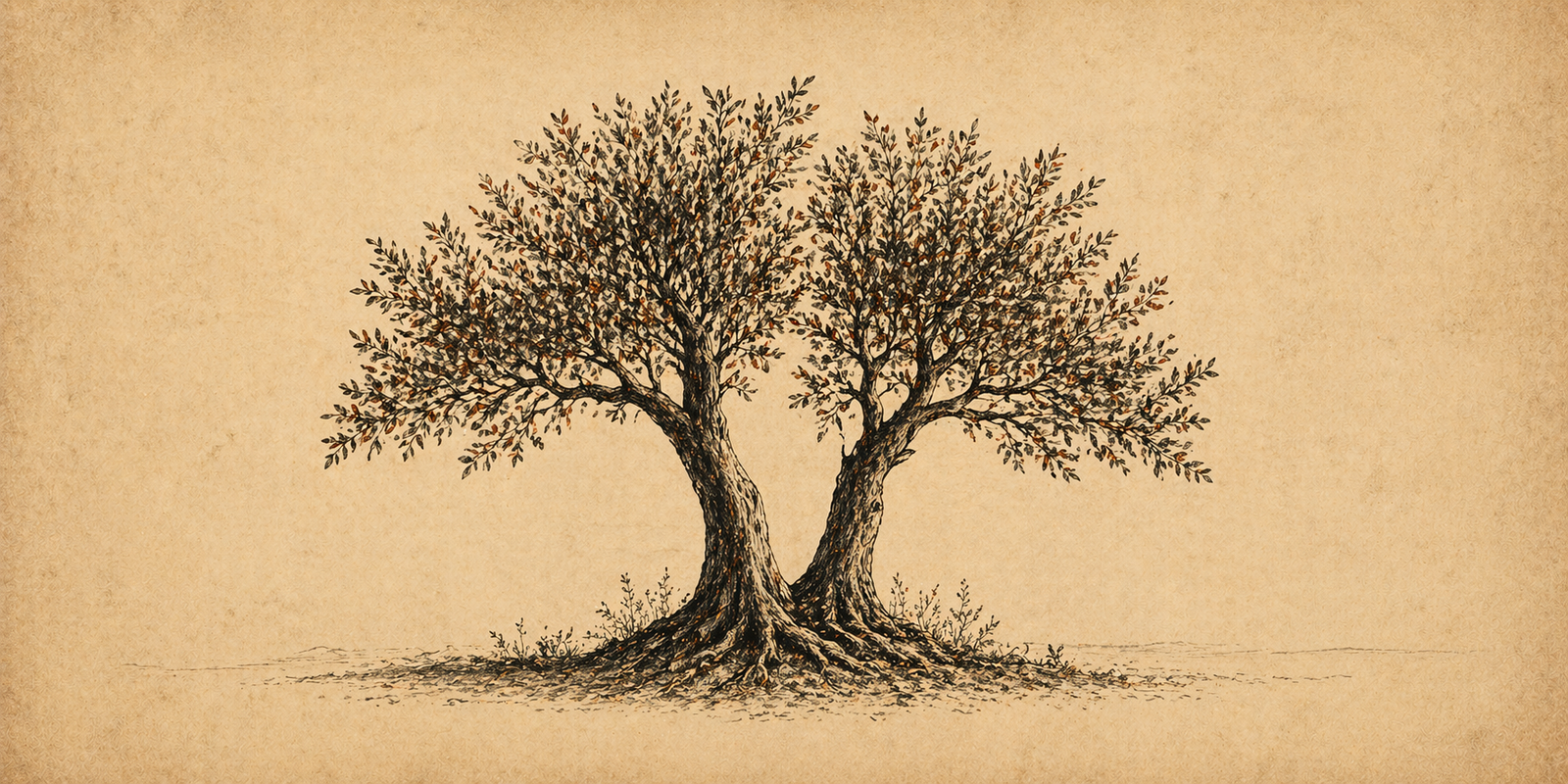
Branches rose. Roots entered the earth where feet had stood. Trunk thickened beside trunk until it was difficult to say where one ended and the other began. One became oak. The other lime. They grew from a single rooted base, side by side, not hurried together by force, but joined in the visible form of what their lives had already made true.
That is the image the tale is written toward, and it asks little from the narrator except discipline.
Not reward, exactly, and not consolation. Something quieter, and perhaps more difficult, is present here.
They had lived so long beside one another, and so exactly within the limits given them, that when the world was required to show what they had been, it could only make of them one enduring life in two forms.
And in those parts, it is said, the trees still stand.
—
Receive the next work
Subscribe free to receive new work from the The Hospitable Dark Library by email.
More from the Library


See Also
A concise and impartial dictionary of absence, promises, quarrels, ordinary objects, and the troublesome instability of words.

The City of Service
The temple we inherit is a building from which almost all necessity has been removed. Nothing must be brought for it to continue being what we call a temple. The sanctuary asks nothing of us. Stone is good at this kind of independence.
A living temple was otherwise.
Water had to come in. So did grain, cloth, oil, aromatic substances, fuel. The things required for worship arrived because someone carried them across a threshold.

Houses of Wood, Light, and Smoke
Some of Angkor’s most intimate ruins do not rise above the ground at all. They are postholes, low mounds, hearths and ponds: durable traces of a domestic city built largely from things that decay. To restore that city is to see Angkor not only as stone, but as wood, smoke, water, repair, and people living within calling distance.