
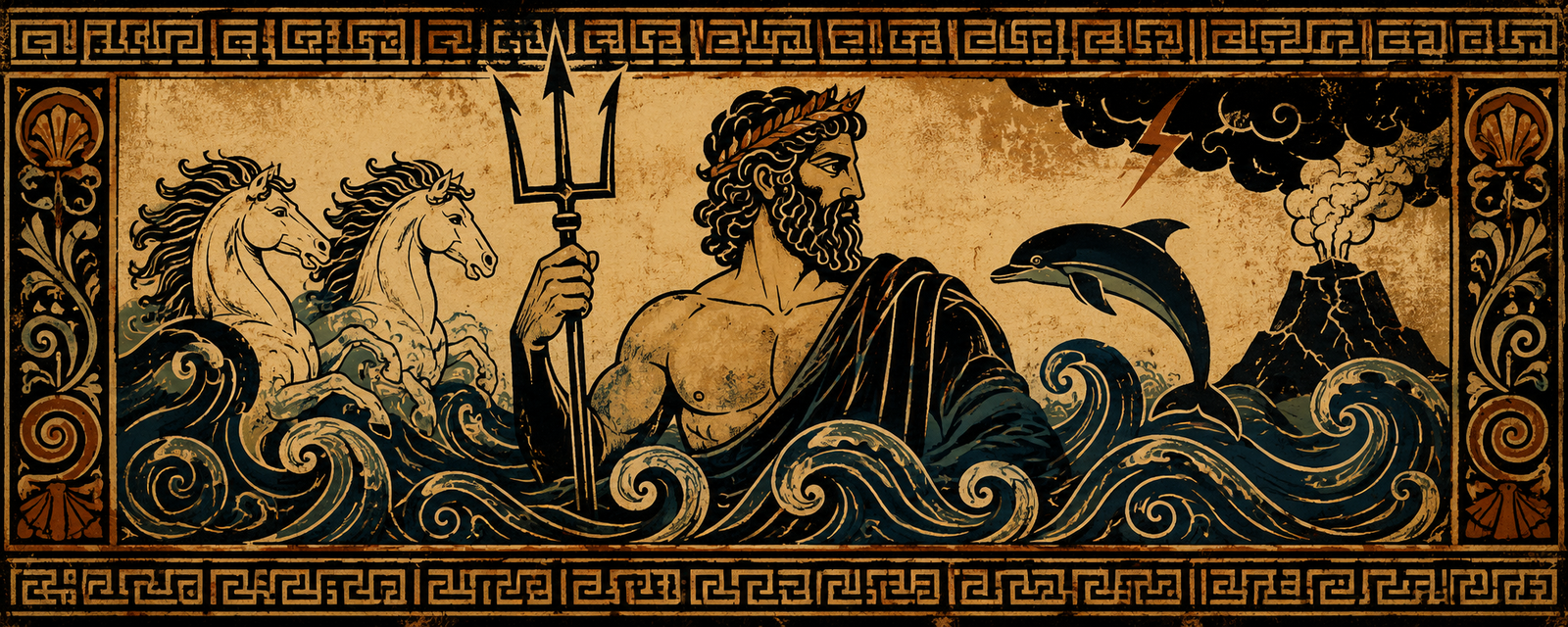

Poseidon: The Sea Is Not Only Water
Before Odysseus enters the Cyclops’ cave, meet the god of the sea, storms, horses, earthquakes, and remembered insults.
Before the Tale
Before Odysseus reaches the cave, before the single eye opens in the dark, before a clever name saves men who have almost run out of hope, there is Poseidon.
You may think the sea is only water.
In Greek myth, this is a dangerous mistake.
The sea has moods. It has roads no one can see. It has voices under its waves and sudden walls of foam. It can carry a ship gently for days, then break it apart because one god has remembered an insult.
To sail on the sea is not simply to travel.
It is to cross Poseidon’s kingdom.
And Poseidon was not a god who enjoyed being laughed at.
The Short Answer
Poseidon is the Greek god of the sea, storms, horses, earthquakes, and sudden, terrible force.
He is one of the great Olympian gods. His brothers are Zeus, who rules the sky, and Hades, who rules the Underworld. Poseidon rules the sea — which, for the Greeks, meant nearly everything between one dangerous shore and the next.
He carries a trident, a three-pronged spear. With it, he can stir waves, split rock, raise storms, shake the earth, and remind mortals that the world beneath their feet is not as firm as they like to think.
Poseidon is powerful, proud, and difficult to appease.
This is useful to know before meeting Odysseus.
Odysseus is clever.
Poseidon is not easily forgiven.
What You Need to Know Before the Story
The Greeks lived close to the sea.
Their cities stood beside harbours, islands, straits, cliffs, beaches, and trading routes. A person might need the sea for fish, travel, war, trade, news, rescue, or return. The sea could make a family wealthy. It could carry a father home.
It could also take everything.
That is why Poseidon matters so much. He is not a small god of waves and shells. He is the power of the sea itself: the dark water under the ship, the storm beyond the headland, the prayer in a sailor’s mouth when the sky lowers and the oars begin to feel useless.
He is sometimes shown with horses, too.
This may seem strange until you remember how the sea moves: white-maned, rushing, stamping, foaming, impossible to hold. In some stories, Poseidon creates horses or gives them to mortals. In others, he drives his chariot over the waves.
He is also called the Earth-Shaker.
That name is not decoration.
The Greeks believed earthquakes belonged to him. The ground itself could tremble under his anger. A city might think it was safe behind walls; Poseidon could remind it that stone also has fear inside it.
So Poseidon is not only the god of water.
He is the god of force beneath surfaces.
The calm sea may be holding a storm.
The quiet earth may be holding a shudder.
The smiling god may be holding a grudge.
What Kind of Help or Trouble He Brings
Poseidon can help sailors, heroes, kings, and cities. He can send fair winds, strong horses, and safe passage. He can make a voyage possible.
But Poseidon’s help is not soft help.
Like many Greek gods, he expects honour. He expects offerings. He expects mortals to remember who is greater. He does not enjoy being cheated, mocked, tricked, or ignored.
This matters because Greek heroes often survive by doing impossible things. They outwit monsters. They slip past death. They speak cleverly. They hide. They lie. They win by nerve, patience, and invention.
The problem is that cleverness may save you from one danger and create another.
A hero may escape a cave.
A god may hear about it later.
That is one of the great rules of Greek myth: victory is not always the end of trouble. Sometimes victory is the moment when a larger power turns its head.
Poseidon is especially dangerous because his anger can follow a person across the sea. A king on land may shut his gates. A monster may be left behind in the dark.
But the sea is everywhere between home and hope.
A man who has offended Poseidon cannot simply walk away.
He must sail.
Family and Connections
Poseidon is the son of Cronus and Rhea. That makes him one of the first generation of Olympian gods, alongside Zeus, Hades, Hera, Demeter, and Hestia.
When the great powers of the world were divided, Zeus received the sky, Hades received the Underworld, and Poseidon received the sea.
This does not mean Poseidon is weak beside Zeus. Zeus is king of the gods, but Poseidon is still one of the mightiest beings in Greek myth. Even Zeus must take him seriously.
Poseidon’s wife is Amphitrite, a sea goddess. Around him are sea-nymphs, dolphins, horses, storms, sea creatures, monsters, and strange children.
Some of his children are noble.
Some are dangerous.
Some are both, which is often how things go in Greek myth.
In the story you are about to read, one of the beings Odysseus meets belongs very much to Poseidon’s world.
Remember that.
A cave can be escaped.
A father’s anger may be harder.
Signs and Symbols
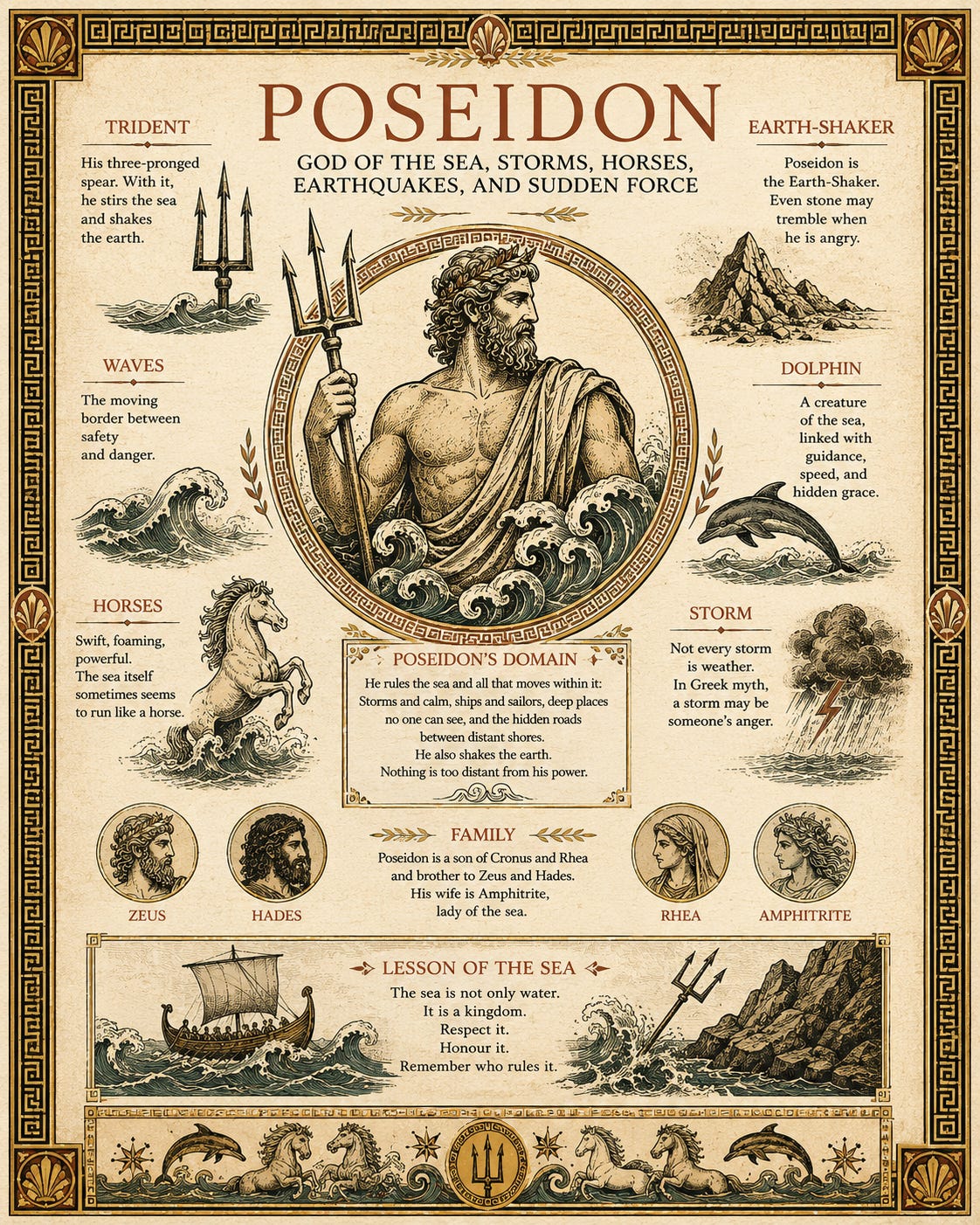
You can usually recognise Poseidon by these signs:
TRIDENT
His three-pronged spear.
With it, he stirs the sea
and shakes the earth.
WAVES
The moving border
between safety
and danger.
HORSES
Swift, foaming, powerful.
The sea itself sometimes seems
to run like a horse.
EARTHQUAKE
Poseidon is the Earth-Shaker.
Even stone may tremble
when he is angry.
DOLPHIN
A creature of the sea,
linked with guidance, speed,
and hidden grace.
STORM
Not every storm is weather.
In Greek myth, a storm
may be someone’s anger.
Signs to Watch For
When you read Odysseus in the Cave of the Cyclops, watch for the sea even when the story is not yet on the sea.
Watch the shore.
Watch the cave.
Watch what kind of creature lives there.
Watch how Odysseus survives.
Most of all, watch what happens after cleverness wins.
Odysseus is one of the most intelligent heroes in Greek myth. He can plan, wait, persuade, invent, disguise, and lie when lying is the only door left open. These gifts save him again and again.
But cleverness has a danger of its own.
A clever man may begin to enjoy being clever.
He may want his enemy to know who defeated him.
He may forget that some names are safer when they remain hidden.
And on Poseidon’s sea, a name can travel.
Why This Matters in the Tales
Poseidon matters because Odysseus in the Cave of the Cyclops is not only a story about escaping a monster.
It is a story about what happens after escape.
The cave is terrible, but it is not the whole trouble. The Cyclops is frightening, but he is not the greatest power in the world. The sea outside the cave is wider than the cave itself, and the god of that sea is listening.
This is one reason Greek myths feel larger than ordinary adventure stories. A hero may solve the problem in front of him and still awaken the problem behind it. He may do the right thing and still pay for the proud thing. He may deserve to live and still have to learn how costly survival can become.
Odysseus will need courage.
He will need patience.
He will need a plan.
But once Poseidon is involved, he will need something harder than cleverness.
He will need endurance.
One Thing to Remember
Poseidon is the god of the sea — and in Greek myth, the sea remembers.
—
Receive the next work
Subscribe free to receive new work from the The Alexander Series Library by email.
More from the Library


See Also
A concise and impartial dictionary of absence, promises, quarrels, ordinary objects, and the troublesome instability of words.

The City of Service
The temple we inherit is a building from which almost all necessity has been removed. Nothing must be brought for it to continue being what we call a temple. The sanctuary asks nothing of us. Stone is good at this kind of independence.
A living temple was otherwise.
Water had to come in. So did grain, cloth, oil, aromatic substances, fuel. The things required for worship arrived because someone carried them across a threshold.

Houses of Wood, Light, and Smoke
Some of Angkor’s most intimate ruins do not rise above the ground at all. They are postholes, low mounds, hearths and ponds: durable traces of a domestic city built largely from things that decay. To restore that city is to see Angkor not only as stone, but as wood, smoke, water, repair, and people living within calling distance.