
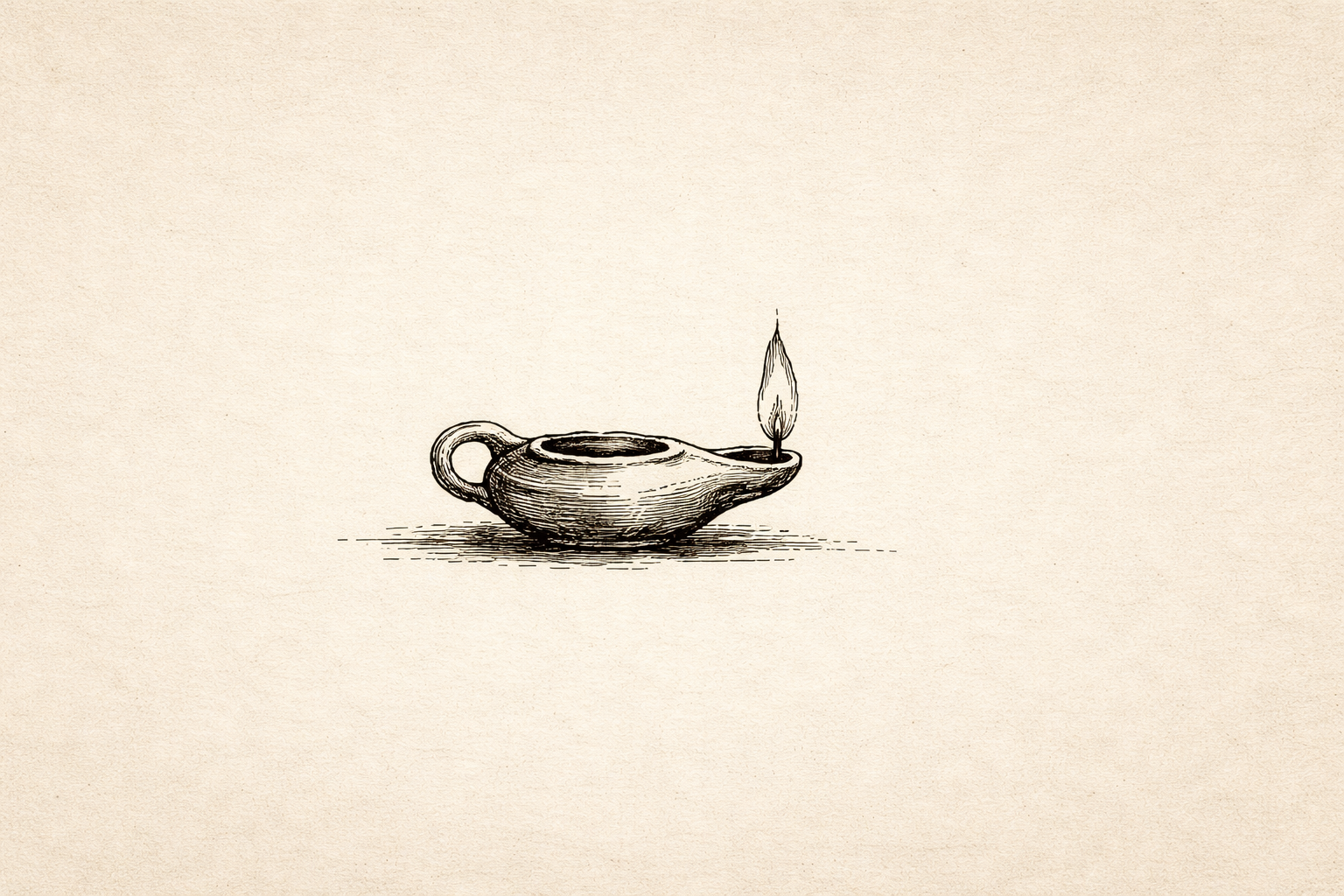

Fires of the Old World VIII — The Bow That Waited
In Mithila, where lamps are trimmed and vows outlast kings, a bow sleeps in its iron case, waiting for the hand that can lift it without violence. This is the old story of Sita’s garland, Rama’s strength, and the moment when force fails before rightness.
—
“What is meant for the true hand does not answer to force.”
In the city of Mithila, when the evening lamps were being trimmed and the scent of sesame oil moved softly through the halls, old nurses would draw the children near and speak of the day the great bow was brought into the court. Outside, peacocks called from the dark gardens. Inside, the stone floors still held the cool of morning. Each listening face was lit on one side and given to shadow on the other.
For that bow had slept longer than any king.
It lay in the house of Janaka like a storm set down and bound. Eight-wheeled carts had groaned beneath it. Iron chains had bitten the lid of its case. Men who could lift ox-yokes with one hand had strained only to shift it an inch. When at last the chest was opened, the air itself seemed to draw back. The wood was dark as rain-soaked earth. Its curve kept the hush of something once held in the hands of a god, and not yet forgotten by them.
Janaka had spoken his vow before princes, priests, and wandering kings. His daughter would be given only to the man who could raise that bow and set string to horn.
Many came.
They came jewelled, perfumed, acclaimed. They came with lion belts and polished arms. They came smiling the smiles of men too long answered by the world.
The bow did not move for them.
One prince bent over it until a vein stood in his brow like blue thread under skin. Another planted his feet so hard his heel-rings cracked against the stone. A third lifted one end a finger’s breadth, then let it fall and turned away wearing the quick smile by which shame first enters the mouth. Their bracelets clashed. Their breath roughened. The court murmured. Above them, behind the carved stone of the women’s gallery, Sita stood with her hand against the lattice, feeling its cool pattern press her palm.
She had seen the bow before.
As a child she had passed the chamber where it was kept and felt the small hairs rise along her arms. From weight. The thing gathered silence around itself, as a deep well gathers coolness. She knew her father’s vow. She knew too the speech of men who believed strength alone was enough to command the world. Yet whenever she looked upon the bow she did not think of conquest. She thought of waiting.
The days of contest filled the court and emptied it again. Boasts arrived bright as parrots and fell as husks. Janaka’s mouth grew lined. Priests bent together over omens. Some began to murmur that the king had vowed too much, or that no mortal was meant to claim the daughter born of furrow and blessing. The garlands in the hall crisped first at the edges. Dust settled on sandalwood chests. Even the musicians touched their strings more sparingly, as though the whole court had become a room in which something unsaid was listening.
Then the sage came.
Vishvamitra entered like a wind that had already crossed mountains. Beside him walked two young men in bark-cloth and simple ornaments, carrying bows of their own as travellers carry staffs. They were plainly princes, yet they wore their rank lightly. One was dark and steady-eyed, with the stillness of deep water under shade. The other moved like a flame carried carefully in the hand. Janaka rose to honour the sage, and before the murmur in the court had settled Vishvamitra asked, with the ease of a man naming what must follow, that the elder prince be shown the bow.
A stir moved through the court. Some smiled into their sleeves. Some turned openly to measure the youth invited to what seasoned kings had failed to do. In the gallery, Sita’s fingers tightened around the carved stone until the edge left a pale crescent in her skin.
The case was opened.
Chains were drawn back with the grave music of metal on metal. Lamps trembled in their cups. Men stepped aside.
The prince called Rama came forward.
He did not swagger. He did not pause to display the firmness of his wrist or the breadth of his shoulder. He stood before the bow as one stands before a river crossing: attentive, without demand. His gaze travelled its dark curve, the horned tips, the long sleeping body of it. Then he laid one hand upon the wood.
Those nearest later said the hall altered then, though none could say how. The oil flames seemed to lean. A faint scent rose, not of sweat or iron, but of old resin waking under remembered sun. Somewhere beyond the pillars a pigeon beat suddenly upward from the courtyard.
Rama set his feet.
Not wide in challenge. True beneath him.
Then he bent and took the bow in hand.
It rose.
Not with the ugly jerk of seized weight, nor with the straining violence that turns the face into a mask. It rose as though some ancient balance had at last been found. The great body of it came clear of the chest. The watching princes forgot to breathe. The chains slid down and lay in loose coils like shed snakeskins on the floor.
He set one end against his foot and reached for the string.
The fibre was pale and strong, twisted from such matter as only gods and the oldest craftsmen know. It too had waited, coiled beside the bow in its case, untouched by every hand that had not earned it. Rama drew it upward, calm as a man drawing water from a well.
The bow recognised him before the court did.
Then came the sound.
Not the small twang of a hunter’s bow tried at dawn, but a crack like the sky breaking over dry land. The great curve arched, yielded, and in yielding broke. Its middle burst with a thunder that struck the pillars and ran through the stone floor into the roots beneath the palace. Birds rose shrieking from the roof. Horses stamped in their stalls. Children in far chambers clapped hands to their ears and cried out. Several princes were driven back a step by the force of it. One lamp overturned and spilled oil across the floor, where it shone like black water before a servant rushed in with sand.
For a heartbeat, nothing moved.
Half the bow lay in Rama’s hand.
The other half rang once against the stone and was still.
Then the hall found its breath all at once. Voices broke like surf. Some shouted praise. Some stared in silence. Some princes lowered their eyes, the hard pride gone out of their mouths. Janaka stood as though a burden had been lifted not only from his court, but from some inward chamber he had kept locked for years.
Above, in the screened gallery, Sita closed her eyes. Because something within her, patient and unnamed, had recognised its hour. When she opened them again, the dark-clad prince below was laying the broken bow down with care, as one returns a great creature to rest.
Then Janaka called for the garland.
It was brought fresh, white, and heavy with fragrance: jasmine, with folded lotus petals among the blooms. The women of the palace gathered around Sita. They touched her hair, straightened her veil, fastened gold at her wrist. Yet when the garland was placed in her hands, it was not gold she felt first. It was the cool damp thread hidden inside the flowers, and beneath that the fine trembling of her own pulse.
She descended into the court.
All the lamps seemed brighter now, though evening had hardly deepened. The princes stood aside. The sages watched in grave contentment. Lakshmana shone with pride scarcely held in check, like a young horse at the edge of a race. Vishvamitra sat still as a rooted tree.
Sita came before Rama.
For the first time they stood near enough to hear one another’s breath.
He bowed his head. Only enough.
She lifted the garland.
It brushed his throat, settled upon his shoulders, and gave out its fragrance between them. No trumpet could equal the quiet of that moment. A vow had found the body meant to bear it. A long waiting had entered form. The hall, which all day had been full of noise and wanting, seemed at last to rest its weight upon the earth.
Soon the conches sounded. Drums answered. The women’s voices rose sharp and sweet. Servants ran with lamps. Messengers were sent out like arrows towards Ayodhya. Yet when the first bright tumult had passed and Sita turned with her attendants, her knees trembled beneath her. On the stair a fallen petal had been crushed into the stone. Her sandal slipped once. Her hand found the pillar. Then she steadied and went on.
That night Mithila did not sleep early. Musicians sat cross-legged till the moon climbed high. Rice steamed in bronze pots. Ghee hissed over flame. The courtyards smelled of marigold, cardamom, and trampled leaves. In the women’s chambers they spoke softly and laughed softly and wept a little, as women do when joy enters carrying change in its sleeve. In the outer hall the broken halves of the bow lay under watch, immense even in defeat, their snapped heart bright as fresh-cut timber.
And in the nursery, where the lamps had burned low and the youngest children had begun to drift towards sleep, the old nurses would always end here: with the garland settling, and the great bow at last at peace.
Outside, the peacocks had folded their tails. The oil in the cups had sunk to a thin gold line. Cool air moved over the stone and touched each sleeping brow. Hearing how force had failed, and how the waiting bow had yielded only to the rightful hand, the children would draw closer into their quilts and say nothing.
For some stories close with a crown.
This one closed with flowers and broken thunder.
—
And so the tale comes down to us not only as spectacle, but as recognition: a weight long waiting, a vow entering form, flowers settling where thunder has just broken.
—
Receive the next work
Subscribe free to receive new work from the Lucas Varro Library by email.
More from the Library


See Also
A concise and impartial dictionary of absence, promises, quarrels, ordinary objects, and the troublesome instability of words.

The City of Service
The temple we inherit is a building from which almost all necessity has been removed. Nothing must be brought for it to continue being what we call a temple. The sanctuary asks nothing of us. Stone is good at this kind of independence.
A living temple was otherwise.
Water had to come in. So did grain, cloth, oil, aromatic substances, fuel. The things required for worship arrived because someone carried them across a threshold.

Houses of Wood, Light, and Smoke
Some of Angkor’s most intimate ruins do not rise above the ground at all. They are postholes, low mounds, hearths and ponds: durable traces of a domestic city built largely from things that decay. To restore that city is to see Angkor not only as stone, but as wood, smoke, water, repair, and people living within calling distance.