

Fires of the Old World XIII — The Child Like a Secret
A Fires of the Old World telling of Krishna’s birth
The old woman trimmed the lamp with two careful fingers, and the small room filled with sesame oil, warm smoke, and the cool breath of rain.
Outside, the night leaned against the shutters.
The child beside her had been fighting sleep for an hour. His hair smelt of milk and wet leaves. He watched the flame bend, straighten, bend again.
“Tell me one more,” he said.
The old woman smiled without showing her teeth.
“One more, then. But softly. This is a tale from a night when even the gods listened.”
—
In the city of Mathura there was a king named Kamsa, and fear sat beside him like a second throne.
He had heard a voice from the sky on the day his sister rode from her wedding. The voice spoke only once, and its words entered him like cold iron. The eighth child of Devaki would bring his death.
So Kamsa took his sister and her husband, Vasudeva, and shut them behind stone.
He gave them walls instead of a house. He gave them chains instead of garlands. He gave them guards instead of kin.
One child came.
Kamsa counted.
Another came.
Kamsa counted.
The prison learnt the sound of birth, and after birth, silence.
Six times Devaki held life against her breast. Six times the king came down with fear in his hands. The lamps burned low. The chains did not speak. Vasudeva stood near her and could not break the world.
When the seventh child stirred beneath Devaki’s heart, the night changed.
No guard saw it. No chain felt it. No door remembered it.
The child slipped from danger as a flame slips from one wick to another. He was carried by unseen power to Rohini, safe beyond Kamsa’s reach. In the prison Devaki’s womb fell still, and the guards whispered that sorrow had done its work.
Kamsa believed them.
Fear often believes what helps it sleep.
—
In another village, across the river, cows breathed in their stalls and the rain gathered on thatch. Nanda’s house lay in the dark. Yashoda slept with one hand open beside her, as though waiting to receive what the night would place there.
A lamp burned near her bed.
Its flame was small, but it did not die.
—
The eighth child chose midnight.
Clouds covered the moon. The city slept uneasily. In the prison, the stones were wet with the breath of the storm.
Devaki bent over herself, and Vasudeva knelt beside her. They had no cradle. They had no women of the house. They had no song.
Still the child came.
At first the cell brightened.
It was not the light of a lamp. It was not lightning. It rose from the child himself, soft and terrible, until the walls seemed less certain of their own hardness.
For one moment Devaki saw him as the gods know him.
Four-armed, crowned with stillness, bearing the conch, the discus, the mace, and the lotus. His skin held the blue of deep rain. His eyes were calm as the first water before creation moved.
Devaki covered her mouth.
Vasudeva lowered his head until his forehead touched the floor.
Then the splendour folded itself away.
The crown was gone. The weapons were gone. The many arms were gone. In their place lay a newborn child, dark and small, with wet curls against his brow.
He moved one hand.
Devaki began to weep without sound.
“Do not wake him,” said Vasudeva. “The world is listening.”
The words had scarcely left him when the first wonder came.
The chains fell open.
No thunder broke them. No hand struck them. They simply loosened, as though they had remembered they were only iron.
Vasudeva stared at his wrists.
The child slept.
The second wonder came.
The bolts slid back from the prison door. One after another, the doors opened into darkness. The guards lay slumped beside their spears, breathing deep. Their lamps trembled, but none of them woke.
The child slept.
The third wonder came.
In Vasudeva’s heart, where grief had stood like a stone, a command rose clear as river water.
Take him across.
No more was given.
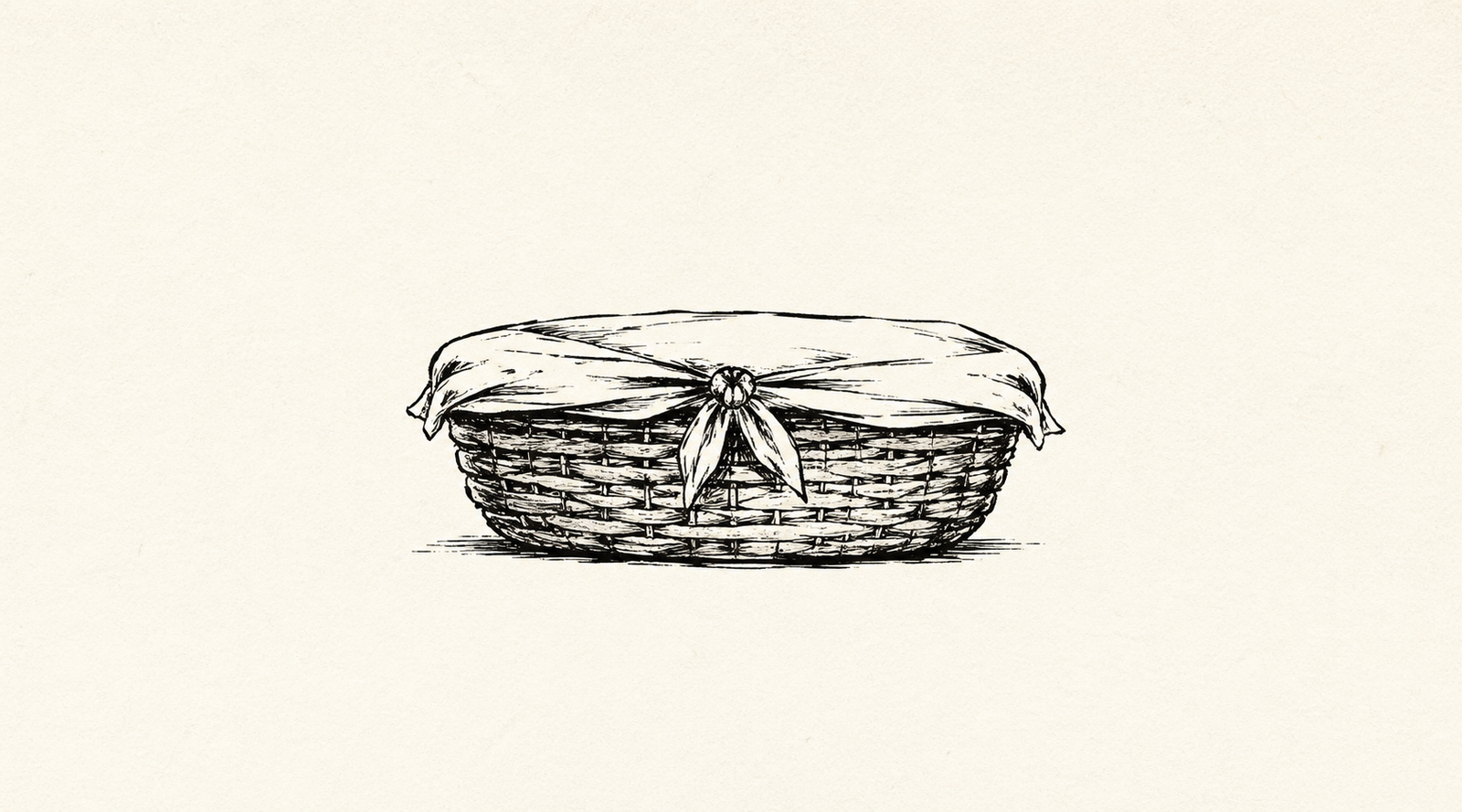
Vasudeva lifted the child and placed him in a basket. He wrapped him in cloth. Devaki touched the small foot once with shaking fingers.
Her lips moved, but no sound came.
Vasudeva looked at her.
There are farewells too deep for speech.
Then he took the basket and walked through the open door.
—
The prison let him pass.
The outer gate let him pass.
The sleeping guards let him pass.
Rain struck his shoulders as he stepped into the night.
Mathura lay dark around him. The streets shone black. Water ran along the stones. Somewhere a dog barked once, then fell silent. Above the roofs, the clouds turned and folded over one another like great animals in sleep.
Vasudeva held the basket high.
The child did not cry.
At the edge of the city the ground softened beneath his feet. Mud took his sandals. Thorn branches scratched his arms. His knees shook, though he had no time to notice it.
He heard the river before he saw it.
The Yamuna was swollen with rain, wide and restless, shouldering through the night. Its banks had vanished. Its water moved like a thing with many backs.
Vasudeva stood before it.
Behind him lay the prison. Before him lay the dark river. Above him the rain fell harder.
He stepped in.
Cold took his ankles.
Then his knees.
Then his waist.
The current pressed against him. Stones rolled under his feet. Once he slipped and caught himself with a sound torn from the body before thought. The basket tilted.
The child slept.
Vasudeva raised him higher.
“Little Lord,” he whispered, though the river took the words, “be lighter than fear.”
The water rose to his chest.
Then to his throat.
Then, as if the river had bent its ear to the basket, the flood lowered.
Not away. Not vanished. Only lowered enough for passage.
Vasudeva took another step.
From the black behind him came a sound like dry leaves over stone.
A coil moved through the rain.
Then another.
Then a vast hood opened above the basket.
Shesha, ancient serpent, rose behind the father and spread himself against the storm. With him came the smell of deep water and cool stone, as though the river had remembered an older river beneath itself. Rain struck his hoods and broke into silver threads. His body moved without haste. His scales held the little light there was.
Vasudeva did not turn.
He felt the shelter. He walked.
The river curled around his thighs. The mud pulled at his feet. His arms burned. His breath came hard through clenched teeth.
The child slept.
So the father crossed with the Lord held over water, and the serpent behind them made a roof out of devotion.
On the far bank, Vasudeva stumbled to his knees.
For one moment the basket lowered.
The child’s foot slipped free of the cloth and brushed the wet earth.
The rain softened.
Vasudeva stood again.
—
In Gokul, the village slept among cattle and warm breath.
No one saw the stranger enter.
The doors of Nanda’s house opened as the prison doors had opened. Inside, the lamp near Yashoda’s bed burned low. Yashoda slept, weary from birth, and beside her lay a newborn girl.
She was small. She was quiet. Her fists were closed as though she held the night in them.
Vasudeva stood between the two children.
Here was the first cradle.
Here was the second.
The boy in the basket breathed softly.
The girl beside Yashoda did not wake.
Vasudeva’s hands trembled.
It is no small thing to carry one child away from danger and another child toward it.
Yet the command that had led him through iron, rain, and river remained. It did not argue. It waited.
He laid the boy beside Yashoda.
The child turned his face toward her breast and slept on.
Then Vasudeva lifted the girl.
She weighed almost nothing.
That was what frightened him.
He wrapped her in the cloth and placed her in the basket. For a moment her eyes opened.
They were dark.
They were awake.
Vasudeva’s breath stopped.
The girl looked at him as though she had known every step before he took it. Then her eyes closed.
Behind him, the boy slept in the house of cowherds.
Vasudeva turned back toward the river.
—
The return was harder.
The rain had entered his bones. His hands had cramped around the basket. Mud held his feet longer now. The river received him again, and the current struck his legs with a colder force.
He nearly fell once.
The basket dipped.
The girl opened her mouth, but no cry came.
Shesha’s hood still sheltered them. The Yamuna still made way. Yet Vasudeva felt the cost of every step. His shoulders shook. His breath cut him. The water slapped his ribs as though trying to wake the whole world.
He reached the Mathura bank before dawn.
The city remained blind.
He passed the outer gate. He passed the sleeping guards. He entered the prison with the girl in his arms.
The doors closed behind him.
The bolts slid back into place.
The chains rose from the floor and fastened themselves again around his wrists.
Devaki looked at the child he carried.
She understood enough. Perhaps too much.
Vasudeva placed the girl beside her.
Then the baby cried.
A small cry.
A mortal cry.
It went through the prison like a struck bell.
The guards woke.
Feet ran in the passage.
Kamsa came down before the cry had faded.
His hair was loose. His eyes were bright with the old fear. He did not look like a king then. He looked like a man who had been running inside his own prophecy for years.
Devaki held the girl to her breast.
“Brother,” she said, and the word itself seemed tired. “This is a daughter. What danger can she be to you?”
Kamsa did not listen.
Fear had made him deaf long ago.
He reached for the child.
Devaki clung once, only once. Vasudeva pulled against his chains until the iron cut his skin. The guards stood still.
Kamsa took the girl.
She was light in his hands.
Too light.
He lifted her.
Then the child slipped from his grasp.
She rose.
Not fell. Rose.
Her little body blazed with a light that was older than his palace and wider than his fear. The prison roof vanished from sight above her. Her limbs shone. Her hair streamed like storm. Around her flashed the weapons no tyrant had given and no tyrant could take.
Kamsa staggered back.
The goddess looked down upon him.
“The one who will end you is born,” she said. “He is elsewhere.”
The word struck harder than thunder.
Elsewhere.
The place Kamsa could not lock.
The room he could not search.
The road his soldiers had not seen.
The breath beyond his counting.
Then she was gone into the night.
The roof was only roof again. The cell was only stone. The guards trembled. Devaki held her empty arms against her body. Vasudeva lowered his head.
Kamsa stood with nothing in his hands.
Far away, in Gokul, the boy slept beside Yashoda.
The cows stirred.
A lamp burned low.
No one in that house knew that the king of Mathura had failed. No one knew that the river had bent, that iron had opened, that a serpent had made a roof in the rain.
The child slept as children sleep after long journeys they cannot remember.
Yashoda turned toward him in her dreams and drew him close.
Outside, the storm passed over the village and went away into the fields.
—
The old woman stopped there.
The lamp between her and the child had burned lower. Its flame was blue at the root and gold at the tip. Rain still touched the shutters, but softly now.
The child’s eyes were almost closed.
“Did the king find him?” he whispered.
The old woman tucked the cloth beneath his chin.
“Not that night.”
“Was the baby afraid?”
She looked at the lamp, then at the small hand curled on the blanket.
“He slept,” she said.
The child smiled a little.
Outside, the dark listened.
Inside, the flame bent once and stood still.
—
Receive the next work
Subscribe free to receive new work from the Lucas Varro Library by email.
More from the Library


See Also
A concise and impartial dictionary of absence, promises, quarrels, ordinary objects, and the troublesome instability of words.

The City of Service
The temple we inherit is a building from which almost all necessity has been removed. Nothing must be brought for it to continue being what we call a temple. The sanctuary asks nothing of us. Stone is good at this kind of independence.
A living temple was otherwise.
Water had to come in. So did grain, cloth, oil, aromatic substances, fuel. The things required for worship arrived because someone carried them across a threshold.

Houses of Wood, Light, and Smoke
Some of Angkor’s most intimate ruins do not rise above the ground at all. They are postholes, low mounds, hearths and ponds: durable traces of a domestic city built largely from things that decay. To restore that city is to see Angkor not only as stone, but as wood, smoke, water, repair, and people living within calling distance.