

The Mercy of an Ending
On Tithonus, mortality, and what remains when an ending is refused.
The horror of Tithonus is not that he grows old.
Growing old still belongs to the human world.
The horror begins because nothing is permitted to follow.
His strength weakens. His body contracts. Memory loosens. Speech becomes difficult. The rooms through which he moves grow fewer. The distance between bed and window becomes enough for a day. All of this would ordinarily belong to a mortal life moving through time.
But Tithonus has been removed from the one condition that would allow those changes eventually to become complete.
He cannot die.
That is the gift.
It is also the wound.
The familiar lesson of the myth is easy enough to state. Eos, goddess of Dawn, loves the mortal Tithonus and asks Zeus to make him immortal. She neglects to ask that he remain eternally young. The wish is granted according to its wording rather than its intention. Tithonus lives for ever and continues to age.
The story can therefore be made into a warning about badly framed desires.
Be careful what you ask for.
Remember the missing clause.
The gods obey exactly.
But this is too small a reading for so terrible a myth.
The forgotten youth explains how the catastrophe occurs. It does not explain why the catastrophe reaches so deeply into us.
For that, we have to ask a harder question.
What is a human life if duration can continue after almost everything by which we recognise a life has been permitted to change?
This is not a question about what makes a life valuable. Age, frailty, dependence, failing memory: none of these cancels personhood or lessens a human being’s claim upon love, dignity or care.
Tithonus is not terrible because he becomes old.
His condition is terrible because ageing has been severed from every possibility of completion.
Everything that can happen within time may still happen to him, but the ordinary boundary of mortal time has been taken away.
Age may proceed.
Loss may proceed.
Change may proceed.
Only completion has been forbidden.
That is what makes the story difficult.
A human life is lived not only through time but within a form of time.
We arrive without having chosen to arrive. We grow into bodies we did not design. We learn, forget, desire, lose, make, inherit, injure, repair, begin again where beginning remains possible. We pass through conditions that do not ask our permission before changing us.
None of this is made meaningful simply because it ends.
Death does not retrospectively sanctify suffering. Finitude does not make every life just. The fact that something is brief does not make it beautiful, and the fact that it ends does not make its ending good.
Yet limit does something that endless duration cannot.
It allows a life to possess shape.
There can be a before and an after because things do not remain indefinitely available. Choices matter because they exclude other choices. Departures become real because return is not guaranteed. Childhood cannot be permanently inhabited. The dead do not ordinarily come back through the door. Time does not offer every possibility for ever.
Mortality is not merely the fact that one day we cease.
It is present much earlier than that.
It is the pressure under which a life becomes particular.
This person.
This body.
These years.
This love rather than another.
This thing done and therefore not undone.
That is the pressure inside Tithonus.
Eos does not ask for something monstrous.
She asks for what love has asked in one form or another since human beings began losing one another.
Do not let him disappear.
There is nothing contemptible in that wish.
To love someone is partly to become unable to imagine the world accepting their absence. The beloved becomes entangled with the furniture of reality. A hand on a table. A voice from another room. A body sleeping beside us. The impossible fact that these ordinary things can simply stop is difficult to hold in the mind.
Eos has one advantage mortals do not.
She can ask the gods to prevent it.
And so she does.
Her mistake is not that she loves Tithonus too much.
It is that love asks permanence from a life whose nature is to change.
She preserves his existence.
She cannot preserve the form in which that existence first became beloved to her.
This does not mean she merely loved his youth. That would make the story easier and considerably poorer. If Eos abandoned him at the first grey hair, Tithonus would become a tale about vanity.
She does not.
She remains.
She touches him.
She helps him rise.
She changes the rooms around him.
She makes the distances smaller.
The tragedy is not that love disappears as he changes.
The tragedy is that love remains while its powers steadily fail.
There are things love can do.
It can stay.
It can tend.
It can carry.
It can warm a room, soften an edge, cut food smaller, place a chair where standing has become difficult. It can learn the pace at which another body must now move. It can answer the same question more than once. It can remain beside someone even when recognition flickers.
These are not failures of love.
They are among its most serious forms.
But the myth gives care an impossible task.
It asks care to sustain for ever what cannot recover, cannot culminate, cannot pass into any final state, and cannot die.
That is different from mortal care.
Within mortal life, care accompanies someone through time even when no cure is possible and no one knows what comes next. It does not make dependency shameful. It does not guarantee restoration. It does not require a person to become what they were.
But Tithonus has been placed beyond even this difficult order.
There is no last winter.
No final illness.
No point at which those who love him are allowed to say: this life has reached its boundary.
The same mercies must therefore be repeated without completion.
The chair is moved closer.
Then closer again.
The bed follows.
The room contracts.
At no point is the kindness itself wrong.
That is what makes the myth so merciless.
No single act explains the horror.
The horror accumulates through acts that would ordinarily be recognisable as love.
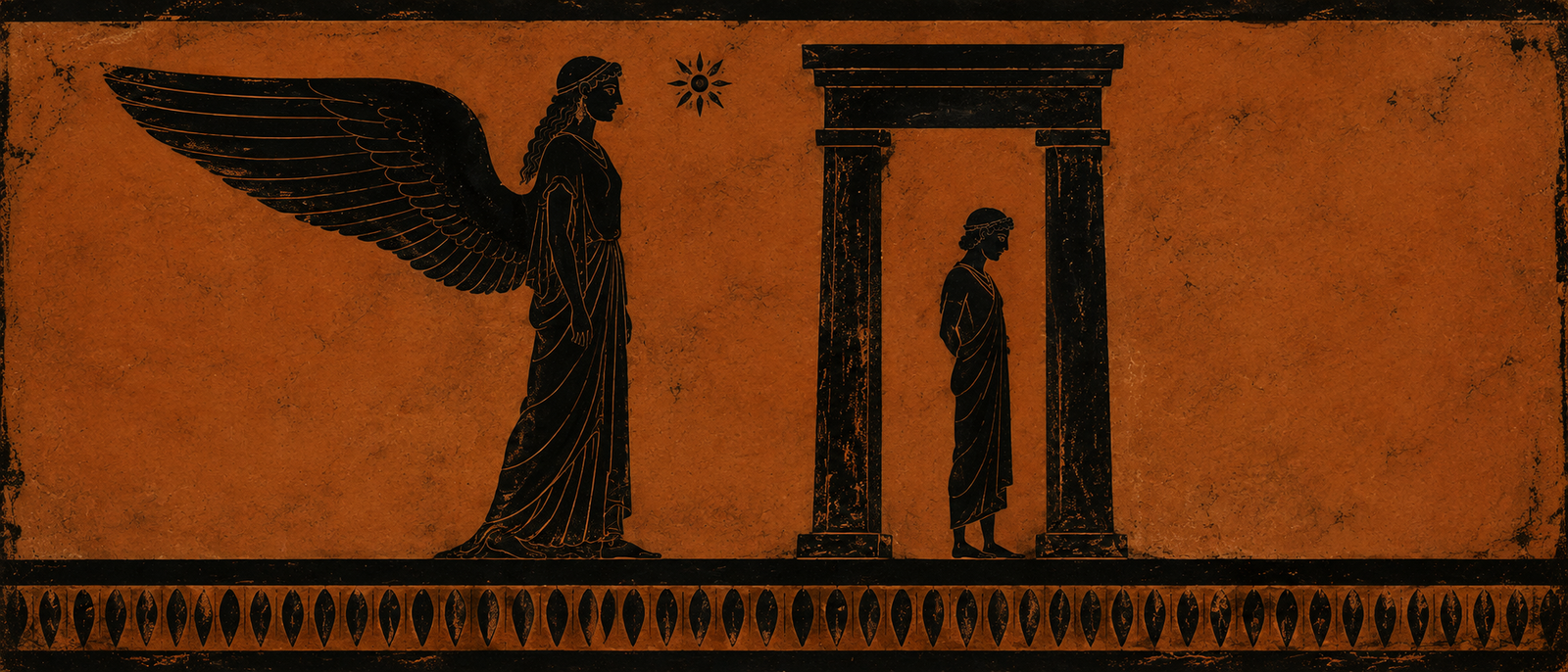
Eventually Tithonus is placed behind shining doors.
The image matters because a door usually implies passage.
Someone enters.
Someone leaves.
A door separates one state from another.
But the doors of Tithonus do not lead him anywhere.
They preserve.
They protect.
They conceal.
They turn the threshold into enclosure.
Behind them, he continues.
Outside them, Dawn performs the opposite movement.
She returns.
Dawn is eternal, but she is not static.
Her eternity is made of recurrence.
She comes because night has come before her. She departs because day must proceed. Her identity depends upon alternation. The world does not remain dawn. Dawn returns because it is allowed to end.
Tithonus receives no such mercy.
Nothing resets him.
Nothing restores him.
Nothing permits him to become new.
He does not recur.
He remains.
That is why endlessness and immortality are not the same thing as salvation.
We often imagine death as the enemy against which every other good must be measured. And much of the time, this is understandable. Death tears people from one another. It interrupts projects. It leaves sentences unfinished. It removes bodies from rooms that still seem shaped around them.
There is no need to pretend this is merciful.
There is no need to praise death in order to understand Tithonus.
The myth asks for something more exact.
It asks what happens when the enemy is defeated and the victory proves incapable of giving us what we thought we wanted.
Eos defeats death.
She does not thereby preserve life in the form she recognised.
Perhaps because life was never a possession that could simply be held still.
To live is not merely to remain extant.
It is to undergo time.
And human time contains irreversibility.
A child becomes someone who is no longer a child. A house changes because people have lived in it. Love accumulates history. The face of the beloved alters. The lover alters too.
We do not preserve these things by preventing them from changing.
Sometimes the desire to preserve them can become a refusal of the very condition under which they existed.
This does not mean that love should welcome loss.
It means that love cannot defeat time by making its object permanent.
The wish is understandable.
The fulfilment is impossible.
What, then, is the mercy of an ending?
Not that death is kind.
Not that suffering becomes acceptable because it stops.
Not that old age should hurry towards disappearance.
Not that dependency is an indignity from which death rescues us.
The mercy is smaller and more difficult than any of these claims.
An ending prevents duration from becoming the only remaining fact.
It allows a boundary to exist beyond which accumulation does not continue indefinitely.
It permits a mortal life, however unfinished it may feel to those who remain, to become something that has happened rather than something that can only go on happening.
Death does not make a life complete in the sense of making it finished, reconciled or whole. Many lives end brokenly. Many leave things undone.
But death does permit one thing Tithonus can never receive: the passage from presence into absence.
He cannot be remembered because he has not gone.
He cannot return because he has never left.
He cannot become ancestor, absence, grave, story, name carried forward.
He remains trapped in the present tense of his own survival.
Morning enters.
Morning departs.
Generations rise beneath it.
Cities fall.
Children become old.
The dead acquire descendants who never knew them.
Dawn continues to do what Dawn has always done: return because she has gone away.
And behind the shining doors is the man for whom no morning can become the last.
The difference is not between life and death.
It is between recurrence and remainder.
Dawn returns.
Tithonus remains.
—
From the Tithonus Chamber
The tale begins behind the shining doors: Tithonus — Behind the Shining Doors →
On Saturday, the Workroom enters the making of the tale: How Do You Write Something That Never Ends? — on narrowing point of view, cutting explanation, and making the reader lose Tithonus as Eos loses him.
—
Receive the next work
Subscribe free to receive new work from the House of Cadmus Library by email.
More from the Library

See Also
A concise and impartial dictionary of absence, promises, quarrels, ordinary objects, and the troublesome instability of words.
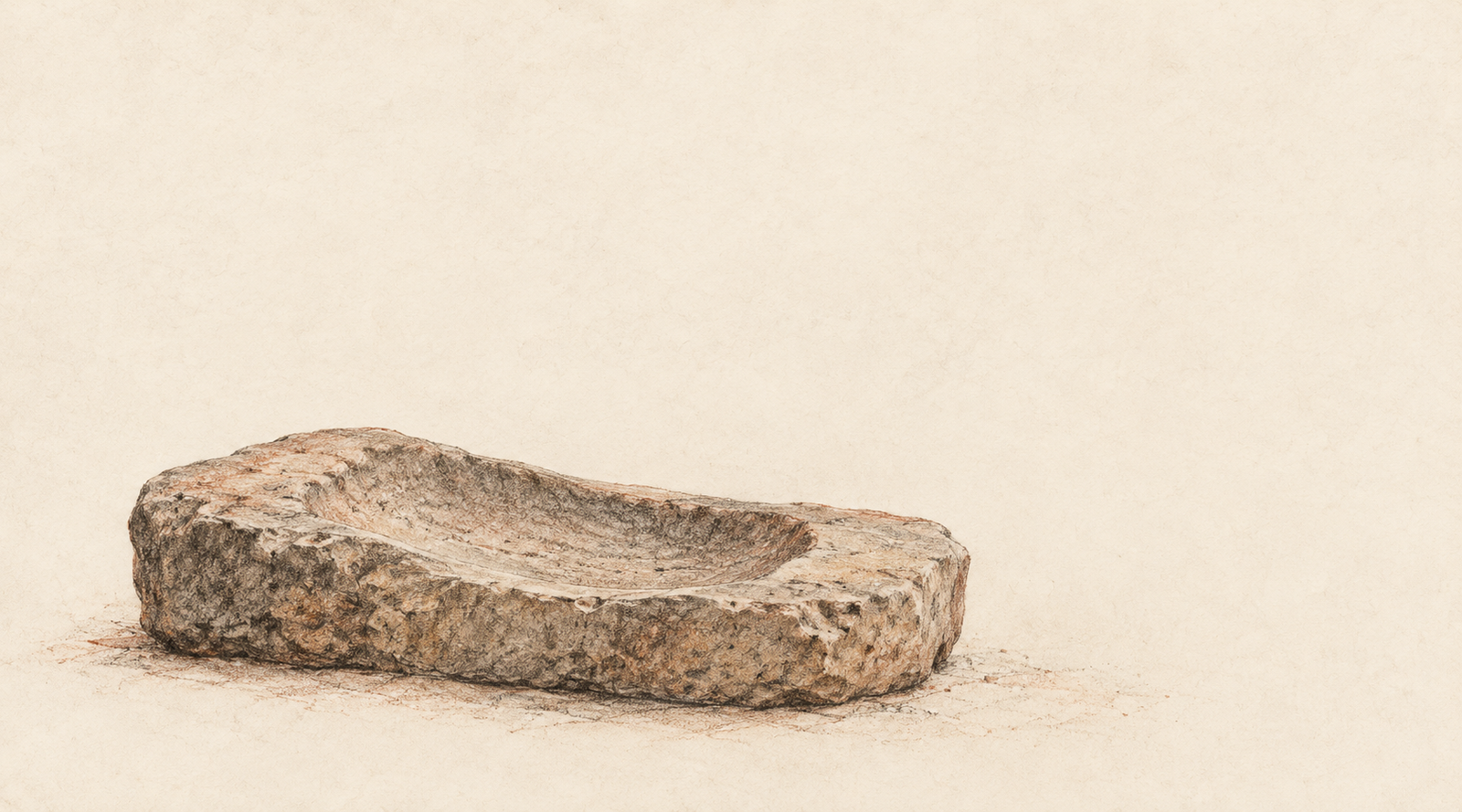

The City of Service
The temple we inherit is a building from which almost all necessity has been removed. Nothing must be brought for it to continue being what we call a temple. The sanctuary asks nothing of us. Stone is good at this kind of independence.
A living temple was otherwise.
Water had to come in. So did grain, cloth, oil, aromatic substances, fuel. The things required for worship arrived because someone carried them across a threshold.
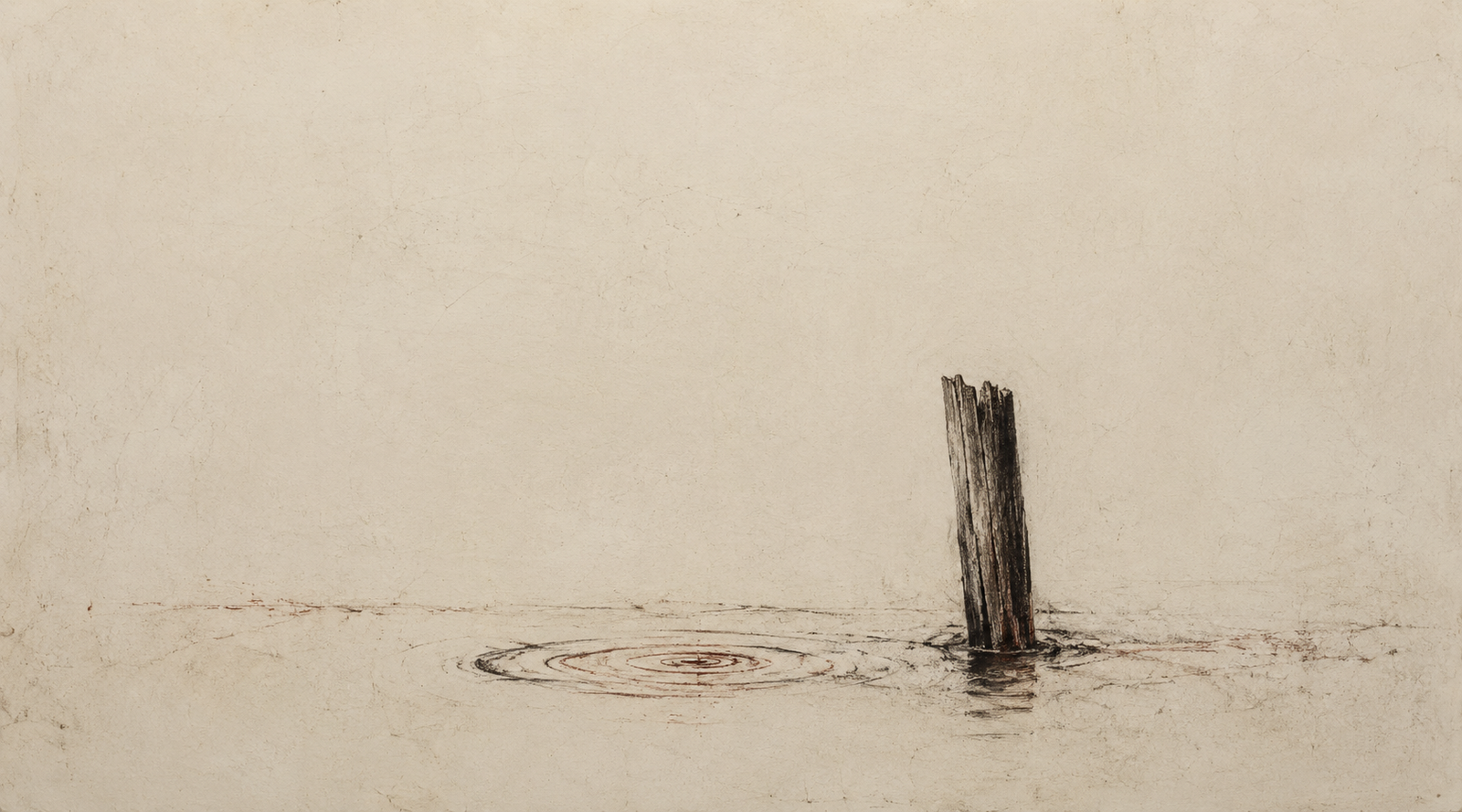

Houses of Wood, Light, and Smoke
Some of Angkor’s most intimate ruins do not rise above the ground at all. They are postholes, low mounds, hearths and ponds: durable traces of a domestic city built largely from things that decay. To restore that city is to see Angkor not only as stone, but as wood, smoke, water, repair, and people living within calling distance.