
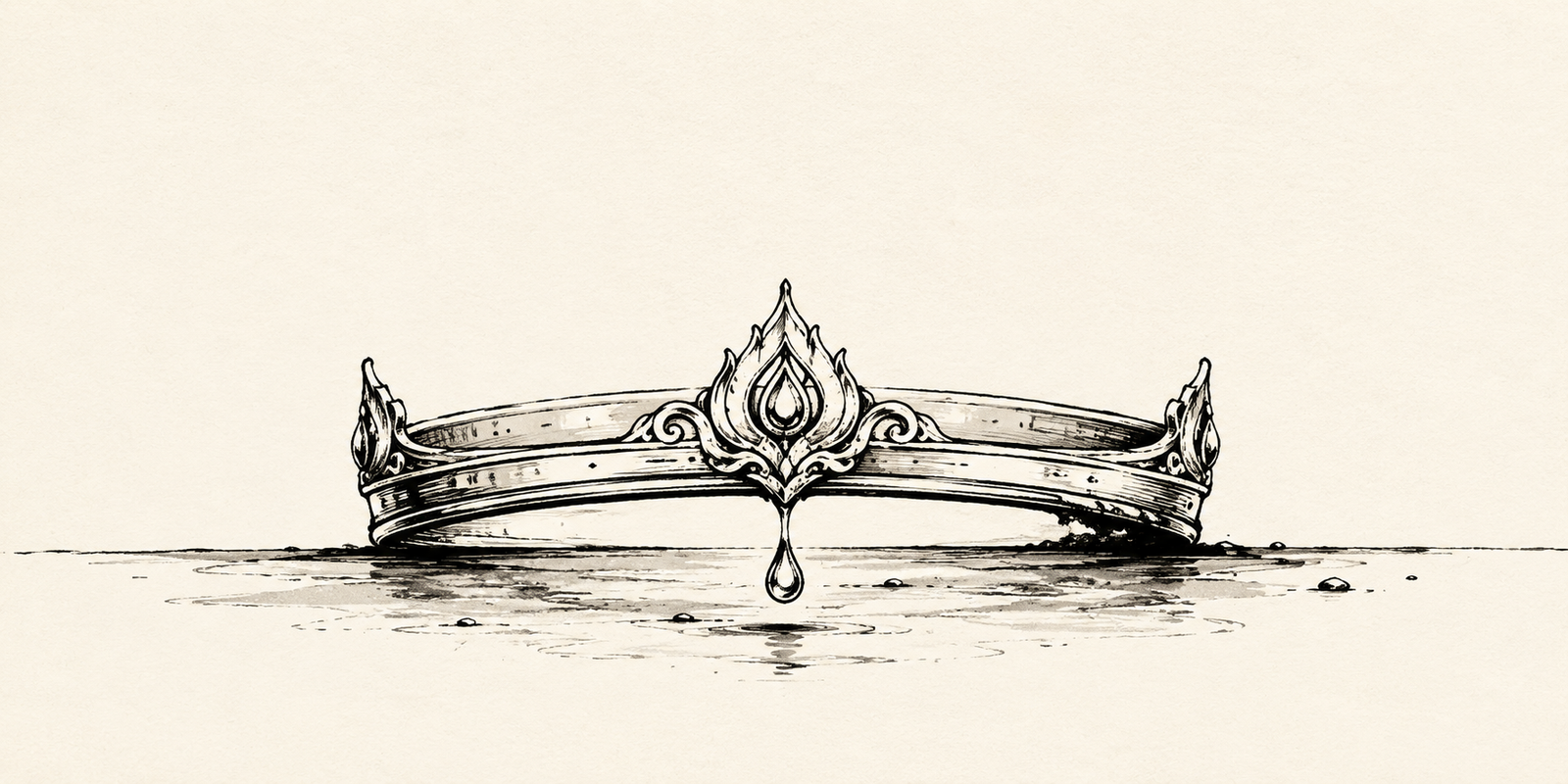

Fires of the Old World XXI — The Storm-King’s Lesson
A hearthlit retelling of Indra after Govardhana: the storm has failed, the mountain still stands, and the king of rain must come down.
The sky had emptied itself.
For seven days rain had broken over Vraja. Paths vanished first, then the banks of streams. Water climbed through the grass and gathered beneath the trees. Hail struck the cattle. Wind tore at roofs and branches. The clouds Indra had summoned were clouds of destruction, and he had sent them against a settlement of cowherds because the people there had ceased to honour him with sacrifice.
Now there was blue.
Water still ran from Govardhana in silver threads. It dripped from leaves, slipped from stone, gathered in hoofprints and hollows. The grass lay flattened beneath it.
And the mountain stood where it had always stood.
Below, the people were emerging.
Women carried children into the washed light. Men led cattle from shelter. Wheels turned slowly through the mud. The old walked carefully, leaning upon the young.
Among them was the boy.
Krishna.
For seven days he had held Govardhana above them with one hand.
Indra looked down from heaven.
He had commanded the storm to begin. He had commanded it to continue. At last he had commanded the clouds to withdraw.
They had obeyed him every time.
Yet the thing he had willed had not happened.
The village remained.
The cattle lived.
The boy walked barefoot through the water Indra had sent to destroy him.
Indra stayed where he was for a long time.
Then the king of heaven descended.
Airavata bore him down through the clearing air.
Indra did not cast aside the signs of his office before he came. His crown remained upon his head. The thunderbolt remained with him. He came as the god who commanded rain, mounted upon the great white elephant who carried him through heaven.
It would have been easier, perhaps, to arrive already stripped of everything.
He came instead with everything still his.
The crown.
The weapon.
The elephant.
The rain waiting somewhere beyond the emptied sky.
Only certainty had gone.
He found Krishna away from the others, near the cattle.
Mud covered the boy’s feet. No throne had been placed beneath him. There was no blaze of celestial light, no mountain balanced now upon his hand. A cow grazed a little way behind him, tearing quietly at the wet grass.
Indra stopped.
The storm-king had imagined this meeting while the rain was falling.
In none of those imaginings had he been silent.
Airavata lowered himself.
Indra dismounted.
His feet entered the mud.
Krishna watched him approach.
There was no triumph in the boy’s face.
No accusation either.
Indra came closer.
Then closer still.
Until there was nowhere left for greatness to stand between them.
He bowed.
The crown of the king of heaven touched the feet of a cowherd.
Mud marked its rim.
Indra remained there.
The gods knew bowing. They knew rank, homage, measured forms of honour. Indra himself had received them countless times.
This was not that.
At last he rose enough to speak.
“I was angry.”
Krishna waited.
“They stopped the sacrifice.”
The words sounded different here than they had among the clouds.
“I thought they had forgotten me.”
Still Krishna said nothing.
Indra looked towards Govardhana.
“I sent the storm to teach them.”
Krishna followed his gaze.
“What did they learn from it?”
The mountain stood dark with rain. Beyond it the cattle had begun to spread once more across the wet grass.
Indra watched them.
“They learned where to shelter.”
Krishna said nothing.
Indra lowered his eyes.
“I tried to destroy them.”
There was no anger in Krishna’s face. That made the words harder to escape.
“The rain was mine to send,” Indra said. “I knew that. I forgot that it did not make everything beneath it mine.”
Krishna bent and picked up a small stone from the mud. He turned it once between his fingers.
“What is the rain for?”
“The earth.”
“And what does it give the earth?”
Indra looked towards the grass.
“Growth.”
“The cattle eat it.”
“Yes.”
“And the people live.”
Indra said nothing.
Krishna let the stone fall.
For a while there was only water running down the mountain.
Then Indra said, “Take the rain from me.”
Krishna looked at him.
“Why?”
“Because I used it against them.”
“And if I gave it to another?”
Indra was silent.
“Would that teach you how to carry it?”
Indra looked down at his hands.
Krishna said:
“No.”
The word was quiet, but it ended the matter.
Indra looked up.
“Then what would you have me do?”
“Go back.”
“To heaven?”
“To the rain.”
Indra stared at him.
“After what I did?”
Krishna looked beyond him, towards the flooded ground, the broken branches, the people beginning again beneath the clear sky.
“You stopped the storm.”
“Because it had failed.”
“You could have sent another.”
Indra said nothing.
“You could have remained where you were.”
Still Indra said nothing.
Krishna looked at him again.
“But you came down.”
Indra’s voice was quieter now.
“I came because I was ashamed.”
“Good.”
It was such an ordinary word that Indra almost looked surprised.
“It cannot do the rest.”
“What can?”
“You know.”
Indra shook his head.
“If I knew, I would not have done this.”
“You did know.”
That stopped him.
Krishna waited.
Indra looked again at the water running from Govardhana.
“I forgot.”
“Yes.”
“How do I know I will not forget again?”
“You don’t.”
Indra waited.
Krishna said:
“So remember.”
Nothing followed it.
No punishment was pronounced. No weapon was taken from Indra’s hand. No crown was lifted from his head.
Somewhere among the cattle a bell moved softly.
Across the wet earth came Surabhi.
The divine cow approached without haste, and the cattle around Krishna stirred as she came among them. There was nothing of judgement in her movement. She came as rain ought to come to thirsty ground: bearing what she had been given to bear.
She stood before Krishna.
Then milk flowed over him.
It passed through his dark hair and over his shoulders, white against skin and wet cloth, and fell around his feet into the mud.
Airavata came forward.
The great elephant lowered his head beside his master.
Indra laid one hand against him.
Only a little while before, water had been his weapon. He had gathered it into clouds, driven it with wind, hurled it against roofs and trees and living bodies. He had made abundance into terror.
Now Airavata lifted his trunk.
Within it he bore the water of the celestial Ganga.
Indra guided him forward.
The water fell upon Krishna.
Not hard.
Not endlessly.
Not in anger.
It ran over the boy’s head and mingled with the milk of Surabhi, then passed down into the same earth Indra had tried to drown.
For the second time Indra bowed.
The crown touched the ground again.
This time he did not feel diminished by it.
He looked at the cattle surrounding Krishna.
Among the gods, Indra himself bore the title of lord.
Here another lordship had revealed itself—not the power to command the herd, but the power to keep it alive.
“Govinda,” Indra said.
Protector of the cattle.
Their keeper.
Their lord.
The consecrating water continued to fall for a little while, gentle now, until Airavata lowered his trunk.
Then there was only dripping.
From Krishna’s hair.
From Surabhi’s flank.
From the leaves above them.
The storm had ended long ago, yet water remained everywhere.
Changed only by what was asked of it.
When the rites were finished, Indra returned to Airavata.
He placed one foot against the elephant’s side, then turned back.
Krishna had already begun to walk towards Vraja.
Someone was calling him from among the houses.
He went barefoot through the mud, towards the people who had spent seven days beneath a mountain held in his hand.
Indra watched until the cattle moved between them.
Then he mounted.
Airavata rose.
Govardhana slowly diminished beneath them. The cattle became pale marks scattered over green. The people returned to damaged roofs, flooded paths, overturned vessels, all the ordinary work that follows survival.
Higher still, the whole wet country opened below.
Rivers shone.
Forests darkened the earth.
Fields waited beneath the clearing sky.
Indra still carried the thunderbolt.
The clouds would still answer when he called.
Soon enough, somewhere, the earth would look upward and wait for rain.
Airavata lifted his trunk.
A few drops of Ganga-water remained there from the consecration.
They loosened in the wind and fell.
Indra watched them go.
He did not command them.
—
From the Workroom
In Why Indra Had to Keep the Rain, I write about the moment this tale stopped being a second retelling of Govardhana—and became a story about the power Indra was not allowed to surrender.
—
Receive the next work
Subscribe free to receive new work from the Lucas Varro Library by email.
More from the Library


See Also
A concise and impartial dictionary of absence, promises, quarrels, ordinary objects, and the troublesome instability of words.

The City of Service
The temple we inherit is a building from which almost all necessity has been removed. Nothing must be brought for it to continue being what we call a temple. The sanctuary asks nothing of us. Stone is good at this kind of independence.
A living temple was otherwise.
Water had to come in. So did grain, cloth, oil, aromatic substances, fuel. The things required for worship arrived because someone carried them across a threshold.

Houses of Wood, Light, and Smoke
Some of Angkor’s most intimate ruins do not rise above the ground at all. They are postholes, low mounds, hearths and ponds: durable traces of a domestic city built largely from things that decay. To restore that city is to see Angkor not only as stone, but as wood, smoke, water, repair, and people living within calling distance.