
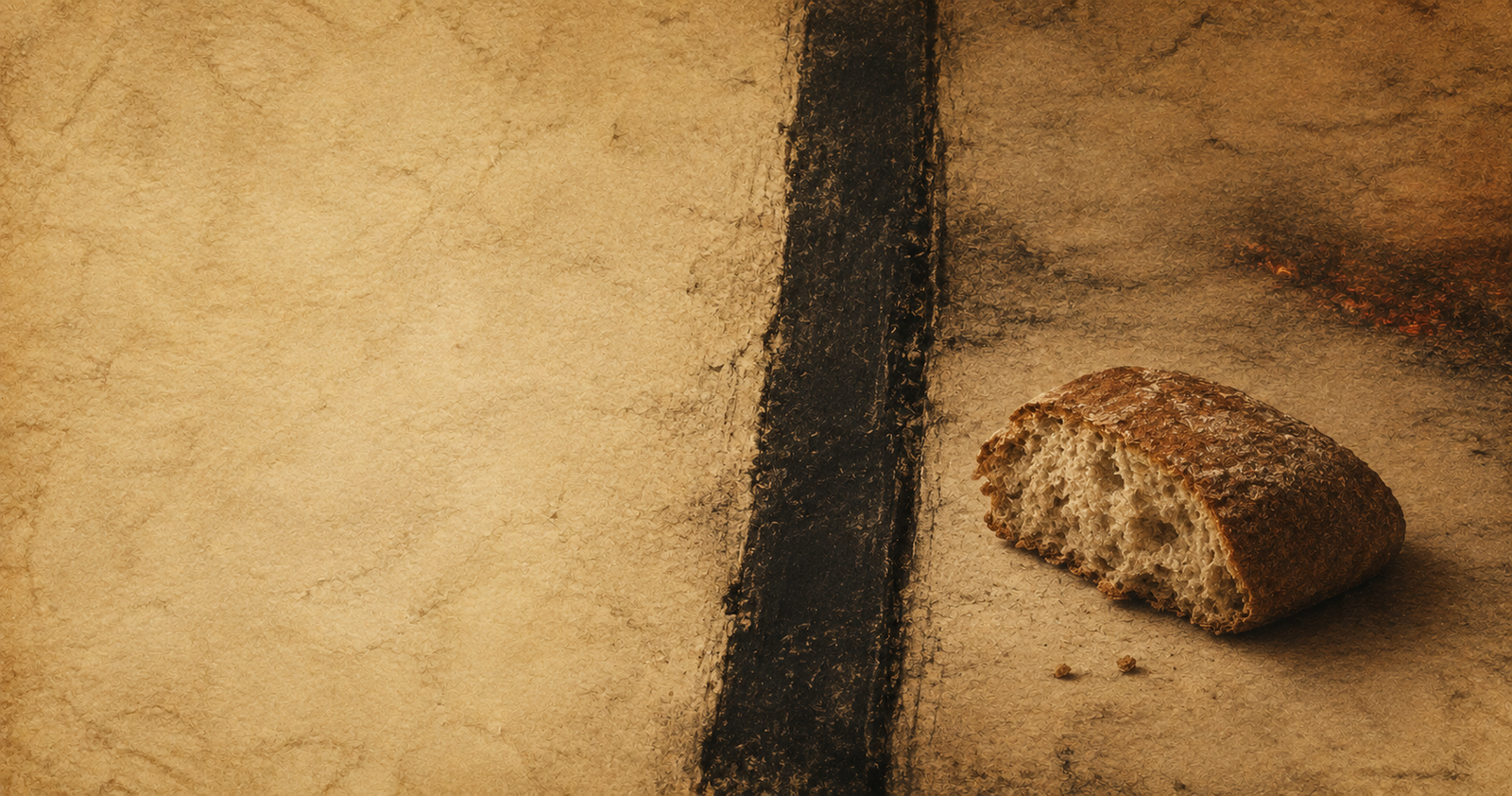

The Poor Man’s House and the True Law of Welcome
A Long Return reader’s guide
This is a reader’s guide to The Long Return XIV: In the Swineherd’s Hut. Begin with the tale.
Eumaeus does not believe him.
Odysseus has come to the swineherd’s hut disguised as a beggar. He brings news of the missing king and gives the news everything a good story needs: distance, witnesses, reversals, hardship, the persuasive clutter of things that sound too inconvenient to have been invented. Eumaeus listens because he is hospitable. He refuses to believe because he is not foolish.
He has heard such stories before. Twenty years of absence have taught men that grief can be traded upon. Bring a hopeful rumour to a household that has waited long enough and perhaps there will be meat, wine, a bed, a cloak. Perhaps the widow will listen because listening is easier, for an hour, than admitting that nothing is known.
Eumaeus understands the transaction.
He simply refuses to make the stranger’s hunger part of it.
That is what makes Book XIV such an important chamber in the Odyssey. Hospitality here is not warmth of feeling, instinctive trust, or an ability to recognise hidden worth. Eumaeus does not recognise Odysseus. He does not accept the stranger’s most important claim. His judgement remains intact.
His welcome remains intact too.
The Odyssey repeatedly asks what happens when one person enters another person’s power. The traveller comes from outside the household circle. He may have no kin nearby, no reputation the host recognises, no food, no shelter, no means of compelling decent treatment. The host has the roof, the fire, the meal, local protection and the right to close the door.
That imbalance is why hospitality carries such weight in Homer. Guest-law is not merely an attractive social custom laid over the poem’s adventures. It answers a dangerous human fact: the stranger is dependent upon the character of the house he reaches.
And for Homer the law is sacred as well as social. Eumaeus himself places strangers and beggars under Zeus. To receive the vulnerable person at the threshold is therefore not simply to display personal generosity; it is to honour an obligation that stands above private preference. The host may dislike the guest, distrust him, or think his story false. None of these judgements cancels the larger law.
This makes Eumaeus’s scepticism essential rather than incidental. If he simply believed Odysseus, his hospitality would be easier to explain. The stranger would possess valuable information. Hope itself might become a kind of payment. But Eumaeus gives after he has discounted the story.
He can judge the tale without judging the teller out of the human community.
That distinction becomes clearer because the hut contains so little.
The great houses of the Odyssey can receive a stranger magnificently. There can be baths, servants, polished rooms, mixing bowls, music, gifts sufficient to load a ship. Eumaeus has none of that. He has bread, wine, fire, a goatskin on which to sit and, when night becomes cold, a cloak.
His poverty should not be romanticised. Homer does not make him virtuous by making him poor. Eumaeus is tired, suspicious, capable of bitterness, and marked by displacement of his own. He knows that the best animals he tends are being consumed elsewhere by men who have done nothing to raise them. He knows what his master’s absence has cost the household and what it has cost him personally.
What scarcity does is not sanctify him.
It makes the cost of his hospitality visible.
The goatskin offered to the stranger is something Eumaeus himself uses. The food comes from a household already being depleted. Warmth matters because the night is cold. A cloak cannot cover two men in two different places at once.
Abundance can conceal generosity because the giver scarcely notices what has gone. In the hut, every gift has edges.
This is also why the contrast with Odysseus’s palace matters, though it is not simply a contrast between rich men and poor ones. The Phaeacians have already shown that abundance can serve hospitality beautifully. Wealth is not the problem.
The question is what possession teaches a person to believe.
At the palace, the suitors treat abundance as permission. They find food, wine, servants, animals and shelter, and ask how much longer these things can sustain their appetite. They behave as though access creates entitlement.
Eumaeus begins from the opposite assumption. What he possesses creates responsibilities as well as comforts. There is bread, therefore bread can be divided. There is a fire, therefore another body may sit beside it. There is shelter, therefore a traveller need not remain outside.
The same distinction appeared earlier in a more terrible form when Odysseus entered the Cyclops’s cave. Polyphemus possessed overwhelming physical power and recognised no obligation towards the strangers who had entered his domain. Nothing could compel him to keep the guest-law, and so he did not.
That is precisely the point at which power reveals its moral character.
Hospitality matters because refusal is possible.
Eumaeus has far less power than Polyphemus, but what power he possesses is limited voluntarily by obligation. He could send the beggar away. He could make food conditional upon useful information. He could decide that a suspected liar deserves whatever the road gives him.
Instead he continues cutting bread.
The stranger does not have to become credible before he becomes hungry.
This is where the guide’s central distinction becomes hardest and most useful. Mercy and belief are separable judgements. Eumaeus does not have to suspend his intelligence in order to practise hospitality. Indeed, the scene is more morally serious because he does not.
He believes that the stranger has suffered. He doubts the story about Odysseus. He feeds the man.
Human decency sometimes begins in precisely that unresolved place. We cannot always know another person completely before some smaller decision is required of us. We may not know whether every account is accurate, whether gratitude will follow, whether the person before us will ever become useful, admirable or familiar.
The first question may be much simpler.
You are here.
You are hungry.
Eat.
But bread is only the first chamber of the episode.
Later, night comes down cold and wet. Odysseus needs a cloak, and because he is Odysseus he takes the longest available route towards asking for one. He tells a story from Troy about a freezing soldier and the clever means by which another man’s cloak was made available to him.
Eumaeus understands.
Nothing about the stranger has become more certain. No disguise has been lifted. No proof has appeared. Eumaeus has not been rewarded for his earlier generosity with the truth.
What has changed is the cost.
Food can be divided. A place at the fire can be widened. A cloak is finite.
To give it is to accept that warmth must move from somewhere to somewhere else.
That is why the cloak does not merely repeat the lesson of the bread. The bread establishes admission: the stranger may enter the circle of human care before his story has been verified. The cloak carries hospitality further. Welcome eventually asks something of the host.
And Book XIV quietly makes that cost larger still. Eumaeus settles the stranger near the fire, then wraps himself against the rain and goes outside to sleep near the animals he is responsible for guarding.
There is no audience for this act as Eumaeus understands it. His master is gone. The suitors will not praise him. No reward has been promised. The work remains because it is still his to do.
The Odyssey contains kings, palaces, divine gifts, heroic names and treasures carried home across the sea. Yet here its guest-law becomes visible through smaller things.
Bread.
Fire.
Wool.
A little room beneath a poor roof.
The true law of welcome does not require the host to know exactly who has arrived before he opens that room. A stranger is at the door. Night is coming. The house has bread. The fire is lit. There is a cloak that can cross from one body to another.
So room is made.
—
For paid subscribers, I have added a Workroom note on a different kind of revision problem: what to change when the argument is already right, why bread and the cloak had to stop proving the same thing, and why one of my favourite lines from the tale had to be removed from the essay.
Enter the Workroom: When the Argument Was Already Right
—
Receive the next work
Subscribe free to receive new work from the The Hospitable Dark Library by email.
More from the Library

See Also
A concise and impartial dictionary of absence, promises, quarrels, ordinary objects, and the troublesome instability of words.

The City of Service
The temple we inherit is a building from which almost all necessity has been removed. Nothing must be brought for it to continue being what we call a temple. The sanctuary asks nothing of us. Stone is good at this kind of independence.
A living temple was otherwise.
Water had to come in. So did grain, cloth, oil, aromatic substances, fuel. The things required for worship arrived because someone carried them across a threshold.

Houses of Wood, Light, and Smoke
Some of Angkor’s most intimate ruins do not rise above the ground at all. They are postholes, low mounds, hearths and ponds: durable traces of a domestic city built largely from things that decay. To restore that city is to see Angkor not only as stone, but as wood, smoke, water, repair, and people living within calling distance.