

The Stranger, the Girl, and the Law of Mercy
A Long Return reader’s guide.
This is a reader’s guide to The Long Return VI — Nausicaa at the River. Begin with the tale.
The first mercy shown to Odysseus after the storm is not grand.
It is not a palace. It is not a feast. It is not a ship pulled down to the water and filled with men willing to row him home. It is not even welcome, not yet.
It is a girl standing still.
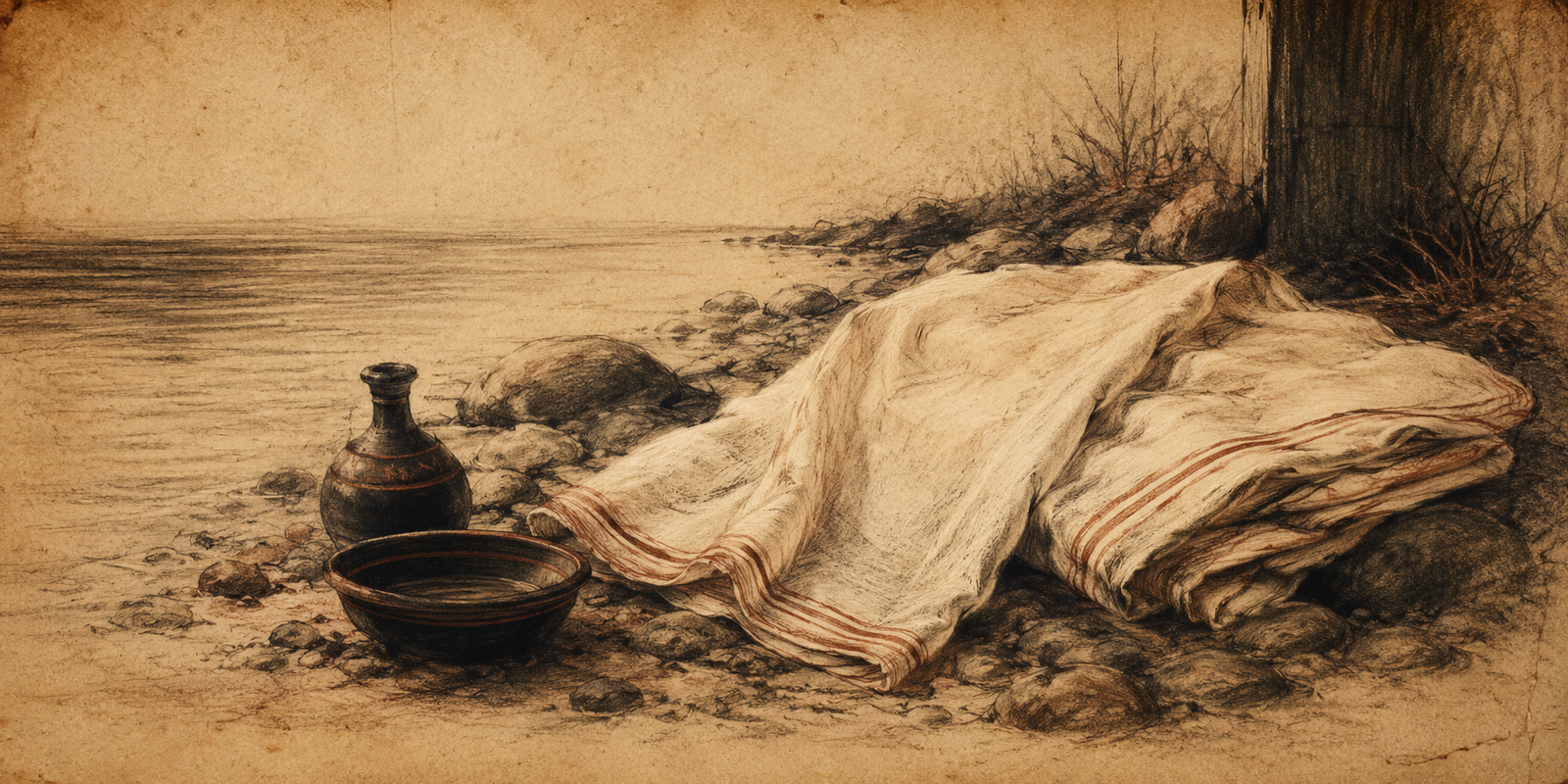
That is easily missed, because the river scene has so much brightness around it: the washing, the ball, the garments spread in the sun, the sudden movement from household work into mythic consequence. It is one of the tenderest thresholds in The Odyssey, and tenderness is often misread as softness. A princess finds a shipwrecked man. A young girl sees a stranger. The possibility of romance rises briefly on the surface of the water and then is gone.
But the scene is more serious than charm.
Odysseus comes out of the bushes before he can be safely understood. He has no ship, no companions, no cloak, no visible rank, no proof of origin, and no name he can yet use. The sea has stripped him back almost to the bare fact of need. He is not, in any way useful to those who see him, the king of Ithaca, the husband of Penelope, the father of Telemachus, the man of Troy, or the favourite of Athena.
He is a frightening stranger at the edge of the river.
That is why Nausicaa matters.
Mercy that begins after recognition may still be noble. It may still be costly. But it is not the first law of welcome. The first law begins earlier, before the stranger has become legible, before the house knows whether honour or danger has arrived at its door. It begins when someone sees need before anyone can safely identify merit.
Mercy begins where proof has not yet arrived.
This is one of the deep laws of The Odyssey. Again and again, the poem asks what a house is by asking how it receives the unknown person before it. The stranger may be a beggar, a god, a murderer, a king, a liar, a survivor, a threat, or a test. The house does not yet know. That is the point. Hospitality is not a reward for a completed biography. It is the discipline of behaviour before certainty.
The stranger reveals the house.
Or, more exactly, the stranger reveals what the house believes about humanity before rank has done its comforting work.
Nausicaa is young, and the poem never lets us forget it. She wakes from a dream of marriage. She thinks about garments, reputation, household preparation, and the strange rooms that may one day receive her. She goes to her father and asks, with perfect decorum and imperfect disclosure, for the wagon and the mules. She works at the river with the maids. She plays ball when the washing is done. She belongs, still, to that brief interval of life in which a person stands between childhood and departure, watched by the future but not yet taken by it.
Then Odysseus rises out of the leaves.
The other girls run, and they are not wrong to run. This matters. The scene becomes false if their fear is treated as foolishness. They do not know what the reader knows. They see a naked, salt-stiffened man coming from the thicket, holding a branch before him, marked by exhaustion and sea-violence. Fear is not moral failure. It is information entering the body quickly.
Nausicaa feels fear too.
Her courage is not the absence of fear. That would make her less intelligent, not more. What distinguishes her is that fear does not complete the judgement. She sees what the others see, but she also sees one thing more: the stranger has stopped at a distance. He has not rushed toward them. He has not seized or demanded. He has not used need as permission. He stands there as one asking leave even to be visible.
That pause is the beginning of civilisation returning.
Odysseus knows the old gesture of supplication. He could fall at her knees. He could cross the space and claim the ancient right of the desperate man. But he understands, even in extremity, that the right law may become the wrong act if used without judgement. A girl alone among younger girls, far from the palace, cannot be approached as though she were a king seated in a hall. Need does not abolish the vulnerability of the person from whom help is requested.
So he stays back.
It is one of the most important restraints in the episode. Odysseus is in need, but he is not only need. He is still capable of measuring another person’s danger. He asks for mercy without becoming a second threat.
Nausicaa hears him.
His speech is beautiful, but its beauty is not innocent. Odysseus is never harmless in language. Even shipwrecked, hungry, naked, and near collapse, he knows how speech may build a bridge across terror. He praises her without touching her. He honours her rank without presuming intimacy. He names the blessings of father, mother, brothers, and husband because he understands the social world in which she lives. He places honour around her before asking for help.
It is a cunning speech.
It is also true.
That double quality is part of the Odyssean difficulty. His tact is real. His need is real. His self-command is real. His calculation is real. The poem does not ask us to choose one and discard the others. A lesser story would make him either purely noble or merely manipulative. Homer’s stranger at the river is more troubling and more human than that. He speaks beautifully because he must survive. He speaks carefully because he knows what careless speech can damage. He speaks truthfully because truth, shaped well, may still be the strongest tool left to him.
But the great judgement in the scene is not his.
It is hers.
Nausicaa does not know his name. She does not know his story. She does not know whether the gods have sent him as blessing, burden, danger, or all three at once. But she knows enough to act. He is a stranger. He is in need. Therefore he must not lack clothing, food, washing, and direction.
That is not sentiment. It is form.
And because it is form, it becomes practical.
Cloth is laid out. Oil is given. Food is brought. Privacy is granted. The maids are called back from fear into duty. Odysseus is not stared at while he washes. He is not made to stand exposed in the condition the sea has left him. He is not asked for his name before his hunger is acknowledged. He is given, piece by piece, the first articles of human restoration.
Nausicaa’s mercy is not the absence of calculation.
It is calculation placed in the service of kindness.
This is where she becomes extraordinary. She does not simply pity Odysseus and then leave the rest to chance. She understands that a good act must still pass through the world. The world has eyes. The world has tongues. The world arranges suspicion quickly, especially around young women. If she drives into the city with a strange man openly beside the wagon, the story will arrive before the truth. Young men will talk. The household will hear a version before Nausicaa can give the real one. Odysseus may reach the palace already damaged by rumour.
So she thinks ahead.
There is nothing cold in this. There is nothing cowardly in it. It is not a failure of hospitality that she tells him to come later, separately, and carefully. It is hospitality becoming wise enough to survive contact with society.
A child’s version of kindness imagines that sincerity is enough. An adult kindness knows better. Food must be brought in a way that does not humiliate. Shelter must be offered in a way that does not endanger the household. Help must be arranged so that the vulnerable person is not delivered from one peril into another. Nausicaa understands all of this almost immediately.
That is why it is wrong to reduce her to sweetness.
She is merciful, but she is not soft-headed. She is young, but not naive. She is moved by Odysseus, but not mastered by the movement. She may glimpse, for one brief moment, the possibility of a husband like this man, and the poem allows that moment its delicacy. But it does not turn her into a foolish girl overcome by romance. The thought passes through her and is gone. She returns to the world that must be managed.
That restraint is the beauty of her.
Athena is present, of course. The goddess has brought Nausicaa to the river by means of a dream. She strengthens the girl’s heart when the stranger appears. She arranges timing, chance, courage, visibility. But divine help does not erase human judgement. The gods in The Odyssey often prepare the conditions under which mortals must still become themselves.
Athena may place the encounter in motion.
Nausicaa still has to stand there.
Divine favour does not wash the stranger. It does not fold the clothes. It does not instruct the maids. It does not understand the gossip of young men in the city. It does not choose the exact distance between mercy and danger.
Nausicaa does.
What she gives Odysseus, then, is not merely rescue. It is the first return of human order after the storm. The sea has done what the sea does: broken, stripped, scattered, reduced. The river begins another work. It takes salt from his body. It receives the grime and violence of survival. But water alone cannot restore a man to the human world. For that, there must be cloth, food, speech, modesty, instruction, and someone willing to say: this person is in need, and need has a claim before name.
Before Odysseus can be recognised, he must be received.
That is why the episode belongs so deeply to the larger movement of return. Ithaca is still far away. Penelope has not seen him. Telemachus does not yet know that his father lives. The suitors are still eating through the house. Nothing final has been solved at the river.
And yet something decisive has happened.
Odysseus has crossed from mere survival back into relation. He is not home, but he is no longer only a body thrown out of the sea. He has spoken and been heard. He has asked and not been refused. He has been washed, clothed, fed, and instructed. He has entered the first small shelter of law.
The return begins here in miniature.
Not with triumph.
Not with recognition.
Not with the hero’s name spoken under the roof.
But with a girl beside a river who sees a frightening stranger before her and refuses to let fear have the final word.
The law of mercy is not that every stranger is safe.
It is that danger does not erase obligation.
Nausicaa knows enough to be afraid. She knows enough to be careful. She knows enough to protect herself, her maids, her house, and the man whose life has come into her keeping for one morning. But she also knows that a human being in need cannot be left outside the world simply because his story has not yet been made presentable.
So she does the first necessary thing.
She remains.
—
Receive the next work
Subscribe free to receive new work from the The Hospitable Dark Library by email.
More from the Library

Houses of Wood, Light, and Smoke
Some of Angkor’s most intimate ruins do not rise above the ground at all. They are postholes, low mounds, hearths and ponds: durable traces of a domestic city built largely from things that decay. To restore that city is to see Angkor not only as stone, but as wood, smoke, water, repair, and people living within calling distance.


What Stone Brings Forth
I had mistaken a gift for something being expelled.
Beneath the nāga's mouth, a stone garland descended bead by bead. Nearby, a makara opened its jaws and another form emerged. Looking closer, the whole temple began to change: serpent became ornament, ornament became architecture, architecture became foliage.
The forest did not introduce this language.
It answered it.

The Eighth Daughter
Seven daughters have already been taken by Yamata-no-Orochi when Susanoo reaches the River Hi. Only Kushinada-hime remains. The Eighth Daughter retells the Kojiki episode through a family’s waiting, a girl transformed into a comb, and the patient preparation for the serpent’s return.