
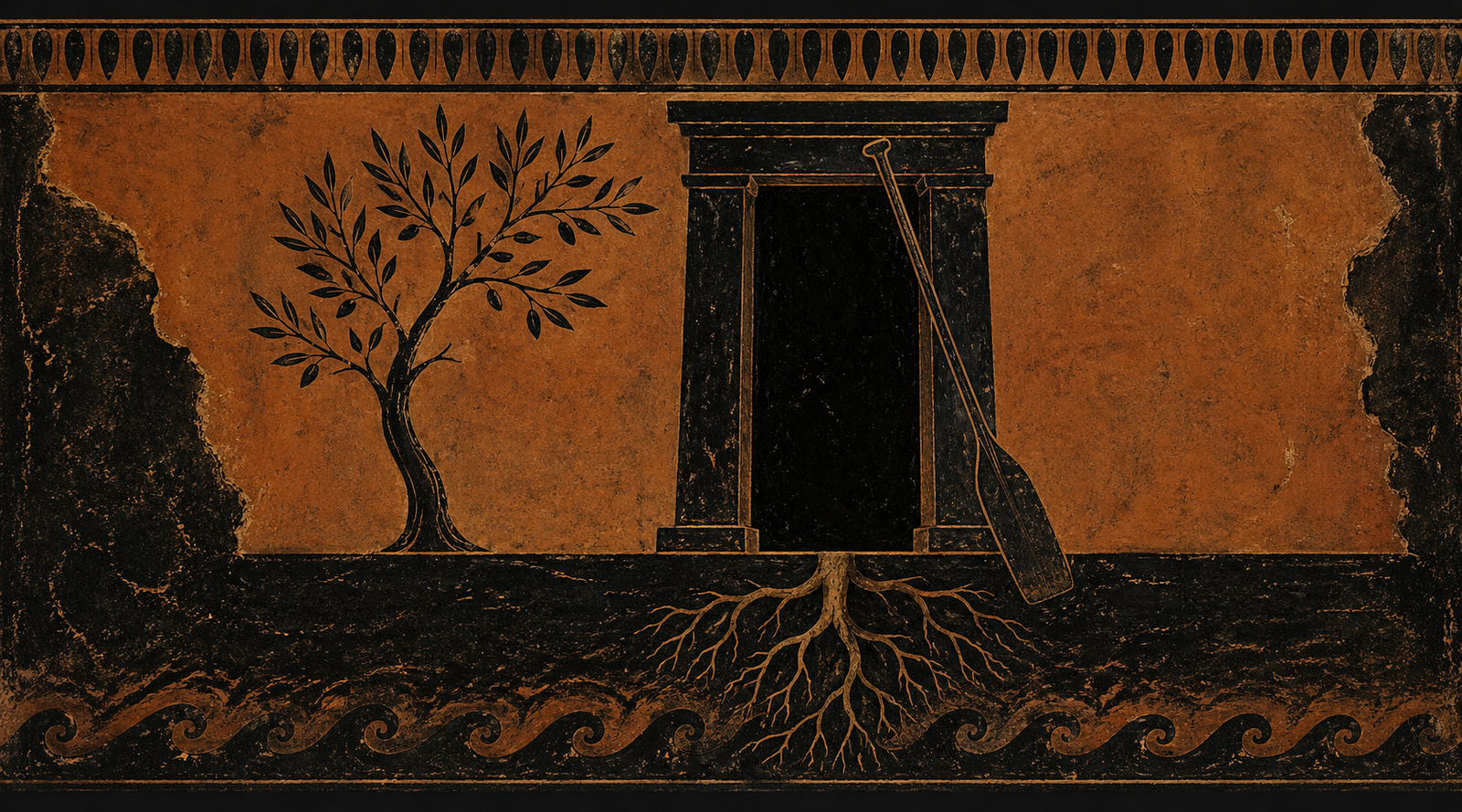

No Man Comes Home V — The Name Inside the Cave
Odysseus survives the Cyclops by becoming Nobody, then endangers the road home by needing his name to be known.
The feast had ended, but the stranger had not.
That was the danger of hospitality when it succeeded. A man may be washed, clothed, seated, fed, honoured, and still remain withheld. The Phaeacians had done what a house must do before knowledge. They had received him. They had given bread before interrogation, wine before judgement, dignity before proof. They had behaved as though the stranger’s humanity came before his usefulness.
Now the story demanded its due.
Song had begun the breaking.
The bard sang of Troy.
He did not know what he opened.
A singer can enter another man’s wound by accuracy alone. He need not intend harm. He need only remember well. The hall listened as halls listen when suffering has become art: with pleasure made solemn by distance. They heard horses, walls, bronze, fire, kings, the cunning that entered the city in wood, the silence that held men inside victory before slaughter opened. They heard what had made them safe from the event itself.
Odysseus heard what he had survived.
He covered his face.
This was not theatrical grief. A man who has concealed himself successfully cannot always choose which thing unmasks him. Not accusation. Not beauty. Not hunger. Not the queen’s question. Song.
The body betrayed the name before the mouth did.
Alcinous saw.
A king who knows hospitality knows when concealment has become pain. He stopped the song, not because song was false, but because truth had begun to injure the guest. Games followed. Gifts followed. Young men tested the stranger’s dignity and discovered, too late, that ruin is not weakness.
Still he held his name.
Until the king asked.
Who are you?
Where is your house?
What grief brings you here?
What name shall my ships carry home?
A name is never only a sound.
It is a key, a debt, a target, a genealogy, a wound entrusted to other mouths. To give it is to become findable. To withhold it is to remain possible. Odysseus had lived too long by the distance between himself and what others called him. He knew the uses of namelessness.
Yet there are houses where concealment becomes insult.
The Phaeacians had received him without knowing him. Their ships would risk the sea for him. Their king had honoured him. Their queen had judged him with clean severity and allowed him place. To remain wholly hidden now would corrupt the welcome that had preserved him.
So he spoke.
“I am Odysseus.”
The name entered the hall and altered what had already happened.
The stranger became the story men had been telling without knowing it. The tears became legible. The gifts became dangerous. The passage home became implicated in old divine anger. Men leaned towards him not merely because he was a guest, but because fame had stood among them in torn cloth and eaten at their table.
This is the cruelty of renown: it arrives after the body, then revises the body in every eye.
Odysseus did not begin with the Cyclops.
He began where men often begin when trying to make their suffering orderly: with departure, storm, landfall, hunger, mistake. He told of the Cicones and the cost of greed; of men who would not leave quickly enough; of retaliation following appetite; of ships driven off course by weather and the anger that attends victory when victory has not learned restraint.
He told enough.
Then came the land of the Lotus-eaters, where forgetting wore the face of gentleness. Men tasted the flower and no longer desired return. They did not die. They did not rage. They did not betray. They simply ceased to suffer home.
That was why they had to be dragged back.
A longing that can be dissolved by sweetness was not yet safe. Odysseus forced them to the ships and bound them under benches until the oars could carry them away from mercy. He did not ask whether they thanked him. Command often saves men from what they would have chosen in the moment and leaves them to resent the rescue later.
Already the pattern was forming.
Home would not be kept by desire alone.
It would require force.
Then he told of the island of goats, the harbour, the neighbouring land where smoke rose from the homes of beings unlike men. He had ships. He had companions. He had no need to enter the cave.
That is important.
Not every danger comes to meet a man. Some are approached under the name of inquiry.
Odysseus wanted to know.
Curiosity is not innocence in a leader.
He took selected men and crossed towards the smoke. Perhaps he expected gifts. Perhaps he expected savage men who could be measured by Greek custom and found lacking. Perhaps he expected a story worth carrying. Perhaps he expected the world to reward the courage of approach.
The cave stood open.
That was its first deception.
An open cave is not an open house. Doorlessness does not mean welcome. The distinction should have been clear. It was not. Inside they found order of a kind: pens, lambs, kids, cheeses set in rows, vessels of milk, the signs of labour without the laws of hospitality. His men urged him to take what could be taken and leave.
They were right.
Odysseus refused.
He wanted to see the owner.
That desire killed them.
No lightning announced the error. No god cried warning from the mouth of the cave. There was only a choice made under the respectable cover of knowledge. They lit a fire. They ate some of the cheese. They waited where they had not been invited, trusting that the law of guests would follow them even into a place that had never promised law.
Then Polyphemus came home.
He was not first a monster.
He was a fact too large for the room.
The cave altered around him as a shore alters when the sea rises suddenly. He drove his flock inside, set the mothers apart, milked with heavy competence, ordered his own world according to his own brutal sufficiency. Then he lifted a stone to close the cave-mouth, and the day ended.
The men understood then.
Some truths arrive as darkness.
The stone was not merely weight. It was the correction of every assumption by which they had entered. No guest could leave. No host would be judged. No ship could help. No custom could be enforced. The law outside the cave had not crossed the threshold with them.
Polyphemus saw the strangers.
He asked who they were.
Odysseus spoke first of shipwreck and Zeus, of strangers under divine protection, of the duty owed by those who live beneath heaven. It was a good speech in the wrong world.
The Cyclops heard it and laughed.
His laughter did not resemble the suitors’ laughter. The suitors laughed because they feared being seen. Polyphemus laughed because he saw no one before him whose seeing mattered. He had no city to shame him, no assembly, no neighbour whose judgement shaped him, no table-law, no fear of Zeus that could be turned into restraint. His life was vast, solitary, sufficient, immediate.
He did not violate hospitality.
He lived outside its reach.
That was worse.
Against lawlessness, speech loses one of its oldest powers. It may still charm, delay, misdirect, wound, or preserve; but it cannot appeal. There was no court in Polyphemus to which justice could be addressed.
Odysseus understood this too late.
The cave became a school.
Not of courage. Courage was too small a subject.
Of scale.
The men had entered as Greeks, companions, sailors, veterans of the long war, men who had seen walls fall and kings quarrel and gods choose sides. Inside the cave they became meat, labouring breath, bodies counted by a hunger too large to negotiate with. The mind resists such reduction. It searches for insult, because insult preserves personhood. But the Cyclops did not insult them.
He used them.
That was the deeper horror.
Night came.
No one slept truly.
Men can close their eyes inside terror and still remain awake beneath the skin. Odysseus lay among them, listening to breath, animal movement, the huge sleeper, the stone, the sea impossibly near and useless beyond it. His hand wanted the sword. His mind refused it. To kill the Cyclops at once would be to die slowly behind the stone. Force could answer appetite, but not geography.
So intelligence had to serve survival.
Morning brought no mercy.
The stone moved. Light entered. Flocks went out. The great body left with them. The cave remained closed behind him. Day outside. Prison inside. The men were alive because Polyphemus had not yet needed them.
Odysseus found the stake.
A club, really, green wood, large enough for the giant’s hand, absurd in mortal scale. He chose it because the world inside the cave had given him almost nothing else. Men survive by discovering the use hidden inside what was meant for another power. They cut it, shaped it, hardened its point in fire, buried it beneath dung and shadow.
Work steadied them.
That was merciful.
Planning gives fear a task and calls it courage until courage can arrive.
When Polyphemus returned, Odysseus had wine ready.
Wine from the ship. Dark, potent, civilised, carrying in its scent another world: vine, cup, feast, measure, exchange. He offered it to the Cyclops because gift can become weapon when law has failed. Polyphemus drank. He liked it. He asked for more. Appetite, even vast appetite, may be led by pleasure towards its own defeat.
Then came the question.
“What is your name?”
Everything gathered there.
The stone. The dead. The hidden stake. The men holding silence. The giant softened by wine. The old laws unavailable. The future balanced on a sound.
Odysseus answered.
“Nobody.”
The name was a door without a room behind it.
It was perfect because it made absence usable. A man without a name cannot be found by the cry that seeks him. The answer did not deny his person; it turned personhood into a trap. Polyphemus accepted the word because he did not understand language as a field where another mind might hunt.
Nobody.
The companions heard it.
Perhaps some almost laughed.
Not from joy. From the terrible relief that comes when intelligence enters a closed place and makes a little air.
The Cyclops promised to eat Nobody last.
This was his gift.
Law had collapsed so completely that postponement became mercy.
He slept.
The men moved.
They lifted the hardened stake into the fire until its point was alive with heat. Then, together, they drove it where sight ruled appetite. The cave filled with sound. Not battle. Not honour. Not the clean exchange of armed men beneath a sky. Work. Pressure. Men bracing themselves inside an act no song could make noble while they did it.
Polyphemus cried out.
The neighbouring Cyclopes came to the mouth of the cave, voices beyond stone, asking who harmed him.
Nobody, he cried.
Nobody.
The name performed its work.
The others heard no crime requiring their strength. A private pain, perhaps. A sickness. A god’s punishment. They left him to it.
This was the triumph.
This was also the warning.
The best concealment creates a world in which even truth cannot summon help.
At dawn, Odysseus completed the escape. He did not open the stone. He could not. He used what the Cyclops loved and trusted: the animals. Under the bellies of the rams, his men clung, wool over backs, fingers buried in fleece, breath held beneath the hands of the blinded master as he felt the sheep pass out into light. Odysseus chose the greatest ram for himself and hung beneath it, the captain below the beast, surviving by the humility of inversion.
That image should have cured him.
It did not.
They reached the ship.
They pushed from shore.
Water opened between them and the cave. Distance returned, and with distance came the old intoxication: safety becoming speech too soon. The men bent to the oars. The wounded Cyclops raged along the shore, blind and enormous, tearing at sound. Odysseus’s companions begged him to be silent.
They were right again.
He was not silent.
At first he taunted without the name. A little cruelty thrown back at cruelty. A man may understand that. They had endured terror. They had lost companions. They had escaped by intelligence sharpened under doom. Some words rise after survival like steam from blood-warm stone.
Not all are wise.
The Cyclops hurled rock.
The sea heaved. The ship almost died beneath the answer.
The men begged again.
Do not speak.
A leader should know when those who fear for the ship have become wiser than the man who commands it.
Odysseus heard them.
Then the name inside him could bear concealment no longer.
This was not need.
This was hunger.
Not hunger of the body. Hunger of the self after having lived as Nobody and been saved by it. The concealment that preserved him had become intolerable because victory without recognition tasted incomplete. He needed the wounded enemy to know who had overcome him. He needed the world to return his personhood after the cave had reduced it to function.
So he gave the name back to danger.
“If anyone asks who blinded you,” he cried, “say Odysseus did it.”
The sea received the name.
So did the god.
Names are doors.
They open both ways.
Polyphemus lifted his arms to Poseidon and prayed. Not with eloquence. Eloquence was not his gift. But prayer does not need beauty when pain gives it force. He named his father. He named Odysseus. He asked that the man never reach home; or if he must, that he arrive late, ruined, alone, in another’s ship, and find grief waiting in his house.
The curse entered the poem and began walking ahead of him.
Odysseus had wanted the Cyclops to know.
Now the sea knew.
His men rowed.
They did not praise him.
What could they have said? That Nobody had saved them and Odysseus had endangered them? That the captain’s brilliance and vanity were not two men, but one? That the name they followed was both shelter and storm? Men under command often learn these things before they dare to form sentences around them.
They reached the island where the other ships waited. The goats were slaughtered. Wine was poured. The surviving men ate because grief must share the body with hunger. They mourned the dead, but not enough to raise them. They looked at their captain perhaps with gratitude, perhaps with fear, perhaps with the difficult loyalty born when a man has saved your life and shown you how he may yet lose it.
Odysseus gave offerings.
The god did not accept them.
Or accepted them darkly.
The story moved on, because stories, like ships, often continue after they have been damaged.
But the name had changed the sea.
From that moment, return was no longer merely delayed by weather, error, appetite, enchantment, and the long disorder of the world. It had been personally opposed. The hidden man had made himself findable to wrath.
This is the law of the cave:
Nobody can escape.
Odysseus must answer.
And yet it would be too simple to condemn the cry entirely.
A man cannot live forever as his own absence. The name demands air. The self, denied too long, will seek witness even from enemies. To be unnamed is safety. To be known is danger. Human beings are made inside that wound.
Odysseus chose danger.
Or rather, the part of him that needed to be more than survival chose it before wisdom could stop him.
The Phaeacian hall listened.
Perhaps they admired him.
People admire cunning more easily than they understand its cost.
Perhaps they admired the trick of Nobody, the stake, the sheep, the escape. Perhaps they felt the thrill of a small human intelligence undoing solitary force. Such pleasure is natural. The story invites it. It would be dishonest to pretend otherwise.
But beneath the pleasure another thing had been placed.
A man had entered a cave to learn what lived there.
He had left having taught the sea his name.
Odysseus paused.
Not long.
Long enough, perhaps, for the hall to hear what had not been said: that some errors do not end where the episode ends; that a name once given to wrath cannot be taken back; that the road home may be lengthened by the very hunger to be known.
Then he continued.
There were more islands.
There were always more islands.
But the cave remained inside the telling. The stone. The wine. The false name. The ram. The cry from the ship. The prayer lifted to the sea.
Somewhere under all of it, the simplest fact waited.
Nobody had brought them out.
Odysseus had called the storm.
—
Receive the next work
Subscribe free to receive new work from the House of Cadmus Library by email.
More from the Library


See Also
A concise and impartial dictionary of absence, promises, quarrels, ordinary objects, and the troublesome instability of words.

The City of Service
The temple we inherit is a building from which almost all necessity has been removed. Nothing must be brought for it to continue being what we call a temple. The sanctuary asks nothing of us. Stone is good at this kind of independence.
A living temple was otherwise.
Water had to come in. So did grain, cloth, oil, aromatic substances, fuel. The things required for worship arrived because someone carried them across a threshold.

Houses of Wood, Light, and Smoke
Some of Angkor’s most intimate ruins do not rise above the ground at all. They are postholes, low mounds, hearths and ponds: durable traces of a domestic city built largely from things that decay. To restore that city is to see Angkor not only as stone, but as wood, smoke, water, repair, and people living within calling distance.